July 31, 2011

Revisiting Ray Stevens, Part 3...

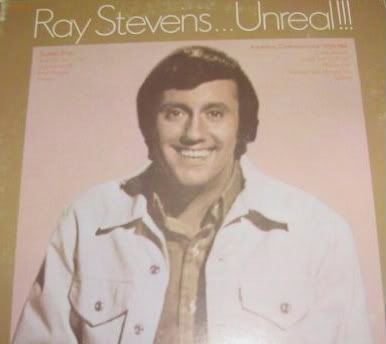
Unreal is quite an album from Ray Stevens. The collection came along in 1970 as the second album by Ray Stevens on the Barnaby label. Officially there are three exclamation points after the album's title but I hardly ever include them whenever I write about the album. This album includes a lot of topical songs...a keen understanding of history will go a long way for some to enjoy the collection as most of the songs deal with some sort of news item of the day. Protests, social turmoil, anti-war riots, and general chaos were on the menu during the late '60s/early '70s era. This one album, in particular, seriously tackled a lot of the issues of the day and it's one of his all-time best. The political aspect of a lot of the songs are common sense, middle-of-the-road observations of the 1969-1970 political scene. Ironically, much in the same way that a lot of Ray's modern-day songs reflect a common sense approach to 2011 politics the very same thing was happening on this album but with an obvious 1970 flavor. I always like to point out this 1970 album whenever a modern-day critic accuses Ray of "being political all of the sudden". Those who really pay attention to Ray's music are well aware of this album and are aware that Ray's an Independent thinker and continues to be one...in spite of what his critics would have you believe.

The album contains 11 songs...9 of which were written by Ray Stevens! The only songs that Ray didn't write were "Come Around" and "Talking". In the case of the latter Ray's brother, John, wrote the song. A writer credited as B. Smith wrote "Come Around".

The album's title, Unreal, or Unreal!!! as it appears on the album cover, as far as I know was lifted from "Sunset Strip". Within the song's chorus the background vocals (all Ray Stevens I might add!) can be heard singing "something Unreal about you!" several times. "Sunset Strip" is arranged to show reverence to the sounds of the Beach Boys. The song became a Top-20 hit on the Easy-Listening chart.

1. Sunset Strip
2. Can We Get To That? (social comment)
3. Imitation of Life (love song)
4. Night People
5. America, Communicate With Me (political/topical)
6. Come Around (social comment)
7. Loving You On Paper (topical)
8. Dream Girl (love song)
9. Monkey See, Monkey Do (social comment)
10. Talking (political/topical)
11. Islands (love song)

Besides "Sunset Strip", the album contains another Easy-Listening Top-20 hit...the very topical "America, Communicate With Me". The song is often misinterpreted today as being a full-on 100% show of support for liberal politics and the anti-war movement but in reality, if you listen carefully, Ray's political Independence is heard loud and clear as he examines the problems going on in the country and he offers his solutions on how problems can be solved.

The most revealing aspect of the song's true intent, for those still unclear about the song's message, is near the end when he sings about remaining loyal to the country and in spite of the wars and protests going on...brought about by both political parties...that he'll continue to be a patriot that won't turn his back on the country or wish it were like some foreign land whose people have no freedom or rights. The song, as I mentioned, has a distinctly Independent flavor and I can bet that Ray wrote the song and put it out to give a voice to those who were often over-looked by the extremes in both political parties. All anyone has to do is listen to the song's opening lines to understand how Independently thought out the song is...but nevertheless some people out there who've discovered the song in the last several years have gone to great lengths to paint the song in a decidedly liberal direction perhaps in the hopes of undermining Ray's modern-day political success with conservatives and those who consider themselves members of the Tea Party? Whatever their motive is the facts always defuse the left-wing bomb throwers of the world.

"Night People", "Sunset Strip", "Imitation of Life", "Islands", and "Dream Girl" depart from the political, topical, and social comment nature of the album. So it's like half the album is distinctly political and topical while the other half of the album breaks up the mood, just a bit.

The 1970 album was issued on CD and Mp3 in 2005. It marked the first time that all the songs from the album had been in commercial circulation in more than 30 years. Up until 2005 Ray's Barnaby albums had remained in the vaults and never re-issued on CD...but that all changed when Collectible's Records re-issued 6 of Ray's Barnaby albums in 2005.

Revisiting Ray Stevens, Part 2...

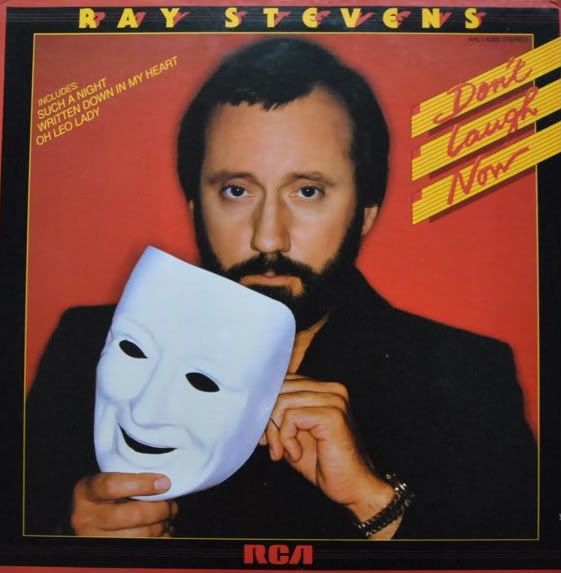
Those who stop by this blog on a frequent basis know the love I have for Don't Laugh Now, the 1982 album from Ray Stevens. In part 1 of this latest series of blog entries I wrote about a 1990 compilation from Curb Records on Ray called His All-Time Greatest Comic Hits. This time the spotlight returns to Don't Laugh Now. I like all the songs on the 1982 album...and that album cover is great, too. The album's title is written in a 1950's neon style...perhaps as an acknowledgement of the album's lead-off track, "Such a Night"? When I saw Ray in concert back in early 2009 he opened up his show with "Such a Night". The song dates back to late 1953 when it was recorded by the R&B group, The Drifters. The group is often mentioned by Ray as one of his favorites. Aside from "Such a Night" the rest of the material doesn't offer a sound out of the past. As a songwriter Ray wrote the title track, "Don't Laugh Now", as well as the clever "Oh Leo Lady". The latter uses such subjects as the horoscope, astrology and astronomy in telling a love story of two opposites that found one another and formed a relationship against the odds. The love ballad "Written Down In My Heart" became a Top-40 country hit while the comical "Where the Sun Don't Shine" (an up-tempo sing-a-long with a gospel overtone) reached the lower portion of the charts.

1. Such a Night
2. Written Down In My Heart
3. Take That Girl Away
4. Always There
5. Where the Sun Don't Shine
6. Oh Leo Lady
7. Don't Laugh Now
8. This Old Piano
9. Country Boy, Country Club Girl
10. Why Don't We Go Somewhere and Make Love

In spite of "Written Down In My Heart" obtaining Top-40 country status it wasn't picked by RCA for inclusion on the 1985 release, Collector's Series. The tracks from Don't Laugh Now that appeared on the 1985 project were "Where The Sun Don't Shine", "Country Boy, Country Club Girl", and "Why Don't We Go Somewhere and Make Love". Since the Collector's Series release is the only overview of Ray's RCA output...a stingy 8 song overview I might add...but since it's the only collection to spotlight just his RCA recordings I continue to make people aware of it's existence.

The tracks that were lucky enough to make the Collector's Series in 1985 were:

1. Shriner's Convention; 1980
2. You're Never Goin' To Tampa With Me; 1980
3. Country Boy, Country Club Girl; 1982
4. Where The Sun Don't Shine; 1982
5. The Dooright Family; 1980
6. Let's Do It Right This Time; 1981
7. One More Last Chance; 1981
8. Why Don't We Go Somewhere and Make Love; 1982

In 1987 RCA re-released the collection with just a slight change in the track list. The 1987 re-issue was released on CD in 1992:

1. Shriner's Convention; 1980
2. You're Never Goin' To Tampa With Me; 1980
3. Country Boy, Country Club Girl; 1982
4. Where The Sun Don't Shine; 1982
5. The Dooright Family; 1980
6. Let's Do It Right This Time; 1981
7. Why Don't We Go Somewhere and Make Love; 1982
8. Put It In Your Ear; 1980

You can find reasonably priced Collector's Series releases on eBay. The 1985 and 1987 versions are readily available. While at eBay simply click the name of the CD for product descriptions. Usually sellers will post the image of the 1987 re-issue but feature the 1985 track list by mistake or they'll post the image of the 1985 release and feature the 1987 track list...so it's always wise to make sure you're placing an order for the correct version and obviously you can always ask a seller a question.

Revisiting Ray Stevens, Part 1...

One of the various compilations that have been issued on Ray Stevens through the years was this one in 1990. The collection was released by Curb Records and it eventually became certified by the RIAA as a Gold album. All-Time Greatest Comic Hits collects 10 of Ray's signature comic hits...from the '60s through the mid '80s. The picture of Ray comes from a publicity picture that appeared around the time "It's Me Again, Margaret" was a single. Long-time fans of Ray are well aware of the song and could easily tell which performance is being promoted in the picture. Nine of the ten songs on this collection were also featured in the 1987 releases of Greatest Hits and Greatest Hits, Volume Two on MCA. The only song that wasn't featured in either of the 1987 albums was "Bridget the Midget the Queen of the Blues". That particular song comes from late 1970 and was a Top-5 hit in England for Ray early in 1971. The 1990 collection on Curb Records is where I first heard that particular 1971 hit and have loved it ever since.

1. The Streak; 1974
2. Shriner's Convention; 1980
3. Would Jesus Wear a Rolex?; 1987
4. Mississippi Squirrel Revival; 1984
5. Gitarzan; 1969
6. It's Me Again, Margaret; 1984
7. Ahab the Arab; 1969 (re-recording of his 1962 hit)
8. In The Mood; 1976
9. Freddie Feelgood; 1966**
10. Bridget the Midget the Queen of the Blues; 1970

As most fans know, "Freddie Feelgood" was recorded by Ray in 1966. Three years later laughter was over-dubbed onto the recording when it appeared on the Gitarzan album. The over-dubbed version would be the one that became more widely distributed over the years. The same holds true for "Ahab the Arab". Most purists would prefer that the 1962 recording Ray did for Mercury Records be the only version that gets distribution but what happened is the 1969 re-recording became more widely available. I was raised familiar with the 1969 re-recording. When I was hearing the song as a kid and teenager on a couple Ray Stevens albums I was unaware that there existed a 1962 recording of the song. I love the song...the 1962 recording became a million seller...but while being a lover of the song it's the 1969 re-recording that I'll often make reference to. When played back to back with the 1962 original you can't help but be drawn into the way in which Ray sang the song in 1969. There's so much more energy and zest put into the 1969 recording...even though it's the same song and it's the same artist. Does this mean that I don't like the 1962 recording? No...I like them both...but 1969 wins out if we were to make it a contest.

"Would Jesus Wear a Rolex?" from 1987 was a big hit...although on the airplay charts in country music it didn't reach Top-40 status it nevertheless was a hit with the public who were caught up in the televangelist scandals that were going on at the time. It also became a song that got the attention of non-country music entities like The Tonight Show, for example. I'd have to look in my notes but I believe Ray appeared on the show twice in 1987...several months apart...specifically to perform the song. Paul Harvey, a radio commentator who I enjoyed hearing, was one of the critics of the song, as I found out, when I discovered a column he wrote in February 1988 where he made the song the topic of one of his columns. The song had been out half a year by then but the exposure in non-country music forums helped a lot in it being nominated for a Grammy in the Best Comedy Recording category. 1984's "Mississippi Squirrel Revival" was made into a music video in 1992. It was included in Ray's million selling home video, Comedy Video Classics. In 2009 Ray uploaded it onto You Tube and so far the video's gotten 1.2 million views. The exact total is 1,282,196 on-line views.

As a friendly reminder...tomorrow, August 1st, Ray Stevens will be the special guest of Eddie Stubbs on WSM radio. The show, Intimate Evenings, will air from 7-9pm Central time which is 8-10pm for the Eastern time zone. I'll be listening to the program, jotting down things that I hear, and writing an informal review of the interview. Ray's current music video, "Obama Budget Plan", has 429,298 on-line views so far. This is an increase of nearly 5,000 views in a day and a half.