Well, hello all of you Ray Stevens fans!! It's the start of a brand new month...yes, it being April 1st usually means that some radio stations spotlight comedy/novelty songs. However, in this blog entry I'm spotlighting a love ballad, of sorts, from Ray Stevens titled "Get Crazy With Me". I have written about this song before as you could've probably guessed and I've written about the 1977 album it appears on, Feel the Music. That album is the one that featured Ray as the songwriter on 9 of the 10 tracks. The lone track that Ray didn't write, "Set The Children Free", is from the pen of Buddy Kalb.
In the video upload you'll see Ralph Emery and Donna Fargo introduce Ray.. the performance is from an episode of Pop! Goes the Country. As a tie-in with Ray's song he appeared on the cover of Country Song Roundup magazine with an accompanying article/interview titled Get Crazy With Ray Stevens. I have a copy of that magazine but I don't have a photo of me showing it off. One day I'll probably get around to photographing it. In the meantime... Ray insists "Get Crazy With Me"... and so let's take a few minutes and listen to this obscure gem of a song.
Hello fans of Ray Stevens!! We only have 11 more days left in the month of March and so in this installment of love songs from Ray Stevens we pick up in the year 1977. Ray was no stranger to love ballads but during his years at Warner Brothers (1976-1979) and RCA (1980-1982) there were a whole lot more love ballads per album than at any other time. Well, that's not an official stat but it certainly seems like Ray was singing more love songs than ever.
Here we have the great Ray Stevens, in performance, in 1977 belting out one of those love songs. Completely lost in the song as anyone can see from looking at the photo. The album released that particular year was almost completely written by Ray. There were 10 songs on the album and Ray wrote 9 of them. Feel the Music, the name of the album, also features an unusual album photo. On the front of the album there's an illustration of a stereo speaker. On the back of the album there's an illustration of the back of a stereo speaker. The idea behind the album's cover art ties into the title track, "Feel the Music", literally. I come across a music critic's review of the 1977 album a couple of years ago while browsing online. The critic described Ray's style as bluesy-country. "Feel the Music", production wise, is marvelous as practically every Ray Stevens production is. The song has a catchy melody and at various moments Ray sounds as if he's totally in the spirit as the production takes on a gospel vibe. It's an inspirational song. Some of the love ballads on the 1977 album happen to be the exquisite "Road Widow", a song about a traveling musician constantly on the road but constantly thinking of the wife waiting at home. I'd never heard the expression, road widow, before but it's a neat song title for this kind of lonely, road weary song. How many of you are familiar with the phrase 'cheery sad song'? There shouldn't be hardly anyone familiar with the phrase since I just made it up. The phrase describes a sad love song with an up-tempo sing-a-long arrangement. A great example of this happens to be "Alone With You". When you see the title of the song while reading the track list on the album you'd think a song with a title like that would be a full-on, heavy romantic ballad. Well, it isn't.
"Alone With You" is a sad song about a couple who have lost the spark they once had and that the love is all gone and he sings "I'm all alone with you". The music arrangement is up-tempo and bouncy, as mentioned. Now, staying in the same vein, we have the mid-tempo bluesy "Blues Love Affair". That particular song is about a guy who's more or less unlucky in love and all his relationships cause him to be down in the dumps.. causing him to feel as if his love life is just a love affair with misery and the blues. The bluesy-country flavor continues with "Junkie for You", where Ray uses a man's intense desires for a woman as something comparable to an addict. It's a song that only Ray could've come up with.
Ray issued two albums in 1978. The first release was his salute/tribute to the music of the 1950s and 1960s. It was specifically rhythm and blues songs that crossed over to the pop chart. The album title, There is Something On Your Mind, is named for the album's closing number. It's a classic that's narrated frenetically. Ray provides commentary on both the front and the back of the album cover. He explains his reasons for recording the album. Then, on the back of the album, commentary from Ray appears underneath each track explaining his decision for recording it and giving some history behind each song. Every track on the album is a love song. It includes his renditions of "One Mint Julep", "Money Honey", plus several medley performances "Dance Trilogy", "Old Faithful Trilogy", and "Banned in Boston Trilogy". The latter features abbreviated performances of "Sixty Minute Man"/ "Work With Me, Annie"/ "Annie Had a Baby". The second album of 1978 was the more conventional album. Titled Be Your Own Best Friend it centers around love ballads, for the most part, and most of the love songs are performed in a soft-rock/Easy-Listening flavor. The one that features this touch the most is the inspirational "With a Smile".
The love songs found on the album are "You're Magic" (one of my all-time favorites), a soft re-recording of "You've Got the Music Inside", and the majestic "L'amour". That recording is another of my all-time favorites. It also has a neat backstory. Ray mentioned in an interview in the early 1990s that while he was on tour overseas he had heard one of the most beautiful melodies but couldn't understand the lyrics because the singer was French. Ray eventually found out the French recording artist's name and the title of the song. The singer/writer was Gilbert Becaud. Ray got permission to use the melody and he wrote English lyrics to it. "L'amour" is fabulous.. the music and Ray's singing.. it's heavenly. The album credits both Gilbert Becaud and Ray Stevens as the writers. There are a couple of sad love songs on the 1978 album and those are "Two Wrongs Don't Make a Right", more of a song of reconciliation, but we're not told if the pair patched things up or not. "Comeback" is a fast tempo song where Ray pleads and begs for the woman to comeback and don't hesitate. "The Feeling's Not Right Again" would become the name of Ray's 1979 compilation album on Warner Brothers but it made it's debut on Be Your Own Best Friend. The song deals with a man who can't seem to find his soul mate since every time he gets into a relationship it just doesn't have much feeling to it.
In the latter half of 1979 Ray moved to the RCA label. His first project for the label happened to be his first comedy album since 1974. Shriner's Convention hit early in 1980, the first all-comedy studio album from Ray since Boogity Boogity. The album featured the hit title track and a couple of other recordings became fan favorites. As far as love songs go there happened to be a couple of bizarre ones with it being a comedy album after all. One of the most clever love songs is "You're Never Goin' To Tampa With Me". The women in their southern accents pronounce the word, tamper, as tampa. So, when Ray hears all the women he encounters during Spring Break say that he's never going to tampa with them it confuses him...considering he wasn't planning on going to Tampa anyway. The song doubles as a neat tribute to Florida, though, as Ray name drops quite a lot of famed beaches and cities.
"The Last Laugh" has Ray singing about multiple ways he'll end his life as a result of being treated badly by a former lover. "Rita's Letter" is a song about a woman that receives a letter from her second husband telling her that he'd be in the neighborhood and would she like to reunite. Eventually they come face to face and she learns that he's changed his name from Beauregard to Nirvana and is part of a religious cult wearing a robe and pony tail. In "The Watch Song" Ray tells the story of being in a bar room fight. In the song Ray's accused of being the other man in a woman's life and her husband wants to fight. They fight and the guy breaks Ray's wristwatch and it causes him to snap. Ray beats the man up, too much it seems, because the guy dies. Ray's character finds himself headed to life in prison and an eventual death sentence. Throughout the song Ray wonders aloud and prays John Cameron Swayze will help him get out of prison and off death row.
Hello fans of Ray Stevens!! Several hours ago I come across a product being sold over on eBay that caught my eye. If you're familiar with the cassette tape releases on Ray Stevens from Warner Brothers in the late 1970s, well, this one may intrigue you considering that it's an Australian pressing of Ray's 1977 album, Feel the Music. I had seen the United States cassette copy of Feel the Music on eBay a number of years ago and it's overall cover design is identical to the other Warner Brothers cassette releases from that time period in the United States. However, the Australian copy of Feel the Music is aesthetically different as you can see.
Yes, that's the Australian copy of Feel the Music. As you can see the album cover which accompanied the vinyl copy is on the cassette cover but then you have his name and the title of the release posted at the top. The thing that caught my eye the most is the title is shown in lower case letters. That particular album cover of a stereo speaker, as you can see, presented something of a challenge to the designers of the cassette tape release. We have Ray's name and the title of the album shown twice. In practically every cassette tape release of a vinyl album what typically happens is only the image of the vinyl album photo is used. However, in this case, since the 1977 album cover is an in illustration of a stereo speaker and not simply a photo of Ray it would've been impossible to to a magnification because Ray's name and album title is printed within the illustrated image of the stereo speaker. If they were to have done a blown up/magnified image of the album cover for the cassette tape release all a consumer would see is a large brown area...and it's hard to tell if consumers would've been able to figure out that what they're looking at is a stereo speaker should they not be familiar with the vinyl copy which contains more detail of the illustrated image. The United States cassette copy looks like this...
Do you own a copy of 1977's Feel the Music? If you have the vinyl album as I do then you know that on the back of the album it features a photo of Ray. Since the album cover is meant to look like a stereo speaker then, as you may have guessed, the back of the album looks like the back of a stereo speaker with illustrations of small screws and to indicate the look of a speaker's back panel. Also, the photo of Ray features small illustrated images of tape on the upper left and lower right hand sides. This is the typical appearance of how strips of tape look on the back of a stereo speaker holding up the plastic pouch containing the manufactures warranty. This 1977 album was almost completely written by Ray Stevens. There are 10 tracks on here and he wrote 9 of the 10 songs. The one song that he didn't write happens to be "Set the Children Free" which came from the pen of Buddy Kalb. Now, if you're a long time fan of Ray Stevens, then it should come as no surprise that the music on this album would've been considered country in 1977. In fact, Ray has always delivered what most of us would call Ray Stevens music. This means that a recording is produced and arranged as if Ray happened to have been the writer. When he's singing a song he didn't write it sounds like it was something he had written. Also, when we refer to it as Ray Stevens music what we're also saying is that the lyrics seem to fit Ray's style.
Ray has a style? Yes...if you know your Ray Stevens music then you know that he has a style. That style comes across in the lyrics but also in the manner in which he performs the song, vocally, and when on stage, visually. The 1977 album is filled with this sort of thing where Ray demonstrates all kinds of delivery based on the lyrics...and since Ray is his own music arranger he decides how the songs will sound, instrumentally, as well as how the songs will be sung (tempo) even with songs that he didn't write. What are the 10 tracks on this marvelous 1977 album? "Dixie Hummingbird" reached the country charts in 1977. It was the highest charting single release from the album and therefore, in hindsight, it's referred to as the main release from the album. The single reached the Top-50 on the national country music charts but it ranked among the Top-40 and Top-30 lists of specific markets. If you do in-depth research on a lot of Ray's single releases from the bulk of his career you'll find out real quick that he had a lot of presence/impact in specific regions (markets) throughout the Midwest, the South, and the Plains states but you'd perhaps never realize that if you simply looked at the national charts of Billboard or Radio and Records, for example. Sometimes these statistics of regional activity would be presented in sections of the trade magazines and titled 'Regional Breakouts'. What it meant is that you'd see a city listed and it would include that city/radio station's most requested or most played songs. A lot of the time each local radio station's playlist would contain single releases that had yet to make the "national charts". Ray was on these lists hundreds of times. Now, then...here are the 10 tracks on the 1977 Feel the Music album.
1. Feel the Music
2. Daydream Romance
3. Blues Love Affair
4. Alone With You
5. Junkie For You
6. Get Crazy With Me
7. Save Me From Myself
8. Road Widow
9. Set The Children Free
10. Dixie Hummingbird
In 1995 when Warner Brothers released three compilation albums of Ray's recordings they included most of the songs from this 1977 album. The songs were spread out over the three compilation releases except tracks 5, 6, and 8. The titles of those 1995 releases were Cornball, Do You Wanna Dance?, and The Serious Side of Ray Stevens.
Hello fans of Ray Stevens!! I came across a CD copy of the 1995 Warner Brothers CD, Cornball, for sale on eBay. The seller resides on the east coast. When I saw the CD listed on eBay it had me thinking, once again, of Ray's years on Warner Brothers (1976-1979) and how the Cornball CD isn't available for online listening like the other two compilation companion CD's happen to be. In 1995 the record company issued three compilations on Ray's years at the label: Cornball, Do You Wanna Dance?, and The Serious Side of Ray Stevens. The latter two CD's can be found either as digital downloads or are able to be heard on streaming sites. Cornball, for whatever reason, hasn't been as easily accessible. That particular CD collects ten of Ray's recordings during that mid to late '70s time period. In fact, all of the CD's showcase that time period, but because Cornball features his 1979 recording, "I Need Your Help, Barry Manilow", it's the one compilation from 1995 to feature each year he was with Warner Brothers: 1976, 1977, 1978, and 1979. How come? Well, "I Need Your Help, Barry Manilow" was Ray's only recording in 1979...meaning that the other two CD's focus on 1976, 1977, and 1978. Cornball, as an album title, is misleading.
The title would have you believe that this CD is filled with humorous recordings and nothing else. The fact is that "Cornball" is the name of a song that Ray wrote...a love ballad...and it was originally released on his 1976 album, Just for the Record. There are three or, possibly, four, humorous songs on this ten track collection depending on what you might consider funny or comical. There's his two chicken clucking recordings as The Henhouse Five Plus Too titled "In the Mood" and "Classical Cluck". There's also the parody, "I Need Your Help, Barry Manilow". Those are the three, without a doubt, comical recordings. I've read vintage music essays of the 1950s and most of those consider "One Mint Julep" a comical/novelty song. That particular recording, track 7, comes from his 1978 album, There Is Something On Your Mind. It had been a hit in 1952 for the rhythm and blues group, The Clovers. That particular 1978 album is Ray's salute/tribute to the music of the 1950s. "Money Honey" and "Your Cash Ain't Nothin' But Trash", tracks 4 and 8 on the 1995 CD, also come from that 1978 album.
When I heard "One Mint Julep" for the first time on the 1995 compilation CD I didn't hear it as a humorous song...but apparently those who find it comical are those who know more about drinking alcohol than I do.
The song is about a guy who has drank numerous mint juleps and has learned that, while under the influence, he's gotten himself into a relationship he didn't want. Music essayists and historians say the humor comes from a guy getting himself drunk by way of what's mostly a drink observed for special events (like the Kentucky Derby) and isn't what most would commonly want to get drunk on.
Hello fans of the legendary Ray Stevens!! I came across a video clip on YouTube yesterday of songwriter Layng Martine, Jr. discussing his association with Ray and how much of an impact Ray had on his career. If you're a long time fan of Ray then you will probably know some of the things that Layng discusses in the interview but don't let that persuade you not to watch the video clip. Layng, based upon the things he discusses, loves Ray Stevens as much as we all do. When you watch the video you'll easily follow along as Layng talks about meeting Ray for the first time and how unassuming and modest Ray happens to be. Layng became a writer for Ray's publishing company and the two had a pair of massive hits as a writer/publisher team. Layng elaborates on Ray's work ethic and talents in the recording studio. He also lets a lot of us Ray Stevens fans know what it was like being in the recording studio with Ray and watching him make records. Layng has nothing but praise and respect for Ray as a person as well as high praise for Ray as a singer/songwriter/musician/publisher. Layng sheds some light on Ray's modesty as well as his integrity. The two hits that they enjoyed were "Rub It In" and "Way Down". The former had actually been recorded by Layng...released as a single on Barnaby Records in 1973 and produced by Ray...but the record company released it at the wrong time of the year. However, not all was lost. Billy 'Crash' Craddock recorded the song and it became an enormous hit...and sharing in that success was Layng as the writer and Ray as the publisher. The other big hit for the writer/publisher duo came in 1977 with "Way Down", recorded by Elvis Presley. It was released in what turned out to be the final months of Elvis' life...reaching the Top-10 not long after he passed away. Ray published more songs that Layng wrote but those two were the biggest commercial hits. The video's title is 'Writing for Ray Stevens - Layng Martine, Jr.'. The interview is conducted by Otis Gibbs. It is a fascinating and fabulous interview but rather than just go by my obviously pro-Ray Stevens biased opinion take a look for yourselves. The video clip is a little more than 13 minutes in length and it goes by quickly, too...it's that engaging and informative. Do you know what an escalator is? Keep your ears open for that topic as you enjoy this video. The photo they used of Ray is from a photo session in 1975. A very similar photo later, in 1980, appeared on the cover of a September issue of Country Song Roundup. It might even be the same photo but with the outdoors backdrop cropped out.
Hello Ray Stevens fans!! A few days ago was the birthday of Dolly Parton and to celebrate it Ray uploaded his 1977 performance of "Sir Thanks-a-Lot". Ray had performed the song on Dolly's variety show which went by the name Dolly. That TV series was syndicated and it's official air-dates were September 13, 1976 - March 7, 1977. Ray appeared on the episode that aired, ironically, on his birthday. On January 24, 1977 the Ray Stevens episode of Dolly aired in syndication. Ray had worked with Dolly at Monument Records back in the mid 1960s before she joined the Porter Wagoner group. Ray performed a couple of recordings on the 1977 episode...one of which happened to be "Get Crazy With Me", a brand new song at the time. That song would appear on his 1977 Feel the Music album. Ray and Dolly performed two duets: "Searchin'" and "Happy, Happy Birthday Baby". Ray performed "Sir Thanks-a-Lot" and it included Dolly as the damsel in distress. The comedy song is about a Knight during the time of King Arthur...of course the Knight that Ray sings about was never a member of the Round Table in Camelot. Nonetheless Ray tells us about Thanks-a-Lot and his heroic chivalry in days of old.
Ray had originally recorded the song in 1969 for his Gitarzan album and this may be the only time he ever performed it on television. Ray is at his up-tempo best churning out lyrics a mile a minute without missing a single beat but there are some giggles and laughs from both at various moments in the performance...but that sort of thing only adds to the charm.
I was looking through some of my archives a few minutes ago and noticed a blog entry from 2017 where I highlighted a performance from Ray Stevens on the Marty Robbins Spotlight television series. The series aired in first-run syndication throughout 1977 and I believe, in other markets, it aired for several more years (repeat episodes) until the end of the decade. The video embed in that blog entry, I discovered, no longer existed and so I edited the blog entry and removed the blank video screen. A few weeks ago Ray uploaded a 10 minute video clip from his 1977 appearance on Marty's show. Ray sings "Feel the Music" and this appearance includes a comical banter between Ray and Marty who sit at separate pianos, back to back. Marty's piano is designed as if it were to match stage clothes from that time period...you'll see that it has a blue plaid/checker design. Ray was a spotlight artist in one episode of Marty's show and he made a guest appearance in the spotlight episode of Chet Atkins. When Ray guest starred on Chet's episode they both sang "Frog Kissing".
Country music in 1977 was riding a wave of national recognition and the music reflected the presence of what some would call outsider influence...the music had become more polished and had a pop penchant in an effort to attract a wider audience. I bring this up because some people would have you believe that country music didn't insert any changes until the early 1990s but if you look at country music over the decades you'll see all kinds of changes in sound and production...some era's the sound is traditional while other era's, like the mid to late '70s, the sound is pop-like. Most, not all, but most established country music artists resisted the changes but others embraced the benefits of expanding their audience reach. Ray Stevens is one of those artists that had never publicly stated what he defines as 'country music' or 'pop music'. Ray has always come across as an entertainer...not defining himself to any specific music format...but over the course of time it's the country genre that's had more of a welcome to his style of entertainment and with country having a sub-genre of 'country comedy' he fits right in...but in 1977 and specifically in this video clip Ray Stevens once again demonstrates that he can be serious, somber, and sensitive with his music one minute and the next minute he's a zany, silly, and absurdist comic with an endless supply of funny facial expressions and one liners.
Well, hello Ray Stevens fans!! As longtime readers of this fan created blog should be aware of by now I love the recordings Ray did for the Warner Brothers label in the mid to late 1970s. I like all of his songs...but I have a particular love for that era in his recording career. I've often wondered the reason for this...maybe it's because as a child growing up I wasn't as familiar with Ray's songs from that particular record label. It could also stem from, as I've discussed often, the sound of his recordings in this time period. There's a specific sound that you hear on the Ray Stevens Warner Brothers songs that you don't hear before and after he was on the label. Then again it could just be my own ear hearing things unique to that specific time period in his recording career (1976-1979). Well, in 2022, his 1977 album, Feel the Music, reaches 45. The gem stone that represents a 45th anniversary is Sapphire. This gem can come in different colors...I prefer blue. I had thought about typing out this blog entry in blue color but I decided I'd just use that color a few times. The album contains 10 songs...9 of the songs were written by Ray Stevens. There are several music styles heard on this album, too. A bluesy flavor dominates songs like "Blues Love Affair", "Junkie For You", and the title track, "Feel the Music". However, the title track starts out as if it's going to be a bluesy ballad but lyrically it's a motivational number...and the tempo picks up dramatically as the song reaches it's conclusion. All of the songs on the album are sensational, in my opinion. One thing to keep in mind, though, is the sound may be, to some, indicative of 1970s country music. I don't have a strong opinion, either way, with how the sounds in country music have changed throughout the decades but from beginning to end on this album you'll hear certain moments, if you're a student of country music of the late 1970s, where you'll know it's from that time period.
The Warner Brothers label is the first to market Ray Stevens as a country music artist. If you were look up album reviews or write-up's in music magazines about Ray Stevens from the early to mid 1970s chances were he was being covered by Pop music and Easy-Listening music journalists and critics. When he'd cross-over to country music, frequently, beginning in the early 1970s, the country music section of weekly music magazines would feature reports on his albums and singles, too. As a legitimate cross-over artist he went decidedly country once he joined Warner Brothers in 1976. His second album for the company, Feel the Music, featured a couple of single releases. One of those releases was "Dixie Hummingbird" which reached the Country Top-40 in Record World magazine. In a 12 week run on the Country singles chart in Record World, beginning on June 11, 1977 the single reached it's peak on August 6, 1977 in it's 9th week. Ray Stevens reached the Top-40 with several single releases on the pages of Record World and Cashbox magazine which missed the Top-40 in Billboard magazine. "Dixie Hummingbird" is one of those examples of Ray having a Top-40 hit single in a publication other than Billboard. Another single release from the 1977 album arrived earlier in the year in the form of "Get Crazy With Me". This single reached the various music charts...achieving it's highest chart ranking in Record World where it peaked below the Top-40 on March 26, 1977. It was a single that had a funky sound to it.
As mentioned the album reaches 45 this year...and in case you're wondering the front of the album is an illustration of a stereo speaker. Ray wants you to quite literally, "Feel the Music". The back of the album features an illustration of the back of a stereo speaker...and a photo of Ray Stevens is placed in a position where you'd normally find the manufacturer's warrantee taped. The illustration is so detailed you'll think you're looking at the back of a real stereo speaker. There's a gospel flavored sing-a-long on here titled "Save Me From Myself" and a slow love ballad called "Daydream Romance". The album reached the Top-50 Country Albums on Billboard and the Top-40 Country Albums on Record World...reaching it's highest peak in Record World in April 1977. If you are interested in hearing some of the songs on this 1977 album you can always look them up on YouTube. Ray has the audio of "Feel the Music" on his YouTube channel and there's also a performance of the song from the Marty Robbins television show on YouTube. If you love "Get Crazy With Me" as much as I do then you're going to love the entire Feel the Music album!!
The ten songs on this album, not in chronological order, are: Feel the Music; Daydream Romance; Alone With You; Blues Love Affair; Dixie Hummingbird; Set The Children Free; Junkie For You; Road Widow; Get Crazy With Me; and Save Me From Myself.
The 45th anniversary is represented by the gemstone, sapphire. So, with the Ray Stevens 1977 album, Feel the Music, reaching 45 this year it's now sapphire. If I were in charge of marketing I'd re-issue the album on sapphire vinyl (the color of sapphire is blue). The album comes from the time period in which Ray recorded for Warner Brothers records. He joined the label in 1976 and stayed there until the mid-point of 1979 before moving on to RCA later in the year. His output on Warner Brothers was eclectic and fun...he did a lot of experimentation with his overall sound while at the label. The Feel the Music album was written almost entirely by Ray Stevens. There are 10 songs on the album and 9 of them were written by Ray...the only song that wasn't happened to be from the pen of Buddy Kalb, "Set The Children Free". You'll hear a wide range of styles on this album and with that wide range of styles you'll hear a wide range of vocalization from Ray, too. The title track features a forceful vocalization...inspirational with a church choir overtone when he reaches the chorus of the song. The harmony singers on this album were: Ray Stevens, Toni Wine, Prissy Reed, and the Mt. Pisgah Young People's Chorus. It's my assumption that "Feel the Music" features the Mt. Pisgah group singing harmony while the remainder of the album features Ray, Toni, and Prissy as the primary harmony vocals.
If you're a collector of Ray Stevens then you're probably always going to be on the hunt for cassette tapes of his vinyl albums...simply for the sake of adding them to your collection...and when I seen an image of the cassette copy of Feel the Music I added it to my online image library. It's such a rare item and even more rare to see it with your own eyes. Cassette tapes of 1970's Ray Stevens vinyl albums just aren't in abundance...and the rare moments one comes up for sale on eBay or elsewhere the price is outrageous. I have the vinyl copy of Feel the Music but not the cassette tape. The cover art for the 1977 album is a stereo speaker. On the back of the album there's a photo of Ray and detailed art work of what the back of a stereo speaker looks like. The artist included a lot of detail! Ray's photo is depicted as if it's sticking to the back of the stereo speaker with a couple pieces of tape. So, yes, when I got the vinyl album and added it to my personal collection I looked at the back cover...which is rarely seen online. I sat there for several minutes looking at the art work and the songwriter credits, producer credits, etc. etc. The first single release from the album happened to be the adventurous "Get Crazy With Me". Ray remarked in a print interview in 1977 that he had a lot of fun in the studio while recording the song and made mention of the unusual audio hook found within the music itself. It's a crazy, memorable sound effect unlike anything heard before or since. The single, apparently, was a bit too out of left field because it charted for a total of 4 weeks on the Cashbox country chart...entering March 5, 1977 and exiting at the end of the month on March 26th.
"Dixie Hummingbird" was the most commercially successful single release from the album. I have yet to see any video footage of Ray singing the song on television, though. The single hit in June of 1977 and reached the Top-30 in the Cashbox Country chart in late July. It flew up the 100 position Cashbox Country chart and was in the Top-30 in it's 7th week. It reached it's peak within the Top-30 the following week on July 30, 1977. Ray performed "Feel the Music" and "Get Crazy With Me" on a couple of television shows of the era but never performed "Dixie Hummingbird". The bluesy "Junkie For You", "Blues Love Affair", and "Road Widow" are a trio of songs that I'd have loved to have seen Ray sing on television. You can also add "Alone With You" to that list. Ray Stevens is always striving to sing, write, arrange, and produce music that is uniquely his own. He has often said that he doesn't concern himself too much, now, if he's the writer or if someone else writes the songs he sings. The main writer of songs for Ray Stevens is Buddy Kalb. In interviews Buddy has remarked that he writes lyrics and a melody but once he turns the lyrics over to Ray then it's turned into a song that sounds as if Ray wrote it. It's a personalization talent that Ray has with the songs that he sings...it's in the vocal delivery, the production, the music arrangements. The track list on the Feel the Music album is below...
Earlier in the year I wrote a blog entry about a 1976 Ray Stevens album reaching 45 this year. That album, Just for the Record, is a wonderful collection of songs and it was the first of several studio albums Ray recorded for Warner Brothers. I periodically return to the Ray Stevens recordings of the late 1970s...I just have this attachment to them...it can't be explained beyond my saying that I love those recordings! Maybe I love them because they're over-looked and under-appreciated? Maybe I love the sound of those recordings and perhaps because those records sound so different than what he was doing at Barnaby Records during the first half of the decade and what he would eventually do at RCA Records at the start of the 1980s...because the Warner Brothers sound is so different from what came before and after his years spent there maybe that's why I have this intense love for those songs. See, I told you it's hard to explain my attachment to those songs!!
"You Are So Beautiful" was Ray's debut single for Warner Brothers in 1976...and as you can see from that 1979 television appearance on Pop! Goes the Country he enjoyed performing it for the fans. Ray followed it up with "Honky Tonk Waltz"...a clever song blending country music within the framework of a waltz. The song takes place inside a bar room. There's a video performance of Ray from 1977 singing the song on an episode of Pop! Goes the Country...but I'm going to embed the audio track...
A lot of the recordings Ray Stevens did for Warner Brothers were spotlighted in 1995 on a set of three CD's: Cornball, Do You Wanna Dance?, and The Serious Side of Ray Stevens. YouTube has the audio tracks from the second two compilation albums but for whatever reason there weren't any official uploads of the songs featured on the Cornball release. Some wonderful recordings from Ray of "Your Cash Ain't Nothin' but Trash", "One Mint Julep", "Cornball", "Once in Awhile", and "Money Honey" are on that compilation. I came across an audio of "Money Honey" just recently but I've not posted it in any blog entry yet. I've been waiting to see if it'll stay online...and so far it's remained on YouTube. Instead of posting a YouTube embed of the audio track I'll post this "Money Honey" LINK.
If anyone comes across this blog entry at some future date and they click the link and it takes you to a blank screen then you'll know why I decided not to embed the YouTube screen.
I thought the title of this blog entry was to focus on Ray Stevens songs that are mellow, smooth, and calm...the songs I've opened the blog entry with are anything but mellow, soothing, or calm...especially the heavy drum beats and all out showmanship heard on "Money Honey". That recording featured only five musicians...in fact, the entire 1978 There is Something On Your Mind album from which "Money Honey" originates, it only featured five musicians total! The musicians heard on "Money Honey" were Ray Stevens (keyboard, synthesizer, percussion), Mark Casstevens (acoustic guitar), Reggie Young (electric guitar), Jack Williams (bass), and pounding away on the drums on that recording was Jerry Kroon. This line-up of musicians was also heard in the recording of "Old Faithful Trilogy". The 1978 album has 8 songs...on 6 of those recordings Johnny Christopher played acoustic guitar while Jerry Carrigan played drums. I'm sure the two of them were unavailable the day "Money Honey" and "Old Faithful Trilogy" were recorded.
Yes, after getting things started with some up-tempo songs we're heading into mellow lane now...take a listen to this soothing ballad from Ray Stevens titled "Two Wrongs Don't Make a Right"...you're gonna love the sound and the way in which Ray sings the lyrics...
Staying with that same 1995 compilation album we have the 1976 inspirational ballad, "One and Only You", from the pen of Buddy Kalb. This is significant...it marked the first time Ray recorded a song written by Buddy Kalb...a writer who would go on to dominate a lot of Ray's albums beginning in the mid to late '80s.
Ray's Warner Brothers era also contains these ballads: "L'amour", "Blues Love Affair", "Road Widow", "You're Magic", "With a Smile", and "Daydream Romance". Here's a bluesy, mid-tempo offering from Ray titled "Blues Love Affair"...from his 1977 Feel the Music album...
Although I love the recordings Ray Stevens did in the late 1970s and I've shared several in this blog entry...historians/critics only focus on novelty songs when it comes to Ray Stevens...and because of that his Warner Brothers time period is often referenced with two novelty recordings: 1976's chicken clucked "In the Mood", released as The Henhouse Five Plus Too, and 1979's "I Need Your Help, Barry Manilow"...and all of the serious recordings he did for the company get ignored time and time again...but yet that's one of the reasons why this blog exists...to spotlight what historians and essayists, alike, choose to ignore. "Daydream Romance"...that one is so mellow you'll feel as if you're off in a dream world...take in the relaxed, tranquil music...this is the perfect audio track to conclude this blog entry with!
Hello all once again!! One of Ray's greatest friends and business associates, the late Chet Atkins, was born on this day in 1924. Chet was one of the people that saw the natural talents of Ray Stevens and the two became nearly inseparable friends. They went into real estate together as well. Chet, as everyone knew, was a master guitarist and he was also the head of RCA Records in Nashville for many, many years...and he was a top record producer for RCA. Ray played on numerous recording sessions for Chet in the early to mid '60s. Ray was also a consistent session musician on a wide range of recordings produced by Shelby Singleton (Mercury Records) and Fred Foster (Monument Records). If all of this wasn't impressive enough both Ray and Chet, when they found the time, were golfing buddies.
In 1976, according to Ray's recollections, Chet asked him if he'd produce a recording on him...singing! Chet Atkins singing was something of a rarity...and therefore it became a novelty item when the Buddy Kalb song, "Frog Kissing", was released on Chet Atkins. Ray produced, arranged, and published the song as well as sang soft harmony vocals...listen carefully and you'll hear the faint harmony vocals on the single release. The novelty became a hit in 1976. Ray and Chet appeared together on the syndicated Marty Robbins television show in 1977 and performed the song. In the television performance Ray is noticeably more present with his harmony vocals. The two performed the song a second time on television in 1980 during a Chet Atkins special. By this time Ray had a beard and was recording for the label, RCA, that Chet was once an executive of.
Chet stepped down from his executive role at RCA by the early 1970s (Jerry Bradley took over most of the country music productions from that point forward) and in 1982 he left the RCA company after a 35 year run (joining the label as a guitarist in 1947) and he signed with Columbia. Chet was elected to the Country Music Hall of Fame in 1973. A life-size bronze statue of Chet was unveiled in January 2000. It became a tourist attraction...similar in the way the life-size statue of Chet's contemporary, Owen Bradley, seated at a piano, had become. Owen's statue was unveiled in 1999.
Chet Atkins passed away of cancer on June 30, 2001 at the age of 77...ten days after his birthday.
I'm going to embed the 1976 audio track and the 1977 television performance...you can watch both or pick which performance you'd prefer. The audio recording features more studio production, obviously, than the television performance.
Now then...here's the 1977 television performance...and as far as I know this has to be one of Ray's final television appearances in which he's clean shaven...he'd grow a beard in 1978 and keep it on his face from that point forward...
It's me once more writing another fan created blog entry about Ray Stevens! Earlier today he posted a photo of himself from the 1970's wearing a Mickey Mouse hat. The kind that's worn on the Mickey Mouse Club. I'd made the assumption that he might have been singing "Set The Children Free", a song he recorded for his 1977 Feel the Music album. The Mickey hat had me automatically thinking he may have been performing that particular song. The song is wonderful...written by Buddy Kalb it's a song, from my interpretation, about how adults, in general, tend to strive to be so serious, so mature that they come off overly stodgy out of some sort of irrational fear that if they appear comical, carefree, or less than serious that they'll be looked upon as immature and in need of mental help. The song inspires listeners to set free their inner child and have fun in life rather than behave strict and serious. Now, at least, that's how I interpret the meaning of the song's lyrics. Warner Brothers put the audio track of the song on YouTube a number of years ago.
After I made the assumption on social media that Ray might've been singing "Set the Children Free" while he was wearing the Mickey Mouse ears, a few comments later, another fan of Ray Stevens remarked that Ray closed his show that day singing the theme song to the Mickey Mouse Club and not only did Ray, but also the rest of the band-members, they all put on the Mickey ears during the closing performance. That other fan of Ray, by the way, happens to be songwriter Chuck Martin, he happened to be at that concert in the 1970's. Chuck co-wrote "The Feeling's Not Right Again" with Ray and it appeared on Ray's 1978 album, Be Your Own Best Friend, and then "The Feeling's Not Right Again" became the album title of a 1979 compilation album Ray released on Warner Brothers. That album featured 9 previously recorded songs spanning the years 1976, 1977, and 1978 and one just recently recorded song, 1979's "I Need Your Help, Barry Manilow".
In this blog entry we're going to take a listen to "Can't Stop Dancing", a song written by Ray Stevens and John Pritchard, Jr. If you have Ray's 1976 album, Just for the Record, you're familiar with "Can't Stop Dancing". If you're not familiar with Ray Stevens at all you're probably going to be familiar with pop music duo, Captain and Tennille. If so then you're probably familiar with their recording of "Can't Stop Dancing". Their rendition of the song became a big pop hit in 1977...nearly breaking into the Top-10 of the Hot 100 pop chart. I don't think the pop music media highlighted the fact that it was a song co-written by Ray Stevens...they might have...but I hadn't come across any vintage music reviews or press releases that make mention of that connection.
The Captain and Tennille's recording has a very different arrangement than what Ray Stevens fans might be used to hearing. Their recording is very fast with a disco sound in the background and different instrumentation...their rendition has a passage in the song where Toni Tennille repeats the phrase "can't stop" over and over in a frenetic, fast delivery. Ray's recording is not very fast but it isn't a ballad, either. It's mid-tempo and up-tempo, in parts, with different instrumentation and a straight forward vocal delivery without a lot of acrobatics. The music is wonderful and it captures the time period without it being full-blown, authentic disco. The message of the song is wonderful, too, if you keep your focus on the lyrics...which might be hard to do with the electric, high energy music arrangement Ray created for the song. Again, Ray's performance isn't as fast and frenetic as Captain and Tennille, but it's still highly energetic...
The video quality is so-so in this upload but earlier today "Honky Tonk Waltz" was uploaded onto the social media sites of Ray Stevens. The performance, from a 1977 episode of Pop! Goes the Country, had been uploaded onto YouTube by other people going back at least 10 years but since this is an upload from Ray's official YouTube channel I'm going to embed it. I'm sure I embedded earlier uploads of the performance and if I have then this will be another upload to enjoy!!
Me and Ray Stevens LP
The image off to the right is me and my vinyl copy of the 1976 Ray Stevens album, Just For the Record. I took this photo earlier this morning...the photo is actually larger than what it appears but I made it smaller for this blog entry so that the image wouldn't take up most of the text space. The album's title is in smaller print over top of Ray's name. The back of the album features the same photo of Ray. It's a photo that was apparently taken in the winter months...Ray's bundled up with a heavy scarf and a fisherman's hat. Publicity photo's from around the time of this album's release shown him wearing gloves, too. I don't know the story behind the photo session or how the name of the album came to be. It was his debut album for Warner Brothers...following a lengthy run with Barnaby Records (dating back to early 1970). Ray's debut single for Warner Brothers happened to be a newly arranged version of "You Are So Beautiful"...traditionally performed as a slow ballad but in Ray's rendition it's presented as an up-tempo sing-a-long in the vein of "Misty" but with an even more deliberate Bluegrass feel. It was a Top-20 hit on the country charts and it was followed by "Honky Tonk Waltz".
"Honky Tonk Waltz" deliberately combined two music/dance styles together...the main instrument being the mandolin. In the video Ray plays a guitar and the piano. In this era of his career he often appeared with a guitar on his back while seated at his piano. He has often remarked that he knows a few chords on the guitar but is in no way a guitar wizard...preferring to stick with his main instruments within the piano family. "Honky Tonk Waltz" hit the Country Top-30 midway through 1976. There were only two singles released from his 1976 album. It wouldn't be until 1995 that Warner Brothers began re-issuing Ray's recordings for their label...and they did so with three compilations: Cornball, The Serious Side of Ray Stevens, and Do You Wanna Dance?. This means that it wasn't until those three releases came along that a good dose of his Warner Brothers recordings were on the market. The label never issued any best-of collections on Ray until 1995 and they hadn't issued any since. It would be nice to have his studio albums for Warner Brothers become available in CD or have them become digitally available as Mp3's. It makes little sense to keep them unavailable. I have them on vinyl and I have those 1995 CD's but not everyone does...the late '70s Ray Stevens recordings need to become readily available again.
Hello all!! Ray's social media sites have seen continued activity in this protracted pandemic. In this blog entry I'm sharing an audio clip of "Dixie Hummingbird". Now, this is a fabulous Ray Stevens recording from 1977 and it's from his album, Feel the Music. The single charted in the Top-50 on the country singles chart...falling several positions short of breaking into the country Top-40. It's always mystified me how the rise and fall of single releases go. A single comes onto the charts like gangbusters only to peak outside the Top-40...what could've halted the momentum!? There have been a number of single releases by Ray Stevens to do just that kind of thing: debut with a bang but for whatever reason peak outside the Top-40. In my mind, at least, it makes me think the sales and demand for a song was there but there was resistance along the way from radio. How else do you explain a single stopping in the mid 40's on the chart?
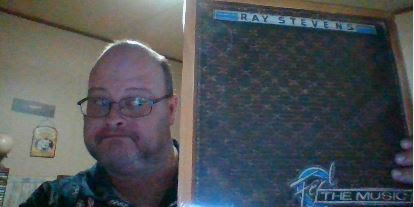
Me and Feel the Music LP
Regardless of whatever industry politics were at play "Dixie Hummingbird" and the album it's from, Feel the Music, are nevertheless another outstanding display of Ray's talents. The album has 10 songs on it...9 of the songs were written by Ray Stevens. Buddy Kalb contributed "Set The Children Free". I have never seen any video footage of Ray singing "Dixie Hummingbird" but if you search YouTube you'll find video footage of him singing "Feel the Music". In fact, I've written some blog entries and embedded the video of "Feel the Music" in them and so you can also search this blog for "Feel the Music" and you'll be able to find the video clip...but if you don't have the time to do in-depth searching then simply visit Ray's YouTube channel and look for "Feel the Music". In the meantime, "Dixie Hummingbird" tells the story of a man who's obviously in love and he tells about how he feels about her and that she's the silent type who doesn't say too many words but reassures him in her own way that she's loves him. He calls her his "Dixie Hummingbird".
I created the collage you see above several years ago. It's from a blog entry I wrote on July 8, 2018. It's what I call the Ray Stevens Warner Brothers Collage. It visually tells the story of Ray's Warner Brothers years...an era in his career that I love the most although I love his entire career. Here is the audio clip of "Dixie Hummingbird"...
Hello all!! Earlier today Ray Stevens uploaded an audio clip of his fantastic song, "Get Crazy With Me". The song is from his 1977 album, Feel the Music. If you know much about Ray's tenure with Warner Brothers then you'll know that it was a very busy period in his career...but he continues to remain active and busy...but in 1977 the record label he recorded for must have had fallen under new management because in hindsight the label issued his singles in a sort of haphazard fashion that year. The label was promoting two Ray Stevens singles concurrently as 1977 kicked off. A release by Ray in December 1976 under the alias of Henhouse Five Plus Too, "In the Mood", had become popular and therefore was hitting the charts as we entered 1977.
In the meantime Warner Brothers, the same month the chicken clucking "In the Mood" was hitting, they issued a new single from Ray, "Get Crazy With Me". As you'll hear in the video clip below Ray is singing as a human instead of clucking like a chicken. The B-side of the January 1977 single is "Dixie Hummingbird".
Some time later in 1977 Warner Brothers issued "Dixie Hummingbird" as the B-side of "Feel the Music". The label also issued "Dixie Hummingbird" as a promo...which means a single with the same song on both the A and B sides. "Dixie Hummingbird" got more notice than "Feel the Music" and received what's known as unsolicited airplay...significant enough to enable "Dixie Hummingbird" to reach the country chart and get inside the Top-50. In June 1979 Warner Brothers re-issued "Get Crazy With Me" and backed it with "Dixie Hummingbird"...perhaps adding even more confusion for the fans that collect Ray Stevens records.
One of my favorite time periods in the career of Ray Stevens is the late '70s when he was recording for Warner Brothers. He recorded four studio albums for the label and then they issued a compilation album on him to promote a newly recorded novelty song, "I Need Your Help, Barry Manilow", in 1979. The label really hadn't did too much to keep the songs he recorded for them in print. In 1995 the label issued a 3-volume collection which, to date, remains the definitive series on Ray's years with Warner Brothers (1976-1979). His studio albums for the label haven't been re-issued. In 1977 he released a studio album titled Feel the Music which features 10 songs. Ray wrote 9 of the 10...he wrote the title track, "Feel the Music". The album cover, as you see below, is an illustration of a stereo speaker. The back of the album has a photo of Ray attached to the back of the 'speaker'. The illustration of the speaker is in great detail. This audio clip appeared on YouTube several days ago but I'm only now getting around to showcasing it in a fan created blog entry...
Longtime Ray Stevens fans should be aware of these 1995 releases from Warner Brothers. I've written about them plenty of times over the last 10+ years that I've been writing this fan created blog. Well, 2020 marks the Silver Anniversary of their release. I still have my cassette tapes and but I only have one of those in CD format. I have them in Mp3 format now but I won't toss out my cassettes...or CDs...or my vinyl. I have all of those songs, now, on vinyl on the original studio albums they appeared on. Anyway, in the years prior to these three releases coming along you couldn't find hardly anything in retail stores featuring Ray Stevens from his Warner Brothers years (1976-1979). You would come across compilation albums that featured one or two selections from that time period and that was it. Can you guess the songs from this era in Ray's career that got the most repeated exposure on compilation albums throughout the 1980s and into the mid 1990s? The novelty "In the Mood" late in 1976...released under a pseudonym, Henhouse Five Plus Too. The other song from this time period that's gotten a lot of reissue is 1979's "I Need Your Help, Barry Manilow". These 1995 releases went a long way at showcasing the obscurities that weren't kept in print on countless compilation albums. The irony is that these 1995 cassette releases, once they were re-released in CD format, went out print just as quickly as they arrived. A number of years later the releases were digitally uploaded for on-line sale...however, one of those 1995 releases is currently unavailable for digital/Mp3 purchase, but the other two are still available.
The titles of those releases are Cornball, Do You Wanna Dance?, and The Serious Side of Ray Stevens. The material compiled for those releases come from his studio albums for Warner Brothers in the late '70s. Cornball is a misleading album title...there are only three recordings that qualify as comical/novelty but there is a love ballad on there titled "Cornball" from 1976. The CD opens and closes with the chickens: "In the Mood" kicks off the CD and "Classical Cluck" closes out the CD. In between we have track two, "I Need Your Help, Barry Manilow" and beyond that the rest of the recordings are serious love ballads and inspirational easy-listening music. I'm aware that there is a segment of music listeners that can't distinguish between Ray's humorous and serious recordings. I say this because there are many that feel his 1975 recording of "Misty" is a comedy song (believe it or not) but it's actually a straight ahead country performance of a jazz/pop standard...to them it's funny when they hear it performed the way that Ray does it. Cornball is not available for digital download at Amazon but the other two collections are. I'm going to list the songs found on each release.
Do You Wanna Dance?:
1. Feel the Music; 1977
2. Dance Trilogy- Do You Wanna Dance/When You Dance/Save the Last Dance for Me; 1978
3. Blues Love Affair; 1977
4. Country Licks; 1976
5. Honky Tonk Waltz; 1976
6. One Man Band; 1976
7. Can't Stop Dancin'; 1976
8. Old Faithful Trilogy- Shake a Hand/Since I Met You Baby/Always; 1978
9. You've Got the Music Inside; 1978
Cornball:
1. In the Mood; 1976
2. I Need Your Help, Barry Manilow; 1979
3. You Are So Beautiful; 1976
4. Money Honey; 1978
5. Cornball; 1976
6. Dixie Hummingbird; 1977
7. One Mint Julep; 1978
8. Your Cash Ain't Nothin' But Trash; 1978
9. Save Me From Myself; 1977
10. Classical Cluck; 1976
The Serious Side of Ray Stevens:
1. One and Only You; 1976
2. Talk to Me; 1978
3. Alone With You; 1977
4. Daydream Romance; 1977
5. Once in Awhile; 1976
6. Set The Children Free; 1977
7. The Feeling's Not Right Again; 1978
8. Two Wrongs Don't Make a Right; 1978
9. L'amour; 1978
10. Be Your Own Best Friend; 1978
Ray issued two studio albums in 1978. In the first half of the year he released a covers project called There Is Something On Your Mind. This eight song album features Ray's renditions of rhythm and blues classics...and some obscurities that weren't heard on mainstream Top-40 pop radio. That album features commentary on both the front and back of the album by Ray where he discusses his desire to record this kind of an album and how that music was a big influence in his youth. If you have those 1995 releases the person that compiled the songs lists the material from that 1978 album as previously unreleased. I have no idea why those songs are noted as being previously unreleased when they appeared on that 1978 album. I've gotten some replies over the years that perhaps the reason they're noted as previously unreleased is because the 1978 album may have only been released in Canada and other predominantly English-speaking countries. It's possible...but it makes no sense, to me, why it wouldn't get issued in the United States as well.
Ray Stevens; 1978
The songs on these 1995 releases that come from that 1978 covers album are: "Talk to Me", "Money Honey", "Your Cash Ain't Nothin' But Trash", "One Mint Julep", "Old Faithful Trilogy", and "Dance Trilogy". The two recordings from that 1978 album that didn't get spotlighted in those 1995 releases were "Banned in Boston Trilogy" and the title track, "There is Something On Your Mind". The second studio album from Ray in 1978 was Be Your Own Best Friend. An abundance of songs from that album feature heavily on the 1995 CD titled The Serious Side of Ray Stevens. I don't think it will ever happen but nevertheless I still wish that Ray's studio albums for the label would get issued digitally.
In a 1977 video clip from an episode of Marty Robbins Spotlight here's Ray performing "Feel the Music". It's an even more soulful performance than the studio recording if that's even possible. You'll hear Ralph Emery provide the introduction...
Hello all...as the COVID-19 pandemic continues and with the announcement yesterday that the Federal guidelines for combating the virus will remain intact for the month of April (no large gatherings; dine-in restaurants closed; limited retail purchases; etc.) it's obviously caused a chain reaction of events throughout the economy. Some may think it cynical or crass to even think of the economy when human lives are at risk but at some point those economical concerns will have to be addressed. The passage of the $2.2 trillion stimulus bill is a giant first step but we'll see if even that jaw dropping amount is enough. I don't know if any State Governor is going to be defiant and "re-open" their State in April and go against the Federal guidelines. Also, on the flip-side, if the Federal Government would decide to "re-open" the country I don't know if any State Governor would take the chance of COVID-19 cases skyrocketing without a vaccine at people's fingertips. Either way, without a definitive vaccine available, it's a no-win situation for either a State Government or the Federal Government.
To offer an escape, though, I came across a recently uploaded 1977 episode of Dolly, the variety show hosted by Dolly Parton in 1977, guest starring Ray Stevens. There had been a video of Ray and Dolly uploaded from this episode in the past...a clip of the two of them performing "Happy, Happy Birthday Baby" and "Searchin'". Ray's other footage from that episode had never been uploaded, to my knowledge, until recently. The video statistics show it was uploaded on March 28th but yet this is the first time I'd seen it posted on YouTube. I don't know why videos are slow to appear in YouTube search results nowadays. I've come across other video clips that are new to me but the stats for the video show that the video clips were uploaded days earlier.
The quality of the tape isn't top notch but that's to be expected...it's from 1977...and it isn't the master copy of the episode; but, in general, the episodes haven't been well preserved. The reason being is that the owners/distributors of these kind of television shows never had the slightest idea that there would be appreciation or an audience for 'retro' programming as they call it now. Back then I suspect the feeling was "who in the world would want to watch reruns?!?". In spite of the visual quality it's still fun to hear and watch...particularly Ray and Dolly performing "Sir Thanks-a-Lot". Ray performs one of his singles at the time, "Get Crazy With Me". Ironically there's an issue of Country Song Roundup from 1977 in which Dolly is on the cover. One of the articles in that issue is about Ray Stevens...and it's headline is Get Crazy with Ray Stevens.
The album from Ray Stevens in 1977 was a marvelous collection called Feel the Music. In a previous blog entry I wrote about Ray's 1976 appearance on Hee Haw. In that episode he sang "Honky Tonk Waltz" and "You Are So Beautiful", both songs from his 1976 album, Just for the Record. His performance was taped in the summer of 1976 during one of the marathon recording sessions for Hee Haw. The series taped their episodes twice per year: 13 episodes were taped in the summer and 13 episodes were taped in the fall. Ray's summer 1976 taping session appeared on an episode that aired on October 23, 1976.
Hello all! A couple of days ago a video clip originated on Facebook containing the Ray Stevens performances from an episode of Hee Haw in 1976. The clip didn't originate on YouTube and it's one of those auto-play video clips where it begins playing as soon as it appears on your screen. I don't like embedding those kinds of video clips on my blog page and so I decided to just provide a link to the video clip. You can watch Ray Stevens perform two of his hit songs, "Honky Tonk Waltz" and "You Are So Beautiful", when you click HERE. Those two songs come from his 1976 Warner Brothers album, Just For the Record.
The video clip begins with Ray and Hee Haw cast member Jimmy Riddle. In this brief routine Ray sneaks up and surprises a startled Jimmy...who naturally reacts in hysterics...much to the delight of a laughing Ray Stevens. The two perform the classic eef and hambone routine usually performed on the show by Jimmy and Jackie Phelps who were billed as 'Riddle and Phelps' in the earliest years of Hee Haw.
Ray Stevens and Jimmy Riddle; 1976
Attempting to get a screen cap as Ray and Jimmy are doing the hambone routine can be difficult. Given the tempo of Ray's leg slaps it causes the right hand to look unfocused/blurry. Jimmy is in the process of eefing and making music with his hands. A photo posted further down the blog entry of the two of them from 1980 also features some blurry imagery during the hambone routine.
Ray Stevens; 1976
In the screen cap off to the left we have Ray Stevens immersed into his performance of "Honky Tonk Waltz". The song comes from the pen of songwriter Paul Craft. The Facebook video clip becomes only the second on-line video to feature Ray performing this song. There's another video clip from his appearance on an episode of Pop! Goes the Country and in that performance he plays both a guitar and the piano...and midway through the performance he dances briefly with Donna Fargo before being comically interrupted by host, Ralph Emery. In this performance from Hee Haw it is much more subdued and as you can see it's performed with a more serious flair. The song is a clever blend of two different styles of music. There's the honky tonk aspect and then there's the dance aspect of a waltz. The lead instrument is the mandolin followed closely behind by the fiddle. In the video clip the mandolin player is given screen time along side Ray. I've mentioned on social media sites that I think the mandolin player is Larry Sasser...and my assumption appears to be correct because in the second performance, "You Are So Beautiful", the same musician is playing the steel guitar. If my recollection is correct I believe Larry Sasser was part of Ray's touring band for a number of years...but not a lengthy member of his studio band. I think Larry played on just a couple of Ray's albums and those were in the 1980s. Larry appears as the steel guitar player during a performance of "Sunshine" that Ray taped for the Jerry Reed and Tom Selleck movie, Concrete Cowboys. I'll go back and edit this blog entry if I find out the identity of the mysterious mandolin/steel guitar player from the 1976 episode of Hee Haw...but I say it's Larry Sasser. In the meantime, "Honky Tonk Waltz" hit the Country chart on August 7, 1976 and remained charted for 10 weeks. It reached it's peak position in the Country Top-30 during it's 7th chart week on September 18, 1976. It appeared on the Country chart for it's 10th and final week on October 9, 1976. This episode of Hee Haw originally aired October 23, 1976. The footage was taped in the summer of 1976...right around the time "You Are So Beautiful" was his current release.
Ray Stevens and a couple of his musicians; 1976
"You Are So Beautiful" happened to be the debut single on Warner Brothers from Ray Stevens. He had recently left Barnaby Records after a 5 year run and his first single for Warner Brothers hit the Country chart on May 1, 1976. It reached it's Top-20 peak in it's 9th chart week on June 26, 1976 and remained on the chart until July 24, 1976. The single was arranged in a Bluegrass style similar to "Misty" from a year earlier. Whereas "Misty" was mid-tempo and the steel guitar, banjo, and fiddle were prominent "You Are So Beautiful" pushed for a more up-tempo delivery and an even heavier use of those instruments. In both songs there's an interlude where the musicians take center stage. In the performance of "You Are So Beautiful" both the steel guitar and fiddle player are on screen. The fiddle player is Lisa Silver. There's a brief routine with George Lindsey in this 1976 episode, too.
Author Update: 3/30/2020: ***I titled this blog using the year 1977 because I was using my eyes instead of going through my stats. I thought this episode originally aired in early 1977 and featured footage from a fall 1976 taping session. However, I decided to refresh my memory and I looked through my personal notes regarding Ray's career and found out this episode aired on October 23, 1976. This means the footage was taped in the summer of 1976, rather than the fall of 1976 as I originally thought. I've corrected the year, from 1977 to 1976, within the text of this blog entry and in the photo captions but I'm leaving the title of this blog entry as is. It's episode six of the 1976-1977 season of Hee Haw.***
I created a couple of photo comparisons earlier. Ray Stevens, in a 1980 appearance on Hee Haw, performed a hambone routine with Jimmy Riddle just as they had in the 1976 appearance. By this point Ray had grown a beard once again but unlike in years past he's kept the beard and it's become such a part of his look...I don't believe he's ever been clean shaven since the first half of 1978. In Ray's 1980 appearance on Hee Haw both Lisa Silver and Larry Sasser are part of the band. Here are the photos...