Showing posts with label 1998. Show all posts

May 21, 2023

Ray Stevens: This CD is Silver...

Hello fans of Ray Stevens! I'm quite sure you're familiar with the photo of Ray that appears on this 1998 release. This compilation celebrates a Silver Anniversary is year...released 25 years ago by Varese Sarabande. Titled The Country Hits Collection it randomly collects mostly album tracks from several Ray Stevens albums of the early to mid 1970s and gives them a spotlight. This was important in 1998 because the vinyl albums those album tracks originally appeared on were, and still are, out of print but much, if not all, of the songs on this collection have since become available digitally on the internet. Does it mean this collection is no longer a vital item in your Ray Stevens collection due to most of the songs being readily available online? Of course not! This CD comes with a fold-out booklet full of commentary/notes and numerous photos of Ray...and that right there is cause for fans to seek out this CD on various online stores or auction sites. If you're a fan in the manner in which I happen to be then reading liner notes/essays/commentary about Ray is just as good as having the music. I recently purchased an issue of Country Music Magazine from 1981, for example...yes, the magazine is 42 years old this year, but what drove me to purchase the magazine on eBay is because it features an article/interview of Ray Stevens. It had been available online for awhile from various sellers but I happened to see one at the right price and bought it...it arrived in the mail last week. The magazine cover features Burt Reynolds. I make mention of this because, although it's a magazine and not an album, because it has an interview with Ray Stevens I decided to purchase the magazine. So, then, if you're like I am and want to read about Ray and his music but you don't have the CD, Country Hits Collection, go ahead and purchase it if only for the fold-out cover/liner notes and photos. 


The liner notes in the CD's fold-out cover were written by a writer named Mike Ragogna. As far as photos are concerned there's a close-up photo of Ray from 1970 and there are a couple of images of advertisements that originally appeared in music trade magazines. There are 16 recordings on the CD and the first 5 tracks were single releases: "Sunday Mornin' Comin' Down" (1969); "Turn Your Radio On" (1971); "Nashville" (1973); "Misty" (1975); and "Young Love" (1976). The back of the CD lists all 16 songs, the songwriters, and which album the song originally appeared on and the album catalog number and for the single releases it also includes the catalog number for the single release and it's peak in Billboard's pop or country chart. The back of the CD doesn't provide chart data for Easy-Listening/Middle-of-the-Road/Adult-Contemporary nor are Billboard's competitors included (Record World, Cashbox, Radio and Records). Some of the songs were issued as B-sides...and there's one song on here, "Piece of Paradise", that had only appeared as a B-side on a single release and was never part of any album. This collection remains the only showcase on CD for that 1975 B-side. It's A-side, "Indian Love Call", isn't on this collection, ironically. 

Here are the 16 songs on this 1998 CD...

1. Sunday Mornin' Comin' Down
2. Turn Your Radio On
3. Nashville
4. Misty
5. Young Love
6. She Belongs To Me; 1970
7. Losin' Streak; 1973
8. Just One of Life's Little Tragedies; 1973
9. Easy Loving; 1973
10. Sunshine; 1975
11. Take Care of Business; 1975
12. Undivided Attention; 1973
13. Destroyed; 1973
14. Loving You On Paper; 1970
15. Piece of Paradise
16. Deep Purple; 1975

"Young Love" happened to be a single release by Barnaby Records on Ray Stevens in December 1975 and it was his next-to-last single for the company. His very last single for Barnaby would be "Mockingbird Hill" backed with "Lady of Spain" early in 1976 but by then he had joined Warner Brothers Records and was recording his debut album for the label in the early months of 1976...which, my guess is, that very last single for Barnaby, "Mockingbird Hill", was something contractually obligated which is why there's next to no publicity for the release in any music trade magazine of that time period. Research I've done on Ray Stevens indicates that early 1976, in music trade magazines, centers around his debut single and album for Warner Brothers and I've not come across any mention of Ray's "Mockingbird Hill" or "Lady of Spain" recordings but we know the recordings were issued on a single. Their release on a vinyl single is why you'll see one or both of those songs on various compilation albums released on Ray Stevens.     

September 14, 2021

Ray Stevens: The guest appearance on The George Jones Show...

Hello fans of Ray Stevens! A couple of days ago, on what would have been the 90th birthday of country music legend George Jones, Ray uploaded his appearances from The George Jones Show. George once hosted a television show on The Nashville Network for a season...it began airing in February 1998. The show's theme song was the title track of his 1997 album, It Don't Get Any Better Than This. George had a wide variety of country music artists on the show per episode...it was an informal gathering as you'll see in a screen cap I posted below...and in one of those episodes Ray Stevens was a special guest. Ray was on the same episode featuring T. Graham Brown and Allison Moorer. In the episode Ray speaks of his experiences getting into the music business. George spotlights a video clip from the early '60s of Ray singing "Ahab the Arab"...after at least half a minute Ray asks how much longer we're going to have to endure watching that. For the record, though, practically all recording artists in any form of music tend to not enjoy seeing themselves during earlier phases of their career and it can be for any number of reasons. Some tend to cringe at the fashions they wore, the hairstyle they had, or the performance itself. Some performers don't like to watch themselves no matter the time period...whether it be a performance from decades ago or just the other day. As a fan, I don't share the same sentiment as a lot of recording artists. I love seeing performances of my favorite singers from all time periods. I have a feeling most of you share the same feeling as I do...we love watching Ray Stevens no matter if it's a performance from 1961 or 2021. Ray sings "Too Drunk To Fish" on this episode of George's show and video clips from Ray's music video are inserted into the performance. The song is from Ray's 1997 album, Hum It


George's television show, as mentioned, began airing on TNN in February 1998...it was not a full length season of shows, however. It was on a trial run basis. I don't have the number of episodes available...but it was less than the usual 16 episodes or 26 episodes per season norm when it comes to television programming. There may have been 13 episodes produced for airing in 1998. Strangely enough there isn't any definitive information about George's television show online. There are video clips but I haven't come across any website that has a complete episode guide and airdates. Ray Stevens taped his appearance in the latter half of 1998 and it aired in the spring of 1999. I did find out that there were 11 episodes produced in the latter part of 1998 for airing early in 1999...and Ray Stevens was among the guests during the 1998 taping session. When I seen this episode of the show for the first time I was ecstatic and it was thrilling to see two of my all time favorites, Ray Stevens and George Jones, not only on screen together but actually conversing with one another!! Here's a screen cap of Ray and George...and from this screen cap as well as from the video you'll see how informal the conversation part of the show happened to be. The conversation part of the show, where the guests sat on couches, was always taped separately...without an audience. 

September 23, 2019

Ray Stevens: The Road to the Country Music Hall of Fame, Part Twenty...

Welcome back to the mini-blog series I've been writing...focusing on the career path of Ray Stevens and why he's long been deserving of election to the Country Music Hall of Fame...an honor that at long last came along this past March with the formal induction to take place next month (October 2019). In part nineteen I left off in the final months of 1997...and so here we are in early 1998. The release of compilation projects that record labels were issuing on Ray Stevens peaked in this time period. The CD had been around for more than a decade but not every artist's catalog had become available in CD format...and throughout most of the 1990s as if to make up for lost time a wide array of CD's came along keeping Ray's music in print. It was also in this time period that Ray had long since become something of a music video mogul and had racked up millions in VHS sales. The titles available on VHS from Ray Stevens in 1998 were: Amazing Rolling Revue (1992), Comedy Video Classics (1992), Ray Stevens Live! (1993), More Ray Stevens Live! (1993), Get Serious! (1995), the behind-the-scenes documentary Ray Stevens Made a Movie?? Get Serious!! (1995), and the compilation, Latest and Greatest (1996). Varese Sarabande, an Independent record label, had previously re-issued a couple of Ray's vinyl albums in CD format...in 1998 the label unleashed The Country Hits Collection. Now, for me, this was another goldmine...I was slowly adding CD to my music consumption but still had no vinyl in my collection...and almost all of the songs on this CD were vinyl exclusives at that point in time. Some of the songs on this CD are: "Losin' Streak", "Sunshine", "Young Love", "Easy Loving", "Deep Purple", and something that was originally only found as a B-side on a vinyl single, "Piece of Paradise". I believe that this 1998 CD remains the only place you can find "Piece of Paradise" on CD. It may have been digitally re-issued in Mp3 format but I don't actively pursue Mp3's if there's a physical CD available for purchase...so my knowledge of Mp3 availability of a lot of Ray Stevens material is lacking as a result.

The 1998 compilation comes complete with a fold-out booklet of liner notes/essay and a number of rare photos, at the time, but most of those photos have since been uploaded onto the internet. Ray returned to the concert stage in October for a series of concerts at The Acuff Theater located in the Opryland complex. His appearances at the venue were promoted and featured as commercials on radio broadcasts of The Grand Ole Opry.

In the spring of 1999 near-tragedy struck...country music's premier humorist/funnyman Ray Stevens was diagnosed with the all too serious subject of Prostate Cancer. The disease was caught extremely early...and Ray credits the early discovery, of course, as the reason he ultimately beat the disease...and although it's been said by various experts down through the years that this form of cancer is one of the easily beatable and easily detected through PSA testing it nevertheless is a form of cancer...and the C word is serious business no matter how 'preventable', 'curable', or 'beatable' a form of it might be. I say all of that because, believe it or not, some cynical no-name questioned the seriousness of this type of cancer in a rambling post I came across several years ago. The remark, which I came across a couple of years ago, has remained in my collective memory due to Ray having to deal with the disease in the first half of 1999. The diagnosis, therapy, recovery and everything else involved with cancer meant that the series of summer concerts scheduled at The Acuff Theater were canceled. He beat the cancer and set about planning his next series of concerts at The Acuff Theater. His final appearances at the venue were in December of 1999 during Christmas-themed concerts built around his 1997 Christmas Through a Different Window release. As a member of his former fan club we were mailed exclusive Christmas cards...and during his appearances at The Acuff Theater in the Christmas months of 1998 and 1999 the cards doubled as advertisements. I was a member of his fan club from 1994 until it closed in 2002. It had been in operation since 1987.

Clyde Records issued a brand new VHS on Ray in 2000 titled Funniest Video Characters. This collection of music videos mirrors Comedy Video Classics in that it features eight music videos and the packaging is nearly identical as far as letter fonts, etc. and it features a mix of all-new music videos and a couple previously released. This latest VHS was unique in that it opens and closes with a two part video while six additional music videos are sandwiched between. "The Ballad of the Blue Cyclone, Part One" opens the collection while "The Ballad of the Blue Cyclone, Part Two" closes the collection. In between those two music videos: "Virgil and the Moonshot" (1997), "Juanita and the Kids", "Too Drunk to Fish" (1997), "The Haircut Song", "The Pirate Song", and "Freddie Feelgood". The role of the Blue Cyclone was portrayed by Buddy Kalb...also visible in many other music videos from Ray Stevens. Although this collection mirrored Comedy Video Classics aesthetically it didn't have the same economic results simply due to it being a victim of changing trends and times. Advertising rates on cable television had skyrocketed since 1992...and so this VHS wasn't heavily advertised through direct marketing as several of his previous VHS releases had been. I don't think it was ever released/distributed in retail stores...I hadn't come across any Billboard Video chart showing Funniest Video Characters listed among the top selling titles...so that has me thinking it was only available through limited direct marketing and through his fan club store.

This is all my opinion but upon the explosive success of the direct marketing boom, by the mid 1990s, someone got the bright idea to raise advertising costs and with so many late night television ads consisting of commercials for everything from car wax to oldies music as well as ads running through daytime hours for music collections "not sold in stores" the cable television companies, collectively, wanted an even bigger profit given how popular direct marketing had suddenly become. This desire for bigger profits led to less products being offered...the rise in advertising rates impacted the profitability of the actual products advertised...so direct marketing became a high risk...and one by one direct marketing lost a lot of it's impact as far as television exposure was concerned because the companies that offered the products didn't want to spend more money in advertising costs with the possibility of profit loss on their end. If you spend more on advertising but don't turn a profit it's a no-win situation. The rise of the internet also played a factor, too. On the recording front Ray had since left MCA Records following the release of several products (two albums as well as their retail distribution of his Get Serious! VHS) but he nevertheless continued on recording and unleashed a new album, Ear Candy, on his own Clyde Records label. The album cover shows Ray with a candy cane shoved through one side of his ear and out the other. This album features ten songs...several of them shown up in a future album from Ray while one in particular, "No Lawyers in Heaven", became a monster hit in the Bluegrass format more than 10 years later for Charlie Sizemore. Ray didn't happen to be the song's publisher, unfortunately, and so he didn't reap the rewards for the song once it became a hit...but Ray happened to be among the first to record the song...if not thee first to record it. One of the songs that Ray has often included in his concerts originated on this 2000 album. "Safe at Home", an ode to small town America within the recollections of a baseball game, became a very popular song in concert for Ray...in the latter half of the decade...but I'm jumping ahead 10 years, aren't I?

In my next installment of this mini-blog series we make our way into 2001 and we see Ray enter the world of the internet...very cautiously at first...and then we see how a national tragedy impacted an entire world and it played a factor in Ray's career. The 2002-2004 era marks the beginning of Ray's self-administered plans of retiring from the music business...what??? Well, not completely retiring...kind of retiring...well...I'll explain in Part Twenty-One.

December 3, 2012

Ray Stevens: Golden LP Series Extra...1998...

In this Golden LP Series Extra we look at a release from 1998 on Ray Stevens. One of the things that is commonly misunderstood when it comes to compilation releases is that the artist okays their release. This is furthest from the truth when it comes to artists of Ray's generation where songs are passed around and handled and owned by a multitude of record companies depending on which label an artist originally recorded their songs for. A lot of the compilation albums released on Ray were not in his control.

Legitimate Greatest Hits or Best Of collections are often contractually mutual between the artist and label but once individual songs start to get sold and purchased and re-sold and purchased by other parties and licensed and re-licensed, etc. etc. it creates scenarios where record labels, mostly low-budget affiliates or overseas imports, are able to put out projects on artists that never even recorded for their label. Then the next thing an artist knows is there's a flooding of the market of compilation releases featuring their music with a general audience under the impression that the numerous releases are endorsed and approved by the artist.

Ray's Monument and Barnaby recordings featured the most exposure on a whole host of compilation releases through the decades. The owners of those recordings would grant permission, via a licensing fee I assume, to nearly any label in existence to distribute those recordings as they saw fit. This kind of thing has fell off sharply in the last 5 years or so and you don't see the abundance of compilation releases on Ray as you once did.

In 1998 the Varese Sarabande label released a 16 song project on Ray Stevens and it's titled The Country Hits Collection. The CD gathers, at random, 16 songs that Ray recorded between the years of 1969 and 1975. The CD comes complete with a mini booklet/liner notes and several publicity photo's issued on Ray through the years. The notable aspects of this CD when it was originally released was the fact that it was the only CD in existence to feature an abundance of album tracks from Ray's various albums during that 1969-1975 time period. This release came several years before Collectible's Records began issuing nearly all of Ray's full-length Barnaby vinyl albums onto CD and so for a period of years The Country Hits Collection was the lone CD that featured songs that up until then were pretty much exclusively vinyl.

Even though later releases from Collectible's eclipsed the overall importance of this 1998 project, it's still worth looking up for the liner notes, photo's, and "Piece of Paradise", a b-side from 1975 that made it's CD debut on this 1998 collection and it's never been available on any other CD since then. It was first issued as the b-side of Ray's hit recording of "Indian Love Call". It was also a non-album b-side meaning that it didn't appear on any album and was exclusive to the 45-rpm single and so it's one of those rare and obscure recordings that you're not really going to know about unless you branch out into the weeds and learn about all the numerous recordings by Ray Stevens through the decades.

January 18, 2011

Ray Stevens: Nostalgia Valley, Part 18...

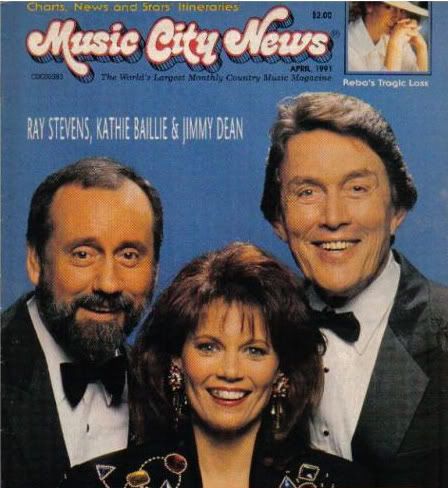
Ray Stevens, along with Jimmy Dean and Kathie Baillie were co-hosts of the Music City News Songwriter Awards 20 years ago in 1991, an experimental program that sought to spotlight and award the songwriting side of Nashville. 1991 was the debut year for this program and as you can see from the cover of Music City News, Ray was one of the co-hosts. This secondary program never obtained the same level of popularity that the artist awards from Music City News readers had gotten mainly because songwriters, usually, aren't in the spotlight. Unless a singer happens to be a songwiter, too, most songwriters aren't well-known outside of the songwriting community. There are a few exceptions, though, when a songwriter becomes prolific and is responsible for a large list of recordings by numerous recording artists. This sort of songwriter becomes just as popular as a singer...but 90% of the time songwriters don't obtain that kind of widespread acclaim.

The Music City News Songwriter Awards can be described as an updated version of an earlier program, The Music City News Top Hits of the Year, which often aired early in a calendar year. In that program, which had aired annually since 1981, the top country music hits of the previous year were performed on-stage and the songwriters were given publicity, too. For example...a 1982 telecast would celebrate hit songs from 1981.

I have a DVD of the 1983 edition of the Top Hits of the Year, actually it's a Best-of compilation from that 1983 special. All of the songs nominated and honored were hits in 1982. Ray Stevens was the co-host...along side Tammy Wynette. In the DVD release, which is cut down considerably from it's original running time, Ray and Tammy are shown introducing guests and bantering back and fourth which is customary on many programs. The two open up the DVD performing "We Got the Music In Music City" while later in the DVD we get to see Ray perform "Country Boy, Country Club Girl" which was a song featured on his 1982 album on RCA, Don't Laugh Now.

Here's a little bit of trivia concerning the 1983 awards program: The day the show was taped happened to be January 24, 1983...on Ray's birthday!

By the way...speaking of 1991 it was during the Gulf War that Ray's song, "Ahab the Arab", was routinely proclaimed politically incorrect by those who advocate political correctness. The highly entertaining song had it's share of critics prior to 1991 and those criticisms were few and far between. The criticisms tended to be about potential stereotypes of Arabs by modern-day listeners of the song. So, it's safe to assume there were politically correct hacks floating around in the '70's and '80s. By and large from 1991 onward the liberal-progressive movement took a firm grip in the so-called mainstream media and the progressive activists branded the song 'politically incorrect'. Very few media outlets from 1991 onward have had any positive references toward the song. If the song gets mentioned in modern-times it's almost always referred to as being politically incorrect or "harshly offensive". Political correctness is nothing more than language-based McCarthyism where liberal-progressives recklessly proclaim anything they take offense to as being politically incorrect. Once they smugly proclaim something to be politically incorrect in some way or another then the demagoguery begins.

In current interviews Ray Stevens takes up for "Ahab the Arab" and goes to great length explaining his inspiration for the song. Demagogues who hear his explanations have no use for the truth and therefore they continue to brand the song politically incorrect in spite of testimony from the song's writer. These politically correct hacks don't care what people or organizations say in their own defense...instead, the hacks want to dictate and control what others do and say no matter what. That's the bottom line. Political correctness has nothing to do with being inoffensive or being nice and kind to each other...it's all about controlling how a person communicates. The hacks want to control how people think toward certain organizations, singers, entertainers, books, TV shows, etc. etc. The literary field is littered with books that have been put on a so-called banned list because politically correct hacks object to their content. The same holds true for cartoons made largely before the mid 1980's.

There's also a double-standard at play, too. While the politically correct hacks are largely liberal-progressives who want to control how people communicate and dictate what entertainment we should enjoy...they get fighting mad whenever there's potential threats from Congress of non-funding of NPR (National Public Radio), PBS, or other left-leaning public funded organizations. These same people who demand that we adopt political correctness in our daily lives and accept their mandates on how to treat other people turn right around and get angry, insulting, and hostile if something they enjoy [like NPR; Unions] is threatened in some way. The hypocrisy is enormous.

Meanwhile, it was fun finding a VHS tape in my private collection and coming across an episode of The George Jones Show with Ray Stevens as a guest. I knew I had taped the show but among my VHS tapes it had gotten misplaced and for the first time in several years I watched the episode. The episode originally aired on TNN back in 1998 and I watched the episode multiple times throughout 1998 and beyond but when I purchased a DVD player and started watching DVD's with much more frequency I put away the VHS tapes into storage containers where they've remained since.

On the episode Ray sings his latest, "Too Drunk To Fish". The song was originally found on his 1997 CD, Hum It. The episode also features Ray and the other guests, Alison Moorer and T. Graham Brown, sitting in a living room set discussing with George the music industry and their careers. George plays a small clip of Ray singing "Ahab the Arab" from the mid '60s. Ray performs part of "Everything Is Beautiful" during the living room segment and moments later he and George perform "She Thinks I Still Care" as a duet blending the pop-version Ray recalled singing in an unreleased recording while George performs it the way he's known for.