
Showing posts with label 8-track. Show all posts
Showing posts with label 8-track. Show all posts
June 26, 2011
Ray Stevens: Look Back at 8-track, Chapter Three...
The 8-track version of Shriner's Convention comes up for sale a lot on-line. I know of nobody personally who has an 8-track player anymore but I'm sure some people out there still have one. A few of the mainstay's of flea markets are 8-tracks, vinyl albums, and record players. There's never been a flea market yet which doesn't offer at least one of those items. Those familiar with 8-tracks can perhaps explain the reason behind the inclusion of the song "The Last Laugh" twice. As you'll see on the back of the 8-track the song is listed twice. I assume this is because the company wanted an even amount of songs...and considering "The Last Laugh" is the shortest one of the bunch it's the one that got picked as a duplicate but that's just my guess. Perhaps they made a mistake and listed the song twice? As I've written about before...I've got the vinyl album and the cassette version of Shriner's Convention. It officially has 9 songs on it but the duplicate on the 8-track gives it 10. There was once a time when it was hard to find a vinyl copy...the cassette copy is even harder to find. I came across a vinyl copy on a web-page years ago and the price was right and so I sent off for it. A couple of years ago, out of the blue, a cassette copy became available on eBay. I bought it right away! I am always interested in finding cassette tape from the late '70s and early '80s of my favorite singers. I'd love to find cassette versions of One More Last Chance, Don't Laugh Now, and Me. I've got them on vinyl but the completest side of my brain would like to have the cassette releases, too. "The Last Laugh" and "Coin Machine" trade places depending on which format you own: the cassette has "The Last Laugh" closing out the collection while the vinyl has "Coin Machine" as the album's closer.

September 9, 2009
Ray Stevens: Look Back at 8-track...another chapter
 The 8-track has a polarizing effect on music buyers. I should say it has that kind of effect on those who experienced the 8-track. You can find places on-line and even at flea markets and yard sales where 8-tracks are in abundance. I'm not into 8-tracks but I know that there's an audience out there that buys them. I buy CD's and vinyl albums...sometimes cassette's...I've never had a nostalgic feeling about the 8-track but given that this is my Ray Stevens blog I thought I'd put up some 8-track images. I've did blog entries before about 8-tracks but in this entry I plan on putting up several images of Ray Stevens 8-tracks. In a lot of instances the 8-track was a good idea and it gave music buyers a new way to listen to music that hadn't been done before. The idea of continuous play without having to flip it over to the other side I think was the main selling factor. The drawback as I touched upon months ago was the continuous play tended to wear out the magnetic tape to the point where other songs could faintly be heard in the background. If an 8-track was severely over-played the tracks would jump and you could be listening to a song and then it would click to another song and then go back.
 The image you see above is a music/song book promoting "Sunset Strip", a Top-10 Adult-Contemporary hit for Ray in 1970.
Don't Laugh Now; 1982 RCA 8-track

As with cassettes, the 8-track was a compact device...a bit more bulky than a cassette...but it was popular with the crowd who didn't want to fool with flipping the record or cassette over and hearing side two. You'd shove the 8-track cartridge into it's player and there you'd have it...whenever you wanted to stop hearing the music you simply yanked the cartridge out of the 8-track player. Today the 8-track is synonymous with the '70s. Quite a few of these images aren't in perfect shape...but the point is to showcase the 8-track.
Feel The Music; 1977 Warner Brothers 8-track

This particular release as you can see didn't feature a picture of Ray on the cover. Ray's image appeared on the back of the album...and I've yet to find out why even though the album title is pretty obvious why his image didn't appear on the front. On this 8-track the song "Junkie For You" was the continued track. In most if not all 8-tracks, there was always one song or two that would have a beginning and then halfway through the song there would be a pause while the track jumped to the next sequence and the second part of the song would play. In albums and cassettes this sort of thing never happened unless a song actually had two parts. When I used to play my grandparent's 8-tracks I'd be singing to myself and then the inevitable break in the song would occur and then you'd hear a click and the second part would continue.
Losin' Streak; 1973 Barnaby Records 8-track

From the looks of this particular 8-track the songs are located on the back label. For those who don't know, the 8-track label would start at the top and run down the front of the cartridge and go up the back of the cartridge to a certain point. On most 8-tracks there were grip marks on the side where a person would place their thumb and one of their other fingers on either side to push or pull out the cartridge. I know that some tossed this kind of procedure to the side and grabbed the tape improperly and would yank the cartridge out. Sometimes, though, the improper removal of the tape from the 8-track player would do more harm than good. As you look down the 8-track you'll see that the label starts to curve around the cartridge. When 8-tracks were carried in stores they would be displayed much like cassettes were: the artist and name of the project would be written across the spine. Well, in books you'd call it the spine...I wouldn't know what you'd call it when referencing cassette or 8-track tape. Vinyl album jackets have a spine, too.
Have a Little Talk With Myself; 1969 Monument 8-track

Looking at this 8-track from 40 years ago I can see that there were no songs that had a break in the performance. In the previous image we see that one song had a (Beg) and a (Contd) which of course stood for beginning and continued. This is the album that featured Ray tackling 9 contemporary pop songs ranging from the Beatles to Blood, Sweat, and Tears. Three songs on the album, "The Little Woman", "Sunday Mornin' Comin' Down", and the title track "Have a Little Talk With Myself" were original songs. "Sunday Mornin' Comin' Down" was at the time a brand new song from a songwriter named Kris Kristofferson. Ray was the very first artist to record the song. It became a minor hit for Ray but a huge hit for Johnny Cash the next year. I know rock and pop fans are pretty loyal and fierce when it comes to covers and re-makes...i'm sure rock and pop purists would have headaches or worse if they were to hear Ray's versions of "Help", "Hey Jude", "Aquarius", "Spinning Wheel", and others. The way rock and pop music fans and critics are so irreverent, though, they might have headaches hearing those songs...period...no matter who's singing them. This concludes the 8-track portion of the blog entry...
And now a few words about anti-Ray Stevens commentary surfacing on-line...
Obviously, this is a Ray Stevens blog site...and positive Ray Stevens commentary fills this blog site. I doubt anyone who has problems with Ray, both past or present, ever visits this blog. Chances are, though, the critics of Ray who find this blog site by accident probably have more than they can stomach and exit as soon as possible instead of taking the time to learn about Ray's career down through the years which brings me to this point:
The long silent critics of Ray I've noticed have ratcheted up their rhetoric lately in blogs of their own...no, not in blogs dedicated to Ray but in politically charged blogs. Perhaps I'm becoming even more defensive and on the look-out for negative comments and have just now noticed? I happen to think that it's becoming a trend, though, to evoke Ray's name into arguments by pulling in songs or quotes to back up whatever statements are being made in the blogs.
A lot of it, I think, centers around a few appearances he's made on mainstream cable programs, specifically Hannity and Huckabee. Ever since the re-issue of "If 10% Is Good Enough For Jesus" I'm finding that Ray's name appears in passing or is name-dropped in a number of blogs...but due to the positive response from a number of people in various on-line blogs the critics come out of the woodwork and they feel the need to try and put a damper on things and bring out the old "Ray's not politically correct" label. I tend to think that these critics latch onto a popular misconception and feed it into the brains of most people. I'll bet that most people who call Ray politically incorrect have never really heard anything he's recorded straight through.
I happen to think a lot of people just jump on the bandwagon and see a song called "Ahab the Arab" and instantly say it's politically incorrect. "Shriner's Convention", his 1980 hit, has gotten such a beating during the last several years from people who don't really understand the song and only choose to see it as a mockery of Shriners and these people are ready to argue with anyone who has a positive view of the song. I don't know if it's still uploaded but someone on You Tube uploaded a 1995 music video of the song and there were scores of people roasting the song and accusing Ray of being "sick", "sacrilegious", "politically incorrect", "mean"...there were all kinds of verbal attacks directed at Ray all because of a harmless satirical song about a convention of Shriners and the one-sided phone conversation between the straight-laced Shriner and the one who likes to party. The song is very comical but it gets nothing but contempt from those who think Shriners are above being spoofed...which is how the critics of the song come across sounding.
January 8, 2009
Look Back at 8-Track
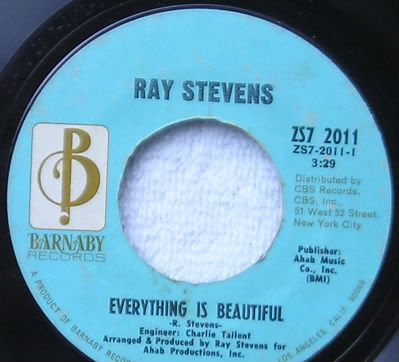
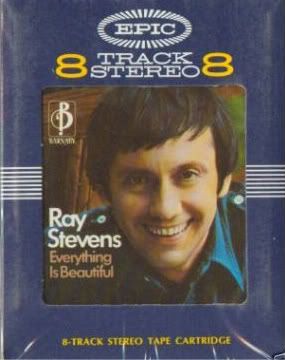
This isn't quite a look back at 8-tracks...I just wanted to name the title of the blog that because it rhymed. I am, however, going to talk a little about this particular 8-track. This project from Ray was released in 1970. The label that Ray was signed to was Barnaby Records, what some might consider an independent label now. The label had a series of distributors that would get Barnaby music into record stores and on radio. The distributor at the time of this album's release in 1970 was CBS, which as you can see, they were using the Epic banner, too. Epic was a label owned by CBS Records. The distribution of Barnaby material shifted from CBS to GRT by the mid 1970's. The change in distributors was evident on the color of the label paper seen on each album and single: the CBS era was solid blue, which you see off to the left, while the GRT/Janus era had a surreal color of bright yellow and an image of a tree with a melted record hanging over the side of a tree limb.
An 8-track tape gets a lot of jokes by those who remember them. The concept was devised to make it easy to listen to music without having to pull out a vinyl album and place the needle down on a record. Also, an 8-track was also suppose to make listening to music headache free because there was no skipping and hissing or any of that stuff that accompanies playing music on a record player. However, almost every new invention or every product that grabs a consumer's eye with claims to be "something new and different and much better than what's currently out there" often have their own brand of problems and drawbacks.
The 8-track tape jokes often center around how easily it was to hear pieces of other songs while listening to the current track selected. Often the sound would bleed into another song so that when one would hear "Everything Is Beautiful", for example, it wouldn't be far-fetched to make the claim that one could also hear another song from the album in the background. The 8-track had a variety of problems including vibration...I can still remember being in a car with my grandparent's and I pushed in a Dave Dudley 8-track and all you could hear a lot of the time was a thumping vibrating sound which affected the sound quality as you could imagine. Also a problem was the eating...the tape machine, usually portable, but often built into late '70s model record player sound systems, had a notorious reputation for eating the tape so that when you'd go to listen to a tape, you'd be in the car singing along and then suddenly you'd hear sounds you wish you didn't hear...the song would abruptly come to an end and you'd go and pull out the 8-track only to find inches upon inches of tape caught inside the tape player.
So, unless you had a knife or something in your car, the tape would just have to sit there until you returned home. Amazingly, though, 8-tracks because of their compactability and the elimination of having to turn it over to the other side to hear the rest of the album, they became an "overnight" success in the mid to late '70s. Cassette tape, I should point out, was also available at this time as well but those creations never caught on until the early to mid 1980's. In an example of companies attempting to make the population even more lazy, "auto reverse" was invented for cassette tapes...because people didn't want to simply turn their cassette's over, they'd let the tape run out to the very end and then you'd hear a 'click', the tape would rewind itself as it played songs from the other side of the tape...a process known as auto-reverse...so a person could leave their cassette in their machine and not even have to bother with flipping it over. Then CD's came along and eliminated the entire use for cassette tape altogether...on a CD you don't have to turn it over...it plays and plays and plays but due to it being a digital product, it is far more advanced than tape or vinyl.
Subscribe to:
Comments (Atom)