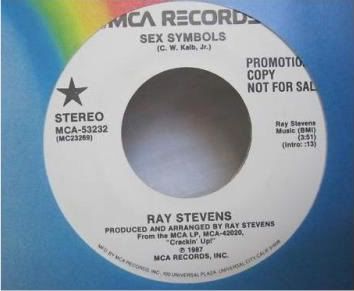
Hello fans of Ray Stevens!! If you happen to be in my age group (40s) then one of the songs that you may be familiar with from Ray is "Sex Symbols". In the era of the internet you really don't have to have been born prior to the song's release to know about it. All you have to be is a Ray Stevens fan with access to online video/music and "Sex Symbols" will be among the song/video selections available to enjoy. Given that today is the birthday of Willie Nelson (turning 91) I thought it would be fun to spotlight Ray's recording of "Sex Symbols" today. Why? Well, the song features Ray doing a vocal impression of Latin singer Julio Iglesias. Willie and Julio teamed up in 1984 to record a duet together called "To All The Girls I've Loved Before". It became a million selling international hit. It spawned some parodies given the unlikely pairing of Willie and Julio. In 1987 Ray released a comedy album titled Crackin' Up. Although the main single release from that album happened to be "Would Jesus Wear a Rolex?" Ray eventually issued "Sex Symbols" as a single. It's B-side being "The Ballad of Cactus Pete and Lefty". In "Sex Symbols" Ray sings as himself as well as Julio. Ray, performing in an exaggerated southern accent, continually pronounces the 'J' in Julio's name (coming out as jew-lee-o) and mispronounces a lot of other names along the way for comic effect. Ray and Julio sing about how popular they are with women. In the chorus of the song Ray gives his examples of who he feels are extremely popular "Sex Symbols". Julio, on the other hand, gives examples of sex symbols from classic movies.
When Ray performed the song in concert he utilized a dummy of Julio (seen above). Ray would sing to a click track in concert. As Ray operated the dummy's mouth, and kept the dummy upright next to him, the audio track of Ray as Julio would be playing. "Sex Symbols" became a very popular song in his concerts during the latter half of the 1980s. When Ray was performing at his former theater in Branson, Missouri (1991-1993) "Sex Symbols" is a song he chose to perform during a 1992 concert (the footage surfaced in 1993 on a VHS home video titled Ray Stevens Live!). I don't know if the song was still in his setlist by 1992 or if he decided to include a performance of it because he knew that 1992 show was going to be offered at a later date on VHS home video and with it containing "Sex Symbols", one of his popular songs in concert in that time period, it could generate more publicity with it's inclusion. That's just my theory. This 1992 performance by Ray visually captures how "Sex Symbols" was performed in front of audiences. This performance coming from his Branson theater and filmed with his own cameras and other equipment gives it a different visual and audio quality than what you may have seen if watching the performance on TV in the late 1980s.
A couple days ago Ray Stevens shared a caricature illustration that was drawn by one of his friends, Randy Cullers. The illustration shows Ray seated in front of many suitcases and behind him are people who look similar to Ray and then, off to the right, is a caricature of Ray's dummy, Julio. There's an airplane off to the left and I see windsocks and so the scene takes place just outside the airplane at an airport...coming home from a lengthy tour. The caption of the illustration reads Ray Stevens' Never Ending Purgatory Tour '89. I take that to be an exaggeration. I've never seen Ray's tour itinerary for 1989 to know if it was jam-packed with concert dates but it was probably incredibly lengthy. Are you familiar with Ray's dummy named Julio? Ray, in 1987, recorded a novelty song titled "Sex Symbols". The song was a spoof of the unlikely duo of Willie Nelson and Julio Iglesias several years prior. Ray, throughout "Sex Symbols", mispronounces Julio by calling him Julie-o and Ray refers to Don Juan as Don Joo-Ahn. When Ray performed the song in concert and on TV he'd have a dummy of Julio sitting beside him. Ray was still performing this song in his concerts when he was in Branson, Missouri headlining his own theater. A performance of the song is on his 1993 VHS tape, Ray Stevens Live!. I wrote a blog entry awhile back with the video of Ray and the Julio dummy embedded and I've decided to share it again in this blog entry. The song made it's debut on Ray's 1987 comedy album, Crackin' Up. He performed it on Hee Haw and it was released as a single. The B-side of "Sex Symbols" happened to be "The Ballad of Cactus Pete and Lefty". A limited animation music video was produced for the B-side of the single nearly 20 years later. Ray and Buddy Kalb wrote the B-side whereas Buddy himself wrote "Sex Symbols". Ray doesn't perform the song in his concerts anymore. I think the last time he performed the song in concert happened to be while he was in Branson, Missouri. The times I'd seen him in concert it wasn't performed.
Hello all once again!! Long time Ray Stevens fans should be very familiar with a 1987 recording called "Sex Symbols". The song was one of Ray's biggest hits during concerts...even bringing it with him onto his set-list during his early 1990s run in Branson, Missouri. I had heard the song on his 1987 comedy album, Crackin' Up, and first seen him perform the song on an episode of Hee Haw. Now, in case you have never heard of the song before, it was inspired by the unlikely duet between Willie Nelson and Julio Iglesias on "To All The Girls I've Loved Before". Their duet was a global hit and a million seller in 1984 and it was still racking up airplay in 1985. Well, the visual differences between Willie and Julio were striking, obviously, and not only did the oddity inspire a beloved rendition of the song by Johnny Carson (as Willie) with Julio on an episode of The Tonight Show but it also inspired "Sex Symbols". Ray sings the song with a dummy of Julio...with Ray comically changing his vocals for a broad impression of Julio's distinctive speech pattern. Whenever Ray performed the song in concert or on television he used a click track. He'd have his recording of Julio's voice played back on a device that was mic'd up off-stage while operating the dummy on-stage as if he were the ventriloquist. Ray performed it during his Branson, Missouri concerts of the early 1990s and a couple of days ago a video clip of "Sex Symbols" from 1992 emerged on YouTube...
The second single release on Ray Stevens in 1987 came along this month, actually. "Three Legged Man" hit the market in August 1987 as the follow-up to April 1987's release, "Would Jesus Wear a Rolex?". Unfortunately, for the two additional single releases that year, "Would Jesus Wear a Rolex?" would prove to take a life of it's own and overshadow whatever impact the follow-up singles may have generated. "Three Legged Man" tells the comical story of a man who falls for a woman he met...and even after being told the woman is already in a relationship with a man named Peg Leg Johnson. Ray's character is undeterred and he steals the woman and also takes the wooden leg to prevent (he thinks) Peg Leg from chasing them down. To Ray's surprise Peg Leg starts giving chase... "...hopping and flopping..." on one leg trying to keep up. Ray tells of every place he, the two legged woman, and the one legged fool have passed though during the literal cross country foot chase. Finally, though, Peg Leg's exhaustion gets the best of him and he pleas for something of a truce. He relents and says that Ray can keep the woman for himself but in the name of all things decent he'd like to have his leg returned. However, there's a twist ending to the story, that I won't give away in case you hadn't heard the song. The song was penned by Shel Silverstein.
The third single release on Ray Stevens in 1987 came along in December. "Sex Symbols" (from the pen of Buddy Kalb) had actually become a very popular song in Ray's concerts in the months and years after it was released. In fact he performed the song on television for the first time on an episode of Hee Haw...and I think it could have been on an episode he was the guest co-host. I should clarify that it was the first time I had seen him perform the song...he could have performed the song on Nashville Now as well but if so I hadn't seen it. The song's inspiration was an unlikely but massively popular duet by Willie Nelson and Julio Iglesias called "To All the Girls I've Loved Before" a couple of years earlier. In "Sex Symbols", Ray performs it as a duet with Julio...but it isn't the famed Latin singer featured with Willie Nelson, though. Ray does a broad vocal impression of Julio Iglesias and whenever Ray speaks to Julio he consistently mispronounces the name as Jewel-E-Oh to which Julio always reminds him "no, no, it's Julio, Julio!!". Throughout the song the 'two' reflect on their popularity with women and they compare themselves to other perceived sex symbols (although Ray deliberately names very unlikely sex symbols for comical effect). As an added touch whenever Ray performed the song on television or in concert he'd always deliver it as a ventriloquist. A dummy of Julio would sit next to him and Ray would operate it's mouth whenever Julio would speak. You can see a performance of the song on the Ray Stevens Live! home video from 1993.
The first single release from Ray Stevens in 1987 came along, as mentioned, in April. "Would Jesus Wear a Rolex?" became a very popular hit that year and one that happened to be very timely as it dealt with the national controversy of scandalous televangelists. In this song (penned by Chet Atkins and Margaret Archer) Ray sings about waking up one morning and upon watching television he's greeted by a man asking for donations. He describes the man's attire and notices the Rolex strapped on the preacher's arm. This causes Ray to wonder if Jesus would be wearing a Rolex when he returns. The social commentary combined with the televangelist scandals went hand in hand and although you're not going to see any chart publications showing the song perched at the top do not let that mislead you in any way. The song was more popular than it's chart standings (something that's a common theme in Ray's career). The controversial subject matter it dealt with created a polarizing atmosphere and it never received the airplay it truly deserved given how popular the song was. In 1988 the song was nominated for a Grammy and if I needed to prove it's popularity even further Ray performed it on The Tonight Show...which wasn't necessarily a hot-bed for country music performers...and by this time Ray had firmly established himself as a country music performer/country comedian. Radio legend, Paul Harvey, dedicated two separate editorial columns to the song which ran in newspapers across the country.
The B-sides of two of the singles I wrote about above were "Cool Down, Willard" and "The Ballad of Cactus Pete and Lefty". "Cool Down, Willard" is the B-side of "Would Jesus Wear a Rolex?" while "The Ballad of Cactus Pete and Lefty" appeared as the B-side of "Sex Symbols". In the case of "Cool Down, Willard" we have a very funny song about a farmer who's frustrated that his entire family is obsessed with the weatherman, Willard Scott, of The Today Show. In the song Ray plays the part of the frustrated husband as he complains about all the attention directed at Willard and how it's interfering and destroying his family life. Things are so bad, according to Ray, that nobody helps him with the chores and the women in his life (his wife, his grandmother, and his aunt) spend their day talking and gossiping about all things Willard Scott. Ray gets the chance to do his grandmother voice several times as he relates to us how much his grandmother's flipped out over Willard. "The Ballad of Cactus Pete and Lefty" (written by Ray and Buddy Kalb) is a comical tale of a Western codger and his pet sidewinder, Lefty. It's a spoof of campfire storytelling sessions but in this case it's set in the Old West as Cactus Pete tells of the many adventures he and Lefty have encountered while living in the deserts of Arizona and New Mexico. A running gag in the song is every time Cactus Pete mentions some sort of animal the ever hungry Lefty would shake it's tail in excitement. Like so many Ray Stevens songs the music helps paint a mental picture. Among the adventures recounted is the time Lefty fought an Eagle...described by Cactus Pete in his distinctive gravelly voice, "a baldy headed eagle...".
The B-side of "Three Legged Man" is none other than "Doctor, Doctor Have Mercy On Me" (from the pen of Buddy Kalb). As mentioned earlier this single was released in August 1987 as the second single from Crackin' Up, Ray's album that year. The essence of many Ray Stevens songs is the fact they take on lives of their own...regardless of when they were originally recorded or originally released. "Doctor, Doctor Have Mercy On Me" has always been a favorite of mine and as those of you should know by now it's since been uploaded as a music video on YouTube...some 31 years after it was originally recorded. The video itself, as I learned, was produced in 2013 and had aired on a television series Ray hosted for a retooled version of The Nashville Network (now called Heartland TV). Ray-ality TV was picked up by The Nashville Network in 2013. This 78 episode series was a follow-up to a short-lived subscription based service called Ray Stevens Backstage. It was in service for probably a little over a year, 2009-2011. I have some blog entries in the archives from 2009 spotlighting the subscription-based service and so I know it launched in 2009. The focal point of this service was to spotlight exclusive content and it served as the home for early episodes of his on-line sitcom, We Ain't Dead Yet, which starred Ray and featured many of his close friends and peers in the music business. The series was set in a fictional retirement home called The Encore. Ralph Emery appeared in several episodes as Doctor Wellman...which he plays in the music video of "Doctor, Doctor Have Mercy On Me". After Ray-ality TV aired on The Nashville Network in 2013 it became an on-line series in the spring of 2014 on YouTube. I'm thinking it was put on-line due to the fact that the re-launched Nashville Network had very little subscribers nationally and as a result not many people were able to see Ray's previous series the first time around.
Today, of course, Ray's television series is a music/talk show titled Ray Stevens CabaRay Nashville and it's locally syndicated on PBS stations nationally. His video site, RayStevens.TV, is subscription based and it's the place to watch all episodes of the CabaRay Nashville television series that have previously aired. His current television series has been in production since 2015. It was originally titled Ray Stevens' Nashville and it aired for two 13 episode seasons on RFD-TV (2015-2016). It moved to local PBS syndication beginning in January 2017 under the new title, Ray Stevens CabaRay Nashville. There have been 78 half hour episodes produced of this particular series. Episodes never took place at the actual CabaRay showroom, though, until after it opened it's doors in January of this year. The last nine episodes of it's most recent season (Season Six) took place at the CabaRay showroom. As you all should know Ray and his associates had hoped to have the CabaRay open by the summer of 2017 or at the very least the fall of 2017 but it finally had it's grand opening in January this year.
In closing here's that music video for "Doctor, Doctor Have Mercy On Me"...
One of the funniest songs that Ray Stevens recorded during the second half of the 1980's was "Sex Symbols". I'm quite sure a lot of people who hear the song or have seen him perform the song in concert are well aware of the duo partnership that's being spoofed. "Sex Symbols" for those unaware is a song that comments on the sexual appeal of several male celebrities but for comedic purposes there's also playful mentions of celebrities not exactly considered sex symbol material. Ray sings the song as a duet between himself and a man named Julio...now, by giving out that bit of information you now know that the song is spoofing the unlikely but successful vocal partnership of Willie Nelson and Julio Iglesias. For the record, though, Ray doesn't imitate Willie Nelson...so for those curious and wish to seek out the song for yourselves it won't feature him impersonating Willie. Ray does a broad impression of Julio, though! In concert Ray would sing the song as if he were a ventriloquist...with a dummy of Julio sitting on his lap. An in concert performance of the song can be found on Ray Stevens Live, the home video he released in 1993. "Sex Symbols", as you can see from the image, was released in 1987. Although the song was pretty popular in concert and it received a lot of exposure through television appearances during that era it didn't make the national music charts. The inclusion of "Sex Symbols" as well as "I'm My Own Grandpaw", "Three Legged Man", and "Cool Down Willard" on the 1987 Crackin' Up album led some narrow minded critics of the time to label the album R-rated and unsuitable for the family. Can you believe such nonsense? I wouldn't have believed it either if I hadn't myself seen a few of the critic's reactions to the album.
First off, Ray never to my knowledge made any statements that his albums would be family friendly and lack any kind of adult-themes. Secondly, why would critics rate an album based upon pre-existing expectations? Too many times music critics tend to have this vision of what an album is suppose to sound like or be like and if the album doesn't measure up to their standards then they trash the album in their reviews. All of Ray's comedy albums are different from one another. 1987's Crackin' Up is way different than 1986's Surely You Joust, for example. 1991's #1 With a Bullet is vastly different than 1997's Hum It or 1985's I Have Returned. I think that critics get this sound or this expectation in their minds before they listen to something and if it's different than what they expected they tend to dislike it...even if the material is still top-notch and funny.
It's hard to imagine boisterous and bouncy novelty songs, which Crackin' Up is abundant with, could ever be labeled "graphic", "adult-oriented", or "R-rated". Such over-the-top adjectives are misleading and could cause a potential customer to think that the album is filled with smut and four letter words, etc etc. The bottom line is critics need to be more responsible with how they critique.
The songs I mentioned are harmless and witty...silly as well...Ray, I don't believe, had any subliminal messages at all when deciding to record those songs. The only song that one could consider hard-hitting or pointed is the opening track, "Would Jesus Wear a Rolex?", which skewered televangelists and the concept of millionaire preachers. That particular song was the main focal point of the year for Ray...and the 1987 album was assembled to, I assume, cash-in on the Rolex single. It wasn't long after that single was issued and had become a hit that MCA released Greatest Hits, Volume Two which featured the song as the opening track.
"Three Legged Man" is a comical song about a man who runs off with another man's wife. The wife's husband happens to have a peg leg...and in an effort to create havoc the man steals the husband's peg leg in the early morning darkness. As the song goes on we're told of the adventures of the couple as they flee from the one legged husband in hot pursuit...meanwhile, the one legged husband has some news of his own to deliver once he catches up with the cheating duo. "Cool Down Willard" has some fun with Willard Scott, the weatherman. In that song Ray sings of how his wife, grandmother, and his aunt all have a thing for Willard and they all congregate every weekday morning to catch his weather reports and marvel at his clothes and hair. To make matters worse, the wife spends most of her day shopping and talking on the telephone with her friends bragging about how wonderful Willard is. Does this sound like a song that's adult-oriented or graphic? Did critics consider the swiping of a peg leg to be graphic? What's with those kinds of critics?
"I'm My Own Grandpaw" had been around since the 1940's...Ray's version obviously is produced and arranged with a much more modern sound. The song tells the story of how a complicated family tree is planted. A man ends up becoming married to his step-grandmother after his wife becomes the mother of his mother. It's a very funny tale of step-children and step-parents and how, through marriage, a family tree can exist relating everyone to one another. Some critics have analyzed the song line by line...I'm referring to the original by Lonzo and Oscar...in an attempt to show that the song stays within the boundary of legalized marriages. The intentional omitting of the word, step, in front of brother, sister, mother, and father is where the humor comes from.
All in all Crackin' Up is a very funny album filled with a lot of nutty, silly songs living up to it's title. The album is NOT this adult-oriented, R-rated smut fest that critics would have you believe. Other albums from Ray Stevens in 1987 include...
Greatest Hits Greatest Hits, Volume Two Get The Best of Ray Stevens {television advertised double album}