Ray Stevens will be appearing on the Grand Ole Opry on February 14th, which is a week from this Saturday. As of now I have no idea what time he'll be making his appearance. Ray is not a member of the Opry and usually they have guests during the nationally televised portion on the GAC channel. The Opry is a radio program heard on 650 WSM radio and it can be heard on-line as well. The program runs all evening long, 6:30pm until 11:30pm, on Saturday night. There is also a Friday night version of the show, too, that doesn't run as long into the evening.
I created that image you see. I think it speaks to all of Ray's fans. In addition to this Opry appearance, Ray has added a few more concert dates to his schedule since the last time I wrote about his tour this year. Ray turned 70 years old a few weeks ago, back on January 24th.

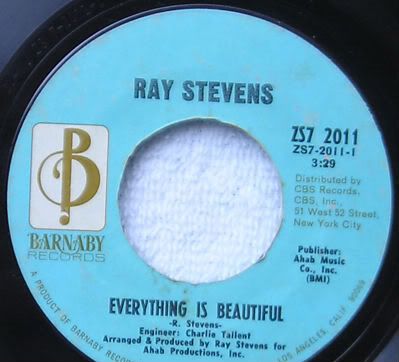
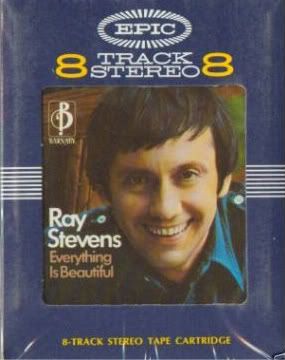
 This isn't quite a look back at 8-tracks...I just wanted to name the title of the blog that because it rhymed. I am, however, going to talk a little about this particular 8-track. This project from Ray was released in 1970. The label that Ray was signed to was Barnaby Records, what some might consider an independent label now. The label had a series of distributors that would get Barnaby music into record stores and on radio. The distributor at the time of this album's release in 1970 was CBS, which as you can see, they were using the Epic banner, too. Epic was a label owned by CBS Records. The distribution of Barnaby material shifted from CBS to GRT by the mid 1970's. The change in distributors was evident on the color of the label paper seen on each album and single: the CBS era was solid blue, which you see off to the left, while the GRT/Janus era had a surreal color of bright yellow and an image of a tree with a melted record hanging over the side of a tree limb.
An 8-track tape gets a lot of jokes by those who remember them. The concept was devised to make it easy to listen to music without having to pull out a vinyl album and place the needle down on a record. Also, an 8-track was also suppose to make listening to music headache free because there was no skipping and hissing or any of that stuff that accompanies playing music on a record player. However, almost every new invention or every product that grabs a consumer's eye with claims to be "something new and different and much better than what's currently out there" often have their own brand of problems and drawbacks.
The 8-track tape jokes often center around how easily it was to hear pieces of other songs while listening to the current track selected. Often the sound would bleed into another song so that when one would hear "Everything Is Beautiful", for example, it wouldn't be far-fetched to make the claim that one could also hear another song from the album in the background. The 8-track had a variety of problems including vibration...I can still remember being in a car with my grandparent's and I pushed in a Dave Dudley 8-track and all you could hear a lot of the time was a thumping vibrating sound which affected the sound quality as you could imagine. Also a problem was the eating...the tape machine, usually portable, but often built into late '70s model record player sound systems, had a notorious reputation for eating the tape so that when you'd go to listen to a tape, you'd be in the car singing along and then suddenly you'd hear sounds you wish you didn't hear...the song would abruptly come to an end and you'd go and pull out the 8-track only to find inches upon inches of tape caught inside the tape player.
So, unless you had a knife or something in your car, the tape would just have to sit there until you returned home. Amazingly, though, 8-tracks because of their compactability and the elimination of having to turn it over to the other side to hear the rest of the album, they became an "overnight" success in the mid to late '70s. Cassette tape, I should point out, was also available at this time as well but those creations never caught on until the early to mid 1980's. In an example of companies attempting to make the population even more lazy, "auto reverse" was invented for cassette tapes...because people didn't want to simply turn their cassette's over, they'd let the tape run out to the very end and then you'd hear a 'click', the tape would rewind itself as it played songs from the other side of the tape...a process known as auto-reverse...so a person could leave their cassette in their machine and not even have to bother with flipping it over. Then CD's came along and eliminated the entire use for cassette tape altogether...on a CD you don't have to turn it over...it plays and plays and plays but due to it being a digital product, it is far more advanced than tape or vinyl.
 Here's a reminder of a couple of Ray Stevens projects being released soon. Later this month, a series of projects will be released to a more wider audience, projects that have been available so far on Ray's official web-site's store. "Laughter Is the Best Medicine" is among the projects being released. There will be two DVD collections of animated music video's issued as well. Each DVD will feature several best-of productions from the past plus a couple of new music video's. These collections are called "Cartoon Carnival, Volume One" and "Volume Two". This audio CD/digital album "Laughter Is The Best Medicine" whose picture appears to the left, will feature hospital and doctor-oriented comedy songs. The bulk of the songs are from the past but it boasts "The PSA Song" which has never been made available until this release. The song itself goes back quite awhile, sometime in the mid 1990's, around the time Ray was diagnosed with prostate cancer, which he battled and won. So, that project will boast "The PSA Song" among other songs. The always fluctuating fan base of Ray's often creates the need for me to make the statement: "for those who are new to Ray Stevens, these songs will be brand-new to you" and therefore you should purchase this CD. If "The PSA Song" becomes available as an MP3 by itself I'll be buying it...since it is the only song on that release that I do not have. I've been a fan for years and years so I often by-pass collections that feature songs I have already in my collection.
The DVD's will feature several music video's he did several years ago combined with brand-new productions. "Hugo the Human Cannonball", "The Camping Trip", "The Moonlight Special", "Smokey Mountain Rattlesnake Retreat", and a couple of others are only going to be available, for now, on the Cartoon Carnival releases later this month. The projects are all on Ray's own label, Clyde Records.
In February his Sinatra CD will be released nationally...previously only available exclusively at his web-store and concert appearances. The CD features Ray's versions of several Sinatra standards. In some of the performances he shortens the songs...making them almost "samples" instead of full performances...but he does perform full-length versions of Sinatra too. Ray, as I touched upon, hits the concert trail again this year. I have plans on attending the May concert in Nashville, Indiana. I already have the tickets and so that's already out of the way. The concert is on a Saturday and it starts at 6pm so that means my sister and I will have to be on the road several hours prior...the trip won't be as far as Renfro Valley, Kentucky which is where she and I went last year to see Ray.