It's September 1st...this means that we're a little more than a month away from the official induction of Ray Stevens into the
Country Music Hall of Fame!! The election took place back in March but the induction ceremony takes place in late October. It's a private ceremony but if I recall correctly it's streamed on-line or there's taped footage made available afterward which gets shared on the internet. It isn't something that's completely closed off to the public...the fans obviously want to see their favorite artist being given the highest honor Country Music offers...but at this moment I'm not sure if the CMA will stream the ceremony live or if it'll become available later for public viewing.
The induction takes place at what's called the Medallion Ceremony, which itself is part of an organization called ROPE, an acronym for Reunion Of Professional Entertainers. The CMA attempts to gather all the living members of the
Country Music Hall of Fame to be in attendance as the next round of inductee's are given their plaques. This means that Ray will be in attendance at each subsequent October ceremony wearing his medallion (if there isn't a scheduling conflict) from here on out along side other members of the
Country Music Hall of Fame. In a lot of ways it resembles the tradition that takes place at the National Baseball Hall of Fame in Cooperstown, New York where each induction ceremony features a number of previously inducted members seated behind the podium while the newest members are receiving their plaques and giving their acceptance speeches.
Now, then, after that brief detour let's get back on the road to the
Country Music Hall of Fame in the career of Ray Stevens and pick things up early in 1974. If you're a long time fan of Ray or are newly acquired then you might know that he's long been known as something of a real estate mogul. He and Chet Atkins, primarily, over the course of several decades, purchased a lot of property all over downtown Nashville in the heart of Music Row during the decades of the 1970s and 1980s. In Part Seven I made mention of Ray opening up his own recording studio in 1973...and while he recorded several albums there and other recording artists utilized the studio, too, he moved to a different location in 1974. This location existed at 1707 Grand Avenue and over the course of time he and Chet more or less purchased the entire block.
Ray, on the other hand, had become even more prominent at country music events and charitable functions...but something funny happened while he found himself browsing through a weekly news publication. He came across a brief article about a college kid that ran through a crowd nude and the news reporter called it 'streaking'. Oh what an idea for a song!! As the story goes Ray did a rough draft of a song detailing the events of a streaker without any kind of urgency to complete it until he noticed that streaking was the dominate headline on all local and national newscasts. He put the finishing touches on a song that ended up being titled "
The Streak" and Barnaby Records released it as a single in March of 1974. The single had one of the most incredible climbs in pop and country music history. The release of the single in the last week of March meant that it was on the market several days before the 1974 broadcast of the Academy Awards. Why do I mention this? Well, it is during that Oscar ceremony on April 2, 1974 that a streaker ran across the stage...behind the podium where one of the hosts, David Niven, stood and so he was unaware for several seconds of the chaotic events taking place behind him as the audience began shrieking with laughter. So, curious as to why there was this sudden eruption of laughter, David turns to his right and sees the streaker off camera after he had ran across the stage.

Coinciding with the streaking at the Oscar ceremony in April 1974 it set in motion heavy demand for songs about streaking. There were other songs about streaking believe it or not...and I've seen visual evidence of their existence although I've not heard them with my own ears...but the only streaking song to have any kind of an impact was "
The Streak" by the one and only Ray Stevens. As I mentioned previously it had an incredible climb up the Hot 100. It entered the charts in April and in less than a month it was sitting at number one on the pop charts...where it remained for three consecutive weeks...beginning with the week ending May 18, 1974. It left the top spot of the Hot 100 the week ending June 1, 1974 and spent several more weeks falling back down the chart before leaving the Hot 100. I'll call it a miracle single...and stating the obvious it's a song that probably wouldn't have had the kind of commercial impact it did without the coinciding aid of a national news story surrounding streaking in general. Consumers of the single were comprised of a large slice of the population...most of them purchasing the song because of the popularity of streaking while, of course, fans of Ray Stevens were purchasing the song as well. Technically speaking, though, streaking wasn't confined to the United States...as a global phenomenon "
The Streak" had major impact in just about every English speaking country and it hit number one or made the Top-10 in the weekly music charts in the United Kingdom, New Zealand, Canada, Irelend, Australia, etc. In addition to those pop music showings "
The Streak" reached the country music charts in the United States and in Canada. In the U.S. "
The Streak" sprinted into the Top-10 while in Canada it topped their country music chart. The sales numbers that are generally quoted range anywhere from four million to five million in global sales for "
The Streak". It was one of the biggest hit singles of 1974 and among the top selling recordings worldwide but it wasn't a big player come awards time. The stigma of 'novelty songs' can be applied to the lack of award recognition for a song that was clearly the most successful of that particular year.
As some of you know "
The Streak" appeared on an album built around the single's worldwide success. The album is titled
Boogity Boogity which is a phrase heard throughout "
The Streak". There are many people that have misheard boogity-boogity and think Ray's harmony singers are saying "look at that, look at that" but they're actually saying "boogity-boogity"...a phrase meant to indicate that the streaker is a fast runner. The prominence of the word 'woosh' on the album's cover has also led many people to mistakenly think the album is called Woosh!! when in fact the album's title can be seen in the clouds of dust on the lower right side of the album. The most popular catchphrase from the song, other than boogity-boogity and the man's reaction that he saw the streaker, is what you see in the comic strip balloon on the lower left: Don't Look, Ethel!. As a song "
The Streak" tells of a man that witnesses a streaking event at three locations throughout town and in each instance he has to warn his wife not to look but it's always too late. The man in each scenario is the subject of a news report being filed by an Action News Reporter. Upon being asked if he's seen what took place the witness replies "yeah, I did". The song's characters, catchphrases, and hooks have long become indelibly linked to Ray by his wide range of fans over the decades. One of the hooks of the songs is the presence of either a kazoo being blown into or what's known as a fan whistle being blown into...whatever it is...the effect creates this high piercing sound in an attempt to musically demonstrate the speed of the streaker as it runs past innocent bystanders. In concert Ray performs this sound effect...and to my eyes it looks like a metal kazoo. As you can see from the album's cover Ray is clean shaven. He appeared clean shaven on the album cover of 1973's
Nashville, too.
As mentioned Barnaby Records built this album around "
The Streak" but strangely enough it doesn't come off as an album that sounds rush released even though three of the songs were previously released. There are just nine recordings on this comedy album and as you see there's a pile of clothes on the lower left side of the album...referring to the fact that Ethel herself had joined the craze and began streaking. The second track, "
Smith and Jones", is Ray's other song about streaking. It's a narration from Ray, in an exaggerated southern voice, detailing the events of two undercover agents, "
Smith and Jones", from different Federal organizations: The C.I.A. and the F.B.I. In the story the two agents are on the lookout for potential streakers but both end up mistaking the other as a person of interest...culminating in an embarrassing chain of events where both of the agents find themselves naked in a public fountain. It's a very funny song and why it was never spotlighted or given much attention back then is a mystery to me...but then again "The Streak" was such a cultural phenomena that it was nearly impossible to escape from at that time...so maybe "Smith and Jones" was kept as an album track just for the fans rather than the general audience. It's long been accepted that sales of albums are usually from fans of the artist while sales of singles are from a general audience as well as that artist's fan base. This is why there's such a thing as a commercial single and an album track. If a recording on an album doesn't have any commercial potential, in the eyes of the record company, then it remains an album track and is most often only familiar with those that actually purchase an album. The previously released songs on this album are: "
Freddie Feelgood" (1966), "
Bagpipes, That's My Bag" (1969), and "
Bridget the Midget" (1970). Track five comes from the pen of Layng Martine, Jr. and it's the rocker "
Don't Boogie Woogie". Ironically enough the musician Ray was channeling in this recording would end up recording his own version of the song the very next year: Jerry Lee Lewis. There's a bit more irony...side two of the album opens up with "
The Moonlight Special"...and in this recording Ray does very funny impressions of Gladys Knight and the Pips, a parody of Alice Cooper, and a spot-on impression of Jerry Lee Lewis...on top of this he does his impression of Wolfman Jack throughout the recording.
Barnaby Records released "
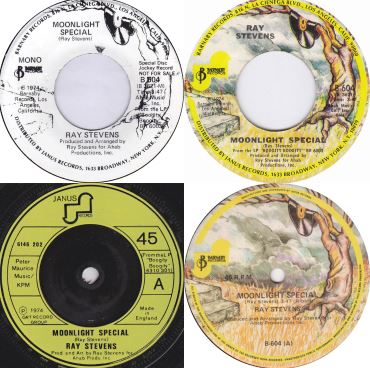
The Moonlight Special" as a single in the summer of 1974. This is a collage featuring four single releases of the song. The white label is a promo copy whereas the second image is the commercial single distributed by Janus Records. The Barnaby recordings of the mid 1970s featured a memorable graphic on the records consisting of melted vinyl on a tree limb. The third photo is how the single appeared in the United Kingdom and the fourth is the single release in Australia. The song itself parodies a television program that aired for a number of years called The Midnight Special. The announcer was Wolfman Jack and each episode usually had a different host. Wolfman's presence and personality, however, ultimately led to the program being identified as
his show. The names of those being parodied in the song were changed to comically reflect the absurdity: Mildred Queen and the Dips, Agnes Stupor, and Jerry Joe Harry Lee Jimmy Billy. The Wolfman, in the song, is named Sheepdog. The single hit the Hot 100 in July of 1974 and strangely enough it peaked outside the pop music Top-40 in spite of it being a parody of one of television's biggest hit shows of that era. A bit more strange happened to be the fact that it managed to make a Top-40 appearance on Canada's Adult-Contemporary chart...and it appeared on Canada's pop music chart...but it obviously didn't have the kind of impact "
The Streak" had but to be fair it would be unrealistic to think that kind of a hit could be equaled or surpassed. The best one can do is continue to make records that entertain your audience and perhaps one day magic strikes again and an entire world-market reacts to your music...but don't hold your breath waiting. "
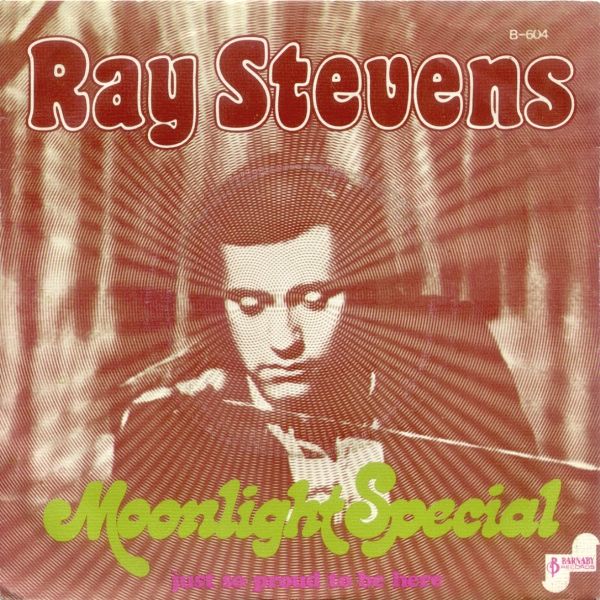
The Moonlight Special" was released in some markets with a picture sleeve of Ray...a somber looking Ray at the piano...definitely not the sort of look you'd take away after hearing his impression of Jerry Lee Lewis! "
Heart Transplant" is a comical story of a man in his 80s that receives a transplant...and it causes him to have the stamina of someone 50 years younger...but his physically older body can't take on the added activity and so he's literally a young man trapped in the body of an old man. The album closer is not a comedy song. It's a love song titled "
Just So Proud To Be Here". I know that Ray was friends with Minnie Pearl...but I don't know if he chose this as a song title as a tribute to Minnie (her catchphrase being "How-dee, I'm just so proud to be here!") or if he created the song independent of his friendship with her.
Ray's publishing company receives a boost upon the successes of his recordings as well as recordings of songs that Ray has published but never recorded himself. I'd say "
Everything is Beautiful" was his biggest hit as a songwriter/publisher given how many other recording artists have recorded the song. The songs from the pen of Layng Martine, Jr. from this time period were published by Ray...and remember when I brought up "
Rub It In" in the last blog entry? Ray published the song and even though Layng's recording wasn't a big hit single the song's publisher remains the same regardless of who happens to record it. This is why song publishing is incredibly lucrative. It was right around the same time "
The Streak" was happening that an artist known as Billy 'Crash' Craddock released his version of "
Rub It In". Billy's recording was released on ABC Records. If you have the single or you look up an image of the single you'll see Ray's Ahab Music Company listed as the song's publisher. Billy's recording hit number one on the country charts in both the United States and Canada in 1974 as well as the Top-20 on the Hot 100.
Ray's recording career and his visibility were as big as ever thanks to "
The Streak" and in the fall of 1974 he released "
Everybody Needs a Rainbow" from the pen of Layng Martine, Jr. This is another great ballad...a bouncy kind of tempo...a song of inspiration, really. Barnaby Records issued the song in October and it became a Top-40 country hit as well as a Top-20 hit on the Adult-Contemporary charts in both the United States and Canada. The bouncy sing-a-long closed out 1974...a year dominated by the continued sales of "
The Streak"...and not surprisingly it ranked among the Top-10 pop hits of the year in the United States and Canada. It made Australia's Top-20 list in that country's year-end review of hit songs. The United Kingdom ranked the single noticeably lower, in comparison to the United States, Canada, and Australia, in their year-end overview even though it peaked at number one in the UK. This more than likely will be the only entry in this mini-blog series where I only spotlight a single year...in this case 1974! In the closing comments in Part Seven I mentioned the bulk of this blog entry would focus on a particular single release in the spring of 1974 and sure enough "
The Streak" dominated this blog entry. In Part Nine I'll focus on 1975 and the professional changes that lay in store for Ray in 1976 and everything else along his road to the
Country Music Hall of Fame.