Throughout the run of the Ray Stevens 2009 sitcom, We Ain't Dead Yet, there were periodic sketches involving a resident at the retirement home who acted as the disc jockey for the other residents. Ray portrayed this character, Rooster Reagan, and the name of the radio station was W-I-L-D. The vocal delivery is patterned after Wolfman Jack. In February of this year I posted a blog entry spotlighting one of Rooster's sketches. Buddy Kalb always portrayed the guy on the other end of the phone.
In the February upload Buddy portrays a man who lives in a condo and doesn't appreciate Rooster's generous offer of delivering 500 baby chicks to the residence. Rooster insists but the upset stranger on the phone says that if 500 baby chicks show up he'll be waiting outside with a shotgun. You can find the blog entry containing that sketch if you search my February archives off to the right.
In this newly uploaded sketch Rooster calls up an unsuspecting victim to confirm that 500 baby chicks will be delivered to the fried chicken restaurant. The guy on the other end has no idea what Rooster is talking about...but that doesn't matter...Rooster insists that the 500 baby chicks are on their way...
Showing posts with label wolfman jack. Show all posts
Showing posts with label wolfman jack. Show all posts
July 5, 2020

July 29, 2018
Ray Stevens and Forty Four shades of Moonlight...
Blasting from the speakers with the pounding of a drum as it's introduction is "The Moonlight Special" by Ray Stevens...which hit this week in 1974. The recording was his follow-up to "The Streak", a particular hit recording which dominated the rest of the calendar year. Why do I say that? Well, even though that single ran up and ran down the charts really fast, it lingered on and was kept a top priority in the music press and articles written about Ray in general. Nevertheless a follow-up recording came along in the form of "The Moonlight Special" and in it Ray demonstrated his prowess at vocal mimicry...doing broad impressions of several high profile rock and pop acts of the era...including his impression of Wolfman Jack. Here's a brief synopsis of the program that Ray's spoofing...
 The comedy/novelty song is a parody of a late night television program called The Midnight Special. This weekly series ran for eight years (1973-1981) on NBC following the Friday night episode of The Tonight Show on the national schedule. In those years the late night talk show ran 90 minutes (11:30pm - 1:00am) and after the airing of each Friday night episode, The Midnight Special would then air from 1am - 2:30am. The program's time slot changed when Johnny Carson asked/insisted that NBC cut the length of The Tonight Show from 90 to 60 minutes in 1980. During the last season of The Midnight Special (1980-1981) it aired from 12:30am - 2am. The series was typically hosted by a different rock/pop act each week (sometimes country music artists that had crossed over to pop radio also guest hosted). The narrator/announcer for the program was the longtime radio disc jockey, Wolfman Jack. Although he sometimes guest hosted the show he was never officially billed as it's host...but nevertheless his larger than life personality and his very distinctive voice was crucial to the program's success on late-night television. His XERF radio program, broadcast on a station with an incredible 250,000 watts, could be heard all over the United States at night and so that voice was very familiar to radio listeners by the time The Midnight Special debuted on television. It also helped that a movie, American Graffiti, premiered in August 1973...a film which featured Wolfman Jack in several scenes set at a fictional radio station.
 By the time "The Moonlight Special" from Ray Stevens hit the market in the summer of 1974 the television series it was spoofing had already been on the air for a season...so it was still relatively new...and one could say the television show itself was considered something of a programming novelty. Network television typically signed off at midnight or not long after. NBC signed off at 1am following The Tonight Show, for example. There wasn't such a thing as 24 hour programming. "The Moonlight Special" took the overall feeling of the television program and condensed it into a comedy song of 3 minutes, 47 seconds. The song itself, as mentioned at the top of the blog entry, starts off with a rousing beat of the drum and then we hear Ray opening the song with a performance of what turns out to be the song's chorus (since those set of lyrics are heard a couple more times throughout the song). After he sets up the song he 'introduces' the host, The Sheepdog, a vocal parody of Wolfman Jack. Afterward the Sheepdog enthusiastically promotes the show he's hosting in a wild succession of adjectives that parody the style of AM rock music disc jockeys of the '60s and '70s. There are three rock and pop acts spotlighted on this parody. The first act to appear is Mildred Queen and the Dips which, to any student of rock/pop music or Top-40 radio in general, should easily be recognized as a spoof of the legendary Gladys Knight and the Pips group. The satire is spot-on as Ray/Mildred performs a series of lyrics while her back-up, the Dips, repeat in harmony. If you listen to Gladys Knight and the Pips after hearing this Ray Stevens song and you find yourself laughing, thinking back to "The Moonlight Special", then you're not alone.
 The second act to appear on "The Moonlight Special" is a bit on the eccentric side. Agnes Stupor and His Chickens sings a far out, ridiculous song with zany, bizarre lyrics. The shrilling, funky music accompanying Stupor's performance is something one might expect to hear in a darkened night club at the height of Woodstock. It's an elaborate parody of Alice Cooper, a shock rock entertainer that used all kinds of horror movie related props in his stage shows and often utilized snakes in his act. As a child of the '80s I only knew of Alice Cooper for a particular music video my two older sisters loved watching on MTV. I was and still am a country music fan...although in my late teen years and into early adulthood I branched out and started listening to classic rock music (branded as Oldies)...but because my two sisters are the oldest they controlled the television, more or less, back then. The song played heavily was "Poison". It wasn't until the late '90s...early 2000s...that I learned of Alice Cooper's history which meant that even though I was aware of "The Moonlight Special" I had no idea who Agnes Stupor was a parody of when I first heard the song. The third and final act to receive spotlight on "The Moonlight Special" is another spectacular parody...this time around it's a parody of piano playing legend Jerry Lee Lewis. The performance is not only spot-on as far as Ray's intentional piano pounding emulating the style associated with Jerry Lee Lewis but the fictional act's name is a parody, too. The performer goes by the name of Jerry Joe Harry Lee Jimmy Billy! Since he's the closing 'act' of "The Moonlight Special" he's considered the main attraction and The Sheepdog refers to him as the king of the rock and roll piano in the introduction.
The song concludes as Sheepdog thanks the people for tuning in and reminding them to tune in the next week for more excitement. The song fades out as Sheepdog howls...and throughout the song Sheepdog howled many times during his introductions and commentary about the performers. The single, as mentioned, hit this week in 1974 on Billboard's pop chart. It debuted July 27, 1974 and remained on the chart for 7 weeks. It's last appearance being September 7, 1974. The single inexplicably stalled midway up the pop chart. I say inexplicably because, to me, the subject matter being spoofed wasn't something obscure...it should have been embraced more at radio for the spot-on, accurate spoof of The Midnight Special that it was and therefore should have hit the Top-40, but it could have also been promoted more, too.
Research indicates that there was next to no publicity. Whether this was by design or whether it was from careless neglect on the part of a promotional team at the label it's anybody's guess...though I don't think it had anything to do with the former...but more to do with the latter...a publicity department still clinging to the massive sales success of "The Streak" from several months earlier. Regardless of why the single stalled on the charts, "The Moonlight Special" remains of one Ray Stevens greatest comical performances.


The song concludes as Sheepdog thanks the people for tuning in and reminding them to tune in the next week for more excitement. The song fades out as Sheepdog howls...and throughout the song Sheepdog howled many times during his introductions and commentary about the performers. The single, as mentioned, hit this week in 1974 on Billboard's pop chart. It debuted July 27, 1974 and remained on the chart for 7 weeks. It's last appearance being September 7, 1974. The single inexplicably stalled midway up the pop chart. I say inexplicably because, to me, the subject matter being spoofed wasn't something obscure...it should have been embraced more at radio for the spot-on, accurate spoof of The Midnight Special that it was and therefore should have hit the Top-40, but it could have also been promoted more, too.
Research indicates that there was next to no publicity. Whether this was by design or whether it was from careless neglect on the part of a promotional team at the label it's anybody's guess...though I don't think it had anything to do with the former...but more to do with the latter...a publicity department still clinging to the massive sales success of "The Streak" from several months earlier. Regardless of why the single stalled on the charts, "The Moonlight Special" remains of one Ray Stevens greatest comical performances.
October 24, 2012
Ray Stevens: Golden LP Series, Part Eleven...
Welcome to the Golden LP Series...we're up to studio album eleven in the career of Ray Stevens. This particular album, released in 1974, centered around a certain single that's become the biggest selling hit of his career. The fad of streaking dominated much of 1974...which consisted of people taking off their clothes and running naked through a crowd.
 In his various interviews, Ray recalls how he was inspired to write "The Streak". He remarked that he had read about the phenomena in the back of a weekly news magazine and since the subject had potential for a comedy song he started drafting it. As luck would have it, at the 1974 Oscar awards, a streaker appeared from out of nowhere. David Niven famously commented on this and before long streaking became a fad across the country and even overseas. Coinciding with all the front page news and editorials about streaking that took place on television news programs and in newspapers, in addition to the streaker at the Oscars, according to Ray's recollections he quickly dug out the streaking song he'd been working on and he put the finishing touches on it. The single was rush released, literally, in the early part of spring 1974. Since the song was so topical and about a subject everyone, it seemed, was talking about worldwide it quickly became what's referred to as a monster hit. It was well-written and had several hooks and catch-phrases which probably played a key factor in it becoming the only streaking song to be a genuine hit single.
"The Streak" flew up the Hot 100 pop chart within a matter of weeks...hitting #1 in one of the fastest climbs to the top. It remained at #1 for 4 weeks, eventually selling over five million singles, and it reached #1 in several other counties, too. It crossed over and became a Top-5 country hit. It was certified Gold and Silver for international sales and easily became one of the Top-10 hits of the entire year in America and overseas. "The Streak", a novelty song, became Ray's first #1 single since 1970. Although Ray had quite a few Top-40 hits in various music formats between the years of 1970 and 1973, "The Streak" was by far the biggest single from Ray since early 1971's novelty, "Bridget the Midget".
The song went on become one of his most requested and highest selling. In pop culture the fad of streaking was primarily looked down on and the national fad didn't last any substantial length of time beyond the spring/summer months of 1974 yet "The Streak" hit at the perfect time, a quintessential ingredient for a true novelty song. A modern day music listener not familiar with streaking and how big of a fad it was and perhaps not familiar with Ray Stevens, neither, will probably wonder why a song about running around naked was written or even released. Ray made a music video of the song 18 years later in 1992 and he still performs it in concert to this very day. Why shouldn't he? It's one of his biggest hits.
The streaking single eventually spawned a studio album, Ray's 11th...titled Boogity Boogity. Just about anyone not familiar with the titles of Ray's albums will see this particular release and mistakenly think the album is titled Woosh but it isn't. The album features 9 songs, including "The Streak", and three previously released comedy songs added to fill out the 9 song LP. The previously released songs are "Freddie Feelgood", "Bagpipes, That's My Bag", and "Bridget the Midget"
 The follow-up to "The Streak" came along in the latter half of summer 1974. The single, "The Moonlight Special", is a spot on parody of the massively popular rock music program, The Midnight Special, which featured disc jockey Wolfman Jack. In this song Ray does impressions of Wolfman Jack, Gladys Knight and the Pips, Alice Cooper, and Jerry Lee Lewis. It reached the Top-80 on the Hot 100...it should've been a much bigger single than that considering how hilarious his impressions were and the fact that it spoofed a television program that was quite popular through much of the '70s. This was the second and final single release from the Boogity Boogity album. The remainder of the selections include a mix of comedy and novelty...plus one love ballad. "Smith and Jones" is the second streaking song...it's more about flashers, though. The song is about two undercover agents staking out a public park with neither agent knowing the other and each suspecting the other as a flasher. "Heart Transplant" tells the strange story of a guy who gets a heart transplant at age 82...he's given a younger heart and as a result he has the inner stamina of a twenty something but a body of an 82 year old. We're told of the conflicts he goes through wanting to rock out and party but his body just isn't into it. "Don't Boogie Woogie" is not exactly a comedy song and it's not a love ballad...it's a piano rocker in the vein of Jerry Lee Lewis. I believe Jerry Lee recorded this before or after Ray did. "Just So Proud To Be Here", the love ballad, is mid-tempo and breaks up the overall uptempo-frantic-comic feeling of the LP. After the comedy album and it's two singles ran their course on the weekly music charts, Ray turned to serious works once again. In late 1974 he released a new ballad available as a single-only titled "Everybody Needs a Rainbow" and it ultimately found it's pot of gold as it hit the Easy-Listening Top-20 and the Country Top-40. Ray would move more into country music the following year although he was still charting on the Hot 100 and Easy-Listening with frequency. In Part 12 of the Golden LP Series we'll take a look at his 1975 studio album where he brought back pop standards with new arrangements.

"The Streak" flew up the Hot 100 pop chart within a matter of weeks...hitting #1 in one of the fastest climbs to the top. It remained at #1 for 4 weeks, eventually selling over five million singles, and it reached #1 in several other counties, too. It crossed over and became a Top-5 country hit. It was certified Gold and Silver for international sales and easily became one of the Top-10 hits of the entire year in America and overseas. "The Streak", a novelty song, became Ray's first #1 single since 1970. Although Ray had quite a few Top-40 hits in various music formats between the years of 1970 and 1973, "The Streak" was by far the biggest single from Ray since early 1971's novelty, "Bridget the Midget".
The song went on become one of his most requested and highest selling. In pop culture the fad of streaking was primarily looked down on and the national fad didn't last any substantial length of time beyond the spring/summer months of 1974 yet "The Streak" hit at the perfect time, a quintessential ingredient for a true novelty song. A modern day music listener not familiar with streaking and how big of a fad it was and perhaps not familiar with Ray Stevens, neither, will probably wonder why a song about running around naked was written or even released. Ray made a music video of the song 18 years later in 1992 and he still performs it in concert to this very day. Why shouldn't he? It's one of his biggest hits.
The streaking single eventually spawned a studio album, Ray's 11th...titled Boogity Boogity. Just about anyone not familiar with the titles of Ray's albums will see this particular release and mistakenly think the album is titled Woosh but it isn't. The album features 9 songs, including "The Streak", and three previously released comedy songs added to fill out the 9 song LP. The previously released songs are "Freddie Feelgood", "Bagpipes, That's My Bag", and "Bridget the Midget"
December 13, 2008
Anniversary Under the Moonlight...

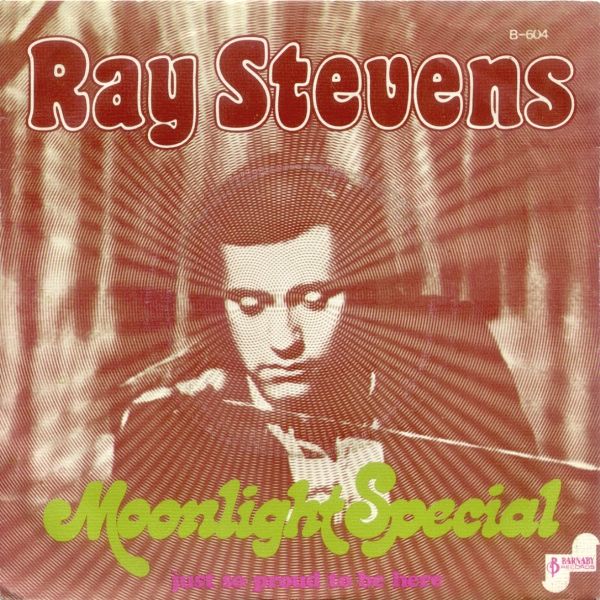
2009 marks the Thirty-Fifth Anniversary of a particular Ray Stevens recording that often goes over-looked. "The Moonlight Special" is a parody of a late-night TV show called The Midnight Special. In this particular recording, we hear an impressive set of impressions starting off with a stunning Wolfman Jack take off. The Wolfman for those who do not know was the show's announcer and "face" of the show during it's lengthy run. Although Wolfman was the announcer and not the "host", it's Wolfman Jack's personality and distinctive voice and fan-base from his radio listenership that made him arguably the star of that program. The song that parodies the show features Ray's vocal impressions of Wolfman Jack...howling and screaming and carrying on about the show and bringing on the acts one by one. The acts are all spoofs of pop and rock singers who made frequent appearances on The Midnight Special during the 1970's. The ironic part of this whole parody is that Ray wrote and recorded it while the show was in it's infancy...well before it developed into the show it became...for the show itself was in production for 8 and a half years, 1973-1981, and Ray's parody was released as a single in 1974, almost 35 years ago...the show was a cult hit at first but soon it became a huge hit because of it's unique air-time, late at night...90 minutes of pop and rock music performed in a studio with a different host each week and the presence of DJ Wolfman Jack as it's announcer. It aired after The Tonight Show on Friday nights...and so when Johnny Carson would say goodnight, what many viewers saw afterward was The Midnight Special.
Ray opens up the song in his own singing voice...singing the chorus of the song. He then brings on The Sheepdog...his version of Wolfman Jack. Amidst thunderous applause, Sheepdog crams a series of slang expressions together "crazy, too cool, outta sight, right on, and far out!" and welcomes everyone to the show and brings out the night's first guest. Satirizing the sound of Gladys Knight and the Pips, we're treated to Mildred Queen and the Dips. The group sings a nonsense song...Mildred leading the vocals with the Dips repeating everything she says word for word. After becoming frustrated by the repeaters, she screams...only to have the Dips scream in harmony. Sheepdog comes in asking for applause "how 'bout that all you dudes and chickies out there...yeah!!!". After Sheepdog informs everyone what they're experiencing, The Moonlight Special, we hear a more rushed Ray Stevens singing the chorus again in his natural voice as Sheepdog talks over the chorus...concluding with a series of howls.
Sheepdog then brings out the bizarre/alternative rock act...Agnes Stupor and his Chicken. This is a parody of Alice Cooper, who was known for having snakes in his performances. Agnes, however, regals the audience with a bizarre tale that allows listeners to wonder if he's in his right mind...implying about the streaking/flashing craze that was going on "yeah, flash an old lady now!" and then telling us about painting the living room carpet. A completely nutty act that's for sure. Sheepdog returns asking for applause...then we hear Ray singing the chorus once again as Sheepdog informs everyone that they're listening and watching The Moonlight Special.
The closing act, usually reserved for a legend or a classic, features the piano rocking appearance of a Jerry Lee Lewis spoof. Ray incorporates several Jerry Lee-type vocals during the piano rocking...which include a passage where Jerry plays with his feet...hollering and screaming all the while as Sheepdog marvels at the display...
The song comes to a close with Sheepdog thanking everyone for coming to the show and thanks everyone for listening and watching and reminds everyone to tune in next time for The Moonlight Special and he ends by making a series of howls. As this is going on, in the background we hear cheers and claps and Ray's natural voice singing the chorus once again.
The song is a wonderfully produced record...in pop music circles it may even be considered a "gimmick record". Critics and radio people alike often frown on novelty records and records with a gimmick...but thankfully i'm not a professional critic nor am I a radio insider. All kidding aside, though, it's a well-crafted song putting to good use the over-dubbing process. I am not sure but I think Ray is one of the first acts in Top-40 music who used over-dubbing way back before it became so common today in all forms of entertainment...if he wasn't the first he certainly has my vote as the artist who used over-dubbing to it's maximum effect. It is highly unlikely that Ray ever performed this song in concert...the multi-tracking and over-dubbing is not easily duplicated in concert or even on a TV show. The single hit the Hot 100, peaking in the Top-80. It would be perhaps impossible for any of his singles to over-shadow "The Streak"...a monster #1 pop hit for Ray earlier in 1974 that was still selling and getting feedback throughout the rest of the year...so I don't even think Barnaby Records or Ray himself was seriously looking to top "The Streak" but "The Moonlight Special" is a funny recording all the same and it showcases Ray's various talents with his broad vocal impressions.
Subscribe to:
Posts (Atom)