Showing posts with label I Saw Elvis in a U.F.O.. Show all posts

August 26, 2020

Ray Stevens: Rare Cassette Single...

I was looking on eBay earlier today and I came across a rare cassette single released on Ray Stevens. When I first seen the image listed on the product page I thought it was a VHS tape. My guess is the seller enlarged the photo. Anyway, it's a cassette single of "I Saw Elvis in a U.F.O." backed with "I Used To Be Crazy". I have a couple of cassette singles from other recording artists...the cassette tape slips into the cardboard carrying case. The item is still a current offer. There aren't any bids on it...as of this writing the seller is asking twelve dollars if you 'Buy It Now'. I saved the front and back of the image because it's such a rare item...

Ray Stevens cassette single; 1989.
That's the art work on the front of the single. In the background there's an illustration of a flying saucer with music notes emanating from it. The song comes from Ray's 1989 album, Beside Myself, and it's from the pen of Ray and Buddy Kalb. The B-side also comes from the pen of Ray and Buddy Kalb.


The back of the cassette single, as you can see, features the two songs included and promotes the album both songs come from. This is the only time I've ever seen a Ray Stevens cassette single. I posted about this on a couple of social media sites and asked if other Ray Stevens cassette singles exist or if this was simply a one time thing. I'm not going to feature a link to the eBay product page but if you're wanting even more information go to eBay and search for Ray Stevens + cassette tapes and it'll be in the search results. When did cassette singles emerge? I know that record companies were issuing vinyl singles, albeit in limited quantity, into the early 1990s. I have several vinyl singles that were issued during the first several years of the '90s. Some of those early '90s vinyl singles were designated as promo-only, some meant for jukeboxes, and some were shipped to whatever radio stations in the early '90s still incorporated a turntable into their shows. I type that and then it hits me that FM radio disc jockeys hadn't been able to "have a show" for many years. Radio stations have become computer controlled...with a live person there to deliver local promo's for area businesses or do a vague news report at the top of the hour...but the music itself is pre-programmed well in advance but then again so is the voice-overs by the "disc jockey". Voice tracking is what they call it when radio stations have their on-air personalities tape intro's and deliver chatter/small talk in advance and it's added into a broadcast to create the audio illusion someone's sitting in a studio playing music.

May 22, 2020

Ray Stevens: Singling Out I Saw Elvis in a U.F.O.

Me with 1989 Ray Stevens vinyl single
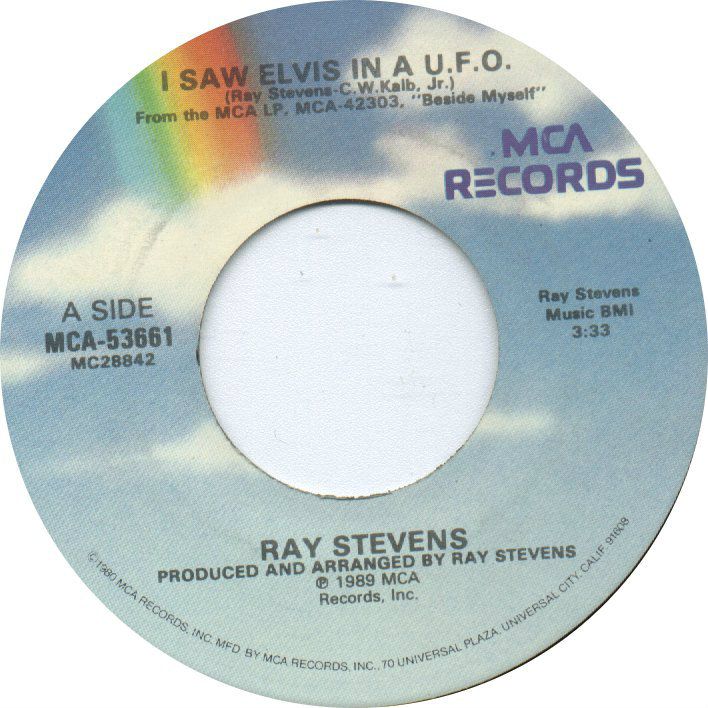
In this edition of the Singling Out series I take a look at one of the last vinyl singles released on Ray Stevens. Throughout much of the 1980s the vinyl format continued to have wide distribution and it continued to have a presence in retail stores along side their smaller counterpart, the cassette tape. The presence of vinyl albums and singles began to rapidly disappear in the late 1980s even though manufacturing of them remained for turntable equipped jukeboxes and for mail-order record clubs but vinyl was becoming less and less visible in retail stores. The cassette, along with the emergence of the compact disc (CD), became the dominant format of music consumption and so vinyl releases became scarce and often were only found in privately owned, local record shops specializing in the sale of vinyl records and if you happen to be fans of country music the Ernest Tubb Record Shop continued to offer vinyl and in some cases that store had exclusive vinyl records. Jukeboxes began to vanish, too...those that remained in use had been converted from being equipped with a turntable for vinyl singles to being manufactured for CD's. The operation of the jukebox remained the same...you put in the money and make the song selection and instead of a vinyl single being pulled out and played on a jukebox turntable the song would automatically begin playing due to the memory of the computerized programming. You select B-6, for example, and the jukebox's computer memory will know what song to play. This vinyl single from Ray Stevens is "I Saw Elvis in a U.F.O.". The song was found on his 1989 album, Beside Myself, and he performed it on several television shows that year. It was not a 'radio hit' but it became popular. Ray and Buddy Kalb wrote the song. The main concept of the song centers around the various Elvis sightings that frequently appeared in tabloid newspapers since the late '70s. I have no idea why those tabloid stories became so frequent...Elvis didn't vanish or disappear in 1977...he passed away; so it's always puzzled me why Elvis sightings became something of a fad and had such a presence.

The song tells the story of a couple that are camping in the woods. The performance begins with a narration/recitation. An anchorman telling us that we're tuned into the 'evening news' and he hands the story off to their literal field reporter, Renaldo Rivera (a pun on Geraldo Rivera). Renaldo interviews a witness who goes into his story of having seen a U.F.O. land just beyond their Winnebago and when he went over for a closer look pink aliens emerged and then he says he looked inside the U.F.O. and "there he was!!", the reporter asks "there who was??", and after a brief music interlude the witness emphatically declares: "I Saw Elvis in a U.F.O." and the singing portion of the song commences. When Ray performed the song in concert he used props and visuals...a large U.F.O. would hover over top of the stage...he'd have people dressed in pink alien suits 'emerge' and then run around the stage and out into the audience. In the song's conclusion, amid all the smoke of the U.F.O., he gets beamed aboard the U.F.O. which lifts upward and out of sight. If the performance includes post-production Ray literally vanishes on-screen but in his Branson, Missouri performances in the early 1990s a life size dummy of Ray in Elvis attire on wires is hoisted upward toward the U.F.O..

Me with Ray Stevens B-side vinyl
The B-side of "I Saw Elvis in a U.F.O." is the equally funny "I Used To Be Crazy". As so many Ray Stevens comedy songs have done it's taken on a life of it's own. Although it originally emerged on 1989's Beside Myself as the closing track and is found as a B-side in single format, "I Used To Be Crazy" has gotten a lot more exposure in the years since. He made a music video of the song in 1995...part of his direct-to-VHS movie, Get Serious!. That music video was recently uploaded on Ray's YouTube channel where it gained a whole lot more exposure than it otherwise had. Ray and Buddy Kalb wrote the song and it allows Ray to demonstrate his skill of mimicry. The subject matter enables Ray to deliver his impressions of chickens, dogs, mad English Kings from the 1700s, Walter Brennan, John Wayne. Along the way he lets out with a loud, shrieking scream...it happens in a section of the song where he mentions that on some days doesn't everybody from time to time enjoy a 'little' primal scream?? In the 1995 music video he performs the song in an Americanized Austrian accent but in the 1989 original recording he performs the song in his natural voice...except when he demonstrates his mimicry. The concept of the song is a case study in irony. He proclaims he used to be crazy but yet he's a whole lot better now...yeah, right!! This vinyl single was the last one released on Ray Stevens by MCA Records. There would be two vinyl singles released on Ray by Curb/Capitol Records in 1990 in limited availability but then that was it as far as vinyl releases go. The very first vinyl single released on Ray was "Silver Bracelet" in 1957 on Capitol Records subsidiary, Prep Records.

April 20, 2020

Ray Stevens: 1991 performance of I Saw Elvis in a U.F.O.

One of the funniest comedy songs from Ray Stevens came along in 1989 titled "I Saw Elvis in a U.F.O.". The song itself tackles the tabloid driven newspaper stories where people claim to have either spotted Elvis at a fast-food restaurant or seen him in bizarre places long after his 1977 death. The concert performance of the song was one of Ray's most elaborate. It almost always began with the lights being dimmed and a prerecorded video clip of Ray playing the part of a news anchor, a reporter, and the witness himself would be shown to the audience. Upon the conclusion of the video clip the lights would come up and Ray would start singing the song.

The video clip below, from 1991, is one of those elaborate performances. The prop of a gigantic U.F.O. was part of the stage performances. In this particular video you'll see one of the song's writers, Buddy Kalb, playing the part of the reporter. The dialogue performed in the opening sequence isn't the dialogue performed on the 1989 recording. In this 1991 reenactment Buddy's reporter character uses nearly word for word dialogue found in Ray's 1974 recording, "The Streak", instead of using the reporter dialogue heard on Ray's 1989 studio recording of "I Saw Elvis in a U.F.O.". Ray, playing the role of the witness, offers different dialogue in this 1991 sketch than what's heard in the 1989 recording. In the 1989 recording the witness who claims to have seen a U.F.O. was out in the woods camping with his wife in a Winnebago. In this 1991 performance the witness claims to have seen the U.F.O. hovering over a fast-food restaurant while awaiting food to take to his wife, Ethel. It's my guess that Ray had gotten a lot of audience feedback over how the witness in the 1989 recording sounded so much like the witness who seen "The Streak" in 1974 that they (Ray and Buddy) decided to re-write the opening part of the song to make it appear that the U.F.O. witness is the same man who seen "The Streak".


That performance is from the 1992 VHS, Amazing Rolling Revue. That was the title of a 1991 unsold television pilot Ray produced and since it wasn't picked up by any network Ray decided to issue the 1991 unsold pilot on VHS in 1992 through his fan club. It wasn't sold through nationwide television advertisements and so it wasn't as well known as some of his other VHS releases at that time. Ray had earlier performed "I Saw Elvis in a U.F.O." on the 1989 edition of the Music City News Country Awards. It's my belief that it was the first time Ray performed the song on stage and in that performance it included the gigantic U.F.O. and the pink aliens running all over the place. In the stage performances in Branson, Missouri in the early '90s Ray would be in an Elvis suit while performing the song. Ray appeared as fictional anchorman Stan Blather in the pre-recorded video clip that played before the start of the song in the Branson performances. Ray portrayed the reporter, too, as he had in the 1989 recording; and the witness, also played in the video by Ray, returned to being a camper in the woods in a Winnebago with his wife.

I don't know if Ray continued performing this song after he left Branson in 1993. I don't think he performed it during his brief return during the 2005 and 2006 seasons...and he never performed it in the concerts I'd been lucky enough to attend. I seen him in Mount Vernon, Kentucky at Renfro Valley in 2008; Nashville, Indiana at The Little Nashville Opry in 2009; and on the West Side of Nashville at the CabaRay in 2018.

November 25, 2012

Ray Stevens: Golden LP Series, Part 26...

In this installment of the Golden LP Series we look at studio album twenty-six in the career of Ray Stevens. We also say farewell to the 1980's in this blog series. Studio album 26 hit in 1989 with the title of Beside Myself. The album featured, for the first time since 1983, non-comical recordings from Ray Stevens. The project was split in half between the serious and the comic personalities of his songs and it featured a memorable album photo, too. Since the early '80s Ray's albums featured memorable photo shots and as the decade went on the photo shots became increasingly memorable and deliberately eye catching.

Beside Myself contains 10 songs and as mentioned the project devotes equal time to the two main recording styles in Ray's career. Serious Ray Stevens is heard during the first 5 songs while comical Ray Stevens is heard during the remaining 5 performances. The album's photo illustrates, as well, which style of Ray Stevens you'll hear as the more serious looking Ray is positioned first while comical Ray is seated second. This particular LP reached the Country Album chart as did all of his studio albums for MCA. This one peaked in the middle of the chart in 1989 but the single releases weren't able to reach the Country Singles chart. As mentioned in Part 25, Ray's single releases were having a difficult time gaining favorability among country radio programmers. Ray has often said that it's a lot more difficult to have a comedy song or a comedy album that's successful than it is to have a love ballad become successful. In my opinion the challenge is finding people in radio that will embrace a comical recording and then everything else should fall into place. It all starts with airplay. If a single isn't getting any significant airplay chances are the public at large will have no idea that a song is available for purchase. What I think happened is more publicity was given for the actual LP instead of the single releases.

The cassette release came into my possession at some point in the very early '90s. It had been an elusive release and a project that I was not aware of until I saw it sitting in a tape rack at a local shopping store. I was unable to convince my parent's to purchase the tape. Apparently it was still selling for it's original asking price which would've been anywhere between $9.95 to $12.95. I was never able to come across another Beside Myself for the longest of time. As luck would have it, though, another retail store had the tape in what's known as the discount rack and my parent's got it for me for Christmas. I was excited beyond belief...I unwrapped the plastic from the case and opened the cassette. I glanced at all the song titles, the writers, musicians, etc. etc. but I held off playing it. When I spent the night with my grandparent's I had my grandfather play it on a portable tape player he had. This was a memorable occasion for the wrong reasons, though. After the first song was over we assumed the cassette was defective because Ray's vocals were in slow motion...after listening to the next song I didn't know what to think. I stopped the tape because I couldn't take the sound quality. Thinking the elusive gem was defective I was not going to play it anymore but something caused me to play it on my own tape player. The one I had was the standard radio/tape player combination. I put the tape into the tape deck, hit play, and was astounded at how crisp and crystal clear the music was and how Ray's voice was as it should be. What had happened is my grandfather hadn't used his portable tape player in quite awhile and the batteries were nearly run down! This had caused the tape to playback in a low, barely listenable quality...much like when you switch speeds on a turntable and play an LP at 45-rpm speed or play a 45-rpm at LP speed.
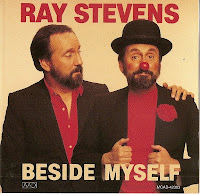
So, then, what were the songs that appeared on Beside Myself? The LP kicks off with "Your Bozo's Back Again" which ties in perfectly with the album's cover shot. In this song Ray sings about a relationship where the woman continually hurts and humiliates a man but in spite of this the man can't gather up enough courage to walk away for good and so he finds himself returning to her each and every time he's walked out for a few hours. The second song, "Another Fine Mess", features prominent saxophone accompaniment and with this the song comes across much more easy-listening than a lot of the other non-comical songs found on this LP. It's also a mood setter...once you hear a saxophone played in this fashion you'll immediately recognize that the song will be heavy on romance and other love song conversation. This song has Ray singing about a relationship where the woman makes a series of little mistakes...but the crux of the entire song has to do with a man who finds himself falling in love with this accident-prone woman and how, to him, the whole situation has become "Another Fine Mess"...but it's a mess that he particularly enjoys as you'll realize when you hear it. "Marion Michael Morrison" is hands down the greatest tribute, in song, to the movies and impact of John Wayne. When I first heard the song I had know idea that John Wayne was his stage name...but once Ray started referencing the movies, the catch-phrases, and the characters associated with John Wayne it didn't take me that long to realize who the song was about but I was still baffled why it was called "Marion Michael Morrison" rather than something else. I later found out Marion Michael Morrison was the birth name of John Wayne. I was still unaware that celebrities used stage names. It was a few years later that I learned that Ray's birth name is Harold Ray Ragsdale...so yes, there was still a lot for me to learn about Ray Stevens as time went on.

The fourth track, "Butterfly Inside a Coupe de Ville", tells the story about the pressures of fame, the trappings of success, and how even if someone appears to have everything, the lack of a relationship makes it all meaningless. This deep thinking was prompted by the sight of a harmless butterfly that was trying to get out of a cadillac. The song's title would have you believe it's a comical song but it's not. The fifth song, "There's a Star Spangled Banner", uses topical news and the military conflicts of the era to salute the American flag and all it stands for. It's another great performance.

 The comical portion of the LP starts with track six, "I Saw Elvis in a U.F.O.". This recording spoofs the multitude of tabloids that consistently report Elvis sightings and how U.F.O.'s of all descriptions abducted him in 1977 and took him to outer space. I've never researched or understood the whole Elvis sighting craze so I wouldn't know how it all came about but nevertheless people seem to get a kick out of claiming to see Elvis from all corners of the planet and after all this time tabloids still run with Elvis sighting stories to this day. In Ray's song we hear a spoof of a newscast where Ray plays the part of the newscaster, the reporter, and the eyewitness who tells of his encounter with the U.F.O., the aliens, and Elvis himself. The song is done in a rock and roll arrangement with Ray using a rocker type of vocalization. Sound effects are featured throughout as we hear the U.F.O. hovering around and for added hilarity is the sped-up vocal effects of the aliens. Ray comically states that these high-pitched aliens sound like The Jordanaires. When Ray would perform this song in concert he'd usually have a big inflatable U.F.O. hovering above the stage, lots of smoke and fog effects, dancers running around on stage in pink alien attire, but the best part of all was Ray dressed up in a typical Elvis jumpsuit. It's definitely a show-stopper in concert. "The Woogie Boogie", track seven, is a funny little song about a fictional Indian tribe in Chattanooga, Tennessee called the Woogies. It's one of the shortest songs on the LP but a lot of it's charm is the "oogie" factor applied throughout the lyrics. The song ends with a continued refrain of the Woogie chant over and over until the song fades. "Stuck on You" comes off like a musical infomercial as Ray sings about the purchase of a super glue kind of product that he saw advertised on television. Ray tells about the various incidents and the chaos that ensues after he opens the tube of glue. The song's title, "Stuck on You", is taken literally as you can tell! Strangely enough it was never made into a music video. "Bad Dancin'" is a song that champions the art of dancing with an undertone of satire as it singles out the culture of the 1980's and blends these elements together. The story takes place at a country club and Ray acts as spectator/reporter filling us in on what all he's seeing as he watches the wild dancing taking place. Several dances and entertainers are mentioned at various places in the song, too. The closing track, "I Used To Be Crazy", is the b-side of "I Saw Elvis in a U.F.O.". In "I Used To Be Crazy", Ray sings about how he used to be crazy...but demonstrates to us that he's perfectly sane now. Once you hear the way he demonstrates his sanity you'll find yourself laughing and giggling. The song is a marvelous showcase for his skilled impressions and mimicry. By the end of the performance and still trying to convince us that he's sane and serious and no longer "crazy", Ray has assumed the role of a british King. The song ends as Ray offers a frenetic, comical exchange of dialogue between himself and his impressions of John Wayne, Walter Brennan, and the King of England. Amidst this activity you'll also hear a chicken and a barking dog lend themselves to the chaos.

Beside Myself wrapped up the 1980's for Ray Stevens and it also wrapped up his association with MCA for the time being. He joined the label in 1984 and by the end of 1989 he was in the process of joining up with another record label. It was the start of a new decade...which always brings about feelings of a new direction, a new outlook, a new start, a change in direction, etc. etc. What would 1990 and beyond hold in store for Ray Stevens? Which label would he find himself on? How would the changing tastes on country radio and country television impact his career? How would political correctness impact his career? Would his next LP be a comical one or a blend of comedy and ballads? Were there any music videos on the horizon? Such questions will more than likely be addressed in the next installment of the Golden LP Series. Although the manufacturing of the LP had dwindled down considerably and it's commercial appeal had dwindled down as more people were buying compact devices like cassettes and CD's, I'll still use "LP" in the blog entry title even as we get more and more into contemporary technology.