Showing posts with label be your own best friend. Show all posts

June 5, 2022

Ray Stevens: Soft and Smooth...

I know, I know...a lot of you Ray Stevens fans probably don't use the phrase 'soft and smooth' when you think of Ray Stevens. A lot of you probably consider Ray to be a hard-driving, quick witted entertainer that more than likely brings a whole lot more to his recordings than 'soft and smooth'. The truth is Ray Stevens can be so many things on record...and if you look carefully enough you'll find a lot of 'soft and smooth' sounds on numerous Ray Stevens albums. A sound that's never been a favorite of pop or country music journalists and critics...soft rock and mellow country music is pleasant to hear, however. Now, before I go any farther, I wanted to share some links to Ray's social media pages. I don't share them nearly enough. First off here's a link to his Facebook PAGE. Ray has more than half a million followers on his Facebook page. Second, here's a link to his Twitter PAGE. On that social media platform Ray has 7,688 followers. 

Ray's YouTube channel can be accessed HERE. He has over 200,000 subscribers to his YouTube channel. Ray has an Instagram page as well...on that page he has a little over 45,000 followers. You can see his Instagram page when you click HERE. In addition to those social media sites Ray also has a Spotify page and you can find his songs on Amazon and elsewhere on the internet. He definitely has an online presence. Now, back to 'soft and smooth'...

In 1978 Ray Stevens released a wonderful album called Be Your Own Best Friend. It is an album chock full of what I mentioned earlier...mellow country music and what some may call soft rock or Adult-Contemporary. The title track could've become an Adult-Contemporary hit if the record company would've pushed for it. The single rose to the Top-40 on several weekly country music publications. It achieved it's highest Top-40 peak position in the United States on both the Billboard Top Country Singles and the Record World Country Singles chart. It also peaked in the Top-40 on the week ending September 30, 1978 on the Cashbox Country Singles chart. In fact, the single reached it's peak right around the same time on all of the weekly music charts. Ray's publishing company, Ray Stevens Music, was reaping some benefits with not only Ray's single but a couple of other releases by Jacky Ward and Billy 'Crash' Craddock in 1978. In Canada "Be Your Own Best Friend" reached the Top-20 on their Country RPM chart. The title track was the only single release from the album...and it's a shame that nothing else from the album was released as a single. The album contains some of the following songs: "You're Magic", "Comeback", "Two Wrongs Don't Make a Right", and the exquisite "L'amour". This turned out to be Ray's fourth and final studio album for Warner Brothers. He'd come to the record company late in 1975 and his debut album for the label arrived early in 1976. In 1979 the record company would issue a compilation album on Ray titled The Feeling's Not Right Again to promote his spring 1979 novelty single, "I Need Your Help, Barry Manilow". In addition to the novelty song the album contained previously released love ballads from three of his four studio albums. The title track of the 1979 album happened to be a song from the Be Your Own Best Friend album. The record company issued a publicity advertisement in which the cover of the 1978 album appeared underneath a whimsical statement: "Take some advice from a man who knows what he's singing about! Be Your Own Best Friend!". I have never seen Ray Stevens sing "Be Your Own Best Friend" on television even though I know that he performed it on an episode of Pop! Goes the Country. I still hope somebody uploads that performance onto YouTube. 

Well, now that I've written a little bit about the 1978 album here's a couple of songs from it. The full length album has never been uploaded onto YouTube but some of the songs have. In 1995 Warner Brothers issued three compilation albums. It marked the first time that an abundance of songs from his years at the record label become available on cassette and CD format. YouTube has two of those 1995 albums available in their entirety. Do You Wanna Dance? collects songs that Ray recorded that fit a dancing and music oriented theme. Songs like "Can't Stop Dancing", the "Do You Wanna Dance Trilogy", "Country Licks", "Blues Love Affair", "Feel the Music", and more while The Serious Side of Ray Stevens collects songs that Ray recorded that are mostly love ballads or thought provoking. The title of that compilation is a bit misleading in that all three of those 1995 compilations spotlight mostly all serious, non-comedic recordings by Ray. A third compilation, Cornball, has never been uploaded onto YouTube. The presence of three novelty songs on that particular collection must have justified the entire album to receive the title, Cornball...there is a wonderful love ballad on there called "Cornball" but it isn't a novelty/comedy song. Since this blog entry has an overall theme of 'soft and smooth' here are a couple of songs that fit that description from the 1978 Be Your Own Best Friend album...

The smooth "Two Wrongs Don't Make a Right" from the 1995 compilation...


Next we have the exquisite "L'amour"...you're gonna love it! You could lose yourself in that arrangement...you'll probably find yourself singing along with the chorus...


I'm sure you're all familiar with audio tracks that appear on YouTube. We're unable to leave comments, which is a shame. We could educate a lot of people about some of Ray's lesser heralded work in the comment section but we don't have that opportunity. I'm glad the audio tracks are on YouTube, however...we can share them and promote his music that way...but since I like writing about his music and career the inability to leave commentary on YouTube is disappointing.    

February 12, 2018

Ray Stevens Best Friend turns 40...

It's early Monday morning and I find myself putting together a 40th anniversary spotlight on a Ray Stevens album from 1978 titled Be Your Own Best Friend. This is one of Ray's finest albums and it includes quite a lot of love ballads...more than, I'd say, any Ray Stevens album up to that point in time. Unusual for an album it features nine recordings...rather than the standard ten or eleven. It is one of Ray's under-rated albums in a career that has seen a lot of them due to the common practice of focusing on single releases at the expense of the LP (long-play album).

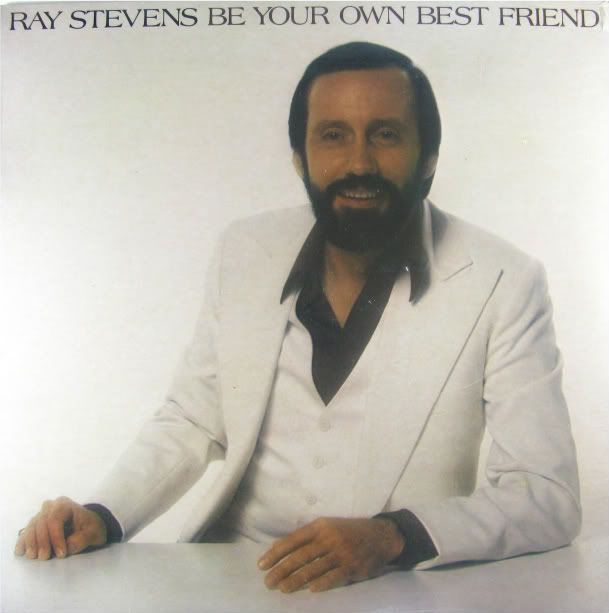
If you do not own this vinyl album then I suggest searching for it on-line and purchasing it. It's, as I said, one of his finest albums. One of the things that grabbed my attention regarding this album is the visuals. This is an image of the album with it's shrink wrap not removed and so if you click the image you'll see the annoying glimpses of shiny distractions but if you don't want to see that then just look at the image as it appears off to the left. As you can see the album's visuals feature a striking all-white background with a tanned Ray Stevens decked out in a white suit and black dress shirt seated at a table or he may be seated at the side of a piano. I never came across any information in my years as a Ray Stevens fan explicitly stating if he's seated at a table or piano. Anyway...once I got a copy of this album the thing that leapt to mind was it's visuals and then I listened to the album. I was familiar with several of the songs already because Warner Brothers had issued a 3 volume set of material Ray had recorded for them in the mid to late '70s. Those releases arrived in 1995. I didn't get my copy of the vinyl Be Your Own Best Friend until several years after that. As a fan of Ray Stevens I had joined his fan club in 1995...with some money I had gotten during my high school graduation party. One of the first things I received was a list of his albums. I was excited to see this because I didn't realize, at the time, he had released so many albums. It also made me curious as to what songs made up those albums because throughout my childhood I was only familiar with the songs on the several cassette tapes owned by my grandfather but I wanted to know more and more about Ray and so I started my quest to find out everything and anything about Ray Stevens...but that's a story for another day...getting back to this 1978 album...

Ray recorded it during his years at Warner Brothers. Even though the material he recorded for the label has more or less been kept out of print you can find his studio albums on-line if you search auction sites...specifically eBay. Given his reputation for recording comedy/novelty songs it's no surprise that the few selections from his Warner Brothers years that have managed to remain in print on various greatest hits/best of collections are comical in nature. One of those being 1979's "I Need Your Help, Barry Manilow" and the other being his chicken-clucking version of "In the Mood" from late 1976.

The album kicks off with a sensational recording called "L'amour". This song has a very interesting origin in that it originated overseas and had been a major hit for it's writer, Gilbert Becaud. If you search for that artist and the song's name you're likely to come across video footage from overseas of him performing the song in his native language. I've watched his performance several times and even though I don't understand a word of it (he's singing in French) the melody is the same and I'm hearing Ray's English language lyrics in my head. In the early '90s Ray was a guest on Ralph Emery's early morning radio series, Take Five for Country Music. Ray remarked that while on tour in Europe in the mid '70s he had heard a song he didn't understand but he loved the melody so much he decided to write English lyrics to it. Years later I hear "L'amour" for the first time and see it's credited to both Ray and a writer named Gilbert Becaud. Eventually I discover that Gilbert was a leading pop singer of his day and putting two and two together I realized "L'amour" must be the song Ray had heard during a European tour and just had to adapt it for English language listeners. I don't care what your political or social leanings are if you do not find yourself smiling from ear to ear and eventually singing along as you listen to the song then consider yourself human personification of a stagnant pond...or at the very least a sourpuss.

After the rousing opening of "L'amour" you'll be treated to a couple of back to back love ballads well over four minutes in length. The bouncy "Two Wrongs Don't Make a Right" clocks in at four minutes and twenty one seconds. In it Ray takes the familiar proverb to examine the stubborn nature often on display between couples, in general, and that if true love exists between a couple then the idea of revenge or getting even shouldn't enter the equation. Ray approaches the song from the point of view of the man learning his girlfriend or wife, it's not specified, has cheated on him and at first he wants to get even but self-control kicks in and he realizes that cheating on her just because she cheated on him solves nothing. This is followed by a re-recording of "You've Got the Music Inside", a song he had previously recorded on his 1973 album, Nashville. The 1978 recording has a much more polished, pop heavy arrangement and Ray has a much more softer vocal delivery...the 1973 recording features much more uncontrollable vocals and even some gravelly, throaty vocalization here and there. I love each recording equally. If you've had the opportunity to see a performance of Ray on Pop! Goes the Country in 1979 (hosted by Tom T. Hall) you were treated to a performance of "You've Got the Music Inside" with a much different arrangement...and to date a performance with this arrangement has never been recorded by Ray. "Hidin' Place" closes Side One of the vinyl album.

Side Two kicks off with the album's title track, "Be Your Own Best Friend". This ballad is self explanatory given it's title. It's a song about having confidence and self-worth no matter if there are people out in the world that may give you headache, grief, or animosity. An interesting tidbit I learned just today concerning the single release of this recording is that there's an edited copy and a full length copy. The A-side of the single, which you can see off to the right, clocks in at two minutes and fifty-two seconds...certainly not a very lengthy recording requiring any sort of edit but the B-side features an edited copy of the song which clocks in at two minutes and twenty seconds. I do not own this promotional copy of the single and so I have never heard the edit but being familiar with the song I'm curious as to what was edited out...thirty two seconds is a lot of time when we're talking about an audio recording. I wonder if bits and pieces of the instrumentation was edited out for a collective thirty two seconds of edits or if an entire section of the song was edited out. I'll post the B-side of the single in the next paragraph or two. Anyway...the title track was the only recording issued as a single. It hit the Top-40 of the country charts and the Top-20 on Canada's country chart.

If you're as much of a fan of Ray Stevens as I am then the next song on the album, it's title specifically, should be familiar to you. "The Feeling's Not Right Again" is a song Ray wrote with a writer named Chuck Martin. You can find Chuck on Facebook. The song is great...a devastating love ballad centering around a man that's forever coming close to finding satisfaction in a relationship but each time things just don't work out. The song's title should be familiar because it became the title of Ray's next album release...a 1979 compilation album built around the single "I Need Your Help, Barry Manilow". The song that Ray and Chuck wrote led to the creation of an album cover spoofing Barry's 1975 album...his album was titled Trying to Get The Feeling. "The Feeling's Not Right Again" lent itself perfectly as the title of Ray's 1979 album. One of the few, if only, times that a compilation album was named for a non-hit album track.

This is the B-side of "Be Your Own Best Friend" showing the edited copy clocking in at two minutes, twenty seconds. Now, moving on to the song that followed "The Feeling's Not Right Again" on the 1978 album, we come to "Comeback". This is one of the legitimate uptempo songs on the entire album. There are a couple of mid-tempo ballads and of course the sing-a-long feel of the opening performance of "L'amour" but "Comeback" features a very lively vocalization from Ray and an urgent arrangement...it could have very easily been highlighted as a single release but it never happened. I say that because it has all the ingredients of a hit song...a lot of hooks, a catchy melody/arrangement, and the repetitious nature of the song's title heard in such a way could have proved irresistible for some. If you're familiar with the song then you know what I'm referring to when I describe the repetitious nature. A piece of it goes like "all you gotta do to make a comeback is just come, come, come, COME BACK!". It's one of those clever word play songs in that the spacing of the song's title transforms it's meaning within the context of the recording. This uptempo performance is followed by the mid-tempo "You're Magic". The shortest song on the entire album at two minutes and twenty one seconds but yet, for me, it's the most catchy. Ray sings this song in a very exaggerated soft spoken style...not necessarily Bill Anderson whispering but it's performed with a hushed overtone. You'd have to hear it for yourselves to understand my baffling description. The song comes from the pen of Layng Martine, Jr. and it's the only song on the album not written or co-written by Ray. The album's closing song is the very slow ballad, "With a Smile". It conveys a kind of motivational message much like the title track conveys so it shouldn't come as no surprise that it's the B-side of the commercial single release of "Be Your Own Best Friend". The promotional copy featured "Be Your Own Best Friend" on the A and B side...with the B side's recording edited as I mentioned at the start of this section.

If you figuratively devour Ray's albums as I do then you should also be familiar, to some degree, with the personnel credited on his albums. The musicians and harmony singers credited on this album have been with Ray for many decades. Chet Atkins, believe it or not, is credited as the electric guitar player on this album along with Steve Gibson. Acoustic guitar is credited to Mark Casstevens. The drummer is Jerry Kroon. The bass player is Jack Williams. Horns are credited to both Ray Stevens and Denis Solee. I'd say that Denis handled the lion's share of the horn section (saxophone) while Ray added trumpet contribution. Ray is also credited as the percussionist as well as his familiar role of playing the piano/keyboard/synthesizer. Ray also produced and arranged the album. The harmony singers credited are Lisa Silver, Sheri Kramer, and Diane Tidwell. The engineer is Stuart Keathley who would later double as the bass player on many of Ray's albums until his sudden death in the mid 1990s.

Now, that was only a partial list of credits found on the back of the Be Your Own Best Friend album. There's credit given to the photographer, designer, the string arrangement, etc. I singled out some of the musicians because they've been a part of Ray's albums for decades. If you watch any episode of his television show you'll see Denis Solee, for example, as the saxophone player and the guitarist on the show's been a fixture on Ray's albums for many years, Jerry Kimbrough.

Do yourself a favor and if you don't have this album in your collection seek it out on eBay and add it to your collection. Ray recorded a whole lot of interesting songs in his career and the material he recorded during his brief stay at Warner Brothers is among the most eclectic.

October 21, 2017

Ray Stevens CabaRay Nashville...Charley Pride

It's me once more...and the recent episode of Ray Stevens CabaRay Nashville ended about half an hour ago from this writing. Ray opened the show seated at the piano and he performed "Be Your Own Best Friend". This is a song that I'd never seen him perform on television but I know that he re-recorded the song for inclusion on his Thank You CD in 2004...but for historical purposes the song originally hit in 1978 and made the Country Top-40. It's the title track of one of his albums that year (the other album being There Is Something On Your Mind). He kept the same arrangement and it was just like the recording note for note.

He brings out Charley Pride and the two of them discuss Texas. Charley mentions that he's lived in Texas since 1969. Ray mentioned that he asked about Texas because there's a follow-up to it involving the Texas Rangers. Charley speaks of his involvement with the baseball team and he brings up his life long love of baseball. He relates a story about Gene Autry and the California Angels and says that during his years in the Minor League he met Gene at a restaurant and tried to persuade Gene into bringing him onto the Major League roster of the Angels. Charley, with his familiar smile, told the audience that Gene looked at him and said that he just owns the team but doesn't make any operational decisions as far as the line-up/roster is concerned and so music became his life's profession from then on.

Upon the conclusion of the baseball talk from both (Ray himself once aspired to be a baseball player, too, but never took it as far as Charley did), Charley performs "Kiss An Angel Good Morning".

After the performance Ray makes mention of the fact that after Elvis the act on RCA that's sold the most records happened to be Charley. Ken Nelson, of Capitol, was mentioned when Charley brought up Ray's birth name. Ray tells about Ken suggesting a name change from Ray Ragsdale to Ray Stevens. Charley then performs one of my favorites, "Roll On Mississippi" and then "Is Anybody Goin' To San Antone?".

After the performances Charley and Ray have some parting words...and Charley makes an exit for backstage. This is a rarity...the guests usually exit during a break in the recording and it's not captured on tape. That is why there's always an edit from the time Ray thanks the guest for being on the show and the performance of the closing song. In another instance of breaking formula an instrumental is offered by The A-Team (the group of musicians that accompany Ray and the guests). Two of the members, Jerry Kimbrough and Jim Ferguson, perform an instrumental that Ray calls "Work Song". The members of the band usually perform on Ray's albums, too. Ray closes the show singing "Family Funeral Fight", a song from his Box Set project in 2005. It was one of the new songs recorded for the Box Set. This is probably the first time he's performed it on a television program.

Yesterday evening I checked the local PBS site and they added more episodes of Ray's show. In a couple of previous blog entries I mentioned that the site had episodes listed through November 18th. To my surprise, though, the local PBS station will not be airing episodes on November 25th or December 2nd. The reason is because of their Winter Pledge Drive and they'll be airing special programming. Those episodes will still air on other PBS stations on those weekends but not on the PBS channel in this area. The guests for those episodes are Jeannie Seely (November 25) and Don McLean (December 2). I'll be envious of others that will be able to see those episodes...particularly the December 2nd episode...Don is to perform his version of "Crying" and to miss out on hearing the stories that Don might tell is going to be tough. The local PBS station will resume airing the show the following Saturday (December 9th) and the guest will be Felix Cavaliere.

But returning to the present day rather than jumping ahead a month, coming up next weekend is the episode guest starring Janie Fricke...billed as the Halloween Show...it'll air October 28th. If I'm not mistaken this is one of the episodes from the RFD years. This will mark the first time an RFD episode has aired since the series changed to PBS exclusives in July. Episodes originally airing on RFD used to air on PBS stations during his early months on their airwaves before the brand new episodes began to air in the late summer.

March 6, 2011

Ray Stevens Song Profile...

In the Ray Stevens song profile this time around we focus mostly on 1978's "L'amour". It's been my belief that those who hear this song and don't get a big smile on their face must have ice in their veins. The music alone is great but Ray's performance is wonderful. "L'amour" is credited to Ray Stevens and the French artist, Gilbert Becaud. There's not many video clips of Becaud performing this song...in fact I'd only been able to come across one very brief clip of him performing the first few words of the song before the video cuts off. The melody, of course, is what will be familiar to Ray Stevens fans. The French lyrics to the song, when translated to English, do not mirror the lyrics that Ray sings and a lot of that has to do primarily with differing song structures between America and France. There are sites that have an English translation of "L'amour c'est l'affaire des gens" (the actual French title of the song) and once you read those lyrics you will be able to see the basic outline of the song that Ray would go on to re-write for the English-language recording, "L'amour". Ray's "L'amour" appeared as the opening track of his 1978 Be Your Own Best Friend album on Warner Brothers. The album features a total of 9 songs and as I've mentioned elsewhere on this blog site: the album cover of Ray is one of my favorites!!

Much of Ray's material on Warner Brothers is available at Amazon's Mp3 store. All you have to do is look the song titles up and see if they're available. I'll make it easy for a lot of you...in 1995 Warner Brothers released a 3-CD set featuring recordings that he made for the label in the mid to late '70s. Those CD's have since been reissued as Mp3 digital albums and so all of the material on those 3 CD's are available for download. "L'amour" is available on the digital album, The Serious Side of Ray Stevens. On that collection you also get several other songs from Ray's Be Your Own Best Friend album: "Two Wrongs Don't Make a Right", "The Feeling's Not Right Again", and obviously "Be Your Own Best Friend". For those, like myself, who own and operate turntables on a frequent to semi-frequent basis the 1978 vinyl album consistently becomes available on eBay. The other songs on the 1978 album are "You're Magic", "Comeback", "With a Smile", "You've Got the Music Inside", and "Hidin' Place". Meanwhile, the two other 1995 titles available for download containing Ray's Warner Brothers material are Cornball and Do You Wanna Dance?. Those 1995 collections continue to be the only commercially available retrospectives on Ray's short stay with Warner Brothers (1976-1979) but there are several recordings that weren't selected for the 3 CD set and the only place to find these particular recordings are on their original vinyl release: "OM", "Gimme a Smile", "Junkie For You", "Road Widow", "There Is Something On Your Mind", "Banned in Boston Trilogy", "With a Smile", "Comeback", "Hidin' Place", and "You're Magic".

The seldom seen back cover of the 1977 Ray Stevens album, Feel the Music. I wasn't able to get the entire image in the camera shot but it serves it's purpose at showing what the back of the album looks like for those who don't own a copy. The 1977 album, much like 1978's Be Your Own Best Friend, featured a heavy dose of easy-listening songs...but there was always a song or two to break up the dominant mood. On Be Your Own Best Friend the sedate mood is broken up by the upbeat "Comeback" and the mid-tempo "Two Wrongs Don't Make a Right". On Feel the Music the overall mood of the album is spread across the entire collection of songs. All kinds of styles are featured on this collection...which features an image of a stereo speaker on the front of the album. The bluesy, funky "Junkie For You", the urgent "Alone With You", the gospel stylings of "Save Me From Myself", the inspirational "Feel the Music", the passionate "Daydream Romance", the lonesome mood in "Road Widow", the somber "Blues Love Affair", the uplifting "Set The Children Free", the carefree, high flying "Get Crazy With Me", and the jazzy, Dixieland flavored "Dixie Hummingbird" demonstrate Ray's eclectic nature...a whole lot of styles are covered on the 1977 album. Ray wrote 9 of the 10 songs...the only song he didn't write is "Set The Children Free". That song was written by his long-time friend/associate, Buddy Kalb. You can see Buddy in a lot of Ray's music videos...particularly as the TSA agent in Ray's current music video, "The Skies Just Ain't Friendly Anymore".