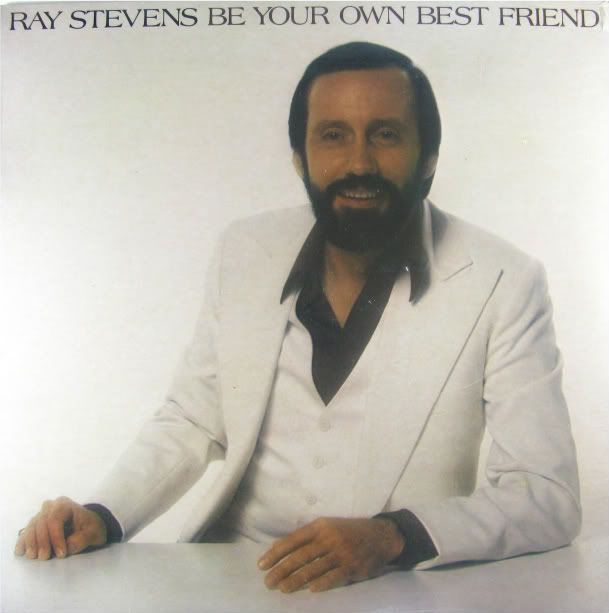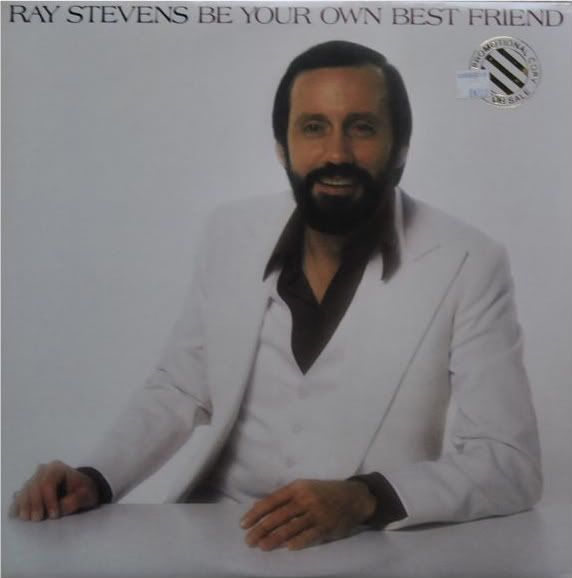
Well, now, we're up to studio album sixteen in the Golden LP Series...it's the second album of 1978 from Ray Stevens titled Be Your Own Best Friend. The album was a much more conventional release...although this particular LP features 9 selections rather than 10 or 11. There was only one single released, the title track, and it reached the Country Top-40 in America.
"Be Your Own Best Friend" is an inspirational song and it deals with self-motivation. It's not as confrontational as 1977's "Feel the Music" happened to be but it conveys a similar can-do message of if you feel everyone in the world is against you, don't let it ruin your day, continue living your life as you see fit and have self worth. As mentioned, "Be Your Own Best Friend" reached the Country Top-40 in America. It hit the Top-20 on Canada's country music chart. You can find the LP on eBay and other on-line music stores. I purchased mine at a flea market...I inspected it prior to purchasing and the vinyl looked to be in good shape and I'm glad I bought it because it sounds just as good as the vinyl appeared. The album goes from smooth crooner country flavored ballads to mid-tempo pop music of the era. As is the case with all of Ray's albums, this one also features flawless, impeccable production and meticulous music arrangements. In the country flavored side of things we have "Hidin' Place", a song that details the excitement and happiness of feeling secluded from the world...and in the song the man feels the most at home and in his own hiding place when he's with the woman in his life. The b-side of "Be Your Own Best Friend" is a breathy slice of easy-listening called "With a Smile" where Ray describes the various headaches and hang-up's in life but if one faces problems by smiling, usually whatever's dragging a person down will go away. I mentioned the song was breathy due to how soft and understated the performance is...it has whispered tones. Ray offers a re-recorded take with "You've Got the Music Inside"...a song he originally recorded in 1973. In this performance from 1978 there's more music accompaniment and the arrangement is on the soft side. The original featured throaty nuances and a free wheeling vocalization...Ray's enunciation in the 1978 re-recording is a lot more mellow and subdued.
One of the highlights, among the many, is "You're Magic". It, too, is an easy-listening pleasant sounding catchy song. The song, armed with a bright and sunny arrangement and breezy vocalization, became an immediate favorite when I heard it for the first time. The song, basically, is about the enthusiasm and uncontrollable desires of a man who definitely has quite a passion for the woman he's singing about. On the other side of the emotional roller coaster is "Comeback"...this particular song rises the volume quite considerably compared to the soft and slow ballads that fill most of the album. In this song we hear a lover's plea in the most urgent kind of way...the hook of the song is the repetitive use not only of the title but also the demonstrative usage of it. When you finish hearing the song you'll have no doubt how much he wants the woman to comeback!
A more pop-flavored offering is heard on "The Feeling's Not Right Again". In this performance, Ray sings about a man who always comes so close to finding true love but without fail it always turns out not so good. "Two Wrongs Don't Make a Right" is a catchy mid-tempo love ballad about a man who falls victim to adultery and he initially wants to get revenge on the woman but ultimately he has a change of heart which leads to the song's title.
"L'amour" is a breathtaking song all about love. It's a song that has a unique origin in that it was written by French artist, Gilbert Becaud, who had a massive hit single with it in his native language. Ray reworked the lyrics and it has a catchy arrangement, too. The feel of the song is French...long before I knew much about the song's origins I suspected that it had some sort of international connection because the song's melody sounds foreign compared to American music. I originally assumed the song had connections with the United Kingdom or even Canada...but then I researched the song and found out it's origins.
One of the interesting trivia notes concerning Ray's stay at Warner Brothers is the lack of strong publicity that his albums and singles had generated. I wish I had a time machine and could go back to the late '70s and see just what was happening. One of the main reasons why I like to Google news archives on Ray is so I can get a feel of the media coverage, or lack of coverage, during certain points in his career. Whenever I search for news articles on Ray from the late '70s, 1977-1978 specifically, what I end up with are news articles mentioning any number of his TV appearances or maybe a write-up promoting an upcoming concert or one that already took place. I rarely find news articles that publicize his albums or singles from that time period...which leads me to believe the publicity machine wasn't cranked up all that high for Ray during that point in time. It's a shame, too, because the music he put out during this late '70s period is just as good as anything else you'll hear.
In the meantime, since there wasn't another single being pushed from Be Your Own Best Friend in the latter half of 1978, fans had to wait several months before the next project hit the market...and it hit in the spring of 1979. It was a novelty single...his first novelty release since the chicken-clucked "In the Mood" in late 1976. The novelty was rooted in parody...and chances were a listener had to at least have some sort of knowledge or familiarity with the subject being spoofed in order to really get the humor. Join me in the next installment as I discuss this 1979 novelty single from Ray Stevens...one that was such a hit that Warner Brothers compiled an album of previously recorded songs from Ray in an effort to have an LP to tie in with the surprise hit single.
Showing posts with label gilbert becaud. Show all posts
October 31, 2012
March 6, 2011
Ray Stevens Song Profile...
In the Ray Stevens song profile this time around we focus mostly on 1978's "L'amour". It's been my belief that those who hear this song and don't get a big smile on their face must have ice in their veins. The music alone is great but Ray's performance is wonderful. "L'amour" is credited to Ray Stevens and the French artist, Gilbert Becaud. There's not many video clips of Becaud performing this song...in fact I'd only been able to come across one very brief clip of him performing the first few words of the song before the video cuts off. The melody, of course, is what will be familiar to Ray Stevens fans. The French lyrics to the song, when translated to English, do not mirror the lyrics that Ray sings and a lot of that has to do primarily with differing song structures between America and France. There are sites that have an English translation of "L'amour c'est l'affaire des gens" (the actual French title of the song) and once you read those lyrics you will be able to see the basic outline of the song that Ray would go on to re-write for the English-language recording, "L'amour". Ray's "L'amour" appeared as the opening track of his 1978 Be Your Own Best Friend album on Warner Brothers. The album features a total of 9 songs and as I've mentioned elsewhere on this blog site: the album cover of Ray is one of my favorites!!
Much of Ray's material on Warner Brothers is available at Amazon's Mp3 store. All you have to do is look the song titles up and see if they're available. I'll make it easy for a lot of you...in 1995 Warner Brothers released a 3-CD set featuring recordings that he made for the label in the mid to late '70s. Those CD's have since been reissued as Mp3 digital albums and so all of the material on those 3 CD's are available for download. "L'amour" is available on the digital album, The Serious Side of Ray Stevens. On that collection you also get several other songs from Ray's Be Your Own Best Friend album: "Two Wrongs Don't Make a Right", "The Feeling's Not Right Again", and obviously "Be Your Own Best Friend". For those, like myself, who own and operate turntables on a frequent to semi-frequent basis the 1978 vinyl album consistently becomes available on eBay. The other songs on the 1978 album are "You're Magic", "Comeback", "With a Smile", "You've Got the Music Inside", and "Hidin' Place". Meanwhile, the two other 1995 titles available for download containing Ray's Warner Brothers material are Cornball and Do You Wanna Dance?. Those 1995 collections continue to be the only commercially available retrospectives on Ray's short stay with Warner Brothers (1976-1979) but there are several recordings that weren't selected for the 3 CD set and the only place to find these particular recordings are on their original vinyl release: "OM", "Gimme a Smile", "Junkie For You", "Road Widow", "There Is Something On Your Mind", "Banned in Boston Trilogy", "With a Smile", "Comeback", "Hidin' Place", and "You're Magic".
The seldom seen back cover of the 1977 Ray Stevens album, Feel the Music. I wasn't able to get the entire image in the camera shot but it serves it's purpose at showing what the back of the album looks like for those who don't own a copy. The 1977 album, much like 1978's Be Your Own Best Friend, featured a heavy dose of easy-listening songs...but there was always a song or two to break up the dominant mood. On Be Your Own Best Friend the sedate mood is broken up by the upbeat "Comeback" and the mid-tempo "Two Wrongs Don't Make a Right". On Feel the Music the overall mood of the album is spread across the entire collection of songs. All kinds of styles are featured on this collection...which features an image of a stereo speaker on the front of the album. The bluesy, funky "Junkie For You", the urgent "Alone With You", the gospel stylings of "Save Me From Myself", the inspirational "Feel the Music", the passionate "Daydream Romance", the lonesome mood in "Road Widow", the somber "Blues Love Affair", the uplifting "Set The Children Free", the carefree, high flying "Get Crazy With Me", and the jazzy, Dixieland flavored "Dixie Hummingbird" demonstrate Ray's eclectic nature...a whole lot of styles are covered on the 1977 album. Ray wrote 9 of the 10 songs...the only song he didn't write is "Set The Children Free". That song was written by his long-time friend/associate, Buddy Kalb. You can see Buddy in a lot of Ray's music videos...particularly as the TSA agent in Ray's current music video, "The Skies Just Ain't Friendly Anymore".
Labels:
1978,
be your own best friend,
french,
gilbert becaud,
l'amour,
ray stevens
Subscribe to:
Posts (Atom)