
Showing posts with label 45 singles. Show all posts
Showing posts with label 45 singles. Show all posts
December 23, 2013
Ray Stevens: '80s Singles...

January 13, 2011
Let's Discuss Ray Stevens, Part 22...
Although we're a few months shy, 2011 marks the 25th anniversary of I Have Returned reaching the #1 spot on the country album chart. The comedy album from Ray Stevens was released late fall 1985 and it started a slow climb to #1. One of the key factors in Ray's longevity is the way he can prolong just about any song, album, or home video/DVD and get all that he can from each project. This album, released in 1985, reached the country album chart in October of 1985...and it didn't reach it's peak until March 1986. See, I wasn't exaggerating when I said that it was a slow climb to #1...a 5 month climb specifically. This is not usual for most albums, of course. Typically an album debuts in or around it's peak position...most albums by country artists today routinely debut in the Top-10. A lot of singers have albums that debut at #1 as well...it's highly unusual for a CD to debut on the album chart and then reach it's peak 5 months later. Prolonged publicity and prolonged attention spans just aren't commonplace in today's music scene...unless you're Ray Stevens and therefore have the talent and ability to prolong your music for months at a time...racking up considerable longevity in the process.
 Turning 25 this year is his 1986 comedy album, Surely You Joust. The name of the album, of course, is a pun on the phrase "surely you jest". The Knight in Shining Armor is a reference to King Arthur. Ray had been appearing in costume as historical figures on his first two comedy albums on MCA: 1984's He Thinks He's Ray Stevens has Ray in costume as Napoleon while 1985's I Have Returned, shown above, shows Ray in costume as General MacArthur...and this time around we have Ray in costume as King Arthur. Ray's Clyde the Camel logo is prominently on display. On this particular album there were a few urbane comedy recordings, if that's the proper word? There were still large aspects of country comedy and the rural life on this album...particularly in the album's first two tracks: "Southern Air" and "The People's Court".
 Incidentally, "Southern Air" is a trio recording. It features Ray along with Jerry Clower and Minnie Pearl. "The People's Court" features a rural couple who decide they've had enough of one another and it's time to go on TV and tell the world all the problems they have with each other. Ray uses his famed grandmother vocal impression for the wife, Myrna Louise. As Arlow, the husband, Ray speaks in a thicker rural accent. The picture on the left is the seldom seen flip-side image of Ray's 1986 album. A few of Ray's albums would feature different poses on the flip-side taken during the same photo session. This, of course, caused the flip-side of his album covers to be as highly entertaining and eye-catching as the front sides were. "Makin' the Best of a Bad Situation" and "Smoky Mountain Rattlesnake Retreat" conveyed a southern feeling as well.
Hi-tech gadgetry and computers were the main focus on "Bionie and the Robotics", an incredible recording where Ray sings most of the song as if he were a robot. "Fat" is a song about a man who feels as if he's so overweight to the point where he can hardly fit in his car among other things. It's a very funny recording and a slice of social commentary in that it pokes fun at the health-conscious. A performance of Ray singing this song when it was brand new, in 1986, can be found on You Tube. The 1986 album also features "Can He Love You Half as Much as I?" and it's also available on You Tube from the same 1986 TV appearance. Unfortunately the interview segment from the TV show isn't uploaded...I had asked the uploader if he had the interview segment, too, but I never got a reply. This album closes with "Dudley Dorite of the Highway Patrol", a song detailing Ray being pulled over for speeding and the eventual nightmare that ensues when he learns that characters he's sang about in previous recordings actually exist and are mad at him. Dudley Dorite turns out to be Bubba, a character from "Shriner's Convention"...Dorite's deputy is Coy, also from that same song. It goes on and on from there. The track list...
1. Southern Air- w/Jerry Clower and Minnie Pearl
2. The People's Court
3. Bionie and the Robotics
4. Makin' the Best of a Bad Situation
5. Fat
6. Can He Love You Half as Much as I?
7. Smoky Mountain Rattlesnake Retreat
8. The Camping Trip
9. Camp Werthahekahwee
10. Dudley Dorite of the Highway Patrol
Moving on...
I have no idea who Al Campbell is but this description accompanies the #1 With a Bullet CD on a variety of on-line music stores...
quote: "#1 with a Bullet collects ten tracks recorded during Ray Stevens' tenure with Curb Records in the late '80s and early '90s, including the original versions of "Teenage Mutant Kung Fu Chickens," "Working for the Japanese," and "Power Tools." This collection is a good bargain for the budget-conscious, but does not feature any of his classic novelty tunes from the '60s and '70s. ~ Al Campbell."
It's an embarrassing description, if you happen to be dedicated/loyal fans of Ray Stevens, because of the way the CD is being erroneously detailed. The writer of the description apparently thinks that #1 With a Bullet is a compilation CD due to his remark that the CD "collects 10 tracks recorded during Ray Stevens' tenure with Curb Records in the late '80s and early '90s". Ray was still on MCA in the late '80s. He didn't join Curb until early 1990. The closing remark is also an example of how the descriptive language from the writer implies that he thought this CD was a compilation when he states that it doesn't contain any of Ray's classic novelty songs from the '60s and '70s.
The fact of the matter is #1 With a Bullet wasn't a compilation CD. It's considered a studio CD. The difference between a compilation and studio CD is that a compilation features previously recorded material from the past while a studio CD features newly recorded songs. The title of the CD clearly must have confused Campbell but then if he had did just a little bit of research on the CD he wouldn't have written a description that lacks accuracy. This description, as I mentioned, accompanies this CD on most on-line music stores...leaving some to think that the material on the CD was previously released at some point. This studio CD, released in 1991, turns 20 this year...something I remarked on in a previous blog.
 Later this year will mark the 15th anniversary of Get Serious becoming available in retail stores. The actual month, 15 years ago in 1996, was December. Get Serious had been available exclusively through direct-mail as well as Ray Stevens' fan club during late summer 1995 through late summer 1996. The home video had sold more than 200,000 copies, qualifying it for Double-Platinum certification, prior to it's retail distribution during the 1996 Christmas season. The home video movie would eventually become a multi-week chart hit on Billboard's weekly video chart...spending nearly 30 weeks as one of the best-selling home videos in the country. This is the same chart where Ray spent months at #1 with Comedy Video Classics in 1993 and into 1994 as well as Ray Stevens Live! throughout 1994. Get Serious made it's chart debut late January 1997 and would remain consistently ranked among the top-sellers in home video through July 1997. Due to the passage of time and the fact that this home video movie has long been unavailable it's caused a lot of people to have no idea that it exists. The home video movie was advertised on TV in 1995...though mostly confined to The Nashville Network...but it also shown up on other television channels as well. It didn't receive the massive advertising that Comedy Video Classics and Ray Stevens Live! had received but Get Serious did get it's fair share of publicity at the time of it's release. I'd say the home video stopped being manufactured by MCA at some point in 1998 and since that time it's become obscure.
Here's another review I've written of the movie and it contains spoilers. Spoilers, for those unaware, is review jargon indicating that within the review there will be commentary that may reveal climatic moments and so for those who don't want to know a lot about the film before they see it for themselves they may hold off on reading a review that contains spoilers...so, here's the Get Serious review complete with several spoilers...
The plot of the movie was built around political correctness but it also spoofed the music industry as well...at a time when consolidation in the music industry was becoming far too frequent. In Ray's movie he records for Integrity Records but it's soon bought by a Japanese conglomerate named SoSumi Records. A scene in the movie shows construction workers literally chain-sawing the Integrity Records sign from the front lawn and replacing it with the glossy looking SoSumi Records, complete with Japanese music playing in the background. The new label is pronounced "So Sue Me".
The Paul Lynde-sounding Damien Darth, the record executive, wants to make too many unnecessary changes...the big change is trying to make Ray Stevens "get serious" and stop all the comedy songs and video making. Ray, at first thinking it's a joke, is soon horrified that the executive is serious with the suggestions. Ray refuses...which causes friction between him and the executive. In revenge the record executive and his underlings hatch a plot to ruin Ray's career by hiring fake protesters to accuse Ray of being politically incorrect. They figure with an artist as clean-cut as Ray Stevens the only way they can harm him is accuse him of being politically incorrect.
During the rehearsal of the "Ahab the Arab" music video the actress playing Fatima complains about supposedly sexist lyrics. The actress, of course, was hired by the record executive to protest the song. Moments later, the actress is seen talking to TV reporters outside the studio and fueling the fire about political incorrectness in Ray's songs.
The plot thickens as a group of people, rounded up by Dudley Dorite and therefore have no connection to the record executive, decide to band together and protest Ray's comedy as being insensitive...this group of people happen to have the same names of characters that have appeared in various Ray Stevens songs: Harv Newland, Sister Bertha, Clyde, etc etc. and their main complaint is character defamation.
Longtime fans of Ray will no doubt realize that his 1986 recording, "Dudley Dorite of the Highway Patrol", plays a big part in this movie's sub-plot. In fact, Dudley Dorite is one of the main characters in the movie. Dudley's played by Ray's frequent songwriting partner, Buddy Kalb.
Mid-way through the movie Ray is reunited with a former lover, Charlene MacKenzie. Eventually Ray is arrested, taken to court, and later put inside a dungeon...literally. He encounters a family who've been chained up in the dungeon for decades.
Later, Charlene breaks Ray out of jail and the two of them embark on a long journey evading Dudley Dorite and his group in addition to the record executive and his group. By movie's end the record executive has become more and more sinister...to the point of madness. I believe this is a spoof on how controlling record executives and those in the music industry generally are when it comes to the roster of artists on the various record labels. Damien Darth becomes so obsessed with controlling Ray's music direction AND life by this point. The irrational, corrupt psychiatrist Sickmind Fraud enters the action around this time, too. Obviously a play on the name, Sigmund Freud.
Sickmind apparently spends most of his day riding a toy horse and making passes at his nurse...which is what we see him do in his first scene. Ray portrays Sickmind...with a heavy Americanized German dialect. Also, Sickmind is dressed as Napoleon...and now you all understand why Ray's dressed the way he is on the home video's cover. Sickmind later sings "I Used To Be Crazy"...one of the last music videos in the movie. The song originated in 1989 on Ray's excellent Beside Myself album and in that recording Ray sings the song in his own voice...but in this 1995 re-recording he sings it in character as Sickmind Fraud.
In addition to the conventional movie there are 10 all-new music videos interwoven throughout:
1. Gitarzan
2. The Woogie Boogie
3. Shriner's Convention
4. Dudley Dorite of the Highway Patrol
5. We Don't Take Nuthin' Off Nobody**
6. The Dooright Family
7. Ain't Nobody Here But Us Chickens*
8. Can He Love You Half as Much as I?
9. I Used To Be Crazy
10. Ahab the Arab
(*)- "Ain't Nobody Here But Us Chickens" was one of the new recordings did exclusively for the movie. It's performed as a duet with his co-star, Connie Freeman, the actress playing the part of Charlene MacKenzie. The two of them are hiding in a chicken coop, dressed in chicken costumes, and upon discovery by Deputy Coy they try to escape but not before they perform that song-and-dance number.
(**)- "We Don't Take Nuthin' Off Nobody" is a partially performed recording/music video. The full-length recording of the song is available on the Get Serious soundtrack. Ray sings the song in character as Luther, the head of the family that's been chained up in a dungeon for decades because they refused to pay an inexpensive bill. Luther has a thick southern accent in addition to long hair and a long beard.
The movie, being a comedy, ends on a happy note with Ray being cleared of all charges and all accusations with the record executive being put in his place. The movie features cameo appearances by a string of performers associated with country comedy and country music in general: Charlie Chase, Chet Atkins, Johnny Russell, George Lindsey, Williams & Ree, and James Gregory. Jerry Clower is a supporting player...his appearances are sprinkled throughout the movie. An actor named Tim Hubbard portrays the easily confused Deputy Coy. Ray's brother, John Ragsdale, plays the role of Clyde and can also be seen as an Indian in the "Woogie Boogie" video as well as playing a member of The Sultan's army. Buddy Kalb plays the part of Dudley Dorite/Bubba as well as a Woogie Indian and The Sultan. Michael Airington portrays the power hungry, obsessive record executive Damien Darth. Ray not only plays himself but he also portrays an Indian, a Calcutta rug salesman, a Judge, Luther, Gitarzan, Coy and Bubba in the "Shriner's Convention" music video, Daddy Dooright, Sickmind Fraud, and of course, "Ahab the Arab".
Get Serious can often be found on eBay...so for those fans of Ray Stevens who want the only movie he's ever made I encourage you to seek out the movie. It's highly entertaining and satiric in places. If you pay close attention in the opening scenes where Ray's inside the offices of the record company you'll no doubt notice all those Gold and Platinum albums and singles on the wall awarded to Ray Stevens through the years. They're all legitimate. In one scene you can clearly see the Platinum certification plaque for his 1987 MCA album, Greatest Hits. There's also a plaque displaying several Gold singles side by side indicating the various millions of copies a single had sold. Back then, Gold certification was 1,000,000 copies and higher...there wasn't any certification for music that sold half a million as there is today. It wasn't until 1976 that the Platinum certification was introduced for sales of 1,000,000 and higher. Gold certification then became indicative of 500,000 {half a million} in sales.
 Turning 25 this year is his 1986 comedy album, Surely You Joust. The name of the album, of course, is a pun on the phrase "surely you jest". The Knight in Shining Armor is a reference to King Arthur. Ray had been appearing in costume as historical figures on his first two comedy albums on MCA: 1984's He Thinks He's Ray Stevens has Ray in costume as Napoleon while 1985's I Have Returned, shown above, shows Ray in costume as General MacArthur...and this time around we have Ray in costume as King Arthur. Ray's Clyde the Camel logo is prominently on display. On this particular album there were a few urbane comedy recordings, if that's the proper word? There were still large aspects of country comedy and the rural life on this album...particularly in the album's first two tracks: "Southern Air" and "The People's Court".
  Incidentally, "Southern Air" is a trio recording. It features Ray along with Jerry Clower and Minnie Pearl. "The People's Court" features a rural couple who decide they've had enough of one another and it's time to go on TV and tell the world all the problems they have with each other. Ray uses his famed grandmother vocal impression for the wife, Myrna Louise. As Arlow, the husband, Ray speaks in a thicker rural accent. The picture on the left is the seldom seen flip-side image of Ray's 1986 album. A few of Ray's albums would feature different poses on the flip-side taken during the same photo session. This, of course, caused the flip-side of his album covers to be as highly entertaining and eye-catching as the front sides were. "Makin' the Best of a Bad Situation" and "Smoky Mountain Rattlesnake Retreat" conveyed a southern feeling as well.
Hi-tech gadgetry and computers were the main focus on "Bionie and the Robotics", an incredible recording where Ray sings most of the song as if he were a robot. "Fat" is a song about a man who feels as if he's so overweight to the point where he can hardly fit in his car among other things. It's a very funny recording and a slice of social commentary in that it pokes fun at the health-conscious. A performance of Ray singing this song when it was brand new, in 1986, can be found on You Tube. The 1986 album also features "Can He Love You Half as Much as I?" and it's also available on You Tube from the same 1986 TV appearance. Unfortunately the interview segment from the TV show isn't uploaded...I had asked the uploader if he had the interview segment, too, but I never got a reply. This album closes with "Dudley Dorite of the Highway Patrol", a song detailing Ray being pulled over for speeding and the eventual nightmare that ensues when he learns that characters he's sang about in previous recordings actually exist and are mad at him. Dudley Dorite turns out to be Bubba, a character from "Shriner's Convention"...Dorite's deputy is Coy, also from that same song. It goes on and on from there. The track list...
1. Southern Air- w/Jerry Clower and Minnie Pearl
2. The People's Court
3. Bionie and the Robotics
4. Makin' the Best of a Bad Situation
5. Fat
6. Can He Love You Half as Much as I?
7. Smoky Mountain Rattlesnake Retreat
8. The Camping Trip
9. Camp Werthahekahwee
10. Dudley Dorite of the Highway Patrol
Moving on...
I have no idea who Al Campbell is but this description accompanies the #1 With a Bullet CD on a variety of on-line music stores...
quote: "#1 with a Bullet collects ten tracks recorded during Ray Stevens' tenure with Curb Records in the late '80s and early '90s, including the original versions of "Teenage Mutant Kung Fu Chickens," "Working for the Japanese," and "Power Tools." This collection is a good bargain for the budget-conscious, but does not feature any of his classic novelty tunes from the '60s and '70s. ~ Al Campbell."
It's an embarrassing description, if you happen to be dedicated/loyal fans of Ray Stevens, because of the way the CD is being erroneously detailed. The writer of the description apparently thinks that #1 With a Bullet is a compilation CD due to his remark that the CD "collects 10 tracks recorded during Ray Stevens' tenure with Curb Records in the late '80s and early '90s". Ray was still on MCA in the late '80s. He didn't join Curb until early 1990. The closing remark is also an example of how the descriptive language from the writer implies that he thought this CD was a compilation when he states that it doesn't contain any of Ray's classic novelty songs from the '60s and '70s.
The fact of the matter is #1 With a Bullet wasn't a compilation CD. It's considered a studio CD. The difference between a compilation and studio CD is that a compilation features previously recorded material from the past while a studio CD features newly recorded songs. The title of the CD clearly must have confused Campbell but then if he had did just a little bit of research on the CD he wouldn't have written a description that lacks accuracy. This description, as I mentioned, accompanies this CD on most on-line music stores...leaving some to think that the material on the CD was previously released at some point. This studio CD, released in 1991, turns 20 this year...something I remarked on in a previous blog.
 Later this year will mark the 15th anniversary of Get Serious becoming available in retail stores. The actual month, 15 years ago in 1996, was December. Get Serious had been available exclusively through direct-mail as well as Ray Stevens' fan club during late summer 1995 through late summer 1996. The home video had sold more than 200,000 copies, qualifying it for Double-Platinum certification, prior to it's retail distribution during the 1996 Christmas season. The home video movie would eventually become a multi-week chart hit on Billboard's weekly video chart...spending nearly 30 weeks as one of the best-selling home videos in the country. This is the same chart where Ray spent months at #1 with Comedy Video Classics in 1993 and into 1994 as well as Ray Stevens Live! throughout 1994. Get Serious made it's chart debut late January 1997 and would remain consistently ranked among the top-sellers in home video through July 1997. Due to the passage of time and the fact that this home video movie has long been unavailable it's caused a lot of people to have no idea that it exists. The home video movie was advertised on TV in 1995...though mostly confined to The Nashville Network...but it also shown up on other television channels as well. It didn't receive the massive advertising that Comedy Video Classics and Ray Stevens Live! had received but Get Serious did get it's fair share of publicity at the time of it's release. I'd say the home video stopped being manufactured by MCA at some point in 1998 and since that time it's become obscure.
 Here's another review I've written of the movie and it contains spoilers. Spoilers, for those unaware, is review jargon indicating that within the review there will be commentary that may reveal climatic moments and so for those who don't want to know a lot about the film before they see it for themselves they may hold off on reading a review that contains spoilers...so, here's the Get Serious review complete with several spoilers...
The plot of the movie was built around political correctness but it also spoofed the music industry as well...at a time when consolidation in the music industry was becoming far too frequent. In Ray's movie he records for Integrity Records but it's soon bought by a Japanese conglomerate named SoSumi Records. A scene in the movie shows construction workers literally chain-sawing the Integrity Records sign from the front lawn and replacing it with the glossy looking SoSumi Records, complete with Japanese music playing in the background. The new label is pronounced "So Sue Me".
The Paul Lynde-sounding Damien Darth, the record executive, wants to make too many unnecessary changes...the big change is trying to make Ray Stevens "get serious" and stop all the comedy songs and video making. Ray, at first thinking it's a joke, is soon horrified that the executive is serious with the suggestions. Ray refuses...which causes friction between him and the executive. In revenge the record executive and his underlings hatch a plot to ruin Ray's career by hiring fake protesters to accuse Ray of being politically incorrect. They figure with an artist as clean-cut as Ray Stevens the only way they can harm him is accuse him of being politically incorrect.
During the rehearsal of the "Ahab the Arab" music video the actress playing Fatima complains about supposedly sexist lyrics. The actress, of course, was hired by the record executive to protest the song. Moments later, the actress is seen talking to TV reporters outside the studio and fueling the fire about political incorrectness in Ray's songs.
The plot thickens as a group of people, rounded up by Dudley Dorite and therefore have no connection to the record executive, decide to band together and protest Ray's comedy as being insensitive...this group of people happen to have the same names of characters that have appeared in various Ray Stevens songs: Harv Newland, Sister Bertha, Clyde, etc etc. and their main complaint is character defamation.
Longtime fans of Ray will no doubt realize that his 1986 recording, "Dudley Dorite of the Highway Patrol", plays a big part in this movie's sub-plot. In fact, Dudley Dorite is one of the main characters in the movie. Dudley's played by Ray's frequent songwriting partner, Buddy Kalb.
Mid-way through the movie Ray is reunited with a former lover, Charlene MacKenzie. Eventually Ray is arrested, taken to court, and later put inside a dungeon...literally. He encounters a family who've been chained up in the dungeon for decades.
Later, Charlene breaks Ray out of jail and the two of them embark on a long journey evading Dudley Dorite and his group in addition to the record executive and his group. By movie's end the record executive has become more and more sinister...to the point of madness. I believe this is a spoof on how controlling record executives and those in the music industry generally are when it comes to the roster of artists on the various record labels. Damien Darth becomes so obsessed with controlling Ray's music direction AND life by this point. The irrational, corrupt psychiatrist Sickmind Fraud enters the action around this time, too. Obviously a play on the name, Sigmund Freud.
Sickmind apparently spends most of his day riding a toy horse and making passes at his nurse...which is what we see him do in his first scene. Ray portrays Sickmind...with a heavy Americanized German dialect. Also, Sickmind is dressed as Napoleon...and now you all understand why Ray's dressed the way he is on the home video's cover. Sickmind later sings "I Used To Be Crazy"...one of the last music videos in the movie. The song originated in 1989 on Ray's excellent Beside Myself album and in that recording Ray sings the song in his own voice...but in this 1995 re-recording he sings it in character as Sickmind Fraud.
In addition to the conventional movie there are 10 all-new music videos interwoven throughout:
1. Gitarzan
2. The Woogie Boogie
3. Shriner's Convention
4. Dudley Dorite of the Highway Patrol
5. We Don't Take Nuthin' Off Nobody**
6. The Dooright Family
7. Ain't Nobody Here But Us Chickens*
8. Can He Love You Half as Much as I?
9. I Used To Be Crazy
10. Ahab the Arab
(*)- "Ain't Nobody Here But Us Chickens" was one of the new recordings did exclusively for the movie. It's performed as a duet with his co-star, Connie Freeman, the actress playing the part of Charlene MacKenzie. The two of them are hiding in a chicken coop, dressed in chicken costumes, and upon discovery by Deputy Coy they try to escape but not before they perform that song-and-dance number.
(**)- "We Don't Take Nuthin' Off Nobody" is a partially performed recording/music video. The full-length recording of the song is available on the Get Serious soundtrack. Ray sings the song in character as Luther, the head of the family that's been chained up in a dungeon for decades because they refused to pay an inexpensive bill. Luther has a thick southern accent in addition to long hair and a long beard.
The movie, being a comedy, ends on a happy note with Ray being cleared of all charges and all accusations with the record executive being put in his place. The movie features cameo appearances by a string of performers associated with country comedy and country music in general: Charlie Chase, Chet Atkins, Johnny Russell, George Lindsey, Williams & Ree, and James Gregory. Jerry Clower is a supporting player...his appearances are sprinkled throughout the movie. An actor named Tim Hubbard portrays the easily confused Deputy Coy. Ray's brother, John Ragsdale, plays the role of Clyde and can also be seen as an Indian in the "Woogie Boogie" video as well as playing a member of The Sultan's army. Buddy Kalb plays the part of Dudley Dorite/Bubba as well as a Woogie Indian and The Sultan. Michael Airington portrays the power hungry, obsessive record executive Damien Darth. Ray not only plays himself but he also portrays an Indian, a Calcutta rug salesman, a Judge, Luther, Gitarzan, Coy and Bubba in the "Shriner's Convention" music video, Daddy Dooright, Sickmind Fraud, and of course, "Ahab the Arab".
Get Serious can often be found on eBay...so for those fans of Ray Stevens who want the only movie he's ever made I encourage you to seek out the movie. It's highly entertaining and satiric in places. If you pay close attention in the opening scenes where Ray's inside the offices of the record company you'll no doubt notice all those Gold and Platinum albums and singles on the wall awarded to Ray Stevens through the years. They're all legitimate. In one scene you can clearly see the Platinum certification plaque for his 1987 MCA album, Greatest Hits. There's also a plaque displaying several Gold singles side by side indicating the various millions of copies a single had sold. Back then, Gold certification was 1,000,000 copies and higher...there wasn't any certification for music that sold half a million as there is today. It wasn't until 1976 that the Platinum certification was introduced for sales of 1,000,000 and higher. Gold certification then became indicative of 500,000 {half a million} in sales.
December 12, 2010
My Modest Ray Stevens 45's Collection...
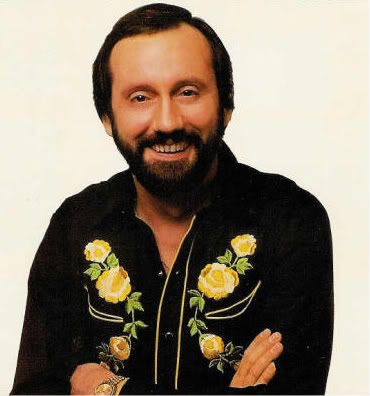 (This is one of my favorite pictures of Ray Stevens!!)
1963: Speed Ball/It's Party Time
1964: Bubble Gum the Bubble Dancer/Laughing Over My Grave
1968: Mr. Businessman/Face the Music
1970: America, Communicate With Me/Monkey See, Monkey Do
1973: Love Me Longer/Float
1974: The Streak/You've Got the Music Inside
1974: Everybody Needs a Rainbow/Inside
1975: Young Love/Deep Purple
1976: You Are So Beautiful/One Man Band
1978: Be Your Own Best Friend/With a Smile
1979: I Need Your Help, Barry Manilow/Daydream Romance
1980: Night Games/Let's Do It Right This Time
1981: Everything Is Beautiful/Gitarzan (Gold Standard RCA series)
1982: Where the Sun Don't Shine/Why Don't We Go Somewhere and Love
1983: Piece of Paradise Called Tennessee/Mary Lou Nights
1983: My Dad/Game Show Love
1983: Love Will Beat Your Brains Out/Game Show Love
1984: My Dad/Me
1985: The Haircut Song/Punk Country Love
1987: Would Jesus Wear a Rolex/Cool Down, Willard
1989: I Saw Elvis in a UFO/I Used To Be Crazy
As you can tell the collection is very small. I hadn't bought anything off eBay in a period of years and that's where I bought several of the singles that I own. Much of the singles were for sale through Ray's fan club which is no longer in existence. The fan club shut down in 2002 after a run of 15 years in operation. I was a member of the fan club during the last 7 years. Meanwhile, there are still 45's for sale on eBay all the time. I have a lot more vinyl albums, cassette tapes, and CD's of Ray Stevens than I do 45 singles...but they're too numerous to mention.
December 17, 2009
Ray Stevens: The 45 Singles...chapter...I've forgot...
 I posted a picture of the a-side of this single in my previous blog entry called "The Clown Prince of Country Music". The a-side is a song called "Speed Ball". The song was inspired more or less by a comedy routine from Brother Dave Gardner. In fact, if you hear any comedy routines from Brother Dave and you hear early Ray Stevens on Mercury Records you'll hear how much of an influence Gardner had on Ray. However, on the b-side, a song called "It's Party Time", we hear a story about the well-visited topic of lost love and putting on a happy face. There are many love songs about this topic and in my opinion what makes the topic feel refreshing in every different recording I hear happens to be connected with lyrics and delivery. A lot of critics of pop music or love songs tend to be a tad bit cynical and say things like "you've heard one love song you've heard them all". In my way of thinking, it's true, we all have heard the same sentiments...but what makes each song different is how the topic is dealt with. To date this song has not been featured on any Ray Stevens album or compilation that I am aware of. As far as I know, this 45 is the only place the song was commercially available. The a-side was available originally on the 1963 album, This Is Ray Stevens and has appeared on several other compilation releases from Mercury through the years.
 This same exclusive nature can be applied to this song, "Laughing Over My Grave". I got the camera too close to the single and the flash lit up some of the title. This is the b-side to "Bubble Gum the Bubble Dancer" and like "It's Party Time", the "Laughing Over My Grave" song is only available on the b-side of a 45. There have been You Tube video montage's made of both b-side songs. Thanks to technology there's a way to transfer vinyl onto CD and then it can be uploaded onto a computer. As far as commercial albums are concerned, though, "Laughing Over My Grave" has yet to make an appearance. The song is about a man who's been abusive to a woman and he's afraid of what she may do to him as a result. A hook of the song is the almost witch-like cackling of the female voice...a voice I assume is Ray in falsetto. As you can tell from my mini-description it's a light-weight song but yet it has a twist toward the end.
 The Best of Ray Stevens, issued in 1970 by Mercury Records, continues to be the best collection of Ray's material on Mercury Records. Unless you are able to come across an even more obscure collection on CD that features his first two albums in one collection, the best chances to have a good number of early '60s Ray Stevens is The Best of Ray Stevens that you see here. I have the collection in cassette format and I have the more obscure two album on one CD collection but I realize not everyone does. So, The Best of Ray Stevens is the best review of his 1961-1963 output. This collection kicks off with the version of "Ahab the Arab" that features Ralph Emery introducing Ray to a small crowd of people. When you hear him perform the song he adds in additional lyrics that aren't in the studio recording. Ralph makes a return appearance at the end when everyone's applauding...asking for even more applause. You'll know what I mean when you hear the song.
 The illustrations on the album cover are caricatures of the characters in Ray's songs. Off to his left is "Speed Ball", the motorcyclist. The corner pictures are: up in the top-left "Bubble Gum the Bubble Dancer", the top-right is "Butch Babarian". In the lower corners we have "Ahab the Arab" and "Harry the Hairy Ape". Off to Ray's right we have "Jeremiah Peabody" and below Ray's picture there's "Santa Claus is Watching You" and "It's Been So Long". The two panels immediately above Ray's picture is "The Rock and Roll Show" and the other panel, through elimination, must be "Loved and Lost" or "Funny Man". The ironic thing is the collection has 11 songs but there's only 10 cartoon panels on the album cover. The cassette copy that I have contains six cartoon panels.
 I've had this cassette for a number of years. Once upon a time it was the only collection of songs I had of Ray Stevens from the early '60s. As I mentioned above, there's 11 songs on here. The recordings were all produced by Shelby Singleton and all the songs were written by Ray. There are liner notes that accompany the collection. The author comments on the recent serious material of Ray's, including name-dropping "Mr. Businessman", but the author reminds consumers that Ray had always sang non-comical songs long before he gained national success with serious works. Naturally there is no reference to Monument Records, the label Ray was signed to throughout the mid to late '60s...and the label in which Ray experienced his first major successes with serious works like "Unwind", "Mr. Businessman", and "Have a Little Talk With Myself".
  These are not sunglasses that I'm wearing. My glasses tint in the sunlight and I brought my vinyl album of Ray's, Losin' Streak, to a house my sister lived in at one time. I had my picture taken with the album using my digital camera as you can tell. It must have been as an experiment as I hadn't had the camera that long. I now take my own pictures using that same camera or I use my web-camera if I want to take a picture quickly without dragging out the USB cord and digital camera. I've used this picture as an avatar on message boards and I think I had the picture here on the blogger site as my profile image before changing it to the one I currently use.
December 16, 2009
Ray Stevens: Clown Prince of Country Music
 A certain value has been placed on a lot of Ray Stevens items down through the years. Of course we're not talking about the kind of value that rakes in hundreds of thousands of dollars like most Elvis or The Beatles merchandise from the past. Instead I'm referring to personal value...that sort of priceless feeling that comes over you when listening to your 45's or your long-playing vinyl albums. Albums from artists that are valuable within one's own mind. I know that when I went through my vinyl buying stage of life I bought any vinyl album or single I could find of Ray Stevens on eBay that was in my price range. I mostly bought the vinyl albums but sometimes I'd buy a single. A lot of the singles that I have of Ray actually came from Ray's fan-club when it was active. Toward the end of the club's existence they got in their possession an inventory of 45's that they were selling. If I remember correctly the only catch was you could only buy 1 copy of a single. Some singles were in very limited quantities...and so if they had 30 copies of a single for sale, you could only purchase 1 copy to be fair to other buyers. This is how I was able to purchase so many singles of Ray's without really using an on-line auction site...but then the singles became unavailable...but I'm fortunate to have been at the right place at the right time to take advantage of the singles that the fan club was selling. The single above is the promo version of "The People's Court" from 1986. It's a spoof of the TV show of the same name but it wasn't promoted as much as I think it could have been. The song that Ray preferred to hype from the 1986 album was "Can He Love You Half as Much as I?"...and that song actually appears on 1987's Greatest Hits, Volume Two in spite of the fact that it didn't achieve a chart position as "The People's Court" and "Southern Air" did that same year. It's one of those songs that appears in his concerts and everyone cheers and applauds when he starts to sing it...a perfect example of a song that's a fan favorite and treated as a hit song even though it didn't reach the national music charts. There are plenty of those kinds of fan favorite songs in Ray's career.
  I have a 45 of this single but it doesn't have the fancy sleeve that you see here. However, this fancy sleeve with the record company logo on it graces a 45 that I have called "America, Communicate With Me". That single was released in 1970...meanwhile, "Indian Love Call" came along in 1975. This is the commercial copy, too, as it contains the funky illustration of the melted vinyl on the tree trunk. All artists who recorded for the Barnaby label had singles with this same illustration. When I was just discovering 45's I thought the funky illustration was just something that the label put on Ray's singles given his reputation for comedy and novelty songs...but that wasn't the case. Barnaby Records is what one would call an Independent label today...it was a subsidiary of larger labels. Originally in 1970 the distributor of Barnaby recordings were CBS. When the label was under the CBS banner, the paper on the vinyl recordings were a solid blue color. When Barnaby switched to MGM the color remained the same. When Janus became primary distributor that's when the melted vinyl illustration began appearing on the singles and albums.
  This is a picture I took with my digital camera. I'm holding up a single I bought from the fan-club quite awhile ago. It's a promo copy of "Speed Ball", a single that Ray had out in mid 1963. It reached the Top-70 of the Hot 100 and the Top-30 of the R&B chart that year. It was what you might call a quick hit...not a song that had long-lasting radio appeal...but it was popular in it's time. You can click the image for a bigger view. The b-side of the single is a ballad called "It's Party Time". I'm wearing rubber gloves because the picture sleeve gets dusty from time to time since it's the first one in my stack of Ray Stevens singles and is vulnerable to any surface dust that may form. I wipe any such surface dust away, though. The vinyl is clear, dust-free, and in mint condition according to my ears. One of the things that I feel I'm fortunate about is my vinyl albums and singles don't skip or pop...you know like the stereotypical record player will do. I've yet to experience an issue where the needle on my record player skips. I think, of course, that has more to do with the quality of the vinyl's surface than my own personal luck.
Ray Stevens is sometimes referred to as the Clown Prince of Country Music. It depends on who you ask...some feel that the nick-name is restrictive because it emphasizes his comical image over his body of work overall which includes a lot more than comedy songs. When I first heard the phrase "Clown Prince of Country Music" I felt then and still feel that it's a nick-name that certainly applies. When you get right down to it, it's the comical songs that will be Ray's lasting imprint. Although us Ray Stevens fans wish the public at large would recognize a lot more serious material from him besides "Everything Is Beautiful", I happen to understand that his comical recordings and his comical music videos have proven to be much more commercially successful by comparison. Ray was selling comedy 45's in the 1980's based pretty much on word-of-mouth and exposure on The Nashville Network and Hee-Haw. Country or pop radio certainly can't take credit for the success that Ray's singles experienced during much of the 1980's.
Now, of course, some out there may say something stupid like: "I don't think radio would want to take credit for any attention Ray's songs may have brought.". The point is, though, Ray sold strong enough during his years with RCA and MCA Records in the 1980's that airplay or lack thereof really didn't play a significant role in his on-going success. To paraphrase his longtime friend and songwriting partner, Buddy Kalb: "if there's a mountain or a road block in Ray's path he finds a way around it.".
In a lot of ways Ray has certainly earned the right to laugh at his critics and those who consistently scratched their heads with each new project he'd come out with. Why? Because of the success he's enjoyed in spite of any critical disdain or contempt that may have come his way. The fuss over "Mr. Businessman" back in 1968 being on the surface anti-capitalism, for example. "Everything Is Beautiful" in 1970 being optimistically cheery caused a lot of critics to reach for their headache medicine. This same feeling swept a lot of the critics in England, too, when Ray had a big hit in early 1971 with the gimmick novelty, "Bridget the Midget, The Queen of the Blues". In some people's minds the song was simply to inane and weird to purchase or even enjoy listening to. As usual the critics over-looked Ray's talent and production skills that are showcased throughout the song. The gimmick was the sped-up vocals of Bridget and her back-up group, sort of like a spoof of the Chipmunks. The single was a Top-5 hit in England...but yet, mysteriously, "nobody" was a fan of it. "The Streak", his 1974 monster hit, generated so much critical contempt you'd have thought Ray had just defected to communism or something awful like that...and for a single that is supposedly hated and something nobody purchased, how did it sell close to five million copies world-wide if people didn't like the song? The truth is, people liked the song and there's nothing to be ashamed of if you hear the song now and grin or chuckle at it....
 Here is another 45 of mine. As you can see I took the pictures on the same day. I keep my vinyl collection and my record player at a relatives house as there is no room in my own bedroom for the records...and so I often take my digital camera along with me if I know I'll be at the relative's house and I end up taking several pictures in one session instead of making frequent trips there. This is the 45 of "Bubble Gum The Bubble Dancer". It isn't a bubblegum song, though. The song is actually about a bubble dancer who goes by the name of Bubble Gum. It's a jazzy, up-tempo number about the exploits of a dancer who drives men wild. The bubble dance is something that was a feature in strip-clubs and other establishments that catered to that crowd. You can look up it's history and everything else on-line if you're so inclined.
 There are two slightly different takes on this song...there is one version that features Ray playing an announcer with a dopey kind of voice bringing out Bubble Gum to the applause of all. This dopey voice can be heard much more in the "Rock and Roll Show" that appeared originally on Ray's debut album in 1962.
There is another alternate take of "Bubble Gum the Bubble Dancer" that features Ray playing an announcer with a more rural drawl bringing out Bubble Gum to the delight of all. The songs, however, are exact duplicates...only the announcer's voice is different. This sort of thing wouldn't be noticed unless you happen to be a Ray Stevens nut-case like myself.
 This road book as I call it was issued in 1977 for Ray's international audience. Note the way the word "program" is spelled on the cover. The booklet was originally available overseas in England. It's not a tell-all book, of course. It's a write-up promoting an overseas series of concerts. It consists of rather large pictures of Ray and an essay giving a quick over-view of Ray's life in the music business. The last page is a write-up of Del Shannon, the artist that Ray was appearing in concert with over there. In spite of the fact that at various points in the early 1970's Ray was seen with his beard, the pictures in the road/tour book show only clean-shaven Ray Stevens. I've written about this booklet before but I decided to bring it back out and promote it again. I bought it on eBay and read it front to back the day it arrived in the mail.
December 3, 2009
Ray Stevens: The 45 Singles...another chapter...
 Revisiting a familiar topic of 45 singles causes me to post images of Ray Stevens singles in no particular order. Some singles are what is known as "promo singles" meaning that at the time of release they were available only at radio stations. Currently these promo singles are available all over eBay, the premiere on-line marketplace. Collectors usually place high value on promo singles due to their rare nature and the fact that the promo single wasn't part of the public domain. One of the distinct characteristics of a promo single verses a commercial single is the label color. Usually a promo single had white paper and the commercial single would have the official design. MCA, for example, their official label was blue with a rainbow design behind the song's title as you see below on 1984's "Mississippi Squirrel Revival" but their promo label was white, as you see on 1985's "The Ballad of the Blue Cyclone". In the case of that song, the single I chose to spotlight here is a color vinyl. Those are considered to be even more sought-after because of their extreme obscureness.
  "Mississippi Squirrel Revival" as I wrote about several months ago is in it's Silver Anniversary...it was recorded 25 years ago back in 1984. The single hit the Top-20 on the country charts and became one of his most popular that decade. A 1992 music video of the song has since become a staple on-line. For those who still don't know what the song is about it's about a squirrel who runs loose inside a church after it was snuck in by a couple of kids. The squirrel's antics are credited with causing miracles because once the squirrel runs afoul of Harv Newland and Sister Bertha, the two confess their sins amidst the pain. The melody is catchy as it conveys an old-time Dixieland-southern feeling...which is appropriate given that the song takes place in the south where one of the kid's grandmother lives in an Antebellum world.
 "Glory Special" is a gospel song from Ray's 1974 gospel album, Turn Your Radio On. It's the b-side of "Love Lifted Me", which didn't make the country or pop music charts. You can click the image for a bigger view. Ray's gospel album was re-issued on CD, paired with the album, Misty, in 2005. "Glory Special" is one of my favorites from his gospel album...it uses the imagery of a train. Ray vocally mimics the train...there isn't a train whistle in the tradition of Boxcar Willie; instead, we have Ray using various harmonies over-dubbing moans and hums to create the sound of the train gaining momentum...other vocal sound effects include the exhaust and the calls from the conductor.
  This single comes from 1989...it's a promo copy of "I Saw Elvis In A UFO". The song was a take-off on all of the Elvis sightings that routinely show up on tabloids then and still do today. In this song Elvis not only is alive but is seeing the sights of outer space with the likes of Jimmy Hoffa, Col Tom Parker, Howard Hughes, and Liberace. The song comes from the album, Beside Myself, which is 20 years old this year. Ray has never made a music video of this song, believe it or not, but he's performed the song on his Platinum selling Ray Stevens Live home video. In the performance a large UFO hovers above him as he's decked out in Elvis attire. Pink aliens show up mid-way through the song. This performance at his theater could serve as an unofficial music video.
Subscribe to:
Posts (Atom)