As a companion blog entry to my most recent blog series called Singling Out I decided to make a list of the vinyl singles of Ray Stevens that I have in my personal collection. As I've made note of in previous blog entries I don't have an enormous amount of his vinyl singles. This list may look surprising considering there aren't too many vinyl singles in my collection that became signature songs in his career. A simple answer for that being most of these singles I purchased on-line more than 10 years ago and as you could imagine the on-line auction sites always price the most notable single releases much higher...so, as a result, I don't have vinyl singles of a number of songs that are among his most notable. Now, having said that, I don't necessarily think I need to have specific recordings in my vinyl single collection to show how much of a fan I am. I more than make up for it with my collection of Ray Stevens vinyl albums, cassettes, and CDs.
1963: Speed Ball / It's Party Time
1964: Bubble Gum the Bubble Dancer / Laughing Over My Grave
1968: Mr. Businessman / Face the Music
1968: Funny Man / Just One of Life's Little Tragedies*^^*
1970: America, Communicate With Me / Monkey See, Monkey Do
1973: Love Me Longer / Float
1973: Mr. Businessman / Sunday Mornin' Comin' Down**
1974: Everybody Needs a Rainbow / Inside
1975: Young Love / Deep Purple
1976: You Are So Beautiful / One Man Band
1977: Dixie Hummingbird / Feel the Music
1978: Be Your Own Best Friend / With a Smile
1979: I Need Your Help, Barry Manilow / Daydream Romance***
1980: Shriner's Convention (Short Version) / Shriner's Convention (Long Version)
1981: Gitarzan / Everything is Beautiful*
1981: Night Games / Let's Do it Right This Time
1982: Where The Sun Don't Shine / Why Don't We Go Somewhere and Make Love
1983: Piece of Paradise Called Tennessee / Mary Lou Nights
1983: Love Will Beat Your Brains Out / Game Show Love
1983: My Dad / Me
1985: The Haircut Song / Punk Country Love
1987: Would Jesus Wear a Rolex / Cool Down, Willard
1989: I Saw Elvis in a U.F.O. / I Used To Be Crazy
*- This 1981 single was issued by RCA Records as part of their Gold Standard Series. Ray, being on RCA at the time, seen several of his older recordings re-issued on vinyl by RCA. I happen to own one of those.
**- Barnaby Records purchased Ray's recordings for Monument Records in the early '70s. As a result of this purchase Barnaby would often re-issue Ray's Monument recordings as if they had been released on Barnaby...complete with a Barnaby Records logo and catalog number, etc. I have one of those re-issues in my collection.
*^^*- Mercury Records, in 1968, re-issued Ray's 1963 single. The 1968 re-issue has a different catalog number as well. Both the A and B side are recordings from 1963.
***- This 1979 single was released, originally, with a picture sleeve. I don't have a picture sleeve accompanying my copy of the single. It's my guess that the picture sleeve became something of an exclusive and therefore any re-issues of the single by Warner Brothers were in plain paper sleeves and that's why I don't have a picture sleeve for this particular single. I've seen the single and it's picture sleeve come up for sale on-line, though, but I've never made a purchase. My reasoning is: I already have the vinyl single...do I want to buy an extra copy of the single just for the picture sleeve? The collector in me says "yes!" but then I talk myself out of it because I already have a copy of the single (minus a picture sleeve). Someday I may purchase a copy of the single with it's picture sleeve.
Showing posts with label 45 RPM. Show all posts
Showing posts with label 45 RPM. Show all posts
May 16, 2020

July 3, 2011
Ray Stevens: 45's at 45...
Several singles from Ray Stevens reach 45 this year...as most people who visit this fan blog are aware I have several continuing blog titles. Often I like to play on the numbers such as "45 at 20" or "45 at 30", etc. etc. and today's blog is no different. Released on Monument Records in 1966 were a trio of 45's by Ray Stevens that turn 45 this year: "A-B-C", "Devil May Care", and "Freddie Feelgood". I like all of those songs (not a big surprise!) and I also like the B-sides, too: "Party People", "Make a Few Memories", and "There's One In Every Crowd". Ray is at his throatiest in several of these songs...and let's see how many people can resist not tapping your foot in rhythm while Ray, in song, insists to the woman that it's best to "Make a Few Memories" before they end their relationship.
 "A-B-C" is your typical pop love song of the era while it's B-side, "Party People", has another one of those irresistible melodies. "Devil May Care" has an arrangement nearly similar to "Down in the Boondocks" which isn't too surprising considering both songs were written by Joe South. In fact, South wrote several of the songs that Ray recorded during 1966-1967. South is credited as the songwriter on not only "Devil May Care" but also "Party People" and "Make a Few Memories". Ray wrote "A-B-C", "Freddie Feelgood", and "There's One In Every Crowd". Also, for those who don't know, out of those six recordings that were issued in 1966, only one of them was a pure novelty song as evidenced by it's eye-catching title: "Freddie Feelgood". The full title is actually "Freddie Feelgood and His Funky Little Five Piece Band". The song illustrates the love of small R&B/jazz combo's that Ray has always said he has a fondness for. This is why you rarely hear a stone-cold country music recording from Ray...unless he's intentionally arranging a song to sound country. A lot of the time Ray performed what's been described as bluesy-country. When Ray started to navigate toward country music in the late '70s he was no stranger to country music audiences...and the non-comical recordings that he put out in the late '70s and early '80s were chock full of bluesy sounding arrangements.
Decades later, in 2000, "Freddie Feelgood" was made into a music video. In the video Ray plays all members of the band. In one scene all five of them appear on screen together playing the instruments. Obviously this is achieved through camera tricks and other video techniques allowing Ray to appear on screen multiple times. To refresh the memories of the readers out there: Freddie played trumpet; Yum-Yum played the drums; Ace played the bass; Tyrone played trombone; Percy played piano. Those who want to see the music video look no further than Ray's own web-store. A link to one of the store's pages is located below.
The 2000 home video, Funniest Video Characters, has long been out of print but you can find the "Freddie Feelgood" music video in a DVD compilation called Complete Comedy Video Collection located here at Ray's web-store. The DVD features a total of 20 music videos. It collects 7 music videos from 1992's Comedy Video Classics; 3 music videos from 1995's Get Serious! direct-to-video movie; all 8 music videos from 2000's Funniest Video Characters; plus 2 additional bonus music videos from 2002 and 2004 respectively.
 Exquisite may be the best word to describe 1966's "Party People". Admittedly, I'm not a party hound, so this song became an instant favorite the moment I heard it for the first time. There was a CD re-issue of Ray's 1968 album, Even Stevens, during the mid '90s and as one of the bonus tracks was a song called "Party People". That CD re-issue is where I heard this song for the first time. Spoiler alert: There's a bit of irony within the song as Ray laments that even though he's lost the woman due to the allure of the party life he finds himself falling victim to the very same lifestyle he admonished the woman for. For him, having the woman was his own kind of party...but now that she's gone he finds himself becoming one of those "Party People" that he seemingly has an equal understanding and disgust for. At least that's my interpretation of the song...others may come away with a completely different interpretation.
 "A-B-C" is your typical pop love song of the era while it's B-side, "Party People", has another one of those irresistible melodies. "Devil May Care" has an arrangement nearly similar to "Down in the Boondocks" which isn't too surprising considering both songs were written by Joe South. In fact, South wrote several of the songs that Ray recorded during 1966-1967. South is credited as the songwriter on not only "Devil May Care" but also "Party People" and "Make a Few Memories". Ray wrote "A-B-C", "Freddie Feelgood", and "There's One In Every Crowd". Also, for those who don't know, out of those six recordings that were issued in 1966, only one of them was a pure novelty song as evidenced by it's eye-catching title: "Freddie Feelgood". The full title is actually "Freddie Feelgood and His Funky Little Five Piece Band". The song illustrates the love of small R&B/jazz combo's that Ray has always said he has a fondness for. This is why you rarely hear a stone-cold country music recording from Ray...unless he's intentionally arranging a song to sound country. A lot of the time Ray performed what's been described as bluesy-country. When Ray started to navigate toward country music in the late '70s he was no stranger to country music audiences...and the non-comical recordings that he put out in the late '70s and early '80s were chock full of bluesy sounding arrangements.
 Decades later, in 2000, "Freddie Feelgood" was made into a music video. In the video Ray plays all members of the band. In one scene all five of them appear on screen together playing the instruments. Obviously this is achieved through camera tricks and other video techniques allowing Ray to appear on screen multiple times. To refresh the memories of the readers out there: Freddie played trumpet; Yum-Yum played the drums; Ace played the bass; Tyrone played trombone; Percy played piano. Those who want to see the music video look no further than Ray's own web-store. A link to one of the store's pages is located below.
The 2000 home video, Funniest Video Characters, has long been out of print but you can find the "Freddie Feelgood" music video in a DVD compilation called Complete Comedy Video Collection located here at Ray's web-store. The DVD features a total of 20 music videos. It collects 7 music videos from 1992's Comedy Video Classics; 3 music videos from 1995's Get Serious! direct-to-video movie; all 8 music videos from 2000's Funniest Video Characters; plus 2 additional bonus music videos from 2002 and 2004 respectively.
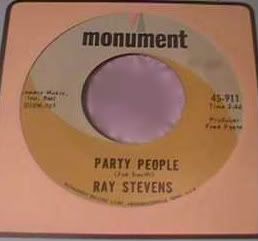 Exquisite may be the best word to describe 1966's "Party People". Admittedly, I'm not a party hound, so this song became an instant favorite the moment I heard it for the first time. There was a CD re-issue of Ray's 1968 album, Even Stevens, during the mid '90s and as one of the bonus tracks was a song called "Party People". That CD re-issue is where I heard this song for the first time. Spoiler alert: There's a bit of irony within the song as Ray laments that even though he's lost the woman due to the allure of the party life he finds himself falling victim to the very same lifestyle he admonished the woman for. For him, having the woman was his own kind of party...but now that she's gone he finds himself becoming one of those "Party People" that he seemingly has an equal understanding and disgust for. At least that's my interpretation of the song...others may come away with a completely different interpretation.
January 14, 2011
Ray Stevens and the Bands...
 One of the more zany novelty songs in the career of Ray Stevens arrived 45 years ago in 1966 in the form of "Freddie Feelgood and His Funky Little Five Piece Band". The official spelling is Freddie...although some record label's through the years have spelled it as Freddy. The song makes good use of the scat-singing style of performance which is often under-appreciated and under-rated. Ray doesn't do many performances with scat-singing but there's a few...and this 1966 single happens to be one of them. Ray vocally imitates several instruments in this performance...except for the piano. The drummer in the band, Yum-Yum, is the main highlight as far as the scat-singing goes. In Yum-Yum, Ray goes all out and comes off sounding exactly like any number of classic Jazz artists known for scat-singing and then for the trumpet man, Freddie Feelgood, he reverses the emotion with a low-key vocalization. The members of the band are as follows...
1. Yum-Yum: Drum
2. Tyrone: Trombone
3. Ace: Bass
4. Percy: Piano
5. Freddie: Trumpet
As anyone can see, several of the band member's names rhyme with their instrument. This particular song required the aid of multi-tracking which is something I consider Ray Stevens a legend in. I'm sure multi-tracking/over-dubbing was going on prior to Ray's arrival on the music scene but in my opinion Ray used the technology more than most. Today it's common for songs to be constructed piece by piece...one day a producer will add instrumentation, the next day a performer will add their vocals, the next day the producer may splice in more instruments or subtract instruments and then piece it all together as one recording. Ray was doing this sort of thing years before it become commonplace. Ray also is one of the few that over-dubs his own voice in several harmonies to sing against. He's always had a back-up group of some kind...for many years it's usually been 3 or 4 females...but there were also instances where he'd sing his own back-up harmony on his recordings in addition to what the actual back-up group were contributing.
"Freddie Feelgood" reached the charts in 1966 but just barely. Three years later the song appeared on Ray's Gitarzan album with laughter over-dubbed onto the recording. This audience enhanced version is usually what appears on many of the compilation albums and CD's from the '70s through the '90s. Ray re-recorded the song for a music video adaptation in 2000.
The concept of "Freddie Feelgood" served as inspiration for a couple of other Ray Stevens songs. 1984's "Ned Nostril", while musically based almost entirely on Johnny Cash's "Folsom Prison Blues", it nonetheless incorporates non-verbal musical accompaniment at various stages in the song. The story of "Ned Nostril" centers around a man who apparently has a big nose but for the purpose of comedy we're to imagine that it's as long as Pinocchio's nose. Ned's band was described as being a group of ragweed sniffers...resulting in allergy-laden, watery eye conditions. Ned made music by humming through his nose while his band sniffed, coughed, and gagged their way to fame. Ray performs the song as Johnny Cash. The full, official title of this 1984 recording is "Ned Nostril and His South Seas Paradise, Puts Your Blues On Ice, Cheap at Twice the Price Band, Ikky-Ikky, Ukky-Ukky".
In 1990 "Freddie Feelgood" received some competition in the form of "Cletus McHicks". "Cletus McHicks and His Band From the Sticks", an up-tempo sing-a-long made up almost entirely of end rhymes, introduced us to a new set of musicians.
1. Flip: Bass
2. Eugene: Drum
3. Mose: Steel Guitar
4. Cletus: Guitar
August 2, 2010
Ray Stevens: 45 at 41...
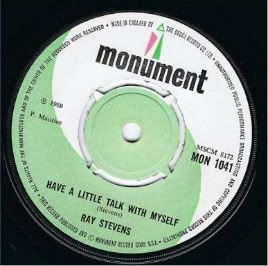 Later this year a certain 45 single from Ray Stevens hits 41. The image of the single is off to the left...this particular image is the United Kingdom release of "Have a Little Talk With Myself". The single was released late in 1969 and it serves as a title track to one of Ray's most under-rated albums. The single in fact hit the country chart during the final week of 1969 and it reached it's peak during the first week of 1970. Yes, you read that correctly...this majestic, exquisite single about self-reflection, ego, and introspection was on the country music charts for just two weeks. The fact that it was on the country music chart in 1969 was a foreshadowing of Ray's eventual switch to the country music market. Prior to this single's release he had made his debut earlier in 1969 on the country chart with "Sunday Mornin' Comin' Down". It's just my opinion but I feel as if those two appearances on the country charts were a fluke...none of my research indicates that Monument Records sought out country radio support. The telling thing about Ray's future singles, though, were the cross genre flip-flopping that would occur. In a period of about 5 and a half to 6 years Ray Stevens singles would consistently chart pop, country, and Adult-Contemporary. Some of his singles would even cross the oceans and chart internationally during this 1969-1975 time period. Adult-Contemporary at the time was referred to as Easy-Listening or Middle of the Road. It was music aimed at adults who considered themselves fans of "pop music" but weren't necessarily fans of the younger, teenage-driven "Top-40" pop music.
 As a Ray Stevens fan and nostalgia nut, looking back, I noticed that Ray's success relied almost entirely on the older, adult-driven market...but some of his songs would appeal to the mostly younger Top-40 set. A single released by Ray 40 years ago, namely "America, Communicate With Me", is a perfect example of the discrepancy between the various age groups and what one age group thought was great and what one age group didn't embrace as much. Among the Top-40 listeners the single did moderately well...almost reaching Top-40 status...but over in the radio formats aimed at the adults 35 and older the single reached the Top-15. Going by that statistic it goes a long way at explaining Ray's long-standing appeal and why it wasn't so difficult to market him as a country singer as time went on.
The Have a Little Talk With Myself album featured a couple of new songs but the bulk of the material was Ray's versions of contemporary pop hits by other artists. I wrote about this album in a previous blog entry called Have a Little Talk...about Ray!. You all can find it by exploring the archives on the right hand side of the screen.
 A couple years ago Ray issued a CD where he covered the songs of Frank Sinatra. The CD was originally released in 2008 on his own label and sold exclusively through his own web-site and during concert stops. The actual title is Ray Stevens Sings Sinatra...Say What??. I purchased by copy at a merchandise table at one of his concerts. When I saw the CD I was stunned because at the time it wasn't being sold on his web-site and I'd wondered why...I then assumed that it must be an exclusive to concert goers but then it became available at his web-site store. Anyway, in 2009 the CD was released nationally but without any fanfare or promotion...I think it's a great CD salute. In an attempt, perhaps, to create a mood or an ambiance, Ray has the music come off like it's from a small, intimate session at some all-night lounge...complete with audience cheers and applause. Ray doesn't keep the same arrangements on every song, though, and the musical accompaniment is more along the jazz/R&B side than big band and swing. A couple of the songs are shortened, as well. The CD contains the following songs made famous by Sinatra...
I’ve Got You Under My Skin
Night and Day
I Get A Kick Out Of You
All The Way
High Hopes
Witchcraft
The Tender Trap
Young At Heart
Strangers In The Night
That’s Life
May 26, 2010
Ray Stevens: 45 at 35...
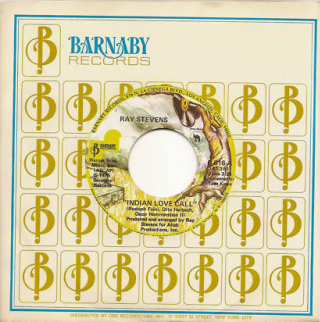 Well, here's some discussion about a couple of 45's from 35 years ago...back in 1975 Ray Stevens was amidst a streak of hit singles that had started in 1968. In 1975 he was on the pop and country charts with "Misty" and later that year, "Indian Love Call". A lot of ink is given to "Misty" and rightfully so...it was a Grammy winner for Ray. However, not much attention is given to the other songs that populated the Misty album that year. "Indian Love Call" is a wonderful vocal performance...the melody is changed from what one may be accustomed to and there's some high tenor love calls heard throughout. The calls are not as high or shrilly as Slim Whitman's worldwide hit version but the vocal dynamics from Ray more than make up for it. The arrangement is jazzy, almost doo-wop like. The recording became a country hit and it crossed over to the pop chart as well. It didn't get much pop radio airplay but the strength of it's sales enabled it to rank among the Top-70.
 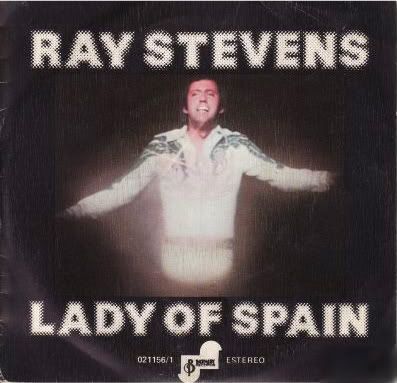 This single's catalog number is Barnaby-619 and it's b-side is "Mockingbird Hill". The single didn't enter the country or pop music charts but nevertheless it's from the 1975 Misty album. This was a follow-up to Ray's version of "Young Love", which hit the country Top-50 in late 1975. Ray's version of "Lady of Spain" is quite a departure, vocally. In the song Ray comes across sounding a lot like Fats Waller in some places. The original version of the song was a crooning love ballad performed by a host of pop music artists but in the hands of Ray Stevens it was turned into an uptempo party song. The Spanish music introduction in Ray's version soon fades away to an urgent early rock and roll arrangement. Ray seems to be completely wrapped up in the free for all performance that he excitedly hollers out "blow it, Norman!!" to the album's saxophonist, Norman Ray, prior to the instrumental solo. I would've loved to see him perform the song, in this arrangement, in concert. Heck, I would've loved to have been in the studio while he was recording this song! It's one of my favorites from the Misty album. The Mp3 digital album of Misty is available at Amazon but their sound clip doesn't necessarily convey the mood of "Lady of Spain" because it's, after all, a sound clip...it doesn't represent the song as a whole. It cuts off right before the rocker instrumentation kicks in.
March 2, 2010
Ray Stevens: 45 at 20...
Welcome to my latest Ray Stevens blog entry! This time around I'm going to write about a certain song that was recorded and released by Ray in 1990. The song is "Help Me Make It Through the Night". The song had been around for decades prior to Ray recording his version of it. This marked the second time that Ray recorded a song written by Kris Kristofferson. The first time around was in 1969 when Ray became the first artist to record "Sunday Morning Coming Down". Ray's take on "Help Me Make It Through the Night" became much more popular as a music video in 1990 than it did a radio hit. His performance of the song is clearly the most wild interpretation and it's what the country music audience came to expect and appreciate from Ray. The song was also a sort of unofficial tip of the hat to Spike Jones...more than any previous novelty song from Ray Stevens, this one contained an abundant supply of sound effects and noises. A 45 RPM was released to disc jockey's only. Sometimes that DJ promo copy can be found for sale on-line. The promo features the same song on both sides of the single as was the custom for promo singles. The color of the paper is white...which is another indication that the single wasn't originally meant for commercial use. Ray rarely performed the song in concert and my guess is due to the over-dubbing and the sound effects that are heard. It's been said that on a television show it's difficult to time a song because of the nature of commercial breaks and the possibility a sound effect not working when it's suppose to, which can throw off a performance. I've only seen Ray perform the song once...and it wasn't technically a full-length performance. Here's the story...
Back in 1990 Ray appeared on an episode of Nashville Now. He was there to promote his latest album and his first for Curb Records, Lend Me Your Ears. While there, Ray began to croon the first few lines of "Help Me Make It Through the Night" and then out walks the host of the show, Ralph Emery, dressed up as the Southern Colonel. Ralph complained that the song was going too slow...afterward the screen faded to black and the music video of the song began playing. The song, for those who hadn't heard Ray's version, is an up-tempo performance. Then, just as the video was about to transition to the final scenes, the screen faded to black and we see Ray at the piano on the Nashville Now set closing out the song, in crooner style, and Southern Colonel Ralph expressing his appreciation at the upbeat tempo of the song. That was the first and only time I'd seen Ray perform the song anywhere and as I was mentioning it wasn't technically an actual performance because the music video was edited in and that's what the people at home and in the studio audience were watching.
Later on in this same episode Ray sang "Barbeque". How I wish I had the foresight to tape these programs where Ray Stevens made an appearance!! I'd love to see them over and over and over again.
 This is a song you don't hear much about. It was released as a single in 1968 and it's from, as you can see, his Even Stevens album. The song is about a man who's excited about heading home after a stress filled day at work. He considers being away from the city and out in the country as his great escape. The song has no connection to the movie of the same name from the early '60s. "The Great Escape" in hindsight should have been the B-side of the single but it was pushed as the A-side when it hit the market. This is not to be taken as a slam against the song but when you hear it and then hear the B-side, "Isn't It Lonely Together?", you may also come away thinking the same thing. The B-side is a tragic story of a couple who have to deal with the consequences of a one-night stand. The woman in the song becomes pregnant and the man wrestles with the idea of doing the right thing and marrying her. Modern-day listeners may cynically wonder why there's a dilemma at all when abortion is an option and the man or the woman can be independent from one another...but, don't forget, that kind of a mind set is of modern-day while this song is from 1968. Modern-day listeners should also realize that the song can be interpreted as being pro-family and anti-abortion...and modern-day listeners should also realize that this was five years before the landmark abortion case, Roe v. Wade, came to it's conclusion. In hindsight I think the reason why "The Great Escape" was pushed as the A-side is because the subject matter couldn't be construed as being controversial.
Speaking of controversy...health care overhaul, also known as ObamaCare, seems to have a life of it's own, still. In spite of the common sense belief that the health care bill will do more harm than good and in spite of the fierce polarization that's taken place between the two political parties and among the American public in general...in spite all of that and in spite of loud messages to Congress and to the President to start over on health care, the Congressional majority plan on continuing down the path they're on. Even a scaled-back version of ObamaCare is not what the doctor ordered. The entire thing needs scrapped. In the meantime, the ObamaCare song from Ray Stevens, also known as "We The People", is currently sitting with 2,730,025 views on You Tube.
Back in 1990 Ray appeared on an episode of Nashville Now. He was there to promote his latest album and his first for Curb Records, Lend Me Your Ears. While there, Ray began to croon the first few lines of "Help Me Make It Through the Night" and then out walks the host of the show, Ralph Emery, dressed up as the Southern Colonel. Ralph complained that the song was going too slow...afterward the screen faded to black and the music video of the song began playing. The song, for those who hadn't heard Ray's version, is an up-tempo performance. Then, just as the video was about to transition to the final scenes, the screen faded to black and we see Ray at the piano on the Nashville Now set closing out the song, in crooner style, and Southern Colonel Ralph expressing his appreciation at the upbeat tempo of the song. That was the first and only time I'd seen Ray perform the song anywhere and as I was mentioning it wasn't technically an actual performance because the music video was edited in and that's what the people at home and in the studio audience were watching.
Later on in this same episode Ray sang "Barbeque". How I wish I had the foresight to tape these programs where Ray Stevens made an appearance!! I'd love to see them over and over and over again.
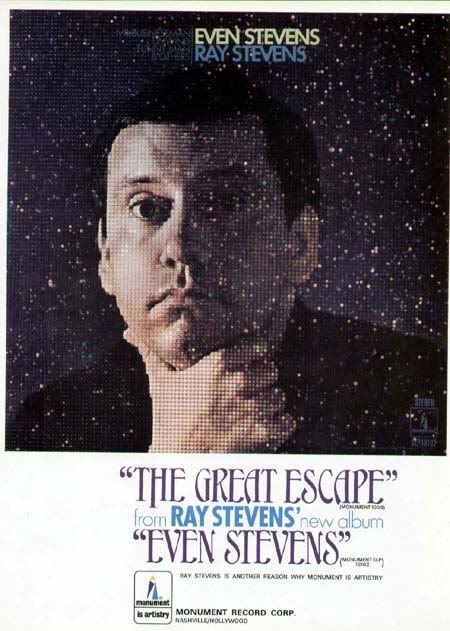 This is a song you don't hear much about. It was released as a single in 1968 and it's from, as you can see, his Even Stevens album. The song is about a man who's excited about heading home after a stress filled day at work. He considers being away from the city and out in the country as his great escape. The song has no connection to the movie of the same name from the early '60s. "The Great Escape" in hindsight should have been the B-side of the single but it was pushed as the A-side when it hit the market. This is not to be taken as a slam against the song but when you hear it and then hear the B-side, "Isn't It Lonely Together?", you may also come away thinking the same thing. The B-side is a tragic story of a couple who have to deal with the consequences of a one-night stand. The woman in the song becomes pregnant and the man wrestles with the idea of doing the right thing and marrying her. Modern-day listeners may cynically wonder why there's a dilemma at all when abortion is an option and the man or the woman can be independent from one another...but, don't forget, that kind of a mind set is of modern-day while this song is from 1968. Modern-day listeners should also realize that the song can be interpreted as being pro-family and anti-abortion...and modern-day listeners should also realize that this was five years before the landmark abortion case, Roe v. Wade, came to it's conclusion. In hindsight I think the reason why "The Great Escape" was pushed as the A-side is because the subject matter couldn't be construed as being controversial.
 Speaking of controversy...health care overhaul, also known as ObamaCare, seems to have a life of it's own, still. In spite of the common sense belief that the health care bill will do more harm than good and in spite of the fierce polarization that's taken place between the two political parties and among the American public in general...in spite all of that and in spite of loud messages to Congress and to the President to start over on health care, the Congressional majority plan on continuing down the path they're on. Even a scaled-back version of ObamaCare is not what the doctor ordered. The entire thing needs scrapped. In the meantime, the ObamaCare song from Ray Stevens, also known as "We The People", is currently sitting with 2,730,025 views on You Tube.
January 9, 2010
Ray Stevens: Misty at 35
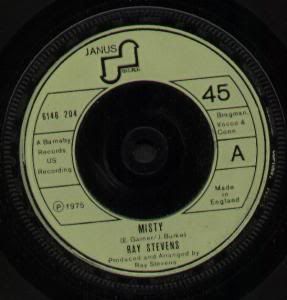 1975 in the career of Ray Stevens was highlighted by the success of "Misty", a song that dated back to the 1950's. The song had became popular by way of Erroll Garner, a piano player. Garner wrote the music and had an instrumental hit with it and then Johnny Burke wrote lyrics to the song a short time later. The lyrical version of the song became the most widely known when recorded by Johnny Mathis in 1959. The song itself was inducted into the Grammy Hall of Fame twice. The first time came along in 1991 when the instrumental was inducted and then in 2002 the vocal version of the song was put into the Grammy Hall of Fame. "Misty" had been recorded several times after Johnny Mathis but the most popular version of the song to depart from the traditional slow ballad approach was the 1975 cover version by Ray Stevens.
Ray's 1975 album was chock full of pop-standards. Well, I should say, his version of pop-standards. The Misty album featured the title track along with a healthy dose of pop-standard covers. The album did boast two original songs: "Sunshine", an up-tempo banjo heavy sing-a-long that Ray wrote and then the slow ballad from the pen of Layng Martine, Jr. titled "Take Care of Business". The rest of the album featured his take on several pop music classics. "Misty" was the stand-out and it went on to become a Top-20 pop hit plus it became a Top-5 country hit. The arrangement of the song, heavy on banjo and steel guitar and performed mid-tempo, won Ray his second Grammy award for Best Arrangement. His first Grammy winner was his 1970 #1 hit "Everything Is Beautiful". There were a couple more singles released from the 1975 album but they didn't match the runaway success of "Misty". The other singles from the album were "Indian Love Call", "Young Love", and "Mockingbird Hill"; of those three, "Indian Love Call" became the most successful...reaching the Top-40 on the country music chart. If you notice anything different about the 45 it's because of the international distribution. Janus distributed the music on Barnaby Records overseas. The image in this blog is of the United Kingdom release of "Misty".
1. Misty
2. Indian Love Call
3. Over the Rainbow
4. Oh, Lonesome Me
5. Sunshine
6. Cow-Cow Boogie
7. Young Love
8. Deep Purple
9. Mockingbird Hill
10. Take Care of Business
11. Lady of Spain
January 3, 2010
Ray Stevens: 45 at 50
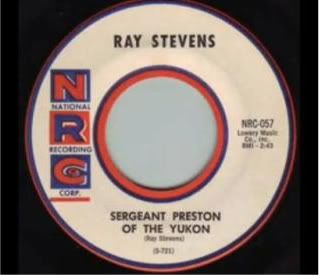 With the temperature outside dipping down into the low teens I felt like adding another blog entry into my "45 at..." series. This time around we have a Ray Stevens 45 at 50. This single saw it's release in 1960 and for most Ray Stevens fans we all know the story behind this song and the fall-out it received at the time. Let's just explain some things for those who may not know. This particular single, "Sgt. Preston of the Yukon", is a novelty single about the character that at the time was one of the more successful live-action children's shows with considerable action and adventure. In most episodes Sgt. Preston would be in some sort of predicament or he'd need assistance at the last second and usually his dog, King, would come to the rescue. Preston, a fictional member of the mounties, became the prototype for just about every Canadian Mountie spoof and caricature throughout the '50s, '60s, and '70s. Mounties aren't spoofed much, if at all, anymore, because of dreaded political correctness, I assume, where people here in America tend to be overly sensitive about how other culture's and other ways of living are depicted on television and in movies. But that's just my theory.
Anyway...after Ray wrote, recorded, and NRC released the single in 1960, it shown some signs of becoming a national hit song. In fact, the single came close to breaking into the Hot 100 pop chart that year...but as word-of-mouth spread it must have spread to the owners of the Sgt. Preston character, too. The owners threatened a lawsuit unless the song was removed from distribution. As history shows, the song was pulled from the market and several months later NRC went bankrupt. Ray found himself on the doorstep of Mercury Records in 1961...well on his way to becoming a popular attraction and singer.
The obscure recording hasn't been well circulated on album or CD but once in awhile it will pop up on an oldies collection...one of the more prominent collections that the song appeared on was All-Time Greatest Hits, a compilation by Varese Sarabande in 2001. This CD is where I heard the song for the first time and I loved the dog howls and everything...the thing that makes me laugh the most besides the dog howls is the narration. Ray was 21 when he recorded the song.
December 27, 2009
Ray Stevens: 45 at 39
 It was 39 years ago this month that a certain novelty single became a hit for Ray Stevens. It was a novelty single in the truest sense of the word. The utterly bizarre concept and the execution of the music and lyrics was comic genius in my opinion. This single, to the best of my knowledge, wasn't suppose to be a major hit because at the time it was released as a single-only and it didn't appear on any long-playing (LP) album. Add to this the fact that a month earlier in November of 1970 Ray's record label issued the much more serious recording, "Sunset Strip". While "Sunset Strip" became a Top-20 hit with Adult-Contemporary radio listeners, called Easy-Listening at the time, it's performance on the mostly sales-driven Hot 100 wasn't as successful. It peaked in the Top-85 of that chart but as I mentioned it did real well with the adult audiences of the time period. How odd, though, that his record label decided to release a new single barely a month after "Sunset Strip" hit. Ray has often said that in a lot of cases he'd come up with strange or bizarre idea's for comedy songs out of the blue that nobody else would touch and so he'd end up recording the songs himself. I happen to think that this is one of those cases when it comes to "Bridget The Midget", a novelty single that hit in December of 1970.
 As I mentioned, the single was only available at the time on a 45 and the fact that it was released a month after "Sunset Strip" indicates to me that there wasn't suppose to be much attention focused on the comedy song. Remember, 1970 was the year of "Everything Is Beautiful" and other more serious recordings from Ray...and it was in late 1969 and throughout the first 11 months of 1970 that music buyers and TV watchers were becoming used to the dead-serious Ray Stevens who had a comical side. Previously, Ray had been known as the comical singer who had a serious side. So, just as the serious Ray had become accepted again out comes "Bridget The Midget" and he's labeled a comedy act once more. The novelty single reached it's peak in early 1971 and in America the song managed to climb into the Top-50 on the pop chart but over in England the single tickled their funny bones, I imagine, because it reached the Top-5 on their pop music chart. The single features the gimmick of sped-up vocals to achieve the singing and talking voice of Bridget, a go-go dancer. The song takes place inside a go-go where Ray plays all the characters. He portrays the singer/narrator, the stagehand, the hippie patron, Bridget and her back-up group.
The single remained on a 45 until some point in the early '70s when it was placed on an album. Since then it's become a fixture on just about all the compilation albums that record labels have issued on Ray through the years. The image below is my Tower of Stevens. Actually it's my cassette tape tower and I snapped a picture of the Ray Stevens section. It's a digital picture that I took this morning and if you click it you'll be able to see a bigger image. I didn't get the 2002 release, "Osama Yo' Mama" into the shot because it's elsewhere in my bedroom because as you can see there would be no room for it...all of the slots are taken up by other cassettes.
 The first cassette tape I lucked out and found on-line. I still keep my eyes open for cassette copies of Ray's 1980's out put. So far Shriner's Convention on RCA, from 1980, is the only album from his 1980-1982 RCA tenure that I've been able to find in cassette format. The tape underneath Shriner's Convention is the 1983 Greatest Hits release that RCA issued which features just two RCA recordings...the rest of his RCA singles weren't spotlighted. For a more legitimate look at some of his RCA recordings one should seek out Collector's Series from 1985. In my Tower of Stevens it's the fifth tape shown. The collection only spotlights eight recordings, though. It was a budget-priced series that RCA issued on artists that had recorded for the label both past and current. For anyone who comes across this blog entry or any other one that I've written be aware that I don't offer links to free downloads. I don't offer links to anything free. The way I see it, 99 cents doesn't kill anyone. That's how much songs on-line cost. So, for those who want to hear the songs I write about in my blog entries, search for them at Amazon's MP3 store or at Itunes...or visit Ray's web-site store and purchase CD's or DVD's.
December 16, 2009
Ray Stevens: Clown Prince of Country Music
 A certain value has been placed on a lot of Ray Stevens items down through the years. Of course we're not talking about the kind of value that rakes in hundreds of thousands of dollars like most Elvis or The Beatles merchandise from the past. Instead I'm referring to personal value...that sort of priceless feeling that comes over you when listening to your 45's or your long-playing vinyl albums. Albums from artists that are valuable within one's own mind. I know that when I went through my vinyl buying stage of life I bought any vinyl album or single I could find of Ray Stevens on eBay that was in my price range. I mostly bought the vinyl albums but sometimes I'd buy a single. A lot of the singles that I have of Ray actually came from Ray's fan-club when it was active. Toward the end of the club's existence they got in their possession an inventory of 45's that they were selling. If I remember correctly the only catch was you could only buy 1 copy of a single. Some singles were in very limited quantities...and so if they had 30 copies of a single for sale, you could only purchase 1 copy to be fair to other buyers. This is how I was able to purchase so many singles of Ray's without really using an on-line auction site...but then the singles became unavailable...but I'm fortunate to have been at the right place at the right time to take advantage of the singles that the fan club was selling. The single above is the promo version of "The People's Court" from 1986. It's a spoof of the TV show of the same name but it wasn't promoted as much as I think it could have been. The song that Ray preferred to hype from the 1986 album was "Can He Love You Half as Much as I?"...and that song actually appears on 1987's Greatest Hits, Volume Two in spite of the fact that it didn't achieve a chart position as "The People's Court" and "Southern Air" did that same year. It's one of those songs that appears in his concerts and everyone cheers and applauds when he starts to sing it...a perfect example of a song that's a fan favorite and treated as a hit song even though it didn't reach the national music charts. There are plenty of those kinds of fan favorite songs in Ray's career.
  I have a 45 of this single but it doesn't have the fancy sleeve that you see here. However, this fancy sleeve with the record company logo on it graces a 45 that I have called "America, Communicate With Me". That single was released in 1970...meanwhile, "Indian Love Call" came along in 1975. This is the commercial copy, too, as it contains the funky illustration of the melted vinyl on the tree trunk. All artists who recorded for the Barnaby label had singles with this same illustration. When I was just discovering 45's I thought the funky illustration was just something that the label put on Ray's singles given his reputation for comedy and novelty songs...but that wasn't the case. Barnaby Records is what one would call an Independent label today...it was a subsidiary of larger labels. Originally in 1970 the distributor of Barnaby recordings were CBS. When the label was under the CBS banner, the paper on the vinyl recordings were a solid blue color. When Barnaby switched to MGM the color remained the same. When Janus became primary distributor that's when the melted vinyl illustration began appearing on the singles and albums.
  This is a picture I took with my digital camera. I'm holding up a single I bought from the fan-club quite awhile ago. It's a promo copy of "Speed Ball", a single that Ray had out in mid 1963. It reached the Top-70 of the Hot 100 and the Top-30 of the R&B chart that year. It was what you might call a quick hit...not a song that had long-lasting radio appeal...but it was popular in it's time. You can click the image for a bigger view. The b-side of the single is a ballad called "It's Party Time". I'm wearing rubber gloves because the picture sleeve gets dusty from time to time since it's the first one in my stack of Ray Stevens singles and is vulnerable to any surface dust that may form. I wipe any such surface dust away, though. The vinyl is clear, dust-free, and in mint condition according to my ears. One of the things that I feel I'm fortunate about is my vinyl albums and singles don't skip or pop...you know like the stereotypical record player will do. I've yet to experience an issue where the needle on my record player skips. I think, of course, that has more to do with the quality of the vinyl's surface than my own personal luck.
Ray Stevens is sometimes referred to as the Clown Prince of Country Music. It depends on who you ask...some feel that the nick-name is restrictive because it emphasizes his comical image over his body of work overall which includes a lot more than comedy songs. When I first heard the phrase "Clown Prince of Country Music" I felt then and still feel that it's a nick-name that certainly applies. When you get right down to it, it's the comical songs that will be Ray's lasting imprint. Although us Ray Stevens fans wish the public at large would recognize a lot more serious material from him besides "Everything Is Beautiful", I happen to understand that his comical recordings and his comical music videos have proven to be much more commercially successful by comparison. Ray was selling comedy 45's in the 1980's based pretty much on word-of-mouth and exposure on The Nashville Network and Hee-Haw. Country or pop radio certainly can't take credit for the success that Ray's singles experienced during much of the 1980's.
Now, of course, some out there may say something stupid like: "I don't think radio would want to take credit for any attention Ray's songs may have brought.". The point is, though, Ray sold strong enough during his years with RCA and MCA Records in the 1980's that airplay or lack thereof really didn't play a significant role in his on-going success. To paraphrase his longtime friend and songwriting partner, Buddy Kalb: "if there's a mountain or a road block in Ray's path he finds a way around it.".
In a lot of ways Ray has certainly earned the right to laugh at his critics and those who consistently scratched their heads with each new project he'd come out with. Why? Because of the success he's enjoyed in spite of any critical disdain or contempt that may have come his way. The fuss over "Mr. Businessman" back in 1968 being on the surface anti-capitalism, for example. "Everything Is Beautiful" in 1970 being optimistically cheery caused a lot of critics to reach for their headache medicine. This same feeling swept a lot of the critics in England, too, when Ray had a big hit in early 1971 with the gimmick novelty, "Bridget the Midget, The Queen of the Blues". In some people's minds the song was simply to inane and weird to purchase or even enjoy listening to. As usual the critics over-looked Ray's talent and production skills that are showcased throughout the song. The gimmick was the sped-up vocals of Bridget and her back-up group, sort of like a spoof of the Chipmunks. The single was a Top-5 hit in England...but yet, mysteriously, "nobody" was a fan of it. "The Streak", his 1974 monster hit, generated so much critical contempt you'd have thought Ray had just defected to communism or something awful like that...and for a single that is supposedly hated and something nobody purchased, how did it sell close to five million copies world-wide if people didn't like the song? The truth is, people liked the song and there's nothing to be ashamed of if you hear the song now and grin or chuckle at it....
 Here is another 45 of mine. As you can see I took the pictures on the same day. I keep my vinyl collection and my record player at a relatives house as there is no room in my own bedroom for the records...and so I often take my digital camera along with me if I know I'll be at the relative's house and I end up taking several pictures in one session instead of making frequent trips there. This is the 45 of "Bubble Gum The Bubble Dancer". It isn't a bubblegum song, though. The song is actually about a bubble dancer who goes by the name of Bubble Gum. It's a jazzy, up-tempo number about the exploits of a dancer who drives men wild. The bubble dance is something that was a feature in strip-clubs and other establishments that catered to that crowd. You can look up it's history and everything else on-line if you're so inclined.
 There are two slightly different takes on this song...there is one version that features Ray playing an announcer with a dopey kind of voice bringing out Bubble Gum to the applause of all. This dopey voice can be heard much more in the "Rock and Roll Show" that appeared originally on Ray's debut album in 1962.
There is another alternate take of "Bubble Gum the Bubble Dancer" that features Ray playing an announcer with a more rural drawl bringing out Bubble Gum to the delight of all. The songs, however, are exact duplicates...only the announcer's voice is different. This sort of thing wouldn't be noticed unless you happen to be a Ray Stevens nut-case like myself.
 This road book as I call it was issued in 1977 for Ray's international audience. Note the way the word "program" is spelled on the cover. The booklet was originally available overseas in England. It's not a tell-all book, of course. It's a write-up promoting an overseas series of concerts. It consists of rather large pictures of Ray and an essay giving a quick over-view of Ray's life in the music business. The last page is a write-up of Del Shannon, the artist that Ray was appearing in concert with over there. In spite of the fact that at various points in the early 1970's Ray was seen with his beard, the pictures in the road/tour book show only clean-shaven Ray Stevens. I've written about this booklet before but I decided to bring it back out and promote it again. I bought it on eBay and read it front to back the day it arrived in the mail.
December 3, 2009
Ray Stevens: The 45 Singles...another chapter...
 Revisiting a familiar topic of 45 singles causes me to post images of Ray Stevens singles in no particular order. Some singles are what is known as "promo singles" meaning that at the time of release they were available only at radio stations. Currently these promo singles are available all over eBay, the premiere on-line marketplace. Collectors usually place high value on promo singles due to their rare nature and the fact that the promo single wasn't part of the public domain. One of the distinct characteristics of a promo single verses a commercial single is the label color. Usually a promo single had white paper and the commercial single would have the official design. MCA, for example, their official label was blue with a rainbow design behind the song's title as you see below on 1984's "Mississippi Squirrel Revival" but their promo label was white, as you see on 1985's "The Ballad of the Blue Cyclone". In the case of that song, the single I chose to spotlight here is a color vinyl. Those are considered to be even more sought-after because of their extreme obscureness.
  "Mississippi Squirrel Revival" as I wrote about several months ago is in it's Silver Anniversary...it was recorded 25 years ago back in 1984. The single hit the Top-20 on the country charts and became one of his most popular that decade. A 1992 music video of the song has since become a staple on-line. For those who still don't know what the song is about it's about a squirrel who runs loose inside a church after it was snuck in by a couple of kids. The squirrel's antics are credited with causing miracles because once the squirrel runs afoul of Harv Newland and Sister Bertha, the two confess their sins amidst the pain. The melody is catchy as it conveys an old-time Dixieland-southern feeling...which is appropriate given that the song takes place in the south where one of the kid's grandmother lives in an Antebellum world.
 "Glory Special" is a gospel song from Ray's 1974 gospel album, Turn Your Radio On. It's the b-side of "Love Lifted Me", which didn't make the country or pop music charts. You can click the image for a bigger view. Ray's gospel album was re-issued on CD, paired with the album, Misty, in 2005. "Glory Special" is one of my favorites from his gospel album...it uses the imagery of a train. Ray vocally mimics the train...there isn't a train whistle in the tradition of Boxcar Willie; instead, we have Ray using various harmonies over-dubbing moans and hums to create the sound of the train gaining momentum...other vocal sound effects include the exhaust and the calls from the conductor.
  This single comes from 1989...it's a promo copy of "I Saw Elvis In A UFO". The song was a take-off on all of the Elvis sightings that routinely show up on tabloids then and still do today. In this song Elvis not only is alive but is seeing the sights of outer space with the likes of Jimmy Hoffa, Col Tom Parker, Howard Hughes, and Liberace. The song comes from the album, Beside Myself, which is 20 years old this year. Ray has never made a music video of this song, believe it or not, but he's performed the song on his Platinum selling Ray Stevens Live home video. In the performance a large UFO hovers above him as he's decked out in Elvis attire. Pink aliens show up mid-way through the song. This performance at his theater could serve as an unofficial music video.
November 7, 2008
Ray Stevens: The Awards
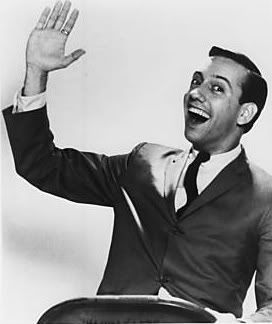 One of the things that also sets Ray Stevens apart from other acts marketed as country comedians is the amount of awards and achievements he has accumulated through the years. This isn't meant to be a definitive list but i'll try and keep it in chronological order...a lot of the awards are from what i've researched, which is why it should not be viewed as a definitive list.
1969: Gold Record- "Gitarzan"
1969: BMI Publishers Award- "Gitarzan"
1970: Billboard- 2 week #1 Pop Single- "Everything Is Beautiful"
1970: Gold Record- "Everything Is Beautiful"
1971: Grammy- "Everything Is Beautiful" Best Male Vocal Performance
1974: BMI Publishers Award- "The Streak"
1974: Billboard- 3 week #1 Pop Single "The Streak"
1974: Gold Record- "The Streak"
1975: BMI Publishers Award- "Misty"
1976: Grammy- "Misty" Best Arrangement
1977: BMI Publishers Award- "Way Down" performed by Elvis Presley
1980: Nashville Songwriters Hall of Fame induction
1980: Georgia Music Hall of Fame induction
1980: BMI Publishers Award- "Shriner's Convention"
1984: Platinum Album- He Thinks He's Ray Stevens
1985: Gold Album- I Have Returned
1986: #1 Country Album- I Have Returned
1986: Music City News Comedian of the Year
1987: Music City News Comedian of the Year
1987: Platinum Album- Greatest Hits
1987: Gold Album- Greatest Hits, Volume Two
1988: Music City News Comedian of the Year
1989: Music City News Comedian of the Year
1990: Music City News Comedian of the Year
1990: Gold Album- His All Time Greatest Comic Hits
1991: Music City News Comedian of the Year
1992: Music City News Comedian of the Year
1992: BMI Publishers Award- "Cadillac Style" performed by Sammy Kershaw
1992: Triple-Platinum Home Video- Comedy Video Classics
1993: Music City News Comedian of the Year
1993: #1 Home Video- Comedy Video Classics
1993: Platinum Home Video- Ray Stevens Live!
1993: #1 Home Video- Ray Stevens Live!
1993: Billboard Home Video of the Year- Comedy Video Classics
1994: Music City News Comedian of the Year
1994: BMI Publishers Award- "I Can't Reach Her Anymore" performed by Sammy Kershaw
1995: Country Weekly Golden Pick Award- Best Comedian
1995: Platinum Home Video- Get Serious!
2002: Gold Single- "Osama Yo' Mama"
Subscribe to:
Posts (Atom)