Showing posts with label monument records. Show all posts

March 3, 2025

Ray Stevens sings "Answer Me, My Love"...

Hello one and all to another fan created blog post focused on Ray Stevens. In my recent series of blog entries I've focused on the recent happenings in Ray's career and the upcoming new album on it's way. Since it's March 3rd at the time of this writing we're now just 4 days away from the release of Say Whut?. Now, for those of you that come across this blog page and read the career timeline on the right hand side of the page you're well aware that Ray's recording career goes back to the late 1950s. On this blog I celebrate the songs, albums, and achievements of the great Ray Stevens and through my commentaries I point out why he's one of the most unique entertainers to ever step foot inside a recording studio. 

A recent video surfaced of Ray on a 1967 episode of The Bobby Lord Show. This was a locally syndicated country music program but it also featured pop vocalists from time to time. Ray was marketed/promoted as a popular recording artist in the 1950s and 1960s who found an audience within the umbrella of country music by the end of the 1960s and he kept it intact throughout the following decades. Ray's appeal to country audiences was such that Ralph Emery often had him as a guest on all kinds of radio and TV programs long before Ray began to intentionally market himself to a country music audience. There's a full episode of Bobby Lord's show featuring Ray as one of the guests but recently Ray's social media pages added the performance of "Answer Me, My Love" from that television appearance. He sings other songs during that appearance but I decided to share the clip of his "Answer Me, My Love" performance since it's the one uploaded on Ray's official YouTube page. The song was never released on an album. It was issued as a single-only on Monument Records. 

Since I've been blogging about his recent happenings this 1967 performance (from nearly 60 years ago) will go a long way at explaining why Ray Stevens is one of the greatest and why a lot of us fans remain forever loyal...

October 12, 2021

Ray Stevens: Session Musicians Lost to Time...

Hello all...and welcome to another blog entry all about Country Music Hall of Fame member, Ray Stevens. As you can see the photo off to the left side of the page is the cover photo of 1968's Even Stevens album. Now, in my opinion, this is another great Ray Stevens album but at the time it was considered his breakthrough album in terms of serious recordings. Ray had always recorded serious love ballads and midtempo love songs since the beginnings of his career. He began to insert novelty songs into his career right around the same time...the flip-side of his debut single, "Silver Bracelet", for example, was the novelty "Rang Tang Ding Dong". That single arrived in 1957. So, he's always balanced serious and comedy. Even Stevens, on the other hand, was a full album of serious songs. There are a couple of social commentary songs on here but by and large it's an album filled with a combination of love songs and social commentary. The main song from the album is "Mr. Businessman" but that one overshadows other great recordings like "Great Escape", "The Minority", "Isn't It Lonely Together", and "The Earl of Stilton Square". 

The reason I title this blog entry the way I do is because there's no online information about the session musicians for this album. We can all assume Ray is the piano/organ player. On the back of the vinyl album it credits Ray as the co-producer as well as music arranger on all but three of the recordings. Fred Foster is credited as a co-producer. Jim Malloy is credited as an assistant engineer and a production assistant. Charlie Tallent is the engineer. Now, beyond those credits, that's it. There is no musicians credited. I received a comment on a previous blog entry about the musician credits for Even Stevens. Instead of allowing the comment to languish in the archives I decided to write a blog entry answering his question. The question came from 'Great Song Podcast'. There are musician credits on Ray's 1969 follow-up albums, Gitarzan and Have a Little Talk With Myself, but there weren't any for 1968's Even Stevens. We could assume some of the musicians on those albums worked on Even Stevens, too, but I don't like to make those kinds of assumptions when it comes to session musicians. 

Anyway, the session musicians for Even Stevens are lost to time...unless someone comes along and knows the list of musicians for that Monument album and reveals them. I wouldn't know who to ask for such information. I don't know if Ray would've kept the musicians list all these years later or not.  

July 25, 2021

Ray Stevens audio: "Have a Little Talk With Myself"...

One of the many fabulous albums from Ray Stevens over the years is 1969's Have a Little Talk With Myself. The album was an artistic showcase for Ray's music arranging skills. The album's co-producer, Jim Malloy, praised Ray on the back of album. Jim remarked that Ray not only arranged the music on every song but also sang all the background harmonies, played piano and organ, and played the trumpet solo in the recording of "Spinning Wheel". Jim Malloy's son, David, would become a hugely popular record producer and co-writer of many hit songs for Eddie Rabbitt. Ray Stevens and Jim Malloy produced this 1969 album and the two of them appear in a photo on the back of the album. Jim was also the co-engineer along with Tommy Strong. The album's first single release happened to be "Sunday Mornin' Comin' Down" from a brand new songwriter named Kris Kristofferson. Ray had a minor hit with the song...reaching the Pop charts both here in America and in Canada. Ray also crossed over and reached the Country chart with this song. It marked Ray's first appearance on the country chart. Ray recorded the album in the Monument Records studio. He had been signed to Monument Records since 1963...first as a session musician, music arranger, and jack-of-all-trades in the recording studio...and this relationship evolved into recordings beginning late in 1965. He was under contract with Mercury Records as a recording artist (since 1961) while simultaneously (beginning in 1963) working behind the scenes at Monument Records as a session musician and music arranger. Once his recording contract for Mercury ended he was then allowed to begin recording for Monument Records. 


Have a Little Talk With Myself was Ray's third and final studio album for Monument Records.  Monument released the title track as the second single release from the album. "Have a Little Talk With Myself" became the second single of his career to appear on the Country chart and it happened in the final month of 1969...more specifically the final week of 1969. The single didn't appear on the Pop Hot 100 but it did make an appearance on Bubbling Under the Hot 100...a chart extension of the main Hot 100 which kept track of single releases that hadn't sold enough to break into the main Hot 100 but were big regional sellers. The third single release arrived early in 1970, "I'll Be Your Baby Tonight", from the pen of Bob Dylan. This song has also been uploaded onto Ray's YouTube channel. One of the interesting aspects of the recording is Ray's over-dubbed vocals. He verbally mimics a harmonica in various harmonies and has the effect playing alongside actual instruments. The album features the largest collection of studio musicians of any Ray Stevens album before or since. The "I'll Be Your Baby Tonight" single never appeared on the Hot 100 or the Country chart...selling regionally enabling it to make an appearance on the Bubbling Under the Hot 100 list. Ironically, it charted higher on the Bubbling Under chart than "Have a Little Talk With Myself" did. Now then...here's the audio track of 1969's "Have a Little Talk With Myself"...

May 27, 2020

Ray Stevens: "Unwind" audio clip...

Hello all...in this Ray Stevens blog entry I'm embedding an audio of his 1968 single, "Unwind". The single was his fifth release on Monument Records. He joined the label in 1963 as a session musician and music arranger while Mercury Records continued having exclusive use of him as a recording artist. Ray's first Monument single as a recording artist arrived in the latter half of 1965 but during the next two years from November 1965 through December 1967 four single releases didn't make the Hot 100 pop chart. "Unwind" came along in January 1968 and it started making some noise and had some chart action...peaking at 52 on the Hot 100...the highest charting position of any of his singles since 1963...and his highest ranking for a non-comedic song to date. A previous Mercury Records single, "Furthermore", peaked at 91 late in 1962. When you hear "Unwind" and think it's a funny song then it's apparent that you can't differentiate between serious Ray and comical Ray. I don't have the vinyl single in my collection...but if you come across one for sale on-line the B-side is a song called "For He's a Jolly Good Fellow". The two songs can be found on Ray's 1968 Monument album, Even Stevens.


March 31, 2020

Ray Stevens: 45 at 55...

Hello all Ray Stevens fans!! As the title of this blog entry shows I'm going to spotlight a recording by Ray Stevens from 1965/1966. Technically the single was released commercially in the spring of 1966 and so it's 54 as of this writing but there's a single release of "Make a Few Memories" in the United Kingdom, on the London American Recordings label, that shows 1965 as the year it was issued...even though I'm pretty sure the year credited on the UK single release is meant as a reference to the label design/color scheme of the actual paper sleeve on the vinyl rather than the actual year of commercial release. The song and it's B-side, "Devil May Care", were uploaded onto YouTube today. I've shared these songs on here in blog's past but they're within the archives here. In previous blog entries I shared the imagery associated with their U.S. release on Monument Records but this time around the video clip uses the United Kingdom single release.


The A-side and B-side come from the pen of Joe South. If you know your Ray Stevens history you'll know that Ray was associated with a lot of recording artists within the Bill Lowery umbrella. Ray played on recording sessions, arranged the music heard on those records, and sometimes wrote songs for a number of those recording acts. Joe South was one of those recording artists...as was Billy Joe Royal, Jerry Reed, and Tommy Roe. If you look at the single release you'll see Lowery Music credited as song publisher. I'm somewhat curious as to the upside down number printed above the single's catalog number. When you look at the single the catalog number is HLU-10027 but directly above this, upside down, is: MSCM 7478. I didn't ask about that over on the YouTube page. I may ask about it if I don't find out on my own why it's written upside down.

The B-side I've embedded below...

March 23, 2020

Ray Stevens sings But You Know I Love You...

Hello all the Ray Stevens fans out there...as all of you know the music world lost a legendary figure, Kenny Rogers. He passed away at age 81 on March 20th but the news wasn't released until Saturday and a flurry of on-line articles flooded social media sites from all over the world. Ray was quoted as saying: "Kenny was a nice man and a great entertainer who had a way of making a song his own. He will be missed.".

1969
Ray Stevens was recording for Monument Records in the late 1960s. The label had issued a series of single releases on Ray during 1966-1967...his first LP for the label didn't arrive until 1968, titled Even Stevens. The following year he issued two albums for Monument. One of those albums was the comical Gitarzan and the other album was this one, Have a Little Talk with Myself. It is on this latter album where Ray demonstrates his mastery of music arrangement. He had produced and arranged a lot of recordings for a whole host of recording acts on Monument Records and other labels...he was also the arranger of his own recordings while production credits were given to Shelby Singleton (Mercury Records) and later on, Fred Foster (Monument Records). The two albums that were issued on Ray in 1969 credit Fred Foster, Jim Malloy, and Ray Stevens as producers on Gitarzan while Ray and Jim Malloy are the credited record producers on Have a Little Talk with Myself. On both albums Ray continued his role as music arranger. The recordings on this 1969 album are mostly cover songs of contemporary pop music hits for other artists...all done with Ray Stevens arrangements. There are several songs that were originals at the time and those were the title track, "Have a Little Talk with Myself", as well as "The Little Woman" and "Sunday Mornin' Comin' Down"...the remainder of the album were his versions of a wide range of pop songs, among them were: "Aquarius", "Help", "Hair", "Spinning Wheel", and this song...


"But You Know I Love You" comes from the pen of Mike Settle who, at the time, was a member of the pop/rock group, The First Edition, whose lead singer happened to be Kenny Rogers. Their recording of the song was issued late in 1968 and it hit the Top-20 on the pop chart in the first half of 1969...also hitting the Top-10 in Canada. In this time period most recording artists filled out their albums with cover songs and once this song had become a hit then it was recorded by a lot of artists in various formats. Bill Anderson had a huge hit with it on the country chart in 1969...Dolly Parton hit number one on the country chart with her rendition in 1981. A bit of trivia is Dolly's rendition of "But You Know I Love You" took over the number one spot on the country chart from a Kenny Rogers and Dottie West duet, "What Are We Doing In Love?". Kenny and Dottie hit number one the week ending June 13, 1981 and the very next week Dolly was at number one with "But You Know I Love You" on June 20, 1981. That trivial tidbit is made even more ironic given that several years after Dolly's recording hit number one she and Kenny would become frequent duet partners.

In between 1969 and 1981 it was covered by numerous artists, as mentioned, and Ray Stevens was no exception as you can hear when you play the embedded audio clip above. A couple of decades later Ray performed "Ruby, Don't Take Your Love To Town" on an episode of his CabaRay Nashville television show. In the context of this performance it was as a salute to the song's writer, Mel Tillis. Ray's performance is on the episode, Tribute Show. In this episode Ray performs songs made famous by others and tells stories behind the songs and the artists that recorded them. The song was a huge hit for Kenny and The First Edition in 1969 but the first commercially successful rendition arrived in 1967 on the country chart by recording artist Johnny Darrell...a singer that recorded a number of songs first which eventually became iconic or country music standards by other artists that were more well known. He was the first to record "Ruby, Don't Take Your Love To Town" in addition to being the first to record "The Son of Hickory Holler's Tramp" and "Green, Green Grass of Home"...the latter becoming more well known as a Porter Waggoner classic. Ray Stevens, for example, was the first to commercially release "Sunday Mornin' Comin' Down" and it's on his 1969 album shown near the top of this blog entry...but the song itself is more well known as a Johnny Cash hit.

Here's Ray performing "Ruby, Don't Take Your Love To Town"...a song closely identified with Kenny Rogers and the First Edition...


August 18, 2019

Ray Stevens: The Road to the Country Music Hall of Fame, Part Four...

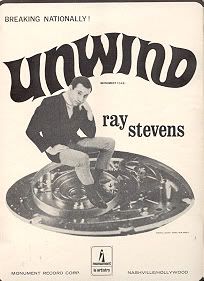
Welcome to Part Four of this blog mini-series as I spotlight Ray Stevens' Road to the Country Music Hall of Fame. The year is 1968 and Monument releases their fifth single on Ray in January...a unique offering titled "Unwind". This single credits both Fred Foster as well as Ray Stevens as producers...Ray also wrote both sides of the single. By unique offering I'm referring to the blending of tempo heard throughout the performance. The recording starts off with Ray in frenetic mode detailing all of the things he's got to do throughout the course of the working day and then as his descriptions near the hour of 5pm his vocalization has decreased in tempo to where he sings about winding down once he arrives home and the vocalization has long since shifted from frenetic to mellow but then, following a brief vocal break as the instrumentation plays, the tempo begins to pick back up and the frenetic vocalization resurfaces as the new workday is underway...and the routine plays itself out...but, once more, Ray winds down his vocalization as it draws closer to the end of the workday at 5pm. In the career time-line of Ray Stevens "Unwind" is typically the single that bridges the gap between the various phases of his career. By this I mean it's a single that frequently shown up on various greatest hits and best-of albums released on Ray Stevens even though it wasn't as widely known as his follow-up single...but if you base a 'hit' as a single that makes an appearance on a popularity chart then "Unwind" certainly qualifies. In part three I mentioned how "Freddie Feelgood" (from 1966) returned Ray to the national Hot 100 pop chart for the first time in three years...that single also appeared on the pop singles chart in Australia. "Unwind" reached midway up the Hot 100 here in America in early 1968 and in Canada it reached their pop music chart, too, peaking the Top-30. The B-side of "Unwind" is a devastating ballad titled "For He's a Jolly Good Fellow". Monument followed up this hit single with a song from Ray dripping in social commentary...a pointed look at the corporate elitists...a song partially inspired by a business deal gone bad involving Ray.

It's often been reported about by historians, journalists, and mentioned by Ray in interviews that early in his career he was taken advantage of, briefly, by opportunists that mishandled his money through unwise investments and when he decided to take a look at his earnings he seen how lousy those in charge of his finances happened to be. As a result of the mishandling of his finances and a general negative feeling overall he came up with "Mr. Businessman"...a single that burst onto the music landscape in the summer of 1968. Production by Ray and Fred Foster this self-penned vocal outrage dealing with corporate America's amoral attitudes, misplaced priorities, and the bottom line was a startling contrast to the bluesy love ballads, easy-listening renderings, and novelty songs he'd long been noted for. The single features single note piano key strikes at the beginning of the song...as the tempo rises the key strikes get more stinging and more keys are added into the performance...as more and more instrumentation is added into the performance the piano blends into the background. It's a great hook and in concert whenever Ray starts to play those familiar piano strikes there's an obvious enjoyment that flows from the audience. Commercially "Mr. Businessman" was a very big hit...it reached the Top-30 on the Hot 100 and, ironically enough, the single had even more impact in Canada where it hit the Top-10. Perhaps it's not an irony...I'd say that the subject matter Ray sings about in the song is almost universal...there's good and bad businessmen and businesswomen all over the world.

The success of "Mr. Businessman" ultimately spawned the release of a vinyl album. In those days record companies often preferred to release singles...and if an artist had accumulated a series of hit singles then the record company would issue an album featuring those single releases, their B-sides, and several other recordings to fill out the collection of songs. This means that a lot of vinyl albums of this era were usually filled with one or two recordings that had been released as singles...and most of the time the album was named for one of those hit singles...while the rest of the album contained songs that were not commercially driven and sometimes an album would contain whatever the artist or producer felt like placing there...knowing full well that albums were purchased by the most loyal of consumers while a single was designed to cater to a general audience. In country music the record companies would release a vinyl album named for the hit single but then the remainder of the album wouldn't be explored by the record label for future single releases. There are a lot of country albums of this era with 10 or 11 songs but only one of those would be the single release...to say the album was looked upon with contempt is putting it mildly. Anyway...Monument Records issued their first studio album on Ray titled Even Stevens in the fall of 1968 on the heels of "Mr. Businessman". The album was produced by Fred Foster and Ray Stevens. It features 10 recordings in which Ray was the songwriter on 8 songs, a co-writer of one, while a tenth song was written by another writer. Ray also arranged every song on the album except two of them.


I created that collage a couple of years ago...or it could have been last year...anyway it's me attempting a similar pose from Ray Stevens as he appears on the Even Stevens album of 1968. The back of the album shows Ray seated in front of a music stand. The album comes with liner notes authored by Tupper Saussy. By the way Tupper is the one responsible for the only song on the album that Ray never had a hand in writing or arranging: "The Earl of Stilton Square". Tupper wrote and arranged the song. One of the television shows from this era, Get Smart, had a popular catchphrase...well, the show had several, but to borrow just one of those phrases... 'would you believe??' that Even Stevens never made an appearance on the Billboard 200 album chart!! If that wasn't ironic enough...Ray himself became a businessman but this was out of necessity given how little faith he had in someone else looking after his finances. He was once quoted as saying that nobody's going to look after you but you and so he reluctantly had to become more involved in the business side of the music industry. He eventually hired a manager, though, by the name of Don Williams...not to be confused with the country singer of the same name.

In the meantime the B-side of "Mr. Businessman", for those curious, is the album's seventh song, "Face the Music". Ray wrote the B-side but the music arranging is credited to Louis Nunley. Monument released "The Great Escape" as a single in the fall of 1968 backed with a phenomenal ballad called "Isn't It Lonely Together?". The A-side followed the social commentary vein and it charted on Canada's version of America's Hot 100...but in America the single Bubbled Under the Hot 100. A third figure emerged prominently in Ray's career during the making of Even Stevens and that figure happened to be Jim Malloy. He's credited as the production assistant to Fred and Ray on the 1968 album in addition to being the engineer's assistant. The engineer of the album was Charlie Tallent. The album itself was recorded at Bradley's Barn (a studio owned by legendary music producer Owen Bradley). In early 1969 Monument released a single on Ray that, according to Ray's interviews and his recollections in a memoir, that Fred Foster was completely against.

The single in question had the unusual name of "Gitarzan"...a word that Ray credits to Bill Justis, which as you can see, combines guitar with Tarzan. A title like that led Ray into creating a story about Tarzan, Jane, and their chimp forming a rock and roll jungle band. Ray also credited the rhyming dictionary in guiding him, line by line, in the song's construction. The song is filled with internal rhymes and end rhymes as well as pseudo-rhymes where sound-a-like words follow each other even though they're not identical rhymes. According to Ray's recollections Fred told him that if this song became a hit then Ray would have complete creative control on his next project. "Gitarzan" became a gigantic hit...in America and internationally...and throughout the first half of 1969 the massive popularity of the novelty song eventually brought certifications of a Gold record by the RIAA. In those days a gold record was indicative of sales of over a million copies. The single hit the Top-10 on the Hot 100, the Top-10 in Canada, the Top-10 in Australia, and the Top-10 in New Zealand. It made the charts in other international markets, too, but I decided to limit it to three additional countries for this blog entry. As you can see in the credits the producers are Ray, Fred Foster, and Jim Malloy. In addition to being a co-producer Jim returned as engineer assistant as he had been during the previous album from Ray in 1968. Songwriting credits go to Ray and Bill Justis...credited under his birth name of Bill Everette. The song's B-side, "Bagpipes-That's My Bag", was written by Ray and produced by both Ray and Fred Foster. For whatever reason Jim Malloy isn't credited...but obviously this is more or less due to his not being a part of the B-side's production. Monument issued their second album on Ray, Gitarzan, in the late spring/early summer of 1969. The album features liner notes from talk show host, Merv Griffin. Upon the release of the album from Monument Records they issued a new single...Ray's version of "Along Came Jones"...and while it didn't hit the Top-10 or sell millions of copies it nevertheless reached the Top-30 on the Hot 100 in America and the Top-30 in Canada in addition to it charting in Australia's Top-20. The original recording of the song had been a hit 10 years earlier by one of Ray's influences, The Coasters. The B-side of "Along Came Jones" happened to be another cover of a Coasters hit, "Yakety Yak". There are those that have often remarked that Ray's version of "Along Came Jones" is the funniest...and a lot of it has to do with the additional material that Ray brought to the song. The original from The Coasters lacks the falsetto cries of Sweet Sue as she's being tortured by Salty Sam...and the original also lacks the sinister laugh from the villain. Those are things that Ray brought to the song. The back to back novelty hits and the album itself labeled Ray a novelty singer...even though some may never have recognized him as being anything but a novelty singer in spite of the recorded evidence proving otherwise...some think "Mr. Businessman" is a funny song. Go figure!

In addition to all of this well deserved and long overdue success Ray had been enjoying lately he became acquainted with pop entertainer Andy Williams by the latter half of 1969. Earlier I mentioned that Ray hired a manager named Don Williams...well, he happens to be one of Andy's brothers...but I don't know what came first off the top of my head. I don't know if Ray and Andy got acquainted first and it led to Don becoming Ray's manager or if Ray hired Don as a manger before becoming a business associate of Andy's. Whatever came first Andy Williams began to have some influence in Ray's career around this point in time...and perhaps not a coincidence Ray began making infrequent appearances on Andy's television series. When "Gitarzan" became a massive hit earlier in the year Fred Foster, as mentioned earlier, made Ray a friendly bet that if it became a hit then on the next project Ray would be given complete creative control over. Fred lost the unofficial bet and so Ray and co-producer Jim Malloy set out to work on his next project for Monument Records...and it was a beauty of an album...which I'll go into more detail about in Part Five of this mini-blog series!!

January 1, 2018

Ray Stevens and the Golden Businessman...

Hello one and all and welcome to 2018!! In my previous blog entry I made mention of several things taking place during the month of January in the career of Ray Stevens but in this blog entry I'm taking a look at a certain single issued 50 years ago...at the time Ray happened to be signed to the Monument label. It's the Golden Anniversary of the Ray Stevens single, "Mr. Businessman", and his studio album that year, Even Stevens. The single hit the Hot 100 on August 3, 1968 and it would eventually rise into the Top-40. It marked the first single release from Ray to reach the airplay heavy Top-40 portion of the Hot 100 since 1963. "Mr. Businessman" was a follow-up to "Unwind"...and both songs come from the Even Stevens album. In the case of "Unwind" it peaked midway up the Hot 100 and signaled a potential avenue for Ray to get much more notice for his ballads and serious recordings. The song hit the Top-20 in Canada. Given that "Unwind" was followed with "Mr. Businessman" and all the success that emerged from the song it's logical to want more and more attention given to non-comedic recordings. 

"Mr. Businessman" made the Top-40 on America's pop music chart and the Top-10 on Canada's pop music chart and it was eventually covered, most notably, by B.J. Thomas and the British pop star, Cliff Richard. The song takes a look at the perceived lifestyle of the businessman in general and the greed, corruption, and amoral values attached to businessmen. Ray wrote the song, according to many interviews I'd heard and have read over the years, as a result of a business deal gone bad...and he vented his anger in song...and years later he addressed the irony of himself being a businessman in Nashville (a recording studio owner, a music publisher, a record producer, an owner/landlord of several properties on Music Row, etc. etc.). In one of those later interviews he said that, in hindsight, his angry composition painted a broad brush of negativity and pessimism on all businessmen and it was probably unfair. The song resonated with the attitudes of record buyers of the late '60s and it's one of his all-time hits.
Prior to the release of 1968's Even Stevens he had long been associated with his comedy recordings even though, if truth be known, he had been releasing serious love ballads and uptempo Rhythm and Blues-flavored recordings in the years leading up to 1968. Going back to 1966's "ABC", for example, and songs like "Make a Few Memories", "Mary, My Secretary", "Answer Me, My Love", "Party People", "Devil May Care", "It Only Hurts When I Laugh", and "There's One in Every Crowd". In fact, between the years of 1965 and 1968, only three single releases were comical: "The Rockin' Teenage Mummies", "Mr. Baker the Undertaker", and "Freddie Feelgood". I offer all of these names of songs due to the fact there's a perception (spread by historians and essayists) that Ray didn't release any music between the years of 1964 and 1968. They often say he spent those years in the background as a session musician, music arranger, and producer but in reality both Mercury Records and later, Monument Records, issued singles on Ray during those years. I think the confusion stems from the fact that no vinyl album (LP) was issued on Ray during the years: 1964-1967. Mercury released 2 albums on Ray: 1,837 Seconds of Humor in 1962 and This is Ray Stevens in 1963. They continued to release singles on Ray through 1965. Monument began issuing singles on Ray in 1966 and they finally issued a vinyl album, Even Stevens, in 1968. So here's to the album and all of the songs on it celebrating a wonderful 50th Golden Anniversary this year!!

March 27, 2016

Ray Stevens: Face the Music CD review...

This 24 song collection from Ace Records is something of a goldmine for many fans of Ray Stevens that do not have vinyl in their music collections. Over the decades of CD availability there have been releases on the market that have included a stray Monument single or 2 from Ray Stevens but never has their been a collection like this. I consider it great (but there's one major error that can't be overlooked). As the CD's title states this is a collection of Ray Stevens recordings during a 5-year period (1965-1970). 12 A-side single releases by Ray on Monument Records and the 12 accompanying B-side recordings make up the 24 songs found here. The song that gets the honor of being part of the CD title, "Face the Music", is one of the great ballads found on the collection and it originally appeared on Ray's 1968 LP, Even Stevens, and eventually found itself as the B-side of "Mr. Businessman". Ray's 5 year stay on Monument Records represents a period of change, growth, adaptability, irony, career flourish, and as always an aura of unpredictability.

Ray had actually been signed to Monument Records for a couple of years prior to the label issuing their first commercial single on him late in 1965. If I remember correctly from research I did years ago Ray had an exclusive recording contract with Mercury Records but he was free to join Monument Records for non-recording endeavors (producing, arranging, session work). Once the recording contract expired with Mercury Records then Monument was now able to begin releasing commercial singles from Ray at long last.

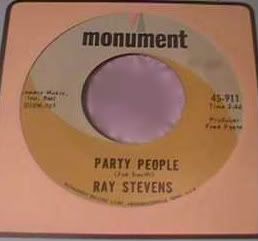
The debut single, "Party People", arrived late in 1965 backed with "A-B-C". The single didn't reach the Hot 100...in fact the first three single releases on Ray didn't reach the Hot 100 (some Bubbled Under). A fourth single, "Freddie Feelgood", did manage to make a Hot 100 appearance in 1966. Ray's novelty songs happen to have to life of their own. Even though statistics say that the song failed commercially (peaking in the bottom five of the Hot 100) it's nevertheless a Ray Stevens classic...more about this later...

Ray's fifth Monument release, "Unwind", became his highest charting single for Monument to date...peaking halfway up the pop chart. The single that really set things in motion came next...1968's "Mr. Businessman". It reached the Top-40 half of the Hot 100. After it's release Ray had suddenly become a 'superstar' and had achieved significant acceptance as a serious pop vocalist rather than being labeled a zany novelty act that DJ's didn't take seriously. A lot of the reason for the lack of success (airplay speaking) of Ray's recordings is due to the lack of acceptance of various radio disc jockey's. I continue to hold the opinion that Ray's songs have a lot of appeal and are highly entertaining but lack of airplay hinders any chance of something becoming a hit song.

A lot of listeners, unfortunately, never really had a chance to hear much of Ray's Monument output simply because radio stations didn't expose the material to potential record buyers. A shame, for sure, but this CD goes a long way at exposing the single releases on Monument Records. Earlier I mentioned that "Freddie Feelgood" has since become something of a Ray Stevens classic in spite of it not actually being 'a huge hit' at the time of it's release. The reissuing of Ray's catalog over a period of 2 decades on a variety of compilation albums has caused many fans to hear obscurities and near-hits tucked away on Greatest Hits and The Very Best Of collections and in their subsequent appearances on compilation CD's a song like "Freddie Feelgood" or "Unwind" have become just as familiar to Ray Stevens fans as "Gitarzan" happens to be.

Speaking of "Gitarzan" I must address a major flaw in this otherwise flawless project. The biggest hit single for Ray during his Monument stay happened to be the million selling Top-10 pop hit, "Gitarzan". The single hit the market in 1969 backed by "Bagpipes, That's My Bag". Unfortunately, bizarre, baffling, and perhaps one could say inexcusable is the major gaff on part of the record company of not doing their research. Rather than having 1969's "Gitarzan" on this CD they instead offer Ray's 1995 recording of the song. It's the audio recording for the official music video which made it's debut on Ray's direct-to-VHS movie, Get Serious!, in 1995.

Yes, you read that correctly. It's puzzling because "Gitarzan" appears on so many compilation CD's and given the work that went into putting this project together you'd think that a release celebrating Ray's Monument recordings would at least feature the original recording of "Gitarzan" instead of placing the 1995 re-recording on there.

The final three recordings on the CD, "Little Woman", "The Fool on the Hill", and "I'll Be Your Baby Tonight" are a trio of recordings that mark their CD debut. Each song comes from Ray's 1969 LP, Have a Little Talk with Myself, in which the title track is song 21 on this CD. That particular 1969 LP has never been remastered and re-released onto CD.

In the liner notes the author does a remarkable job in showcasing a lot of nostalgic promotional images originally found in music trade magazines of the time and there's a lot of images of the single releases, too. The author of the notes also makes mention of various chart positions of the songs but there are several places within the essay that focus too much on the commercial side of a recording...much is made of the fact that a lot of his singles didn't "make the charts" but there isn't any reason for this given. It's left for the reader to assume that a song that isn't a hit means that it must not have been any good...but that's not the case...

As I touched on earlier a lot of the reason behind a song not making it is due to the airplay, or lack thereof, of any recording. If radio isn't playing a song and exposing it to people then chances are it isn't going to sell...and if something doesn't sell then it can't become commercially successful. Ray's lack of massive airplay was never due to him not being popular as an entertainer and it's never been a case of him not being talented. Simply put, influential radio disc jockeys, I feel, had preconceived ideas about his music or didn't understand his music and therefore disc jockeys didn't support him as much as they could have.

This collection of Monument recordings serves as an introduction to the sounds of Ray Stevens during a highly creative and frenetic time in pop music in general. Balancing the novelty singer vs. pop crooner artistic tug of war is clearly on display here from start to finish. One of his most powerful vocal performances is "The Minority"...just listen to him belt out the lyrics! It appeared on his 1968 album but ended up as a B-side of one of his 1969 releases, "Sunday Mornin' Comin' Down". The artistic tug of war would continue on into the 1980s for Ray Stevens before he decided to market himself as a country comedian for the next several decades. The results paid off (several Gold and Platinum albums, Gold and Platinum VHS home videos, and numerous awards as Comedian of the Year throughout the '80s and '90s).

Although he had his fair share of serious hit songs by the time his stay at Monument came to a close in 1970 he more or less remained an enigma to music critics throughout the coming decades. Critics and disc jockey's alike never really knowing if he's pop or country...or if he's to be taken seriously or if he's joking around...the thing that gets lost in all of it is Ray's incredible versatility.

If someone has a difficult time labeling a singer as strictly "pop", "country", "comedy", etc. then all that can be said of such an artist is that they're something more than that...they're an Entertainer!

February 22, 2016

Ray Stevens CD: Face the Music...

It's me once more...I've been busy off-line over the last couple of weeks. I haven't been able to adequately keep this blog updated as much as I'd like...but I continue to keep updated on his career by way of his social media outlets (his official Facebook and Twitter pages) and of course his official website. I also hope that all of you that come across this fan-created blog page take the initiative to visit the various social media sites focusing on Ray Stevens just in case there's something happening that I haven't been able to blog/comment about.

First off...the Monument Singles CD!! I first mentioned this back in mid January...and later that month a product page on Amazon appeared on-line for the CD. It's official title is Ray Stevens: Face The Music - The Complete Monument Singles 1965-1970. Of course, for conversational purposes, I'm going to refer to that CD as simply The Monument Singles CD or, better yet, Face The Music: 1965-1970. The most devoted of fans, once they read my abbreviated references to that CD in future blog posts, should immediately know which CD I'm referring to.

As mentioned in a couple of my blog entries from January this CD contains 24 recordings from Ray Stevens during his five year recording career for Monument Records. Ray didn't only record for Monument and his association with the label didn't just encompass 5 years. He had actually joined the label as a producer/arranger/session musician in 1963...but his own recordings were exclusive to Mercury Records (the label he joined in 1961). Once his contract as a recording artist for Mercury ended he eventually released his first recording for Monument Records in 1965. Since this CD lists his single releases for the label in chronological order the lead-off track, "Party People", gets things off and running on a mid-tempo, bluesy note. As mentioned in the January blogs there are 12 singles on this CD and since the B-sides are featured, too, the actual number of songs on this CD is 24. For those that may have some of the actual vinyl singles released on Ray by Monument you should all be aware that on most of the releases there's no A-side or B-side designation. In some cases a large filled in star symbol is suppose to indicate which side of the single is meant for airplay...but some single releases lacked that feature. Adding to the confusion is in some locales (international releases) a star symbol is featured on both sides of the single.

This Face The Music: 1965-1970 CD is suppose to become available in a couple of weeks. Amazon lists the street date as March 4, 2016 but it can be put on pre-order. It's been available as a pre-order since late January. The recordings found on the CD covers the years: 1965, 1966, 1967, 1968, 1969, and 1970. It's the first commercially available project to exclusively spotlight his Monument recordings albeit limited to single releases only. Tracks 1 through 4, track 6, and tracks 22 through 24 make their CD debut. You can read all about this upcoming CD by clicking Amazon's link located HERE.

On the touring front I felt it necessary to highlight some upcoming appearances once again. On March 9th Ray Stevens is to be in Plant City, Florida. He'll be appearing at the Strawberry Festival. The concert is to begin at 3:30pm. Since it's February 22 I'd not risk mail-order (if you happen to live several States away and were planning on attending!) but it's up to you. Your tickets must arrive by March 9th, obviously, so if any of you live a good distance from Plant City, Florida I'd not hesitate to call the venue and ask about their ticket purchase policy or if they offer on-line tickets (the kind you'll have to print off the internet and take to the venue yourselves upon on-line purchase). The venue's box office number is 813-754-1996.

On April 1st Ray is to appear at The Florida Theater in Jacksonville, Florida. You can read all about this upcoming concert and the venue itself by clicking HERE. It's a hastily put together artist bio but regardless of that if you're planning on attending the concert click the link and call the venue for ticket information.

On April 16th Ray is going to be in his home state of Georgia. In an 8pm concert taking place at The Mill Town Music Hall in Bremen, Georgia it'll feature an opening act by the name of Kelsie May. You can read about the ticket purchasing procedure by clicking the promo page HERE.

The next day, April 17th at 7pm, Ray is to appear in Chattanooga, Tennessee at The Tivoli Theatre. In early January after the concert was announced I couldn't find anything on their site about Ray's appearance but since then they've added a page for his upcoming concert there. You can get all the information about the Chattanooga concert by clicking HERE. The promo has an opening act named Etta May being featured. He has 2 more concerts scheduled for the month of May. Now, with this being late February, it wouldn't be uncommon to see additional appearances pop up and so I'll highlight those May concerts in a future blog post (just in case more happen to be added). For all we know more concerts from Ray could pop up for the month of April, too, so keep your eyes posted on his official website or his Facebook page for information surrounding concerts.

January 15, 2016

Ray Stevens: Monument Singles CD...

Hello all the Ray Stevens fans!! I've just returned from reading up on social media sites searching for any of the latest comments and, or, news surrounding Ray. I am here to announce that there's going to be a compilation CD featuring the single releases of Ray Stevens during the time he was on Monument Records as a recording artist (1965-1970). The CD is being offered on a United Kingdom site called Ace Records. The title of the CD is Face The Music: The Complete Monument Singles (1965-1970) and it features a clean-shaven Ray, arms folded, looking as if he's about ready to bust out laughing at something he's hearing or seeing. The CD focuses only on the 12 single releases issued by Monument, presenting each A-side and B-side in chronological order, for a total of 24 recordings. It isn't a complete collection of recordings from that time period (his 1969 album, Have a Little Talk with Myself, has yet to get released on CD) it's just a collection of the single releases. There are three specific recordings from the 1969 album that make their CD debut here. "Little Woman", "The Fool on the Hill", and "I'll Be Your Baby Tonight". Several other Monument recordings mark their debut on CD here: "A-B-C", "Make a Few Memories", and "There's One in Every Crowd". The CD's selling price in the United Kingdom is 11 pounds, 50 pence. I visited a currency converter site and if I entered the numbers in correctly it equals $16.39 in U.S. dollars before shipping and handling. Do not take my message about the price of the CD as a guarantee that it's accurate. I'm going to post a link to the on-line store that's selling this CD and once there you'll find contact numbers and addresses for specific questions you may have regarding the CD's price in American dollars and the shipping method, etc. etc.

To see more information about the above CD, such as all 24 recordings, click HERE. The CD's release date is February 26th. As of this writing there isn't any indication that it'll become imported to America and sold on domestic music sites and so for the time being it'll only be available for purchase through on-line music sites headquartered overseas.

February 4, 2013

Ray Stevens: Nostalgia Valley, Part 47...

Welcome to February 2013...as we look at in the Nostalgia Valley we see a 1966 recording titled "Baby the Magic is Gone", produced by Ray Stevens and performed by a group called The Velvets. As you can see, the recording was for the Monument label. As visitors of this blog are aware, if you've read some of the earlier Nostalgia Valley entries, Ray took a hiatus from recording and he focused on being a producer and music arranger before resuming his recording career in 1966. Ray continued to produce and arrange musical acts for Monument as well as on a host of lesser known labels through the mid '60s but he eventually focused more time and energy on his own recording career by the end of the decade and beyond.


I mentioned a particular You Tube channel several blog entries ago that specialized in obscure mid '60s recordings...and some of those recordings are associated in some way to Ray Stevens. In some instances he's the music arranger and in some he's the songwriter and in others he's the producer. I think in a couple he's all three! The channel uploaded a new clip a few days ago and that's the embed you see above. The upload happened on January 30, 2012 and so it's a few days old. This one was uploaded a year ago today on February 4, 2012...it's a group called The Casuals performing "Promise Her Anything" from 1965. Ray Stevens is the credited music arranger while the producer is Fred Foster.


Here's the You Tube Channel featuring the obscure mid '60s recordings. I've posted a link to this channel before but it's been a few years. There are currently 11 uploads associated with Ray Stevens. When you visit the channel you can easily find the video clips because they're all divided up into different playlists. The playlist devoted to Ray's production/arranging is 8th on the list. 

I'd say the bulk of recordings where Ray was the arranger/producer came from that 1964-1967 era. Once Ray's first LP for Monument hit the market in 1968, Even Stevens, followed by 1969's Gitarzan and Have a Little Talk With Myself, Ray, as mentioned earlier, started to focus more and more on his own recording career and slowly drifted from the production and session work he had been doing for other artists. His increasing presence on television by way of The Andy Williams Show and a change to Barnaby Records in 1970 ushered in different directions and opportunities for Ray as well.

I recall an interview where Ray mentioned that the session work he did all seems like a blur (which is understandable). He participated in hundreds of recording sessions, including his own, in a span of 3 to 4 years...arranging music and playing on sessions and being a producer, at times...it's all a blur to me, too, and I'm only writing about it!

Fast-forwarding to 2013...a couple of days ago, on February 2nd, Ray took part in a benefit concert at the McClain Christian Academy in Lebanon, Tennessee. There were other artists that took part in the concert including Deborah Allen, The Oak Ridge Boys, and Ricky Skaggs just to name a few. The event was titled Music at the Mill. Some of the posts I saw on social media sites indicated that Ray performed "Mississippi Squirrel Revival". There were pictures made available of several of the artists who attended...I found three featuring Ray Stevens...one of those was a picture of Ray and Deborah Allen. I also found what could be described as a publicity photo promoting the benefit concert. Search the internet and use the various combination of keywords 'Ray Stevens', 'Deborah Allen', 'McClain Christian Academy + Ray Stevens', etc. etc.

October 14, 2012

Ray Stevens: Golden LP Series, Part Three...

We take a look at the third studio album from Ray Stevens today entitled Even Stevens. This particular album was a surprising departure from the material that was found on his first and second albums in 1962 and 1963 respectively. The third album came along in 1968. In between his last studio album in 1963 and the release of Even Stevens in 1968 he had left Mercury Records and signed up with Monument Records. It was during this period that Ray became a key figure in the A&R department. His songwriting, musical skills, and production prowess led him into a series of single-only projects for a whole host of artists and groups on a wide variety of record labels. Almost all of the acts that Ray worked with were heavily involved in R&B, sometimes soul, and straight ahead pop music. As early as 1962 he was becoming familiar as a session musician but this activity didn't necessarily pick up in any considerable way until the mid '60s. Some of the most important people in Ray's early career were Bill Lowery, Shelby Singleton, Chet Atkins, Ralph Emery, Fred Foster, and Andy Williams. Each of those talented personalities individually gave Ray all kinds of advice, studio work, and career boosts. Monument Records had released four consecutive singles on Ray between the years of 1965 and 1967. A couple of those singles became regional hits but a fifth release titled "Unwind" broke through the Hot 100 and reached the Top-60 early in 1968 yet in Canada the single hit the Top-20. The next release, "Mr. Businessman", did even better in America as it reached the Top-30 of the Hot 100 and the Top-10 in Canada. Monument issued their first studio album on Ray that very year...Even Stevens.

The album features 10 songs and runs the gamut from the social commentary of "Mr. Businessman" to the poignant and haunting "Isn't It Lonely Together?". The material seems to have been written specifically for the time period, too, as we get another topical entry by the title of "The Minority". In that song we hear about specific instances where a person's activities are examined as being a representation of a majority or a minority point of view and how neither points of view should automatically render an outcome valid. It's some heavy stuff but this was the era of the protest song where pop music artists were routinely inserting political and social points of view into their writings. "Mr. Businessman", "Isn't It Lonely Together?", "The Minority", "Unwind", and "The Great Escape" all feature heavy topicality and social commentary. In the case of "The Great Escape" we hear about the angst, irritation, and overall headache a worker experiences as he makes his way to and from work everyday. The worker, living outside the city in a quiet area, can't stand the traffic and the overall fast paced environment he has to put himself through day to day all for a paycheck and yearns to make the escape once the clock on the wall indicates it's time to go home. The single reached the Top-30 in Australia. It's b-side, "Isn't It Lonely Together?", told the story of unwanted pregnancy while "Unwind" celebrated the quiet life in a similar fashion as "The Great Escape" does. The hook of "Unwind", for me, is how Ray goes from a frantic, uptempo delivery of the song's verses to a mellow, laid back delivery at the start of the song's chorus. In essence what Ray did was transition from one tempo to the next, back to back, to show he's vocally unwinding and becoming more relaxed and subdued as the music softens but then he's right back uptempo with the start of the next verse. The single's b-side is "For He's a Jolly Good Fellow". Ray wrote 8 of the 10 songs himself, co-wrote one of the songs with Bob Tubert, while the one exception is "The Earl of Stilton Square" from the pen of Tupper Saussy. That song carries a British flavor musically. It is on this album that Ray gives us an updated and much more melancholy take on "Funny Man". The original from 1963 had a soaring tenor vocal effect from Ray but in the 1968 update it's much more sedate by comparison.

I have the vinyl album in my collection and the CD version that came along in 1996 that you see in the picture above. The CD features all 10 songs plus four bonus additions.

This 1968 project is collectively referred to by critics and fans alike as Ray's first serious album...and it wouldn't be his last...yet what some have described as an internal musical battle between the comic and the crooner would play out for the next decade and a half as Ray valiantly attempted to create awareness for his more serious work while the infrequent comedy recordings he'd issue every once in awhile were what music consumers were ultimately buying. He'd eventually top the acclaim that the serious work on this album had garnered but more about that later on in this series.

Coming up next in this series is Ray's fourth studio album, the all-comedy project, Gitarzan!

July 3, 2011

Ray Stevens: 45's at 45...

Several singles from Ray Stevens reach 45 this year...as most people who visit this fan blog are aware I have several continuing blog titles. Often I like to play on the numbers such as "45 at 20" or "45 at 30", etc. etc. and today's blog is no different. Released on Monument Records in 1966 were a trio of 45's by Ray Stevens that turn 45 this year: "A-B-C", "Devil May Care", and "Freddie Feelgood". I like all of those songs (not a big surprise!) and I also like the B-sides, too: "Party People", "Make a Few Memories", and "There's One In Every Crowd". Ray is at his throatiest in several of these songs...and let's see how many people can resist not tapping your foot in rhythm while Ray, in song, insists to the woman that it's best to "Make a Few Memories" before they end their relationship.

"A-B-C" is your typical pop love song of the era while it's B-side, "Party People", has another one of those irresistible melodies. "Devil May Care" has an arrangement nearly similar to "Down in the Boondocks" which isn't too surprising considering both songs were written by Joe South. In fact, South wrote several of the songs that Ray recorded during 1966-1967. South is credited as the songwriter on not only "Devil May Care" but also "Party People" and "Make a Few Memories". Ray wrote "A-B-C", "Freddie Feelgood", and "There's One In Every Crowd". Also, for those who don't know, out of those six recordings that were issued in 1966, only one of them was a pure novelty song as evidenced by it's eye-catching title: "Freddie Feelgood". The full title is actually "Freddie Feelgood and His Funky Little Five Piece Band". The song illustrates the love of small R&B/jazz combo's that Ray has always said he has a fondness for. This is why you rarely hear a stone-cold country music recording from Ray...unless he's intentionally arranging a song to sound country. A lot of the time Ray performed what's been described as bluesy-country. When Ray started to navigate toward country music in the late '70s he was no stranger to country music audiences...and the non-comical recordings that he put out in the late '70s and early '80s were chock full of bluesy sounding arrangements.

Decades later, in 2000, "Freddie Feelgood" was made into a music video. In the video Ray plays all members of the band. In one scene all five of them appear on screen together playing the instruments. Obviously this is achieved through camera tricks and other video techniques allowing Ray to appear on screen multiple times. To refresh the memories of the readers out there: Freddie played trumpet; Yum-Yum played the drums; Ace played the bass; Tyrone played trombone; Percy played piano. Those who want to see the music video look no further than Ray's own web-store. A link to one of the store's pages is located below.

The 2000 home video, Funniest Video Characters, has long been out of print but you can find the "Freddie Feelgood" music video in a DVD compilation called Complete Comedy Video Collection located here at Ray's web-store. The DVD features a total of 20 music videos. It collects 7 music videos from 1992's Comedy Video Classics; 3 music videos from 1995's Get Serious! direct-to-video movie; all 8 music videos from 2000's Funniest Video Characters; plus 2 additional bonus music videos from 2002 and 2004 respectively.

Exquisite may be the best word to describe 1966's "Party People". Admittedly, I'm not a party hound, so this song became an instant favorite the moment I heard it for the first time. There was a CD re-issue of Ray's 1968 album, Even Stevens, during the mid '90s and as one of the bonus tracks was a song called "Party People". That CD re-issue is where I heard this song for the first time. Spoiler alert: There's a bit of irony within the song as Ray laments that even though he's lost the woman due to the allure of the party life he finds himself falling victim to the very same lifestyle he admonished the woman for. For him, having the woman was his own kind of party...but now that she's gone he finds himself becoming one of those "Party People" that he seemingly has an equal understanding and disgust for. At least that's my interpretation of the song...others may come away with a completely different interpretation.

October 15, 2010

Examining Ray Stevens on Monument, Part 2...

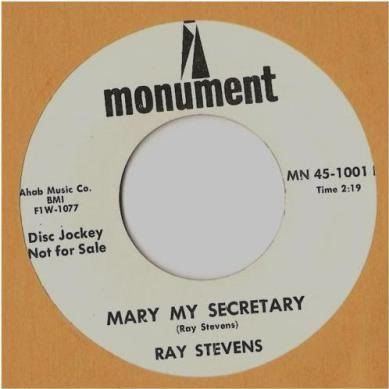
In part 1 of this blog I mentioned that "Unwind" was the fifth single release from Ray while on Monument Records. The previous single, "Mary, My Secretary", came along late in 1967 as a sort of precursor to "Mr. Businessman". In the secretary song Ray sings about the wandering eyes inside an office setting as a man can't fight his feelings for his secretary. The reason I say it's sort of a precursor is because as you can see Ray wrote the single...Ray wrote a lot of his songs during the '60s and '70s. But anyway...the poppy, bouncy "Mary, My Secretary", hinted at the deadly serious social commentary of "Mr. Businessman" the following year. "Mr. Businessman" was the breakthrough single that Ray had been waiting for...at long last he enjoyed a Top-40 single that wasn't comical or silly. This recording, in addition to "Unwind", were the focal points of Ray's 1968 debut album on Monument, Even Stevens.

The b-side of "Mr. Businessman" was the somber "Face the Music" while "For He's a Jolly Good Fellow" was the b-side of "Unwind". The album featured quite a few pop ballads and a couple uptempo numbers. Ray wrote or co-wrote 9 of the 10 songs on the 1968 album. The lone song that Ray didn't write was "The Earl of Stilton Square". This particular song was written by Tupper Saussy. "The Great Escape" was released as a single later on in 1968...it's b-side, "Isn't It Lonely Together?", charted R&B for Ray but became a bigger hit for another singer, O.C. Smith. The album's opening track, "The Minority", later appeared as a b-side on a future single from Ray in 1969. As most readers of this blog are aware...I don't play favorites that much when it comes to Ray Stevens songs. I generally like all of the songs he's recorded and so I don't pick favorites. I typically say things like "all of them are favorites!!". I didn't post as many visuals as I wanted in my previous blog because I was running late and as a result part 1 was so short! So to make up for that I've added some visuals and obviously have added much more detail in part 2.

Now, after having some commercial success with non-comical material Ray stepped back into the comedy vein once more with the release of "Gitarzan". This particular single not only reached the Top-10 on the Hot 100 but it became a million seller and a worldwide hit. The song is based on Tarzan and Jane as if the couple were a husband-wife pop duo. The pet monkey is in on the act as well. The song was written deliberately with a lot of end rhymes and performed in up-tempo fashion. Bill Justis is credited with coming up with the title...while Ray wrote the lyrics. An entire all-comedy album was forthcoming...it featured several cover songs as Ray paid tribute to the Coasters, a group he is fond of saying were big influences. The all-comedy album, Gitarzan, would feature one more single. "Along Came Jones" was a hit for the Coasters in 1959 and now 10 years later it was a hit all over again for Ray. The single reached the pop Top-20 as Ray added some new touches to the song...Ray performed not only Salty Sam's dirty laugh and threats of violence to Sweet Sue but he also performed Sweet Sue who spent most of the time hollering and carrying on hoping her hero, Jones, would come to the rescue in the nick of time. The original by the Coasters lacked the wailing of the victim and the dirty laugh. The rest of the songs on the album range from originals to more covers. He covers "Alley Oop", "Mr. Custer", "Little Egypt", and "Yakety Yak". It was certainly a Coasters salute alright! One of my favorites is "Sir Thanks a Lot", a spoof of Camelot and the Knights of the Round Table. Ray became a recurring guest on Andy Williams' weekly television program around this point in time.

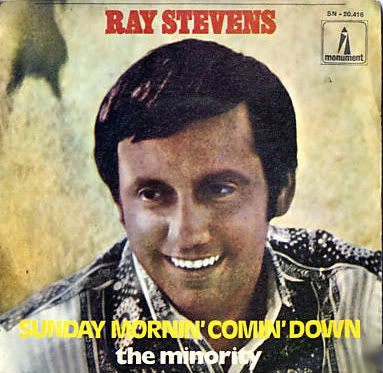
Ray ended 1969 going back to being a non-comical artist once more with the release of "Sunday Mornin' Comin' Down"...a song written by then-newcomer Kris Kristofferson. Ray's performance entered the country music charts...marking his debut on the country charts. It reached the Top-60 there...although there was no real serious push in the country direction until quite a few years later. Nonetheless Ray was becoming a presence on the pop, country, and easy-listening charts and this would continue through the mid '70s. Ray's final album for Monument Records arrived in the form of Have a Little Talk With Myself. This album featured mostly cover songs...there were a few originals...but most of the album was made-up of Ray's versions of other hit songs. The exceptions were the self-written title track, "Have a Little Talk With Myself", plus the self-written ode to family life, "The Little Woman". As mentioned "Sunday Mornin' Comin' Down" at that time was considered a brand new song as well. In fact, the picture sleeve used for that single is the same picture used for the 1969 album. Elsewhere, Ray covers the Beatles in the form of "Hey Jude", "Help!", and "The Fool on the Hill" and there is also Bob Dylan's "I'll Be Your Baby Tonight".

The material on this album is heavy duty and a fabulous trip back in time for modern-day listeners. "But You Know I Love You" was a 1969 hit for the First Edition, a group that included the song's writer, Mike Settle, along with future country singer Kenny Rogers. The song made the rounds that year and saw another hit recording of the song by Bill Anderson. Years later Dolly Parton would have another hit with the song. Ray never issued his version as a single. A further cover song on the 1969 album is "Spinning Wheel" and it, too, was a hit the very year this album was released...the group that had a hit with it in 1969 was Blood, Sweat, and Tears. As far as singles are concerned there weren't any Top-40 hits...but there were a couple chart hits: "Sunday Mornin' Comin' Down" hit the country Top-60 while the title track, "Have a Little Talk With Myself", hit the country charts as well. A third single release, "I'll Be Your Baby Tonight", backed with "The Fool on the Hill", didn't reach the charts. As I earlier mentioned...Ray had become associated with Andy Williams and had appeared on Andy's television program several times in 1969 and at the start of the new decade Ray would soon find himself even more professionally involved with Andy Williams...a change in record labels was first and foremost, from Monument to Barnaby Records, and then Ray was picked to host a replacement television show for Andy which would air in the summer of 1970.

...And with that this concludes the examination of Ray's stay with Monument Records! Those who are avid collector's of singles are likely to find 45 rpm's for sale on eBay and a site called Music Stack. I hadn't purchased anything from the latter web-site but it's a site I came across several months ago and they sell vinyl albums and singles in addition to CD's and other recorded music related items. Ray worked with the likes of Fred Foster and Jim Malloy while at Monument...on the back of Ray's Have a Little Talk With Myself album there's a picture of Ray laughing with Malloy in the recording studio.

October 14, 2010

Examining Ray Stevens on Monument, Part 1...

One of the more challenging things is getting a lot of detail about the Monument Records era of Ray Stevens. I know about the albums and the singles that he issued for the label but there was a period of two and a half to three years at Monument where Ray never released any material and was instead utilized as a session artist and music arranger. A lot of the artists that worked with Ray during the mid '60s are a who's who...some acts never broke out nationally while some later went on to achieve stardom. I guess the artist most associated with Ray during this time period is Dolly Parton as he was a singer/songwriter, musician, music arranger, and jack-of-all-trades in the recording studio and still is. Ray joined Monument Records according to most reports I've researched in 1963 upon departing Mercury Records...and it was on Monument where the behind-the-scenes aspect of Ray's career began to really take shape. By behind-the-scenes I mean the work that goes into making a recording that the general public typically doesn't think about: like the production, the arranging, the musicianship, etc etc.

Aside from working with the likes of Dolly Parton, Ray also worked with Brenda Lee, Brook Benton, Dusty Springfield, and Ronnie Dove. Some of the artists recorded songs that Ray either wrote or co-wrote. I wrote a blog several months ago when Ray appeared on a program entitled Nashville Cats which examined his behind-the-scenes studio work and so I'm not going to go over a lot of what I already covered in that blog.

Ray's former label, Mercury, continued to release singles on Ray during 1964 and 1965 and in 1966 the first-ever single on Ray from Monument Records hit the market. The single was "A-B-C" backed with "Party People". The b-side would eventually get re-issued on CD when Varese Sarabande re-issued Ray's 1968 Monument LP onto CD format. A succession of singles followed throughout 1966 and into 1967...one single in particular, "Freddie Feelgood", would become a cult-hit and over the course of time become synonymous with Ray's career. It wouldn't be until the release of "Unwind" in 1968, the fifth single issued on Ray from Monument, that Ray's commercial fortunes began to show signs of success. That single would reach the mid-way point of the Hot 100 and then the follow-up, "Mr. Businessman", would reach the Top-30 portion of the Hot 100 pop chart. This is the single that reinvented Ray's image in the minds of a lot of record buyers at the time...a much more serious Ray Stevens would become the norm throughout much of the last two years of the decade.