Showing posts with label CMHOF. Show all posts

September 3, 2022

Ray Stevens: The CMHOF Page

Well, hello to all the fans of Ray Stevens!! This is a rare blog entry in the middle of the day. It's not one of my days off work, though...but I decided to write a blog entry a few hours before I leave for the evening. Has anyone recently visited the Ray Stevens profile page at the Country Music Hall of Fame website? I've visited the page several times over the last couple of years...Ray was elected to the Country Music Hall of Fame in 2019...and he has his medallion on display at his CabaRay showroom in West Nashville. The medallion, in case you're wondering, is something that the organization began to award inductees into the Country Music Hall of Fame. In addition to the iconic plaque, which you see off to the left, members are also given a medallion. They wear these medallions around their neck at each subsequent induction ceremony. It is something that emulates the National Baseball Hall of Fame ceremonies...where current members of the Hall of Fame are present to welcome the new induction class...and it's been part of the official Country Music Hall of Fame induction process for at least a decade. I know it's been around awhile but I also remember when there wasn't such a thing as the Golden Medallion ceremony but I can't find an exact date and year for the first medallion ceremony. I'm more than likely not looking in the proper places...but yet the official hall of fame website doesn't give a history time line on the ceremony, neither. Well, anyway, Ray Stevens has a bio page over there. It's been edited by the people who run the site and it looks much more appealing the way it is now. They've also added several photos of Ray from different time periods. 

They skip around a lot...focusing, obviously, on the country music side of his recordings...but when they reach the section where they discuss Branson, Missouri there's a typo error. The site has Ray having performed at his Branson theater from 1981 until 1993...now, of course, it's an obvious typo to all fans of Ray Stevens. Ray had the theater built from the latter half of 1990 and it had it's grand opening in 1991. He performed at the theater for three seasons (1991, 1992, and 1993) and then he returned for another run of concerts in the in 2005 and 2006. In between 1993 and 2003 an organization/country music show called Country Tonite utilized the theater for concerts. Ray, during that 10 year period, was the landlord...so he was still having success with his theater even though he, himself, wasn't performing there. The final section of the bio titled 'From Branson to CabaRay' comes off rushed and far less detailed. In that final section they more or less cram 25+ years (1991-2019) into one paragraph...but then end the bio referencing career awards (his 1980's inductions into both the Georgia Music Hall of Fame and the Nashville Songwriters Hall of Fame). 

There's also mention of his Music City News Comedian of the Year awards...he won these for 9 consecutive years. Those particular awards were fan based and he won in the years 1986, 1987, 1988, 1989, 1990, 1991, 1992, 1993, and 1994. The fans could either vote using a telephone number advertised on The Nashville Network (beginning in 1989) or they could vote using a ballot found inside an issue of Music City News magazine. The Nashville Network had a Viewer's Choice award beginning in 1983...and in 1989 it was merged with the Music City News awards. Prior to 1989, subscribers of Music City News magazine were the only people eligible to vote in the awards. I realize a lot of what I just written is wordy and probably too gaudy for an overview bio at the Country Music Hall of Fame webpage...but that's the kind of detailed information I find fascinating and noteworthy. 

The CabaRay showroom opened in 2018...his syndicated television series, Ray Stevens CabaRay Nashville, began as Ray Stevens' Nashville in November 2015. The show's title change occurred in 2017 when original plans were to have the show start taping at the CabaRay...but the grand opening was pushed back a full year while the property was held up in court awaiting a building permit. As a result of the delay only a handful of episodes were taped at the CabaRay showroom. The bulk of the episodes were taped inside one of Ray's studios in downtown Nashville. The episodes taped at the CabaRay are easy to distinguish from the television studio episodes. The episodes taped at the CabaRay will show a red curtain in the background, Ray on a stage, with the band behind him...while the TV studio episodes show the band off to Ray's left...they're off to his right in the eyes of the TV viewer. This is the bio page at the Country Music Hall of Fame...click HERE

March 8, 2020

Ray Stevens: One Year Ago this Month...

The exact month, date, and year was March 18, 2019 but I decided to compose a fan created blog entry a bit early...looking back one year ago this month...the day that brought the news that the Country Music Hall of Fame had elected Ray Stevens to be one of it's newest members. The Class of 2019 included Ray Stevens, Brooks and Dunn, and record producer Jerry Bradley. The news will break later this month on the Class of 2020 and it's anyone's guess, as it is every year, of who will be elected.

Ray Stevens, Kyle Young, and Ralph Emery.
In the photo off to the left we see Ray Stevens, CEO Kyle Young, and Ralph Emery from October 2019 during the night of the official induction of Ray Stevens into the Country Music Hall of Fame. Ralph Emery was elected to the Country Music Hall of Fame in 2007 and in 2010 the National Radio Hall of Fame. The press release of who's been elected to the Country Music Hall of Fame is revealed in March while the induction ceremony takes place each October. I remember vividly what I was doing and where I was the morning of March 18, 2019. I had known that the latest class of inductees were to be announced by radio disc jockey, Bill Cody, and I had thought about skipping the news release...that is I thought about going to bed that morning rather than watch and hear that Ray Stevens wasn't among those being honored. I can't explain what it was but something made me watch the on-line presentation...and as soon as Bill remarked that this recording artist was born in Clarkdale, Georgia I couldn't believe my ears. The more Bill spoke the more I hung onto his words...the build-up was intense, at least for me, and once he officially announced the election of Ray Stevens into the Country Music Hall of Fame it felt like an 800 pound gorilla had been lifted off our shoulders (the word 'our' being a reference to Ray Stevens fans in general). In the Medallion Ceremony it was Ralph Emery performing the induction...presenting Ray with a medallion and unveiling the plaque alongside Kyle Young. In the presentation speech Ralph mentioned that he'd been lobbying the Country Music Hall of Fame for a period of years in the hopes that Ray would, at some point, receive enough votes/support from the anonymous voters within the country music community and get elected to the Country Music Hall of Fame.

A little bit of history/trivia: Once upon a time there used to be segments of the CMA Awards telecast in which the Country Music Hall of Fame inductions were presented, usually at the surprise of the recipient, but in the years since the creation of the private Medallion Ceremony there's been little coverage, if any, on the nationally aired CMA Awards. I bring this up in my blog entries a lot because I do miss the national attention that the Country Music Hall of Fame used to receive through it's annual presentations on the CMA Awards. The producers of the awards show, as far as I know through what I've researched and read, felt that the Hall of Fame segments slowed down the pace of the show and celebrated performers that a 'modern audience' probably never heard of. In my way of thinking the Hall of Fame segments were educational and helped introduce artists to viewers that perhaps never heard of them...but that kind of thinking was obviously not the majority opinion among the television producers of the CMA Awards. I think the Medallion Ceremony is great...so don't let my little rant about the lack of Hall of Fame coverage on the CMA Awards dampen your mood...and I think the Medallion Ceremony adds more prestige to the process. The news release each year of who's been elected to the Country Music Hall of Fame, as well as the October Medallion Ceremony, receives a lot of national and international coverage all over the internet...so, no, it's lack of presence on the CMA Awards telecast hasn't diminished interest in the Hall of Fame in any kind of way...each and every year the fan base of whatever recording artist who hasn't yet been elected complains while the fan base of whatever recording artist finally gets elected celebrates...so, yes, there's still major interest in the Country Music Hall of Fame or else there wouldn't be any emotional responses whatsoever.

A couple of days from now, March 10th, Ralph Emery will reach 87. Born March 10, 1933 as Walter Ralph Emery in McEwen, Tennessee the life and career of Ralph Emery is legendary within country music. I plan on putting together a blog entry focusing on Ralph's interactions with Ray Stevens. I may include whatever video content is available or just use images/collages. Ray is one of the few recording artists to have been a guest on every national and syndicated radio and television series Ralph has ever hosted. I hadn't decided if I'll write the blog later tonight or just wait until March 10th. I'd prefer to write it sooner rather than later.

February 17, 2020

Ray Stevens: Temporary Exhibit at CMHOF...

Hello one and all...about an hour ago it was revealed that a brand new exhibit is on display at the Country Music Hall of Fame centering around Ray Stevens. He previously had a temporary exhibit on display surrounding his 1970 single, "Everything is Beautiful", but some other items associated with his music were also on display. That temporary display/exhibit was unveiled in September of 2017...it was still on display in March 2018 when I made my first and, to date, only trip to Nashville but since that time it's been removed from exhibition. I had my picture taken next to that display and I've posted it several times in blog's past. The 2017 exhibit was in recognition of Ray's 60th year as a professional recording artist. My previous blog entry discusses Ray's earliest years as a regional entertainer in Albany, Georgia and Atlanta, Georgia in the mid 1950s.

This newest temporary exhibit centers around Ray's 1984 comedy album, He Thinks He's Ray Stevens, and it features the Napoleon costume Ray wore during the photo session for the album. There's also his two Grammy Awards...which were also part of the 2017-2018 exhibit. In addition there's the toy squirrel from his Branson, Missouri theater...upon the conclusion of a performance of "Mississippi Squirrel Revival" a small squirrel toy would be let loose off stage and it would roll out onto the main stage at top speed and it would start chasing after Ray. An image of the display was posted on one of Ray's social media pages and you can see that image when you click HERE. That link will take you to Twitter. He also posted the image on his Facebook page.

He gets much more interaction on Facebook and I think that has to do with the fact that it's message friendly...on Twitter you're limited to so many characters that you're unable to fully express your thoughts without posting several Tweets in a row...but yet Twitter wasn't designed, I don't think, to be used as a 'message board' in the traditional sense...it's meant to be used as a  messaging service composed of acronyms, abbreviations, and brisk dialogue. You can also see the display by clicking HERE. That link will take you to the photo that was posted on Facebook. If you're planning on going to the Country Music Hall of Fame soon be on the lookout for Ray's newest exhibit and be sure to look for his plaque inside the Rotunda. The staff/caretakers rearrange the plaques every so often and if you've visited there recently to see his Hall of Fame plaque, the next time you visit, the plaque more than likely will be on display somewhere else on the Rotunda wall. A message on Ray's Facebook page stated that this newest exhibit will only be on display through the end of March of this year...so it's a very temporary exhibit indeed.

November 24, 2019

Ray Stevens at the 2019 CMA Awards...

Yes, it's me once again...composing a fan created blog entry about Ray Stevens. This time around I'm going to post a couple of photos that surfaced on-line a couple of days ago on Ray's social media sites. Why haven't I posted these yet?? Well, they appeared on November 22nd...and with this being November 24th...it's only been a short two days but I know on the internet a span of two days may seem like an eternity for some. Anyway, in all seriousness, the post appeared on social media on Friday afternoon...typically when I'm away from the internet...and so I didn't actually see the photo's until I got home from work Saturday morning. Okay then...why didn't I post the photos Saturday morning?? Well, it was due to physically being tired. I work nights and some mornings I stay awake a bit longer but most mornings I go to sleep once I arrive home and that was the case yesterday morning but once I got onto the internet Saturday I seen another social media post from Ray Stevens and it sidetracked me...the video clips of his 1983 guest appearance on The Fall Guy were posted yesterday on his social media sites...but then earlier this morning I posted a blog entry focusing on the Christmas concerts at Ray's CabaRay showroom. So, now, at long last here is a blog entry focusing on Ray's appearance on the CMA Awards.

The awards had actually taken place earlier in the month...they aired November 13th on ABC television. The show doesn't have a segment where they honor each of the latest inductee's into the Country Music Hall of Fame...this kind of segment hadn't been part of the CMA Awards telecasts in more than a decade. However, the inductee's are asked to attend the ceremony and they're recognized from the stage. Yes, I understand that it's meant to be taken as recognition, but yet it isn't the same as it used to be when the artists were invited to the event and were presented their plaque on live national television which was often preceded by a brief video documentary of their career. The Country Music Hall of Fame eventually created a series of events centering around eventual enshrinement into the Country Music Hall of Fame culminating with the Medallion Ceremony in the fall of each year. Election to the Hall of Fame is announced in the spring of each year...giving the artists and their families, or, their descendants (should an artist get election posthumously) plenty of time to plan for the event. The formal inductions took place this year on October 20th...a little more than a month ago. The CMA Awards aired on November 13th...and here we are on November 24th and I'm just now posting some photos of Ray's appearance...

2019
There was a red carpet show that aired, locally, prior to the nationally televised awards show. Ray was interviewed during this segment but was battling a persistent cough...every few minutes he'd clear his throat...but it obviously didn't diminish the overall mood of the night.

2019
At left Ray Stevens is interviewed on the red carpet...his Golden Medallion on display...and standing in the background is his songwriting partner/music video co-star/business associate, Buddy Kalb. The career of Ray Stevens continues to move on and on...year after year...and the year 2019 will forever be remembered in the career of Ray Stevens as the year he was at long last elected to the Country Music Hall of Fame. As I pointed out earlier in this blog entry it was a little over a month ago that the Class of 2019 were formally inducted into the Hall of Fame. Record producer Jerry Bradley as well as country music duo Brooks and Dunn were also part of this year's 2019 class. I came across a social media site several weeks ago where someone on a message board proclaimed that Brooks and Dunn were the stars of this year's Hall of Fame ceremony. When I seen that kind of comment I, naturally, got disgusted because it demonstrates a mind-set that the Hall of Fame has attempted to change for many decades in that the election process isn't based on popularity alone but other criteria also comes into play. The fact that Brooks and Dunn were singled out as the headliners of the ceremony, I feel, was offensive first of all and secondly it attempted to turn the Hall of Fame ceremony and it's election process into a popularity contest. I guess some people out there will always feel that everything is a popularity contest...and if a song or album doesn't shatter record sales or bring home any awards then it's a 'failure' and therefore the artist isn't 'popular'. The basic fundamentals of something being entertaining, interesting, or just plain good is overshadowed in this age of judging everything based on it's retail or viral 'popularity'. But then again I guess that mind-set has always been around. The photo below is from the same time frame as the above photo...the main difference being it doesn't show the medallion but Ray's looking just as intense and as alert as ever being interviewed on the red carpet.

2019

October 19, 2019

Ray Stevens and the Country Music Hall of Fame: Eve of Induction...

I've patiently awaited for this weekend to arrive since this past March...for tomorrow, Sunday, October 20th, Ray Stevens will formally become one of the newest members of the Country Music Hall of Fame. He goes into the Hall of Fame along side Jerry Bradley and the duo, Brooks and Dunn. The Medallion Ceremony is scheduled to get underway tomorrow evening. A red carpet event will be streaming on-line prior to the ceremony and I'll create another blog entry later and provide a link. I don't know the order of induction. I don't know if they go by seniority or reverse seniority. The Class of 2019 in order of seniority are Ray Stevens, Jerry Bradley, and the youngest of the inductee's, Brooks and Dunn. In this blog entry I thought it would be fitting to embed Ray's speech back in March of this year upon hearing the shocking news that he'd be going into the Country Music Hall of Fame this year...


The ceremony itself isn't streamed...based on the information I've been reading...but the lead-up to the formal ceremony is streamed and I'll provide a link in my upcoming blog. What I do know is that the red carpet event is scheduled to begin at 4:30pm Eastern...and so tomorrow around that time click on the link I provide in my next blog entry to watch the Class of 2019 make their way along the red carpet and into the Country Music Hall of Fame. It's obviously similar to the Oscar's and other awards that have a red carpet extravaganza before the ceremony...only this time it's the Country Music Hall of Fame's Class of 2019 walking the red carpet. The ceremony is usually uploaded on the Hall of Fame's website in the hours after it wraps up. Once the footage becomes available I'll be embedding it, of course!!!

October 14, 2019

Ray Stevens: The Road to the Country Music Hall of Fame, Part Twenty-Eight...

It has now come to this...the final installment of this mini-blog series chronicling the career path of Ray Stevens as he made his way to the Country Music Hall of Fame. I have reached January 2018 and this is another busy month for Ray...the opening of his long-anticipated venue, CabaRay, dominated the local headlines. The showroom, located on River Road in West Nashville, had a VIP opening on January 10, 2018. The audience make-up consisted of family and friends...and some of the footage and interviews made their way onto the internet in addition to being featured on local television news outlets.

1/10/18: Ray Stevens Day
This photo of Ray circulated on the internet back on January 10th and in the next few days which declared January 10, 2018 to be Ray Stevens Day. The official declaration, signed by Nashville mayor, Megan Barry, is on display in the photo. The grand opening of the CabaRay to the general public came more than a week later. The overall layout of the interior, according to numerous interviews from Ray, was inspired by a venue he used to appear in numerous times in the past...a Las Vegas attraction called The Desert Inn. Ray commented that he wanted this to be a showroom...an intimate supper club kind of venue...and there's dinner served to those that choose that option. The floor level seats are actually tables...where you eat before the concert. Those that choose balcony seats are provided the opportunity for drink service but if you want the dinner option you'll have to purchase floor level tickets. There are booth's located on the floor level, too. The booth's are named after several record producers. Oh yes, the CabaRay also contains a piano bar...the official name is the Bill Lowery High Spirits Emporium. The walls are lined with photo's of numerous musicians, record producers, recording artists, as well as photo's, of course, of Ray. The gift shop is located just inside the main entrance. CDs, T-shirts, and trinkets of all kinds are offered...a lot of these trinkets aren't sold in his on-line store and so the only way to get these gifts is by visiting the gift shop. Large photo's of his album covers line the walls of the gift shop but those aren't for sale. The gift shop generally opens 1 hour before the dinner...the Piano Bar opens 2 hours ahead of the dinner. The piano playing can be heard throughout the showroom...so you don't necessarily have to literally be inside the bar to hear it. The piano player/singer wraps up several minutes before Ray comes out on stage. After the concert Ray usually appears in the Piano Bar to sign autographs or sing songs accompanied by the bar's piano player. The upstairs area contains trophy cases lined with his awards. How do I know all of this?? Well, I attended a concert at the CabaRay a couple of months after it opened...oh how I'd love to get back there one day!!

The performance schedule at the showroom is typically confined to Friday and Saturday nights. There are times when a Thursday night concert is added in addition to Friday and Saturday. Ray made it perfectly clear in those grand opening interviews that he didn't want this to turn into another Branson-type of arrangement. If you're not familiar or are unsure of what he was referring to he was referring back to his early '90s run at the theater he headlined for three seasons, 1991-1993, and how at that time he did two shows a day, six days a week with very little downtime. So, this time around, the CabaRay, unlike The Ray Stevens Theatre, features one concert per night from Ray on Friday and Saturday and occasionally Thursday. In his memoir Ray remarks that the 2 shows a day, 6 days a week Branson schedule left him physically and mentally exhausted...so it shouldn't come as a surprise that the CabaRay would have a far less physically demanding pace. On the music front he had previously issued three CD's in 2016: Just a Closer Walk With Thee/Gospel Favorites, Love Lifted Me, and the holiday release, Mary and Joseph and the Baby and Me, in addition to the music video/single only, "Dear America". The first gospel release was the second volume of gospel songs released through Bill Gaither's record company while Love Lifted Me was a re-issue of Ray's early '70s gospel album with a unique twist: The music tracks were from the 1972 studio album but the audio tracks were re-recordings, except for one song, "Let Our Love Be a Light Unto the People". The Christmas CD, to date, remains the last CD project he's released.

Ray Stevens CabaRay Nashville continued airing in local syndication on PBS television stations across the country throughout 2018. In August of 2018 the city of Nashville selected Ray as one of that year's recipient's for the Music City Walk of Fame. The attraction is located across the street from the Country Music Hall of Fame and Museum...recording artists of all music genres have received Stars on this cemented row of musicians. It's kind of like the Hollywood Walk of Fame...but without the massive hype/attention.

August 21, 2018
The sixth season of Ray's television series wrapped up in the summer of 2018...a little more than a month prior to the Music City Walk of Fame honor. The series, as of this writing, has a total of 78 half hour episodes. The show's title, CabaRay Nashville, was used as a tie-in to the showroom even though almost all of the episodes were taped at a recording studio on Music Row. The last ten episodes of Season Six originated at the CabaRay, though. In the last couple of months in 2018 Ray put on a Christmas series of concerts at the CabaRay showroom before closing things down for the year.

The venue closed down for a couple of months but re-opened for it's second season of concerts in early March 2019. By this time Ray had reached age 80 (back on January 24th) and his CabaRay Nashville television series was returning to the RFD-TV airwaves in addition to a second series, Rayality TV, making it's RFD-TV debut...all of these happenings arrived during the month of January but the biggest news of all arrived on the morning of March 18, 2019. It was on this day that WSM radio personality, Bill Cody, in a news conference, delivered the latest list of inductees into the Country Music Hall of Fame. I was watching the news coverage that morning and it was surreal...as soon as Bill began reading about the inductee being from the small cotton mill town of Clarkdale, Georgia I couldn't believe my ears!!! Ray's election/induction into the Country Music Hall of Fame is something I had championed for years and years. I have always felt that his lack of presence in the Hall of Fame among those he worked with or worked for over the decades was a shame...but beyond that just his talents alone and the impact he had with songs, albums, home videos, and on-line music videos provides a perfect display of his artistic range and why he belongs in the Country Music Hall of Fame.

His talents as a singer/songwriter/musician/producer/arranger/publisher touch every facet of the music industry. For some country music fans they feel election to the Country Music Hall of Fame is more or less a prestigious popularity award. In this mindset they feel that Hall of Fame members need millions upon millions of album sales and dozens of Top-10 and number one hits to qualify. You can have a very successful career without being the dominant headliner or without being known all over the country. Anyway, Ray continued on with his CabaRay concerts, of course. Wednesday nights saw the addition of taping sessions for Larry's Country Diner, a series that airs on RFD-TV. I suspect that Ray had plans for new music to be released this year but the March announcement of his election to the Country Music Hall of Fame perhaps blindsided him so much that everything he had planned was put on hold. There are still several months left in 2019 so it's possible he'll issue something by year's end. In the summer of 2019 Ray appeared on the Close-Up Stage at CMA Fest...being interviewed about his career and recent election to the Hall of Fame. He served as Grand Marshal of an area Shriner's parade in June and held a private concert at the CabaRay for the Shriner's...photo's surfaced which looked as if they came right out of his 1980 "Shriner's Convention" song...but for the record there were no Shriner's in the photos wearing a Fez with a propeller on top.

I have this photo posted along the right hand side of the blog page. It's a photo of Ray inside the rotunda at the Country Music Hall of Fame during the morning of March 18, 2019 after being named one of the 2019 inductees into the Hall of Fame. His plaque will be unveiled this coming October 20th at the private Medallion Ceremony. The gala is a private function but photos, video, and audio from the event show up on-line almost immediately afterward. I felt this was a perfect photo of Ray to use as publicity for his upcoming induction into the Country Music Hall of Fame and so I also have it posted on the photo time line off to the right. Ray gave an acceptance speech back on March 18th when the news broke that he was one of the artists going into the Hall of Fame this year and it's available to see and hear on YouTube. The big speech won't take place until October 20th when the formal induction takes place. I, like so many of his fans, are eager to hear what he has to say and if it's going to be full of laughs or if it'll be serious and dare I say, tear-jerking. Ray isn't known as an artist that shows those kinds of emotions publicly...and so I'm anxious to see/hear Ray's speech once his plaque is revealed for all to see. This mini-blog series was designed not to be an in-depth career history (although that's probably how it turned out) but more or less an overview of his career with some emphasis placed on things that elevate his career as something other than 'novelty singer' which is how he's viewed and it's what his reputation is even though you and I know Ray Stevens is much more than a 'novelty singer'.

In this mini-blog series I attempted to show his skills as producer, music arranger, and his role as music publisher...and the many styles of music he's recorded over the decades. While it's true that the comedy songs and the equally comedic music videos are tough to overcome in the overall legacy of Ray Stevens this mini-blog series gave equal time, in some cases more, to his serious recordings and to more serious aspects of his recording career...at least I happen to think it did. "Don't look, Ethel" is a very popular catchphrase associated with Ray Stevens...but don't let that catchphrase dictate your opinion regarding Ray's overall career. His serious recordings from the late '50s to the present time are definitely worth looking at and discovering if all you know about Ray Stevens is a comedy song or two from the '70s or '80s.

Tune into CabaRay Nashville every Saturday night on RFD-TV at 8pm Eastern or if you don't have the channel look for the show on your local PBS stations. When you watch his television show you'll know exactly why Ray Stevens belongs in the Country Music Hall of Fame and formal induction takes place in six days...October 20, 2019.

August 18, 2019

Ray Stevens: The Road to the Country Music Hall of Fame, Part Four...

Welcome to Part Four of this blog mini-series as I spotlight Ray Stevens' Road to the Country Music Hall of Fame. The year is 1968 and Monument releases their fifth single on Ray in January...a unique offering titled "Unwind". This single credits both Fred Foster as well as Ray Stevens as producers...Ray also wrote both sides of the single. By unique offering I'm referring to the blending of tempo heard throughout the performance. The recording starts off with Ray in frenetic mode detailing all of the things he's got to do throughout the course of the working day and then as his descriptions near the hour of 5pm his vocalization has decreased in tempo to where he sings about winding down once he arrives home and the vocalization has long since shifted from frenetic to mellow but then, following a brief vocal break as the instrumentation plays, the tempo begins to pick back up and the frenetic vocalization resurfaces as the new workday is underway...and the routine plays itself out...but, once more, Ray winds down his vocalization as it draws closer to the end of the workday at 5pm. In the career time-line of Ray Stevens "Unwind" is typically the single that bridges the gap between the various phases of his career. By this I mean it's a single that frequently shown up on various greatest hits and best-of albums released on Ray Stevens even though it wasn't as widely known as his follow-up single...but if you base a 'hit' as a single that makes an appearance on a popularity chart then "Unwind" certainly qualifies. In part three I mentioned how "Freddie Feelgood" (from 1966) returned Ray to the national Hot 100 pop chart for the first time in three years...that single also appeared on the pop singles chart in Australia. "Unwind" reached midway up the Hot 100 here in America in early 1968 and in Canada it reached their pop music chart, too, peaking the Top-30. The B-side of "Unwind" is a devastating ballad titled "For He's a Jolly Good Fellow". Monument followed up this hit single with a song from Ray dripping in social commentary...a pointed look at the corporate elitists...a song partially inspired by a business deal gone bad involving Ray.

It's often been reported about by historians, journalists, and mentioned by Ray in interviews that early in his career he was taken advantage of, briefly, by opportunists that mishandled his money through unwise investments and when he decided to take a look at his earnings he seen how lousy those in charge of his finances happened to be. As a result of the mishandling of his finances and a general negative feeling overall he came up with "Mr. Businessman"...a single that burst onto the music landscape in the summer of 1968. Production by Ray and Fred Foster this self-penned vocal outrage dealing with corporate America's amoral attitudes, misplaced priorities, and the bottom line was a startling contrast to the bluesy love ballads, easy-listening renderings, and novelty songs he'd long been noted for. The single features single note piano key strikes at the beginning of the song...as the tempo rises the key strikes get more stinging and more keys are added into the performance...as more and more instrumentation is added into the performance the piano blends into the background. It's a great hook and in concert whenever Ray starts to play those familiar piano strikes there's an obvious enjoyment that flows from the audience. Commercially "Mr. Businessman" was a very big hit...it reached the Top-30 on the Hot 100 and, ironically enough, the single had even more impact in Canada where it hit the Top-10. Perhaps it's not an irony...I'd say that the subject matter Ray sings about in the song is almost universal...there's good and bad businessmen and businesswomen all over the world.

The success of "Mr. Businessman" ultimately spawned the release of a vinyl album. In those days record companies often preferred to release singles...and if an artist had accumulated a series of hit singles then the record company would issue an album featuring those single releases, their B-sides, and several other recordings to fill out the collection of songs. This means that a lot of vinyl albums of this era were usually filled with one or two recordings that had been released as singles...and most of the time the album was named for one of those hit singles...while the rest of the album contained songs that were not commercially driven and sometimes an album would contain whatever the artist or producer felt like placing there...knowing full well that albums were purchased by the most loyal of consumers while a single was designed to cater to a general audience. In country music the record companies would release a vinyl album named for the hit single but then the remainder of the album wouldn't be explored by the record label for future single releases. There are a lot of country albums of this era with 10 or 11 songs but only one of those would be the single release...to say the album was looked upon with contempt is putting it mildly. Anyway...Monument Records issued their first studio album on Ray titled Even Stevens in the fall of 1968 on the heels of "Mr. Businessman". The album was produced by Fred Foster and Ray Stevens. It features 10 recordings in which Ray was the songwriter on 8 songs, a co-writer of one, while a tenth song was written by another writer. Ray also arranged every song on the album except two of them.


I created that collage a couple of years ago...or it could have been last year...anyway it's me attempting a similar pose from Ray Stevens as he appears on the Even Stevens album of 1968. The back of the album shows Ray seated in front of a music stand. The album comes with liner notes authored by Tupper Saussy. By the way Tupper is the one responsible for the only song on the album that Ray never had a hand in writing or arranging: "The Earl of Stilton Square". Tupper wrote and arranged the song. One of the television shows from this era, Get Smart, had a popular catchphrase...well, the show had several, but to borrow just one of those phrases... 'would you believe??' that Even Stevens never made an appearance on the Billboard 200 album chart!! If that wasn't ironic enough...Ray himself became a businessman but this was out of necessity given how little faith he had in someone else looking after his finances. He was once quoted as saying that nobody's going to look after you but you and so he reluctantly had to become more involved in the business side of the music industry. He eventually hired a manager, though, by the name of Don Williams...not to be confused with the country singer of the same name.

In the meantime the B-side of "Mr. Businessman", for those curious, is the album's seventh song, "Face the Music". Ray wrote the B-side but the music arranging is credited to Louis Nunley. Monument released "The Great Escape" as a single in the fall of 1968 backed with a phenomenal ballad called "Isn't It Lonely Together?". The A-side followed the social commentary vein and it charted on Canada's version of America's Hot 100...but in America the single Bubbled Under the Hot 100. A third figure emerged prominently in Ray's career during the making of Even Stevens and that figure happened to be Jim Malloy. He's credited as the production assistant to Fred and Ray on the 1968 album in addition to being the engineer's assistant. The engineer of the album was Charlie Tallent. The album itself was recorded at Bradley's Barn (a studio owned by legendary music producer Owen Bradley). In early 1969 Monument released a single on Ray that, according to Ray's interviews and his recollections in a memoir, that Fred Foster was completely against.

The single in question had the unusual name of "Gitarzan"...a word that Ray credits to Bill Justis, which as you can see, combines guitar with Tarzan. A title like that led Ray into creating a story about Tarzan, Jane, and their chimp forming a rock and roll jungle band. Ray also credited the rhyming dictionary in guiding him, line by line, in the song's construction. The song is filled with internal rhymes and end rhymes as well as pseudo-rhymes where sound-a-like words follow each other even though they're not identical rhymes. According to Ray's recollections Fred told him that if this song became a hit then Ray would have complete creative control on his next project. "Gitarzan" became a gigantic hit...in America and internationally...and throughout the first half of 1969 the massive popularity of the novelty song eventually brought certifications of a Gold record by the RIAA. In those days a gold record was indicative of sales of over a million copies. The single hit the Top-10 on the Hot 100, the Top-10 in Canada, the Top-10 in Australia, and the Top-10 in New Zealand. It made the charts in other international markets, too, but I decided to limit it to three additional countries for this blog entry. As you can see in the credits the producers are Ray, Fred Foster, and Jim Malloy. In addition to being a co-producer Jim returned as engineer assistant as he had been during the previous album from Ray in 1968. Songwriting credits go to Ray and Bill Justis...credited under his birth name of Bill Everette. The song's B-side, "Bagpipes-That's My Bag", was written by Ray and produced by both Ray and Fred Foster. For whatever reason Jim Malloy isn't credited...but obviously this is more or less due to his not being a part of the B-side's production. Monument issued their second album on Ray, Gitarzan, in the late spring/early summer of 1969. The album features liner notes from talk show host, Merv Griffin. Upon the release of the album from Monument Records they issued a new single...Ray's version of "Along Came Jones"...and while it didn't hit the Top-10 or sell millions of copies it nevertheless reached the Top-30 on the Hot 100 in America and the Top-30 in Canada in addition to it charting in Australia's Top-20. The original recording of the song had been a hit 10 years earlier by one of Ray's influences, The Coasters. The B-side of "Along Came Jones" happened to be another cover of a Coasters hit, "Yakety Yak". There are those that have often remarked that Ray's version of "Along Came Jones" is the funniest...and a lot of it has to do with the additional material that Ray brought to the song. The original from The Coasters lacks the falsetto cries of Sweet Sue as she's being tortured by Salty Sam...and the original also lacks the sinister laugh from the villain. Those are things that Ray brought to the song. The back to back novelty hits and the album itself labeled Ray a novelty singer...even though some may never have recognized him as being anything but a novelty singer in spite of the recorded evidence proving otherwise...some think "Mr. Businessman" is a funny song. Go figure!

In addition to all of this well deserved and long overdue success Ray had been enjoying lately he became acquainted with pop entertainer Andy Williams by the latter half of 1969. Earlier I mentioned that Ray hired a manager named Don Williams...well, he happens to be one of Andy's brothers...but I don't know what came first off the top of my head. I don't know if Ray and Andy got acquainted first and it led to Don becoming Ray's manager or if Ray hired Don as a manger before becoming a business associate of Andy's. Whatever came first Andy Williams began to have some influence in Ray's career around this point in time...and perhaps not a coincidence Ray began making infrequent appearances on Andy's television series. When "Gitarzan" became a massive hit earlier in the year Fred Foster, as mentioned earlier, made Ray a friendly bet that if it became a hit then on the next project Ray would be given complete creative control over. Fred lost the unofficial bet and so Ray and co-producer Jim Malloy set out to work on his next project for Monument Records...and it was a beauty of an album...which I'll go into more detail about in Part Five of this mini-blog series!!

August 17, 2019

Ray Stevens: The Road to the Country Music Hall of Fame, Part Three...

Welcome to Part Three of my mini-blog series spotlighting moments in the career of Ray Stevens as we get somewhat closer to Ray's official Country Music Hall of Fame induction in October...the election took place back in March of this year. We have a couple of months still to go...the rest of this month and all of September and into mid October. I left off in Part Two covering the single that Mercury Records issued on Ray in the fall of 1963, "Speed Ball" / "It's Party Time". Thanks to the internet a lot of Ray Stevens fans were treated to a super rare recording titled "Pin the Tail on the Donkey" that Mercury issued on acetate backed with "Don't Say Anything" in the final weeks of 1963. An acetate release is meant for limited plays due to the brittleness of the material and they're most often used for testing a song prior to it being put on vinyl. Apparently Mercury decided to go with another song for commercial release given that the first single release on Ray in 1964 came along in March and it was a novelty titled "Butch Babarian" backed with the love ballad that previously accompanied the unreleased "Pin the Tail on the Donkey": "Don't Say Anything". There's some interesting history surrounding Butch...it, too, initially appeared in test format in December 1963 (an acetate) and was broken in two parts. On the acetate recording Ray sings "flip the record over to hear part two". The acetate has the song spelled 'Butch Barbarian'. There are pressings of the single in which the title is spelled "Butch Bubarrian" and then there's pressings where it's spelled "Butch Babarian".

The song's title is a pun on the alcoholic beverage, Busch Bavarian. When I heard the song for the first time in the early 1990s I had no idea of it's inspiration but then years later I heard an audio clip of one of the Busch commercials and it led off with almost the exact kind of intro that we hear on this recording.

I don't know the reason for the altered spellings on the various pressings that Mercury Records issued but I do know that the label issued another pressing with a picture sleeve of Ray seated at the piano. The B-side of that pressing is noted as being a Longer Version. The copy meant for airplay clocks in at two minutes, fifty six seconds while the longer version runs four minutes, three seconds. The full length version is on YouTube as is the acetate which includes a lot of lyrics that didn't make it to the commercial recording. The acetate exists in Part One form but Part Two has never been uploaded (the one that uploaded Part One doesn't have Part Two). The edited copy for airplay isn't on YouTube. Well, now, after sorting through all of that wouldn't you know it...this particular novelty single didn't reach the charts when the commercial version hit the market in March of 1964. Mercury followed this with "Bubble Gum the Bubble Dancer" in July...not exactly a novelty song...but the unusual title gave it a novelty flavor. I'm not saying the flavor of the bubble gum is a novelty...but you know what I mean. If you're not sure what a bubble dancer is/was then the inspiration for the overall song's title might be lost on some. This single existed several years prior to the arrival of what music historians refer to as bubblegum music...so I don't think it's a case of tying the song's title in with the music craze. The song's B-side is the vengeful ballad "Laughing Over My Grave". If you recall from the previous blog entry I mentioned that Ray entered an unusual contract in that Mercury Records would release recordings on him while Monument Records utilized Ray's proficient prowess as a session musician, producer, and arranger. In September of 1964 Ray made his way to New York City to work as a music arranger on several songs recorded by Dusty Springfield. The recordings that Ray arranged would appear in single releases by Dusty in 1964 and 1965. Ray arranged several other recordings that remained as album tracks and weren't issued as singles. Those familiar with her recordings these are the titles that Ray worked on as music arranger: "Live It Up", "Guess Who?", "Now That You're My Baby", "If Wishes Could Be Kisses", "Here She Comes", "I Wanna Make You Happy", and "I Want Your Love Tonight". Mercury Records, in the meantime, didn't immediately follow-up "Bubble Gum the Bubble Dancer"...but they eventually released a follow-up and it arrived in January 1965 in the form of "The Rockin' Teenage Mummies". Now, admit it, who doesn't get a great big smile on their face when you see a song title like that?? It, too, was a novelty song as you could tell...backed with the ballad "It Only Hurts When I Laugh". The release of this single marked a slight change in the production credits. The single releases on Mercury Records on Ray dating back to 1961 had all been produced solo by Shelby Singleton but starting with "The Rockin' Teenage Mummies" Jerry Kennedy was credited as co-producer along with Shelby Singleton. These novelty records that Mercury was releasing on Ray throughout late 1963 and into early 1965 weren't reaching the national charts but they made appearances on what the industry refers to as regional charts which can be described as surveys of single releases that are popular in select cities across the country but hadn't met with the same success on a national level.

Regardless of the lack of national chart placings Ray was continuing to build a name for himself behind-the-scenes...and all the while Mercury was issuing novelty songs on Ray he was hard at work as a music arranger on serious recordings by other artists. In February 1965, for example, one of the songs he arranged for Ronnie Dove was released, "One Kiss For Old Times Sake", which became a Top-20 pop hit. This was backed with a song arranged by Bill Justis titled "No Greater Love".

Ray was heavily involved in the early recording career of Ronnie Dove and if you search various single releases you'll find Ray's name listed as music arranger. The singles were released on a label called Diamond Records and most of the songs were recorded at Fred Foster Sound Studio. Some of the other single releases that Ray arranged for Ronnie Dove include: "A Little Bit of Heaven", "Kiss Away", "I'm Learning How To Smile Again", "Dancin' Out of My Heart", and several more. Now, based on my research over the years, I found evidence of Ray being credited as the music arranger for 16 songs recorded by Ronnie Dove between the years 1964 through 1968. 10 of those were released on commercial singles as either the A or B side while the other 6 recordings were album tracks. Something of note is "Kiss Away" being written by Billy Sherrill and Glenn Sutton. Ronnie's recording became a Top-40 pop hit as well as a Top-10 Easy-Listening hit in the fall of 1965. In between the releases of Ronnie Dove's "One Kiss For Old Times Sake" in February 1965 and "A Little Bit of Heaven" in May 1965, Mercury Records released what, at the time, was thought to be their final commercial single on Ray...the novelty "Mr. Baker the Undertaker" backed with another novelty, "The Old English Surfer". The popularity of surfer music in 1965 is my guess as to the creation of this wacky novelty B-side. It's a bizarre story of an Englishman that plays the violin while riding the ocean's choppy waters on a surfboard. As mentioned this 1965 single ended his professional association with Shelby Singleton and Jerry Kennedy as well as, for now, Mercury Records, and from there Ray became more associated with Monument Records founder, Fred Foster, and Ray soon found himself being credited on Monument releases.

In July of 1965 Monument issued a single on a relatively unknown recording artist by the name of Dolly Parton. She had been recording since 1959 but hadn't had any breakthrough success. This single, "Happy, Happy Birthday Baby", backed with "Old Enough to Know Better", were both produced by Ray and released on Monument. It was her second single release on Monument...her first single release didn't feature any involvement from Ray. The story goes that Ray felt that Dolly was suited more toward pop/rhythm and blues and if you listen to Dolly's single releases on Monument that Ray produced, well, you'll hear the direction he felt she should be guided in. In the meantime Ray was gearing up for something of a musical re-invention...deliberately focusing on serious works of music rather than novelty songs (although that side of him had never completely vanished). In November of 1965 Ray issued his debut single for the Monument label...the marvelous "Party People" from the pen of Joe South. The B-side was another invigorating recording titled "A-B-C". These records, if played along side his previous single releases at Mercury, should cause any listener to immediately notice the major shift in his sound. His voice was a bit deeper...in places it was throaty and aggressive...and the music itself seemed just a notch above what he was doing at Mercury even though by no means am I suggesting his Mercury efforts were lousy or anything.

As we move into 1966 the year got underway with the second single release that Ray produced on Dolly Parton: "Busy Signal". Ray not only produced the song but he wrote it as well. Ironically the B-side, "I Took Him for Granted", was produced by Fred Foster and there's no credit given for the music arrangement. That single was, more or less, immediately followed by "Don't Drop Out" backed with "Control Yourself" in February 1966. Ray produced and arranged those two songs but for the remainder of Dolly's stay at Monument Records the production duties would be taken over by Fred Foster. Dolly eventually moved to RCA Records and became part of Porter Wagoner's stage shows, his massively popular television series, and this major exposure led to her eventual super-stardom. Ray, on the other hand, issued his second single on Monument in March 1966...the rocker "Devil May Care". This was backed with the lovely "Make a Few Memories"...both songs from the pen of Joe South...and both produced by Fred Foster. Earlier I mentioned that Ray didn't entirely abandon novelty songs...and in the summer of 1966 Ray issued "Freddie Feelgood and His Funky Little Five Piece Band" backed with the ballad "There's One in Every Crowd". Freddie returned Ray to the national Hot 100...briefly...but the single release marked the first credit given to Ray's publishing company, Ahab Music. All of Ray's single releases on Mercury and the first several for Monument were credited to Lowery Music. Ray would publish, with few exceptions, all of his own recordings from this point forward. Ray remained busy as a session musician throughout the rest of 1966...two notable recordings he was involved in...Ray was the organist on the B.J. Thomas hit, "Billy and Sue", and he did the string arrangements for Bobby Bare's legendary hit, "Streets of Baltimore". In the spring of 1967 Monument released Ray's fourth single for the label titled "Answer Me, My Love" backed with the uptempo "Mary, My Secretary". Monument didn't issue another commercial single on Ray for the remainder of the year...but in January of 1968 things started to get very interesting...so keep a look out for Part Four of this mini-series!!

August 11, 2019

Ray Stevens: The Road to the Country Music Hall of Fame, Part Two...

Ray Stevens, while at Mercury Records, became what is known in the music industry as an Artist and Repertoire man...someone that goes over recordings with artists, finds songs for artists to record, and perhaps rehearses the artist prior to the recording session. Those are just some of the more vague things a person in that occupation does. As you can see by looking at the image off to the left Ray was still an active recording artist as well. Let's back up a few months, though...following a late 1960 Christmas release on NRC titled "White Christmas" backed with "Happy Blue Year" Ray eventually found himself signing with the Mercury label in 1961. He still lived in Georgia at the time of his signing and would drive to Nashville for recording assignments throughout 1961. The first single that Mercury released on Ray was also his very first chart appearance on Billboard's national Hot 100 chart. He had previously appeared on the national lists a year earlier, in 1960, if you recall from Part One of this series...he bubbled under the Hot 100 with "Sgt. Preston of the Yukon". The debut single for Mercury, however, reached the Hot 100...not only did it reach the Hot 100 it eased up into the Top-40 area of the Hot 100. It's at this time I should point out, for those that don't know, that the pop music singles chart consists of 100 songs. Technically any song on this list is a 'hit'...however, as time went by and the music industry developed and became gigantic, focus began to zero in on the first 40 songs on the Hot 100 and once the phrase 'Top-40' was coined it became something of an unwritten rule that a song isn't a 'hit' unless it charts within the first 40 slots of the Hot 100.

I, for one, have long felt that having an unwritten rule such as that does a disservice to music and recording artists, in general. The work that goes into the making of just one recording, let alone an entire album, requires a lot of hard work, detail and attention...but yet if a recording or an album goes onto the market but doesn't sell hundreds of thousands of copies or if single releases from an album doesn't receive much airplay, if any, society in general has more or less been trained to regard that recording or album as a failure, as inferior, and something to ignore because it didn't rank on a popularity chart. I think that kind of thinking is crazy. The more 'popular', indicative of whatever single or album is getting the most airplay or the most sales, would determine it's ranking on the charts and over the course of time the art of recording music became a popularity contest rather than it being something that offers artistic expression whether the end result proves to be popular or not.

As you can see from the image above Ray's debut single for Mercury Records is a novelty song. The full title being "Jeremiah Peabody's Polyunsaturated Quick Dissolving Fast Acting Pleasant Tasting Green and Purple Pills". Do you find yourself singing the song's title when typing it out? I do...that's how I remember not to forget any of the words in the title! As I've mentioned in blog entries past I shorten the song's title to "Jeremiah Peabody's Green and Purple Pills". The novelty song approach tended to be the calling card for Ray...the last single from Ray that gained some national attention happened to be comedic...and so he continued that trend with this recording in 1961. It reached the Top-40 of the Hot 100 in the late summer/early fall of 1961. It's B-side, "Teen Years", is a ballad reflecting each teen year of a child's life as they reach adulthood. As hindsight almost always comes into play whenever one writes about past events it's been said by other writers/bloggers and those that write about music history that the song's unusually long title is a novelty all to itself. The entire song's title, also, had to be written on the paper sleeve on the actual vinyl single. You've all seen the paper sleeves...they're small and round to begin with...and to have the task of typing the song's complete title on the single release must've been a challenge. Mercury managed to do it which is all the more impressive given the lack of the kinds of computer graphics in existence nowadays.

In October of 1961 Mercury issued "Scratch My Back (I Love It)"...this is a funny song, more amusing, even though it wasn't probably designed to be comical. I can't help but grin as I listen to Ray relate how soothing and invigorating it feels when he's getting his back scratched...with the subtitle 'I love it' is repeatedly delivered in various harmonies from Ray. It's B-side is his nice cover of "When You Wish Upon a Star"...the same song associated with the Walt Disney company. Ray's recording of the song remains a B-side exclusive...it's never appeared on any albums. The first three single releases from Mercury, by the way, also featured the same art work and photo of Ray...with the obvious differences being song titles and credits. "Scratch My Back", nor it's B-side, reached the Hot 100. In January of 1962 Ray Stevens moved from Georgia to Nashville, Tennessee. As a resident of Music City, USA he could participate on many recording sessions, which he did, and he also established himself as a jack-of-all-trades in the recording studio. He worked under the guidance of Shelby Singleton. It's been reported for decades, and I'm passing it along here, that during a single day in the recording studio Mercury Records utilized Ray's talents on three recordings that became mega-hits. One of those recordings being "Wooden Heart" by Joe Dowell...the other being Leroy Van Dyke's recording of "Walk on By"...and the third being his own recording, "Ahab the Arab". The latter was released in June of 1962 and this is the song that I hinted at in the last blog entry...the single that caused Ray to become a 'super-star' overnight. The single was, of course, a novelty song and it ultimately became his highest charting single up to that time...reaching the Top-10 on the Hot 100 as well as the Top-10 on the Rhythm and Blues chart. The enormous success of the single provided Ray opportunities to appear on television and radio programs that he otherwise wouldn't have been scheduled but funny things happen when a recording artist has a 'hit'...those in the media tend to suddenly acknowledge your existence.
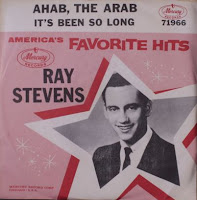
The success of the single provided Mercury the avenue in which to release a full length LP; as was commonplace back then practically every record label would issue singles on a recording artist and if the single or a series of singles proved successful in the label's eyes then they'd release a full length LP containing the songs that had been released as singles plus several album tracks...sometimes the album tracks would surface as future singles but often they'd remain on albums heard only by the most dedicated of fans. The feeling being that only the dedicated of fans would purchase an entire album of songs from one artist...while a general audience is more likely to purchase the single. "Ahab the Arab" tells the story of an Arab and his love for harem woman named Fatima...one of the women in the Sultan's harem...and throughout the song Ray tells of how Ahab and Fatima are in love with one another behind the Sultan's back. Ahab rides the dunes of the desert on a camel named Clyde. Ray has often spoke of the song's origins and how it's based upon the imagery seen in the film, The Sheik, as well as the books on Arabian culture...often cited is One Thousand and One Arabian Nights. The character names, as explained by Ray, come from various inspirations. Ahab is selected due to it rhyming with Arab (when pronounced Ay-rab rather than Air-ub). Fatima was a brand of cigarettes while the camel's name, Clyde, was inspired by Ray seeing Clyde McPhatter walking around in the recording studio one day. Clyde McPhatter, according to interviews I've read and heard from Ray and from passages in his memoir, was one of Ray's musical influences. Mercury edited the original recording of the song...cutting out a third verse...for time reasons. Ray, in later interviews, remarked that he was crushed when told that in order to potentially get airplay for the song it needed trimmed down. Whenever you see the 1995 music video of the song it includes the missing lyrics not included in the single release from 1962. The song's B-side, "It's Been So Long", is a delightful ballad...one of his more soulful of that time period. The success of Ray's first single releases led to Mercury releasing the LP titled 1,837 Seconds of Humor. The album contained almost all of the recordings found on the first three single releases on Ray by Mercury (missing was "When You Wish Upon a Star" and "It's Been So Long"). Some of the other songs on the album were: "Popeye and Olive Oyl", "PFC Rhythm and Blues Jones", "Saturday Night at the Movies", and "Julius Played the Trumpet". There were a lot of songs on that album specializing in pop culture satire which you can tell by some of the song titles. Those that didn't really care for rock and roll music had deep hatred for Elvis Presley...and when he was drafted into the military it tickled a lot of people's funny bones. Those that appreciated the things Elvis did for the music industry and those within the industry that liked this new kind of music also lent their contributions, in song, to the idea of a rock star being drafted into the military. Ray's song, "PFC Rhythm and Blues Jones", tackles the concept of a musician being in the military...in this case it's a rhythm and blues singer who goes by the name of Jones. It's explained that Jones would much rather be back home fronting his rhythm and blues band instead of dodging bullets from the enemy in some foxhole.

Mercury Records issued a further single on Ray in the fall of 1962...this time the love ballad was on the A-side and the comedy song on the B-side. However, the A-side come across as a novelty because it was unusual in it's delivery. As long time fans should already know but I'll explain for newcomers: a lot of Ray's songs in this time period that were intended to be taken seriously were often casually labeled 'novelty' by music critics due to the construction or vocal phrasing being different from what was being heard on radio. Novelty or off-beat were the common descriptions of Ray's serious recordings of this time period even though they were intended to be taken seriously. So, "Furthermore", his fourth single for Mercury, starts out with high falsetto from Ray delivering a scat singing introduction as music plays in the background. The delivery itself crams a lot of lyrics together in strings of what appears, to the ear, as run-on sentences but they're complete sentences but sung fast. It's a love song for sure...but given the performance it's described as off-beat. He re-recorded the song decades later as a slow, bluesy ballad. The B-side of the 1962 original is "Saturday Night at the Movies".

In the winter months of 1962 Mercury released the original recording of "Santa Claus is Watching You". Ray would re-record this song in 1985, with almost an entire set of different lyrics, which was accompanied by a famous music video; and he re-recorded it a second time in 1997. The 1962 original is a cute Christmas novelty...and it reached the Top-50 of the Hot 100. I like the original recording but I love the 1985 re-recording/partial re-write. The Christmas release remained a single exclusive until it began appearing on compilation albums. It should be noted that there's a lengthy recording of 1962's "Santa Claus is Watching You" and there's also an edited version for radio stations that clocks in a little over 2 minutes. The unedited recording is a little more than 3 minutes. You can find an audio clip on YouTube of the unedited 1962 recording by using the search phrase: Santa Claus is Watching You (1962). It was uploaded by a user named verycoolsound. Once you hear it and once you hear the edited version (the edits are noticeable) you'll wonder to yourself the reason why the editing took place...but again one only has to think back on the time period (early '60s) and how pop songs were typically quick and rarely ran longer than 2 and a half minutes whether it be a ballad or an uptempo recording.

As the calendar flipped to 1963 and as Ray was becoming more and more involved in the recording process with his session work and overall duties in the Artist and Repertoire department of Mercury he began to expand his workload...if only in terms of music arranging and other technical aspects of the recording industry. The first single release on Ray from Mercury in 1963 was "Funny Man" backed with "Just One of Life's Little Tragedies". Ray experienced some success in Canada with "Funny Man" as it reached the Top-20 of their pop music chart while on America's Hot 100 it peaked outside the Top-40. Mercury issued their second LP on Ray with the title being This is Ray Stevens. The overall flavor of the album was an almost even mix of comedy and serious recordings and it wasn't as pop culture heavy as the previous LP in 1962. "Harry the Hairy Ape" became a hit for Ray in the summer of 1963...it's all about an ape that wants to be a rock and roll singer...and how his entertaining ways leads to his becoming a recording artist following an encounter with a disc jockey. This novelty single became a Top-20 pop hit in America as well as a Top-20 Rhythm and Blues hit. On Canada's pop music chart it reached the Top-30. Ray's talents as a songwriter had long been on display. He wrote all the songs found on his first two albums. He and Margie Singleton wrote a song titled "My True Confession" which became a big hit for Brook Benton in the summer of 1963...so Ray not only found himself on the charts as a singer-songwriter of his own material but he was on the charts as a co-writer of the Brook Benton hit. Brook's hit was produced by Shelby Singleton (as was all of the songs found on Ray's first two albums) and it was arranged by Bill Justis. Brook was a major recording artist on the Rhythm and Blues as well as the Easy-Listening chart...the latter being a format devised in the aftermath of rock and roll...radio stations played songs from pop music artists who appealed mainly to adult audiences instead of teenagers. On the Hot 100 Brook's recording reached the Top-30 but in the Easy-Listening format it skyrocketed into the Top-10...it repeated this same Top-10 success on the Rhythm and Blues chart in 1963 as well.

Ray entered into a unique situation around this time period. I've never known the specific details but I've been able to come up with somewhat vague information stating that Ray signed a deal with Monument Records in 1963 as a producer/arranger/session musician while still under contract with Mercury Records as a recording artist. This meant that Ray would still issue recordings for Mercury Records but for Monument he was signed as a behind-the-scenes artist. The final single release from Mercury in 1963 on Ray happened to be "Speed Ball" backed with the ballad "It's Party Time". The A-side was another novelty hit...reaching the Hot 100 for several weeks...while reaching the Top-30 on the Rhythm and Blues chart. The B-side wasn't released on any album. I'm hoping that the first two chapters in this mini-blog series is helping go a long way at showcasing just how varied Ray's music career happens to be. In Part Three I won't be as story-telling as I probably come across in this blog entry...for in Part Three I'll be bringing into focus Ray's career as a music arranger and producer for other artists in addition to the recordings being issued on Ray by Mercury Records...so be on the look out for Part Three soon!

August 5, 2019

Ray Stevens: The Road to the Country Music Hall of Fame, Part One...

Hello all once again!! The beginning of another month is underway...which also means a slate of upcoming concerts by Ray Stevens at his CabaRay showroom. He performs there mostly on Friday and Saturday evenings and occasionally on a Thursday, too. The August series of concerts got underway this past Friday (August 2nd) and the remaining August concerts are being held on the following days: 8, 9, 10, 15, 16, 17, 23, 24, 30, and 31. The bold numbers indicate a Thursday night concert. I can't say it enough and for some it may sound like a broken record but if you have not visited this venue and taken in it's spectacular design, interior decoration, and the concert itself then I suggest you plan a trip to Nashville and add the CabaRay to your list of destinations. The CabaRay webpage is easy to navigate...everything you need to know can be found HERE.

Did you all catch any episodes of Ray Stevens CabaRay Nashville over the weekend...either on local PBS stations or the national RFD-TV network? Here in my area I'm fortunate to have an hour of Ray (yay!!). The local PBS station aired an episode guest starring Linda Davis at 8pm Saturday night...followed at 8:30pm on RFD-TV with an episode guest starring Gary Puckett.

I have this image posted first in the pictorial time-line over on the right hand side of the blog due to it being the first commercially issued single on Ray Stevens. The single, as I made note of off to the right, came along on Prep records in 1957. This label was owned by Capitol Records...in the music industry Prep was known as a subsidiary due to it being owned by a larger company. "Silver Bracelet", written by Ray, started it all. It's a good song and if you know anything about pop music in the mid '50s to the mid '60s then you're already aware that a lot of the recordings of that time period have been referred to as teenage ballads if they weren't explicitly a rock and roll vocal performance. This is part one of a series of blog entries where I'm attempting to examine Ray's road to the Country Music Hall of Fame. Yes, as you can imagine, the road leading to this much deserved honor wasn't a road that was under construction for decades with election to the prestigious hall being an absolute certain. Ray's career has long been identified by the various styles of music that influenced him growing up in Georgia...with country music being among those music styles...but a lot of his phrasing leaned more toward rhythm and blues artists and pop music vocalists. His fondness for comedy/novelty songs had been there from the beginning as well...the B-side of "Silver Bracelet" is a novelty titled "Rang Tang Ding Dong I'm the Japanese Sandman". Interestingly, though, a lot of on-line music sites credit "Silver Bracelet" as the B-side even though neither side of the single has an A or B designation. I think a lot of historians, given Ray's reputation for comedy, retro-actively consider "Rang Tang Ding Dong" as the A-side...but that's my opinion. The bottom line is this is the single that's considered his debut on records. It was not a national hit but Ray has often said that it was a local hit in Atlanta, Georgia. Ray was still in high school and had earlier fronted a local band, The Barons, in addition to becoming a radio disc jockey on a local station, WGPC, and so he was receiving a lot of experience as a performer/presenter long before his name ever appeared on vinyl...but had it appeared on vinyl it would've been Harold Ragsdale! His name had been changed for professional reasons by Capitol Records producer, Ken Nelson.

Born Harold Ray Ragsdale on January 24, 1939 he became Ray Stevens on records in 1957. Prior to this, as mentioned, he was known as Ray Ragsdale and during his sophomore year in high school (1954-1955) he and a co-host, Mary Dale Vansant, were personalities/disc jockeys on Albany, Georgia radio station, WGPC, hosting a program called The Record Hop. Sock hops were all the rage at the time...and Ray's band, The Barons, performed at a lot of sock hops. Relocation based upon his father's work forced the family to move from Albany to Atlanta, Georgia and as a result Ray graduated high school in Atlanta rather than Albany following the 1956-1957 school year. The origin of the stage-name, Ray Stevens, is derived from his middle name, of course, and the maiden name of his mother, Stephens, but spelled on records as 'Stevens'. In research from years past I discovered that in high school he went by the name of 'Ray Ragsdale' instead of 'Harold' or 'Harry'. Bill Lowery published the "Silver Bracelet" recording and as explained in earlier blog entries he was something of a mentor of Ray in those very early years...persuading Ray to pursue a career in music education rather than education in architecture. According to Ray's memoir, Ray Stevens' Nashville, Bill Lowery's influence guided him to make the decision to enroll in Georgia State rather than Georgia Tech. When Ray entered college he continued his recording career. It's worth pointing out that this secondary passion in architecture led to Ray, decades later, becoming something of a mogul in real estate and having a hands-on approach in the design of his former music theater in Branson, Missouri as well as his current venue, the CabaRay, in Nashville, TN. Ray's recordings for Prep were followed by a series of recordings for the Capitol label itself but eventually Ray found himself on a label owned by Bill Lowery, NRC, which stood for National Recording Company. The recordings Ray made for Capitol and NRC were post-high school and were recorded while Ray was attending Georgia State. In this era Jerry Reed, Joe South, Billy Joe Royal, and Ray were all featured performers on a local music series, The Georgia Jubilee.

One of the recordings that Ray did for NRC almost became his first breakthrough national hit...a novelty song issued in 1960 titled "Sgt. Preston of the Yukon" based upon the fictional character of the same name. The single was on it's way at breaking into the national Hot 100 pop chart but all of that hype and advertisement for the song caught the attention of the lawyers of King Features Syndicate, the owners of the character. They threatened a lawsuit and so NRC pulled all of the records off the market. Ray remained in college and continued recording whenever he could...ultimately, though, he found himself, as he often remarked, and I'm paraphrasing: "receiving real time experience in the music industry..." and a pursuit of a degree became less important and he dropped out of college at some point in 1961.

It was during this calendar year that he was signed to Mercury Records and it was also during this time period in which his career started to fall under the guidance and direction of Shelby Singleton and he began making himself known as a session musician and music arranger. Ray also found himself in the hustle and bustle of the booming Nashville Sound era that had been sweeping country music into crossover territory since the late 1950s. Although Ray, on records, was marketed as a pop artist and his background consisted largely of pop, novelty, and rhythm and blues influences he always included country music as a favorite listening choice as well and he seemingly felt at ease with pop music, rhythm and blues music, and country music and he worked almost equally as a singer/songwriter/musician/arranger/producer in those music formats and he would eventually form a music publishing company. It is in this era, 1961-1962, in which Ray formed his life long friendships and associations with producers and session musicians up and down Music Row. To name only several: Shelby Singleton, Chet Atkins, Harold Bradley, Boots Randolph, Floyd Cramer, as well as members of The Jordanaires and the list goes on and on. Felton Jarvis, a legendary music figure in his own right, was also associated with Ray...but more in a personal kind of way...for he was Ray's brother-in-law. The two men happened to marry a couple of sisters and so they were brothers-in-law for many years.

I'd like to say that once Ray joined Mercury Records in 1961 that he suddenly became a big time recording artist but, in truth, he was becoming an in-demand session musician and his prowess in the art of music arranging became the main source of his creative output...he hadn't made an appearance on the national music charts yet...this would change in 1961 but he wasn't the 'super-star' overnight...this ascension didn't come along until the next year. He was still living in Atlanta, Georgia in 1961 as well...and this, too, changed when the calendar flipped to January 1962. However, I'm wrapping up part one of this mini-blog series in the year of 1961 and in a future blog entry I'll pick up the narrative as we walk down Ray's road to the Country Music Hall of Fame. I may stretch out this blog series to run through mid October...for it's during the month of October (usually the last week) in which newly elected members of the Country Music Hall of Fame are officially inducted in the private gala known as the Medallion Ceremony. I'm wanting the final part of this mini-blog series to conclude right around the time Ray is officially inducted.

June 17, 2019

Ray Stevens from the Stage of the CabaRay...

There's been so much rain and potential for thunderstorms that whenever I've gotten onto the internet I've tried to make the most of it which is why I've been so blog heavy the last couple of days. This area is in for another round of storms and so when I finish this blog entry I'll be shutting off the laptop for perhaps the rest of the day. Now, the funny thing is, as I'm writing this the downpour is ended but the sky and clouds are still grey looking...indicative of more rain is on it's way at some point.

In the meantime I decided to re-visit the Ray Stevens performance of "Ruby, Don't Take Your Love To Town". Ray performs it from the stage of his CabaRay dinner theater and he speaks about it's writer, Mel Tillis. In the history of country music most singer-songwriters do not normally receive equal notoriety...there are some that have written a lot of well known songs but because their singing career happens to be popular, too, their songwriting is often under-played or under-appreciated. Mel Tillis, in my opinion, is one of those. He had such a stage presence, first of all, and how he turned his stutter into a comical asset made him endearing to thousands of country music fans; and so given the stage presence, his long string of hit songs, and his visibility on television programs, commercials, and an occasional movie appearance his songwriting side was overshadowed.

He wrote a number of songs that became gigantic hits in both country and pop music...and one of them, "Ruby, Don't Take Your Love To Town", became a classic...referred to as a standard. It's been recorded by hundreds of recording artists. The act that put it on the map happened to be Kenny Rogers and The First Edition (the group Kenny was a member of before he pursued country music in the mid 1970s).


Ray has never recorded this particular song for those curious. He and Mel had something of a similar career path during the 1990s as the two of them ultimately found success in Branson, Missouri. Ray's first taste of Branson success arrived with a series of concerts at Roy Clark's theater which caused Ray to wonder whether or not he, too, should take a chance on Branson as others were doing. Ray, as we know, opened up his Branson theater in June of 1991. Mel began performing in Branson in 1990, as well, in a series of existing theatres prior to the 1994 opening of his own theater. Research shows that Mel put his theatre up for sale in 2002 but remained there until 2004 when the purchase was finalized. Ironically, just as Mel was starting up his theater in 1994, Ray had left his theater after three seasons (1991, 1992, and 1993). Mel was elected to the Country Music Hall of Fame in 2007 and passed away at age 85 in November of 2017.

Ray's performance of "Ruby, Don't Take Your Love To Town" is from an episode of CabaRay Nashville...the episode titled 'Tribute Show'...from Season Six. Ray taped 9 episodes of the show from the CabaRay in the spring of 2018 and they were added to the four that had been taped at the previous location in the latter half of 2017. Those episodes are part of Season Six (the final 9 of the series, so far). The Sixth Season should begin to air on RFD-TV in the fall of this year and run through the first several weeks of 2020. As of this writing Season Five of CabaRay Nashville is airing on RFD-TV (episode 3, guest starring Paul Overstreet, aired Saturday night, June 15th).

I'm assuming that production of further episodes at the CabaRay will be underway at some point this calendar year and those episodes will ultimately begin airing on RFD-TV in 2020 at the conclusion of Season Six...but that's only my guess. Ray's series consists of 13 episodes per season and when his show returned to RFD-TV this past January the cable channel began airing Season Three which has been followed by Season Four and currently Season Five is being broadcast. If you're keeping count: 13 + 13 + 13 equals 39 episodes.

Once Season Six begins airing (13 episodes) it will bring the total to 52 episodes. So, by January or early February 2020, recently taped episodes of CabaRay Nashville should begin to air on RFD-TV to mark the start of a Season Seven or the cable channel could start airing select reruns of the show. I wish I could see into the future...unfortunately at this point it's all a guess. Anyway...getting back to the CabaRay itself...

In this video clip Ray gives you a tour of the CabaRay. There's nothing like seeing the showroom in person, though...so don't let the visual tour satisfy you. If you're able to attend a concert there don't put it off. This tour should cause you to want to visit his dinner theater in person if you're able to. You'll be glad you did. The ambience is great.