
Showing posts with label country-pop. Show all posts
Showing posts with label country-pop. Show all posts
February 12, 2023
Ray Stevens: The Great Country Ballads YouTube Playlist

August 5, 2019
Ray Stevens: The Road to the Country Music Hall of Fame, Part One...
Hello all once again!! The beginning of another month is underway...which also means a slate of upcoming concerts by Ray Stevens at his CabaRay showroom. He performs there mostly on Friday and Saturday evenings and occasionally on a Thursday, too. The August series of concerts got underway this past Friday (August 2nd) and the remaining August concerts are being held on the following days: 8, 9, 10, 15, 16, 17, 23, 24, 30, and 31. The bold numbers indicate a Thursday night concert. I can't say it enough and for some it may sound like a broken record but if you have not visited this venue and taken in it's spectacular design, interior decoration, and the concert itself then I suggest you plan a trip to Nashville and add the CabaRay to your list of destinations. The CabaRay webpage is easy to navigate...everything you need to know can be found HERE.
Did you all catch any episodes of Ray Stevens CabaRay Nashville over the weekend...either on local PBS stations or the national RFD-TV network? Here in my area I'm fortunate to have an hour of Ray (yay!!). The local PBS station aired an episode guest starring Linda Davis at 8pm Saturday night...followed at 8:30pm on RFD-TV with an episode guest starring Gary Puckett.
 I have this image posted first in the pictorial time-line over on the right hand side of the blog due to it being the first commercially issued single on Ray Stevens. The single, as I made note of off to the right, came along on Prep records in 1957. This label was owned by Capitol Records...in the music industry Prep was known as a subsidiary due to it being owned by a larger company. "Silver Bracelet", written by Ray, started it all. It's a good song and if you know anything about pop music in the mid '50s to the mid '60s then you're already aware that a lot of the recordings of that time period have been referred to as teenage ballads if they weren't explicitly a rock and roll vocal performance. This is part one of a series of blog entries where I'm attempting to examine Ray's road to the Country Music Hall of Fame. Yes, as you can imagine, the road leading to this much deserved honor wasn't a road that was under construction for decades with election to the prestigious hall being an absolute certain. Ray's career has long been identified by the various styles of music that influenced him growing up in Georgia...with country music being among those music styles...but a lot of his phrasing leaned more toward rhythm and blues artists and pop music vocalists. His fondness for comedy/novelty songs had been there from the beginning as well...the B-side of "Silver Bracelet" is a novelty titled "Rang Tang Ding Dong I'm the Japanese Sandman". Interestingly, though, a lot of on-line music sites credit "Silver Bracelet" as the B-side even though neither side of the single has an A or B designation. I think a lot of historians, given Ray's reputation for comedy, retro-actively consider "Rang Tang Ding Dong" as the A-side...but that's my opinion. The bottom line is this is the single that's considered his debut on records. It was not a national hit but Ray has often said that it was a local hit in Atlanta, Georgia. Ray was still in high school and had earlier fronted a local band, The Barons, in addition to becoming a radio disc jockey on a local station, WGPC, and so he was receiving a lot of experience as a performer/presenter long before his name ever appeared on vinyl...but had it appeared on vinyl it would've been Harold Ragsdale! His name had been changed for professional reasons by Capitol Records producer, Ken Nelson.
 Born Harold Ray Ragsdale on January 24, 1939 he became Ray Stevens on records in 1957. Prior to this, as mentioned, he was known as Ray Ragsdale and during his sophomore year in high school (1954-1955) he and a co-host, Mary Dale Vansant, were personalities/disc jockeys on Albany, Georgia radio station, WGPC, hosting a program called The Record Hop. Sock hops were all the rage at the time...and Ray's band, The Barons, performed at a lot of sock hops. Relocation based upon his father's work forced the family to move from Albany to Atlanta, Georgia and as a result Ray graduated high school in Atlanta rather than Albany following the 1956-1957 school year. The origin of the stage-name, Ray Stevens, is derived from his middle name, of course, and the maiden name of his mother, Stephens, but spelled on records as 'Stevens'. In research from years past I discovered that in high school he went by the name of 'Ray Ragsdale' instead of 'Harold' or 'Harry'. Bill Lowery published the "Silver Bracelet" recording and as explained in earlier blog entries he was something of a mentor of Ray in those very early years...persuading Ray to pursue a career in music education rather than education in architecture. According to Ray's memoir, Ray Stevens' Nashville, Bill Lowery's influence guided him to make the decision to enroll in Georgia State rather than Georgia Tech. When Ray entered college he continued his recording career. It's worth pointing out that this secondary passion in architecture led to Ray, decades later, becoming something of a mogul in real estate and having a hands-on approach in the design of his former music theater in Branson, Missouri as well as his current venue, the CabaRay, in Nashville, TN. Ray's recordings for Prep were followed by a series of recordings for the Capitol label itself but eventually Ray found himself on a label owned by Bill Lowery, NRC, which stood for National Recording Company. The recordings Ray made for Capitol and NRC were post-high school and were recorded while Ray was attending Georgia State. In this era Jerry Reed, Joe South, Billy Joe Royal, and Ray were all featured performers on a local music series, The Georgia Jubilee.
One of the recordings that Ray did for NRC almost became his first breakthrough national hit...a novelty song issued in 1960 titled "Sgt. Preston of the Yukon" based upon the fictional character of the same name. The single was on it's way at breaking into the national Hot 100 pop chart but all of that hype and advertisement for the song caught the attention of the lawyers of King Features Syndicate, the owners of the character. They threatened a lawsuit and so NRC pulled all of the records off the market. Ray remained in college and continued recording whenever he could...ultimately, though, he found himself, as he often remarked, and I'm paraphrasing: "receiving real time experience in the music industry..." and a pursuit of a degree became less important and he dropped out of college at some point in 1961.
It was during this calendar year that he was signed to Mercury Records and it was also during this time period in which his career started to fall under the guidance and direction of Shelby Singleton and he began making himself known as a session musician and music arranger. Ray also found himself in the hustle and bustle of the booming Nashville Sound era that had been sweeping country music into crossover territory since the late 1950s. Although Ray, on records, was marketed as a pop artist and his background consisted largely of pop, novelty, and rhythm and blues influences he always included country music as a favorite listening choice as well and he seemingly felt at ease with pop music, rhythm and blues music, and country music and he worked almost equally as a singer/songwriter/musician/arranger/producer in those music formats and he would eventually form a music publishing company. It is in this era, 1961-1962, in which Ray formed his life long friendships and associations with producers and session musicians up and down Music Row. To name only several: Shelby Singleton, Chet Atkins, Harold Bradley, Boots Randolph, Floyd Cramer, as well as members of The Jordanaires and the list goes on and on. Felton Jarvis, a legendary music figure in his own right, was also associated with Ray...but more in a personal kind of way...for he was Ray's brother-in-law. The two men happened to marry a couple of sisters and so they were brothers-in-law for many years.
I'd like to say that once Ray joined Mercury Records in 1961 that he suddenly became a big time recording artist but, in truth, he was becoming an in-demand session musician and his prowess in the art of music arranging became the main source of his creative output...he hadn't made an appearance on the national music charts yet...this would change in 1961 but he wasn't the 'super-star' overnight...this ascension didn't come along until the next year. He was still living in Atlanta, Georgia in 1961 as well...and this, too, changed when the calendar flipped to January 1962. However, I'm wrapping up part one of this mini-blog series in the year of 1961 and in a future blog entry I'll pick up the narrative as we walk down Ray's road to the Country Music Hall of Fame. I may stretch out this blog series to run through mid October...for it's during the month of October (usually the last week) in which newly elected members of the Country Music Hall of Fame are officially inducted in the private gala known as the Medallion Ceremony. I'm wanting the final part of this mini-blog series to conclude right around the time Ray is officially inducted.
Did you all catch any episodes of Ray Stevens CabaRay Nashville over the weekend...either on local PBS stations or the national RFD-TV network? Here in my area I'm fortunate to have an hour of Ray (yay!!). The local PBS station aired an episode guest starring Linda Davis at 8pm Saturday night...followed at 8:30pm on RFD-TV with an episode guest starring Gary Puckett.


One of the recordings that Ray did for NRC almost became his first breakthrough national hit...a novelty song issued in 1960 titled "Sgt. Preston of the Yukon" based upon the fictional character of the same name. The single was on it's way at breaking into the national Hot 100 pop chart but all of that hype and advertisement for the song caught the attention of the lawyers of King Features Syndicate, the owners of the character. They threatened a lawsuit and so NRC pulled all of the records off the market. Ray remained in college and continued recording whenever he could...ultimately, though, he found himself, as he often remarked, and I'm paraphrasing: "receiving real time experience in the music industry..." and a pursuit of a degree became less important and he dropped out of college at some point in 1961.
It was during this calendar year that he was signed to Mercury Records and it was also during this time period in which his career started to fall under the guidance and direction of Shelby Singleton and he began making himself known as a session musician and music arranger. Ray also found himself in the hustle and bustle of the booming Nashville Sound era that had been sweeping country music into crossover territory since the late 1950s. Although Ray, on records, was marketed as a pop artist and his background consisted largely of pop, novelty, and rhythm and blues influences he always included country music as a favorite listening choice as well and he seemingly felt at ease with pop music, rhythm and blues music, and country music and he worked almost equally as a singer/songwriter/musician/arranger/producer in those music formats and he would eventually form a music publishing company. It is in this era, 1961-1962, in which Ray formed his life long friendships and associations with producers and session musicians up and down Music Row. To name only several: Shelby Singleton, Chet Atkins, Harold Bradley, Boots Randolph, Floyd Cramer, as well as members of The Jordanaires and the list goes on and on. Felton Jarvis, a legendary music figure in his own right, was also associated with Ray...but more in a personal kind of way...for he was Ray's brother-in-law. The two men happened to marry a couple of sisters and so they were brothers-in-law for many years.
I'd like to say that once Ray joined Mercury Records in 1961 that he suddenly became a big time recording artist but, in truth, he was becoming an in-demand session musician and his prowess in the art of music arranging became the main source of his creative output...he hadn't made an appearance on the national music charts yet...this would change in 1961 but he wasn't the 'super-star' overnight...this ascension didn't come along until the next year. He was still living in Atlanta, Georgia in 1961 as well...and this, too, changed when the calendar flipped to January 1962. However, I'm wrapping up part one of this mini-blog series in the year of 1961 and in a future blog entry I'll pick up the narrative as we walk down Ray's road to the Country Music Hall of Fame. I may stretch out this blog series to run through mid October...for it's during the month of October (usually the last week) in which newly elected members of the Country Music Hall of Fame are officially inducted in the private gala known as the Medallion Ceremony. I'm wanting the final part of this mini-blog series to conclude right around the time Ray is officially inducted.
July 14, 2019
Ray Stevens is One of a Kind...
One of the things that I've enjoyed over the last 10+ years of writing this fan-created blog is the variety of music styles and time periods that can be written about from one blog entry to the next given the fact that the career of Ray Stevens is lengthy and encompasses a lot of territory within the music landscape. In the last blog entry I spotlighted a video clip of Ray giving the spotlight to Loretta Lynn at his CabaRay showroom in a concert from July 5th of this year...and in this blog entry I'm stepping back 44 years to 1975.
I'm sure the most devoted of fans out there have heard his rendition of the pop music standard, "Lady of Spain". The recording made it's debut on Ray's 1975 album, Misty. This album featured mostly cover songs from Ray of pop music standards featuring different arrangements...a concept that resurfaced on a couple of future albums from Ray. It isn't a new concept or something unique to the career of Ray Stevens, though. Prior to Misty in 1975 he issued the album, Have a Little Talk with Myself, in 1969. In that album he performed his versions of contemporary pop songs...some with new arrangements and some retaining the original arrangements...but each were clearly transformed into the Ray Stevens style. In the case of both albums each featured a couple of original recordings. The 1969 album, among the cover songs, were originals such as "The Little Woman", "Sunday Mornin' Comin' Down", and the title track "Have a Little Talk with Myself". Oh, yes, if you caught my previous blog entry or have been a longtime fan of Ray Stevens you'll know that he recorded "Sunday Mornin' Comin' Down" before anyone else...so when it appeared on the 1969 album it was considered an original song.
 This is the photo that accompanied the single's release in Germany in early 1976. The irony being that Ray had already left the Barnaby Records roster for Warner Brothers when this single was released. It's rare now but at that time in was commonplace for a record label to release further singles on an artist even after the artist left the label...the most common reason is for contractual reasons. An artist may have signed a contract giving the label the option to release a set amount of recordings, either in the form of albums or singles, after the completion of the contract. In this case the presence of a newly released recording from a previous label finds itself in competition with the artist's newly recorded material for his/her current label but almost always the recordings released from an artist's former record label rarely achieve heavy media publicity. I've read reports down through the years that some record labels issue singles on a previously signed artist, strategically, in an effort to coincide with the artist's current release on a competing label...and although, contractually, it is legal, it nevertheless may be a sign of bitterness on the part of the artist's former record label to possibly diminish whatever media attention/hype the artist may receive from the next record label. In Ray's memoir, Ray Stevens' Nashville, he explains that during the course of his career he's recorded for a lot of record labels and he mentions that some have asked why he's recorded for numerous labels and what causes an artist to go from one label to another. He explained that in most cases an artist leaves one label for another because a contract has expired and either the label doesn't want to re-sign the artist or the artist wants to shop around for another 'home', as they call it. He made mention of never burning bridges...which is a valuable piece of advice...because a record label that you were once signed to may, down the road, show an interest in having you on their roster again or the label may have gone through a major executive shake-up and have a whole new team in charge and they may want to do business with you or you may want to work for them.
The recording of "Lady of Spain" features a completely different arrangement and tempo than the pop music standard from the 1930s. The song is most commonly played as an instrumental...most often on the accordion...but the vocal versions of the song were performed in a slow, ballad presentation. Ray transformed the song into a rollicking, up-tempo festive presentation and his vocal styling on this recording is comparable to Fats Waller, Jim Croce, and Dr. John rolled into one. Ray Stevens is definitely one of a kind...with the B-side being "Mockingbird Hill"...a pop standard from 1951. A couple of years after Ray recorded "Mockingbird Hill" it became a hit single for country singer, Donna Fargo, in 1977. The photo used on the single release in Germany is from Ray's 1973 studio album, Nashville. There are other releases of "Lady of Spain" / "Mockingbird Hill" which features the photo from the Misty album.
The Misty album features the following Ray Stevens recordings:
1. Misty
2. Indian Love Call
3. Over the Rainbow
4. Oh, Lonesome Me
5. Sunshine**
6. Cow-Cow Boogie
7. Young Love
8. Deep Purple
9. Mockingbird Hill
10. Take Care of Business**
11. Lady of Spain
The titles with the two asterisks ** indicate original songs...the rest of the recordings were songs previously recorded by other artists. "Sunshine" was written by Ray Stevens whereas Layng Martine, Jr. wrote "Take Care of Business". "Sunshine" is a bouncy, happy, up-tempo sing-a-long utilizing pretty much the same instrumentation heard on "Misty". Ray once remarked in an interview that not only does he want lyrics to tell a story but also the music to tell a story...and you'll certainly feel happy and be all smiles when listening to the music accompanying "Sunshine". The latter song's title was inspired by a line in Ray's 1968 recording, "Mr. Businessman", but that's where the similarities end. "Take Care of Business" is a slow ballad of mounting lust and desire that a man has for his wife and how his job keeps the two apart...but he's determined not to allow his job to interfere with his relationship any longer...and he emphatically states that he and his wife are going to "Take Care of Business" later that night when he goes home. As you see "Lady of Spain" is the album's closing performance and a perfect way to close out the album.
The musicians featured on the album should be familiar to those that have examined his studio albums over the years. "Misty" and "Sunshine" were recorded during the same session and because of this the credits specify which musicians are heard on those two recordings as well as "Indian Love Call" and "Deep Purple". In today's music industry you may have a different group of musicians for every recording found on an album...and with music being purchased digitally there's a lack of traditional elements found in the physical copy of a CD. On a digital album's product page you're likely going to see a photo of the artist or the cover of the album if it's also available on CD and you'll see the song titles...but rarely will you see musician credits, songwriter credits, publisher credits, or where the songs were recorded. I like seeing those things...so I continue to purchase a CD if one is available...rather than purchasing a digital/Mp3 copy.
I'm sure the most devoted of fans out there have heard his rendition of the pop music standard, "Lady of Spain". The recording made it's debut on Ray's 1975 album, Misty. This album featured mostly cover songs from Ray of pop music standards featuring different arrangements...a concept that resurfaced on a couple of future albums from Ray. It isn't a new concept or something unique to the career of Ray Stevens, though. Prior to Misty in 1975 he issued the album, Have a Little Talk with Myself, in 1969. In that album he performed his versions of contemporary pop songs...some with new arrangements and some retaining the original arrangements...but each were clearly transformed into the Ray Stevens style. In the case of both albums each featured a couple of original recordings. The 1969 album, among the cover songs, were originals such as "The Little Woman", "Sunday Mornin' Comin' Down", and the title track "Have a Little Talk with Myself". Oh, yes, if you caught my previous blog entry or have been a longtime fan of Ray Stevens you'll know that he recorded "Sunday Mornin' Comin' Down" before anyone else...so when it appeared on the 1969 album it was considered an original song.
The recording of "Lady of Spain" features a completely different arrangement and tempo than the pop music standard from the 1930s. The song is most commonly played as an instrumental...most often on the accordion...but the vocal versions of the song were performed in a slow, ballad presentation. Ray transformed the song into a rollicking, up-tempo festive presentation and his vocal styling on this recording is comparable to Fats Waller, Jim Croce, and Dr. John rolled into one. Ray Stevens is definitely one of a kind...with the B-side being "Mockingbird Hill"...a pop standard from 1951. A couple of years after Ray recorded "Mockingbird Hill" it became a hit single for country singer, Donna Fargo, in 1977. The photo used on the single release in Germany is from Ray's 1973 studio album, Nashville. There are other releases of "Lady of Spain" / "Mockingbird Hill" which features the photo from the Misty album.
The Misty album features the following Ray Stevens recordings:
1. Misty
2. Indian Love Call
3. Over the Rainbow
4. Oh, Lonesome Me
5. Sunshine**
6. Cow-Cow Boogie
7. Young Love
8. Deep Purple
9. Mockingbird Hill
10. Take Care of Business**
11. Lady of Spain
The titles with the two asterisks ** indicate original songs...the rest of the recordings were songs previously recorded by other artists. "Sunshine" was written by Ray Stevens whereas Layng Martine, Jr. wrote "Take Care of Business". "Sunshine" is a bouncy, happy, up-tempo sing-a-long utilizing pretty much the same instrumentation heard on "Misty". Ray once remarked in an interview that not only does he want lyrics to tell a story but also the music to tell a story...and you'll certainly feel happy and be all smiles when listening to the music accompanying "Sunshine". The latter song's title was inspired by a line in Ray's 1968 recording, "Mr. Businessman", but that's where the similarities end. "Take Care of Business" is a slow ballad of mounting lust and desire that a man has for his wife and how his job keeps the two apart...but he's determined not to allow his job to interfere with his relationship any longer...and he emphatically states that he and his wife are going to "Take Care of Business" later that night when he goes home. As you see "Lady of Spain" is the album's closing performance and a perfect way to close out the album.
The musicians featured on the album should be familiar to those that have examined his studio albums over the years. "Misty" and "Sunshine" were recorded during the same session and because of this the credits specify which musicians are heard on those two recordings as well as "Indian Love Call" and "Deep Purple". In today's music industry you may have a different group of musicians for every recording found on an album...and with music being purchased digitally there's a lack of traditional elements found in the physical copy of a CD. On a digital album's product page you're likely going to see a photo of the artist or the cover of the album if it's also available on CD and you'll see the song titles...but rarely will you see musician credits, songwriter credits, publisher credits, or where the songs were recorded. I like seeing those things...so I continue to purchase a CD if one is available...rather than purchasing a digital/Mp3 copy.
September 2, 2015
Ray Stevens: The Elusive Ten...
Hello to all the fans of Ray Stevens! September is here and for those that took advantage of the half-price sale of Ray's Such a Night DVD (sale ended yesterday), good for you. I'm sure it and or other items are going to be on sale in a couple of months as the Christmas season begins but perhaps not at such a steep discount as the one that just ended. By that time could it be possible that the long-awaited Volume 2 of his gospel recordings might be available?
I don't, of course, have any idea about the contracts and other things that go on in Ray's business life but I'd like to hear the remaining songs from those gospel recording sessions...at some point.
The reason I bring it up is because during the publicity and promotion for the Ray Stevens Gospel Collection, Volume One CD Ray often remarked that he'd recorded more than 20 songs and the first 10 appear on the Volume One CD and the other batch of songs are going to appear on Volume Two. The gospel CD hit the market on August 19, 2014 and so, given that it's been more than a year, could it very well be possible that the follow-up is right around the corner?
Getting to the heart of this particular blog entry I'm bringing attention to a series of LP's in the career of Ray Stevens that have, to date, remained exclusive to vinyl, cassette, and 8-track format in an era of CD, digital downloads, and other technological inventions. As a result of the LP's not being available in a contemporary format there's a chance that some of his fans may want to track these albums down on internet auction sites to hear what they've been missing.
There's proof via social network commentary that a lot of Ray's younger and or newest fans discovered his music by accident given the lack of mainstream publicity on radio/television...therefore these newer fans of his are more often than not only familiar with Ray for whatever video clip they discovered on YouTube from him. This fan created blog is designed to spotlight his career, from all time periods, for those that have discovered him on YouTube but may not know much at all about his music.
In keeping with that goal here is a list of 10 studio albums from Ray Stevens that have never been available on CD or Mp3...
1. Have a Little Talk with Myself; 1969 Monument Records- This is one of Ray's cover albums. In this collection he delivers the hits originally recorded by the likes of The 5th Dimension, Blood, Sweat, and Tears, The Beatles, Bob Dylan...a varied collection of pop music artists and groups. There are three original songs among the covers...first there's "Sunday Mornin' Comin' Down" from the pen of Kris Kristofferson. Ray recorded this song before Johnny Cash...but it's Johnny that ended up having the big hit single on it. Ray's recording afforded him the chance to appear on the Country music singles chart for the first time in his career...both here in America and in Canada. The other original song is "The Little Woman", a tale of fidelity and devotion. The third original song is the album's title track...the inspirational tale of attitude correction and prioritizing one's life. The title track also reached the country singles chart. The cover songs include "Help", "Aquarius", "Hey Jude", "I'll Be Your Baby Tonight", and "Hair" among others. The highlight among those being "Hair"...the production and time put into making the record sound almost exactly like the original by the cast of the musical, Hair, is a testament to his genius in the recording studio. The entire LP is incredible. It's a travesty it's never been issued on CD/Mp3.
2. Losin' Streak; 1973 Barnaby Records- For whatever reason this LP didn't see a re-issue from Collectible's Records even though the company re-issued the other studio albums Ray recorded for Barnaby (1970-1975). It still remains a mystery as to the reason it was skipped over. The title track appeared as a single release but it never charted. One of the tracks, "Inside", found itself as the B-side of several single releases from Ray in this era. There's an instrumental on here called "Laid Back". My favorites are "Golden Age", "This is Your Life", and "Idaho Wine". Physically, this is the first album of his to show him having a beard. Typically clean-shaven for photo sessions the beard didn't become a physical fixture until around 1978 or so. If anybody has a clean-shaven photo of Ray from the 1980s, 1990s, or even this decade I'd love to see it! I doubt any exist.
3. Just For The Record; 1976 Warner Brothers- Ray's debut on a different label after 5 years at Barnaby. The music he recorded on this album, country-pop, fit in nicely among the other songs on country radio and he enjoyed a pair of Top-30 country music hits in the process... "You Are So Beautiful" and "Honky Tonk Waltz". A non-album single, "In the Mood", hit in December of 1976 and it became a novelty hit in the early part of 1977 in America, Canada, and in the United Kingdom. The single, clucked like a choir of chickens and initially released as The Henhouse Five Plus Too, is one of those rare instances of a single hitting the market out of the blue without any advanced publicity to speak of. It never appeared on any LP but the label promoted the single, heavily, to pop music markets and it became an international Top-40 hit. It's long been said by historians that being primarily a West Coast music company, Warner Brothers didn't necessarily know how to market to country music outlets (especially the southern markets in the Eastern portion of the United States). Also, the label hadn't been in the business of marketing music for too long. Legendary country music artist Buck Owens, also signed to the label around the same time, seen a dramatic drop in his album sales, too, compared to his previous albums for Capitol. In fact, Buck's first 2 studio albums for Warner Brothers never even appeared on the sales charts. Ironically, this Ray Stevens album happened to be a success, however...
4. Feel the Music; 1977 Warner Brothers- For this album Ray penned 9 of the 10 songs! He also, as usual, produced and arranged the music from his own recording studio and contributed his musical prowess on keyboards/piano. Unfortunately the extreme lack of publicity for the LP caused it to literally anchor the Top-50 album chart during an all too brief visit. The label's continued publicity for "In the Mood" may have also hurt this album's potential (commercially speaking, of course). The number of positions on the Country album chart at the time happened to be 50. Even though, by comparison, one of the single releases from the LP titled "Dixie Hummingbird", managed to peak just outside the radio-oriented Top-40 portion of the Country singles chart; however, the funky audio sound effects in "Get Crazy With Me" and it being marketed to country music outlets as it was, well, obviously, the song seen resistance from programmers unwilling to add it. One gets the sense that there wasn't any clear direction, from a label stand-point, as to which way to market his music. He remained just as popular as ever on tour but clearly the label's inability to market/promote his records properly certainly must have caused strained relations...
5. There Is Something On Your Mind; 1978 Warner Brothers- This is a covers album featuring Ray paying tribute to classic rhythm and blues artists and groups. The album is one of his most personal given that he supplied his own liner notes (a rarity) and discussed, song by song, his thoughts and opinions about each of the songs and how he became familiar with them during his child-hood/teenage years. It's a marvelous collection but it never reached the album charts and no song became a single release...almost as if it's a ghost album that existed at one time but yet there's no trace of it's existence in music trade publications. I've yet to come across any article in Billboard from 1978 (via Google archive research) to mention the LP in any write-up or any promo ad from Warner Brothers. If anybody has any publicity about the LP let me know! I've got the LP in my collection but as a fan I like seeing advertisements/publicity for Ray's music at the time it originally surfaced.
6. Be Your Own Best Friend; 1978 Warner Brothers- This is the fourth and final studio album Ray recorded for the label. Surprisingly the album received publicity in a more traditional sense by appearing in a large print ad in Billboard. The album never reached the charts but the title track became a Top-40 country music hit in America and a Top-20 country music hit in Canada. In Canada it happened to be a fairly decent hit...peaking in the Top-20 on October 14, 1978 (after leaping from the lower half of the Top-40 a week earlier). It can be said that the single peaked too soon because, for a Top-20 hit single, it was only among the Top-20 for one week before falling back into the upper Top-30. One also could say the single either had massive sales spikes or enormous airplay during an 8 week period (September 9, 1978-October 28, 1978).
1979's release, The Feeling's Not Right Again, is a compilation album consisting of 9 songs taken from Ray's previous LP's for Warner Brothers and one brand new song, the satirical "I Need Your Help, Barry Manilow". That particular single, chart-wise, is his biggest single release for the label. It charted country (ironically enough) and it peaked in the Top-50 on the Hot 100 pop chart but more ironically is it's performance on Adult-Contemporary/Easy-Listening radio (the format ruled largely by Barry Manilow during the latter half of the 1970s). The single peaked just outside the Top-10 on Billboard's Adult-Contemporary chart. The single reinforced his reputation as a novelty artist, though. His biggest selling hits for the label happened to be this and 1977's "In the Mood". Not long after the success of "I Need Your Help, Barry Manilow" Ray quietly left Warner Brothers and joined the roster of RCA Records. His move to RCA took place in the latter half of 1979...and publicity surrounding his arrival appeared in Billboard that same year. The blurb mentioned that he'd soon be in the studio to start working on his debut for the label.
7. Shriner's Convention; 1980 RCA- This is Ray's debut album for the RCA label and it's an all-comedy project. It marked the first all-comedy album from Ray in 6 years (his previous being the 1974 album spotlighting "The Streak"). This album also reached the Top-10 on the Country album chart...a major success in both sales and publicity. It's big hit, "Shriner's Convention", also became a Top-10 hit on the country music singles chart. The album contained another single release, "Hey There", but it never charted. The title track and "The Dooright Family" have consistently appeared on numerous compilation albums released by RCA and their family of labels.
8. One More Last Chance; 1981 RCA- Like the other LP's this one is also unavailable on CD and Mp3. This collection of songs are meant to compliment the Urban Cowboy craze that had been sweeping the nation for the last couple of years. Even though Ray's previous LP happened to be a Top-10, all-comedy smash hit he immediately began to work on this album. In fact, during a couple of print interviews that surfaced in newspapers at the time of the album and single's success, Ray defiantly took the stance of distancing himself from comedy as soon as possible so he could get back to serious recordings once more. The album's first single, "Night Games", appeared in the latter half of 1980 and it climbed into the Top-20 on the country singles chart in America...but at the time there happened to be no LP in the stores featuring the single and so it remained a single-only release until this album appeared in 1981. In a show of the times Ray is decked out in western attire and on the back of the album he's wearing a cowboy hat. "Night Games" did even better in Canada...peaking 9 positions higher than it's peak position in America. The album's title track reached the country singles Top-40.
9. Don't Laugh Now; 1982 RCA- Ray's third studio album for the label carries a bit more Rhythm and Blues and pop-country than the previous collection as the opening track, "Such a Night", clearly demonstrates. This album didn't reach the charts (neither did the 1981 LP) but it contained a Top-40 country hit in "Written Down in My Heart" and a gospel-tinged novelty single titled "Where The Sun Don't Shine", which also reached the country chart. In contrast to the 1981 LP, this one carried a much more uptempo feel and an optimistic one. Most of the songs on the 1981 LP happened to be ballads and the feel of the collection had an overall melancholy flavor in spite of several rousing uptempo songs. For the 1982 LP there's the fair share of ballads but not all of them are slow ballads...a couple of them are mid-tempo, actually, such as "Country Boy, Country Club Girl" and "Oh Leo Lady" and then there's "Why Don't We Go Somewhere and Make Love". Even though it's a romantic ballad the chorus picks the song up delivering an easy-listening sing-a-long. The only slow ballad is "This Old Piano"...in close second is the title track.
10. Me; 1983 Mercury- Lastly there's this 1983 studio album on Mercury Records...the label that made Ray Stevens a recording star in the early '60s. This time around Ray delivered an album of songs mostly self-written but like his last 2 studio albums for RCA this one didn't make the charts, either. It did contain one single that reached the country charts...the majestic "My Dad", from the pen of Dale Gonyea (the one that wrote "I Need Your Help, Barry Manilow"). The LP didn't receive much publicity and beyond the brief chart run of "My Dad" it didn't get much notice except for an extremely rare promo by Ray Stevens on an episode of The Fall Guy titled 'The Pirates of Nashville'. In that episode Ray plays a character named Covington, a country music artist estranged from his son. There's a performance of one of the songs from the album at the end of the episode but there's no mention of the album's existence or anything. The album hit in the last half of 1983 and the single releases didn't arrive until 1984. "My Dad", "Love Will Beat Your Brains Out", "Mary Lou Nights", "Game Show Love", "Me", and "A Piece of Paradise Called Tennessee" appeared on single releases from Mercury throughout the first half of 1984. Once his contract expired Ray set his attention on MCA Records and an incredible run of commercially successful albums and singles soon followed.
And there you have it! Those 10 studio albums have never seen a re-issue of any kind on CD or Mp3. Some may say it has to do with the lack of major hit recordings contained on those albums....some may say the albums themselves aren't worthy of re-issue...and some may say the albums had no commercial value then so why would there be any audience all these years later. I think there's an audience...a built-in audience of fans that are familiar with his songs but hadn't actually heard the various styles of music those albums represent because the complete studio albums are hard to come by and if found can only be heard on vinyl or cassette tape.
I don't, of course, have any idea about the contracts and other things that go on in Ray's business life but I'd like to hear the remaining songs from those gospel recording sessions...at some point.
The reason I bring it up is because during the publicity and promotion for the Ray Stevens Gospel Collection, Volume One CD Ray often remarked that he'd recorded more than 20 songs and the first 10 appear on the Volume One CD and the other batch of songs are going to appear on Volume Two. The gospel CD hit the market on August 19, 2014 and so, given that it's been more than a year, could it very well be possible that the follow-up is right around the corner?
Getting to the heart of this particular blog entry I'm bringing attention to a series of LP's in the career of Ray Stevens that have, to date, remained exclusive to vinyl, cassette, and 8-track format in an era of CD, digital downloads, and other technological inventions. As a result of the LP's not being available in a contemporary format there's a chance that some of his fans may want to track these albums down on internet auction sites to hear what they've been missing.
There's proof via social network commentary that a lot of Ray's younger and or newest fans discovered his music by accident given the lack of mainstream publicity on radio/television...therefore these newer fans of his are more often than not only familiar with Ray for whatever video clip they discovered on YouTube from him. This fan created blog is designed to spotlight his career, from all time periods, for those that have discovered him on YouTube but may not know much at all about his music.
In keeping with that goal here is a list of 10 studio albums from Ray Stevens that have never been available on CD or Mp3...
1. Have a Little Talk with Myself; 1969 Monument Records- This is one of Ray's cover albums. In this collection he delivers the hits originally recorded by the likes of The 5th Dimension, Blood, Sweat, and Tears, The Beatles, Bob Dylan...a varied collection of pop music artists and groups. There are three original songs among the covers...first there's "Sunday Mornin' Comin' Down" from the pen of Kris Kristofferson. Ray recorded this song before Johnny Cash...but it's Johnny that ended up having the big hit single on it. Ray's recording afforded him the chance to appear on the Country music singles chart for the first time in his career...both here in America and in Canada. The other original song is "The Little Woman", a tale of fidelity and devotion. The third original song is the album's title track...the inspirational tale of attitude correction and prioritizing one's life. The title track also reached the country singles chart. The cover songs include "Help", "Aquarius", "Hey Jude", "I'll Be Your Baby Tonight", and "Hair" among others. The highlight among those being "Hair"...the production and time put into making the record sound almost exactly like the original by the cast of the musical, Hair, is a testament to his genius in the recording studio. The entire LP is incredible. It's a travesty it's never been issued on CD/Mp3.
2. Losin' Streak; 1973 Barnaby Records- For whatever reason this LP didn't see a re-issue from Collectible's Records even though the company re-issued the other studio albums Ray recorded for Barnaby (1970-1975). It still remains a mystery as to the reason it was skipped over. The title track appeared as a single release but it never charted. One of the tracks, "Inside", found itself as the B-side of several single releases from Ray in this era. There's an instrumental on here called "Laid Back". My favorites are "Golden Age", "This is Your Life", and "Idaho Wine". Physically, this is the first album of his to show him having a beard. Typically clean-shaven for photo sessions the beard didn't become a physical fixture until around 1978 or so. If anybody has a clean-shaven photo of Ray from the 1980s, 1990s, or even this decade I'd love to see it! I doubt any exist.
3. Just For The Record; 1976 Warner Brothers- Ray's debut on a different label after 5 years at Barnaby. The music he recorded on this album, country-pop, fit in nicely among the other songs on country radio and he enjoyed a pair of Top-30 country music hits in the process... "You Are So Beautiful" and "Honky Tonk Waltz". A non-album single, "In the Mood", hit in December of 1976 and it became a novelty hit in the early part of 1977 in America, Canada, and in the United Kingdom. The single, clucked like a choir of chickens and initially released as The Henhouse Five Plus Too, is one of those rare instances of a single hitting the market out of the blue without any advanced publicity to speak of. It never appeared on any LP but the label promoted the single, heavily, to pop music markets and it became an international Top-40 hit. It's long been said by historians that being primarily a West Coast music company, Warner Brothers didn't necessarily know how to market to country music outlets (especially the southern markets in the Eastern portion of the United States). Also, the label hadn't been in the business of marketing music for too long. Legendary country music artist Buck Owens, also signed to the label around the same time, seen a dramatic drop in his album sales, too, compared to his previous albums for Capitol. In fact, Buck's first 2 studio albums for Warner Brothers never even appeared on the sales charts. Ironically, this Ray Stevens album happened to be a success, however...
4. Feel the Music; 1977 Warner Brothers- For this album Ray penned 9 of the 10 songs! He also, as usual, produced and arranged the music from his own recording studio and contributed his musical prowess on keyboards/piano. Unfortunately the extreme lack of publicity for the LP caused it to literally anchor the Top-50 album chart during an all too brief visit. The label's continued publicity for "In the Mood" may have also hurt this album's potential (commercially speaking, of course). The number of positions on the Country album chart at the time happened to be 50. Even though, by comparison, one of the single releases from the LP titled "Dixie Hummingbird", managed to peak just outside the radio-oriented Top-40 portion of the Country singles chart; however, the funky audio sound effects in "Get Crazy With Me" and it being marketed to country music outlets as it was, well, obviously, the song seen resistance from programmers unwilling to add it. One gets the sense that there wasn't any clear direction, from a label stand-point, as to which way to market his music. He remained just as popular as ever on tour but clearly the label's inability to market/promote his records properly certainly must have caused strained relations...
5. There Is Something On Your Mind; 1978 Warner Brothers- This is a covers album featuring Ray paying tribute to classic rhythm and blues artists and groups. The album is one of his most personal given that he supplied his own liner notes (a rarity) and discussed, song by song, his thoughts and opinions about each of the songs and how he became familiar with them during his child-hood/teenage years. It's a marvelous collection but it never reached the album charts and no song became a single release...almost as if it's a ghost album that existed at one time but yet there's no trace of it's existence in music trade publications. I've yet to come across any article in Billboard from 1978 (via Google archive research) to mention the LP in any write-up or any promo ad from Warner Brothers. If anybody has any publicity about the LP let me know! I've got the LP in my collection but as a fan I like seeing advertisements/publicity for Ray's music at the time it originally surfaced.
6. Be Your Own Best Friend; 1978 Warner Brothers- This is the fourth and final studio album Ray recorded for the label. Surprisingly the album received publicity in a more traditional sense by appearing in a large print ad in Billboard. The album never reached the charts but the title track became a Top-40 country music hit in America and a Top-20 country music hit in Canada. In Canada it happened to be a fairly decent hit...peaking in the Top-20 on October 14, 1978 (after leaping from the lower half of the Top-40 a week earlier). It can be said that the single peaked too soon because, for a Top-20 hit single, it was only among the Top-20 for one week before falling back into the upper Top-30. One also could say the single either had massive sales spikes or enormous airplay during an 8 week period (September 9, 1978-October 28, 1978).
1979's release, The Feeling's Not Right Again, is a compilation album consisting of 9 songs taken from Ray's previous LP's for Warner Brothers and one brand new song, the satirical "I Need Your Help, Barry Manilow". That particular single, chart-wise, is his biggest single release for the label. It charted country (ironically enough) and it peaked in the Top-50 on the Hot 100 pop chart but more ironically is it's performance on Adult-Contemporary/Easy-Listening radio (the format ruled largely by Barry Manilow during the latter half of the 1970s). The single peaked just outside the Top-10 on Billboard's Adult-Contemporary chart. The single reinforced his reputation as a novelty artist, though. His biggest selling hits for the label happened to be this and 1977's "In the Mood". Not long after the success of "I Need Your Help, Barry Manilow" Ray quietly left Warner Brothers and joined the roster of RCA Records. His move to RCA took place in the latter half of 1979...and publicity surrounding his arrival appeared in Billboard that same year. The blurb mentioned that he'd soon be in the studio to start working on his debut for the label.
7. Shriner's Convention; 1980 RCA- This is Ray's debut album for the RCA label and it's an all-comedy project. It marked the first all-comedy album from Ray in 6 years (his previous being the 1974 album spotlighting "The Streak"). This album also reached the Top-10 on the Country album chart...a major success in both sales and publicity. It's big hit, "Shriner's Convention", also became a Top-10 hit on the country music singles chart. The album contained another single release, "Hey There", but it never charted. The title track and "The Dooright Family" have consistently appeared on numerous compilation albums released by RCA and their family of labels.
8. One More Last Chance; 1981 RCA- Like the other LP's this one is also unavailable on CD and Mp3. This collection of songs are meant to compliment the Urban Cowboy craze that had been sweeping the nation for the last couple of years. Even though Ray's previous LP happened to be a Top-10, all-comedy smash hit he immediately began to work on this album. In fact, during a couple of print interviews that surfaced in newspapers at the time of the album and single's success, Ray defiantly took the stance of distancing himself from comedy as soon as possible so he could get back to serious recordings once more. The album's first single, "Night Games", appeared in the latter half of 1980 and it climbed into the Top-20 on the country singles chart in America...but at the time there happened to be no LP in the stores featuring the single and so it remained a single-only release until this album appeared in 1981. In a show of the times Ray is decked out in western attire and on the back of the album he's wearing a cowboy hat. "Night Games" did even better in Canada...peaking 9 positions higher than it's peak position in America. The album's title track reached the country singles Top-40.
9. Don't Laugh Now; 1982 RCA- Ray's third studio album for the label carries a bit more Rhythm and Blues and pop-country than the previous collection as the opening track, "Such a Night", clearly demonstrates. This album didn't reach the charts (neither did the 1981 LP) but it contained a Top-40 country hit in "Written Down in My Heart" and a gospel-tinged novelty single titled "Where The Sun Don't Shine", which also reached the country chart. In contrast to the 1981 LP, this one carried a much more uptempo feel and an optimistic one. Most of the songs on the 1981 LP happened to be ballads and the feel of the collection had an overall melancholy flavor in spite of several rousing uptempo songs. For the 1982 LP there's the fair share of ballads but not all of them are slow ballads...a couple of them are mid-tempo, actually, such as "Country Boy, Country Club Girl" and "Oh Leo Lady" and then there's "Why Don't We Go Somewhere and Make Love". Even though it's a romantic ballad the chorus picks the song up delivering an easy-listening sing-a-long. The only slow ballad is "This Old Piano"...in close second is the title track.
10. Me; 1983 Mercury- Lastly there's this 1983 studio album on Mercury Records...the label that made Ray Stevens a recording star in the early '60s. This time around Ray delivered an album of songs mostly self-written but like his last 2 studio albums for RCA this one didn't make the charts, either. It did contain one single that reached the country charts...the majestic "My Dad", from the pen of Dale Gonyea (the one that wrote "I Need Your Help, Barry Manilow"). The LP didn't receive much publicity and beyond the brief chart run of "My Dad" it didn't get much notice except for an extremely rare promo by Ray Stevens on an episode of The Fall Guy titled 'The Pirates of Nashville'. In that episode Ray plays a character named Covington, a country music artist estranged from his son. There's a performance of one of the songs from the album at the end of the episode but there's no mention of the album's existence or anything. The album hit in the last half of 1983 and the single releases didn't arrive until 1984. "My Dad", "Love Will Beat Your Brains Out", "Mary Lou Nights", "Game Show Love", "Me", and "A Piece of Paradise Called Tennessee" appeared on single releases from Mercury throughout the first half of 1984. Once his contract expired Ray set his attention on MCA Records and an incredible run of commercially successful albums and singles soon followed.
And there you have it! Those 10 studio albums have never seen a re-issue of any kind on CD or Mp3. Some may say it has to do with the lack of major hit recordings contained on those albums....some may say the albums themselves aren't worthy of re-issue...and some may say the albums had no commercial value then so why would there be any audience all these years later. I think there's an audience...a built-in audience of fans that are familiar with his songs but hadn't actually heard the various styles of music those albums represent because the complete studio albums are hard to come by and if found can only be heard on vinyl or cassette tape.
October 26, 2012
Ray Stevens: Golden LP Series, Part Fourteen...


"Road Widow", another all-time favorite, tells the story of an entertainer who spends a lot of time on the road. This distance from his wife, in his mind, must cause her to feel he's no longer alive and as a result she's referred to as a "Road Widow"...as he sings about the certain death of a relationship...but ironically he reassures himself that she knew and accepted the kind of life he led traveling all over the country and so there shouldn't be anything to worry about. "Daydream Romance" carries the same traveling man scenario as Ray sings about being on the road and fantasizing about an unspecified lover and how he can't wait to turn the daydreams into reality.


October 25, 2012
Ray Stevens: Golden LP Series, Part Thirteen...

One of the artists behind the scenes on this particular album as well as in the previous album was Toni Wine. She was part of the Archies singing group...their biggest release, "Sugar, Sugar", ironically enough featured hand-claps from one Ray Stevens! Toni supplied a song on Just For the Record and she can be heard providing the harmony vocals on it, too. The song is titled "Gimme a Smile" and it's one of my all-time favorite songs on the album. Those who are fans of The Captain and Tennille, or are familiar with their hit songs, might be familiar with a song called "Can't Stop Dancin'". Ray Stevens co-wrote that song and it appears on this 1976 album. It would later be covered by The Captain and Tennille and their recording would reach the Top-20.
All 10 songs, as a whole, carried a similar theme in that nearly all of the songs had to do with music in some shape, fashion, or form: singing, dancing, meditation, instrumental prowess...performing in general. When you title the LP Just For the Record it makes sense to fill the project with songs about music. The album reached the Top-40 on the Country Album chart.

A lot of Ray's Warner Brothers recordings are among the most scarce. For the longest of time they remained out of print until the mid 1990's. Soon after the material went out of print once again and remained commercially unavailable until the Mp3 era took over the music industry in the mid 2000's. Two of the three compilation projects from the mid 1990's that Warner Brothers issued on Ray Stevens are available in Mp3 format at Amazon. The third project wasn't issued in Mp3 format for whatever reason.
Music continued to be a theme for Ray's fourteenth's studio album...the music was so close you could literally feel it...details in Part 14 of the Golden LP Series!
October 22, 2012
Ray Stevens: Golden LP Series, Part Ten...

Now, elsewhere on the Nashville album, we have the breath taking "Golden Age". When I first heard this song I instantly loved it...the arrangement pulls you in first and foremost...the song deals with growing older and how age plays a role in everything. The song on this album that I hinted at in the previous blog entry having heavy production values and multiple overdubbing is Ray's cover of "Never Ending Song of Love". It is almost impossible once you hear Ray's version to ever prefer how the song is often performed by other artists. It's always been a catchy uptempo song...often performed in duet fashion and sometimes solo...but nothing like how Ray covered it. What Ray did was create an urgent vocal delivery complete with wild, uncontrolled accompaniment in the background and an arrangement that complimented the wild accompaniment. I assume Ray covered the song for the specific purpose of recording it the way he did.
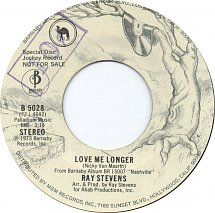
Ray talks directly to the listener at the start of "Fish, Eat, Sleep" telling how he obtained the song and his reasons for recording it. It's one of the few recordings where Ray starts out a recording talking directly to the listener. As his previous album did, Nashville also features an instrumental. This instrumental, titled "Float", is a bit more uptempo than it's predecessor and you'll find yourself humming along to it. In my previous blog entry I mentioned that this album contained more story songs than it's predecessor. I already mentioned "Golden Age", "Fish, Eat, Sleep", and "Love Me Longer"...another example of this can be heard on "You've Got the Music Inside" and "Undivided Attention". Irony fills the lyrics in "Nobody's Fool" in which a woman describes herself as a 'nobody' but the man doesn't buy it. One of the more typical love songs is "Piece by Piece"...which happens to be one of the numerous love ballads found on the album...and Ray sounds like he had fun recording it.
"Destroyed" is one of the unique songs on here...a cleverly written song detailing a broken relationship. It comes from the pen of Merle Kilgore. In fact, seven of the eleven songs on this album were written by other writers. The songs that Ray Stevens wrote are: "Nashville", "Golden Age", "Float", and "You've Got the Music Inside". Layng Martine supplied "Piece by Piece" and "Undivided Attention"; Delaney Bramlett was the writer of "Never Ending Song of Love"; John Pritchard, Jr. wrote "Fish, Eat, Sleep"; and Tupper Saussy wrote "Nobody's Fool". Ray rode the success of this 1973 album and it's country music flavor throughout the latter half of 1973 into 1974...straddling the fence between pop and country with the best of them. Nashville provided some strong country music exposure for Ray Stevens that had been lacking in the past. He crossed-over with some of his pop singles in 1969, 1970, and 1972...but you couldn't exactly call it a serious push for country music acceptance.
Now, just when it appeared that country music was going to be Ray's exclusive outlet with his music, from out of nowhere in the spring of 1974 he hit upon a massive streak of success and before you could say 'boogity-boogity', Ray Stevens found himself having what's turned out to be the biggest selling hit single of his career...
Be on the lookout for Part Eleven of the Golden LP Series as I discuss the bare essentials of this Ray Stevens classic, the impact it had with pop culture both pro and con, and it's undeniable success internationally.
September 9, 2012
Ray Stevens: Nostalgia Valley, Part 41...
In our 41st stroll through Nostalgia Valley as we spotlight the career of Ray Stevens we re-visit 1971. This was the year that Ray placed three vastly different singles onto several Top-10 charts...but if you're a casual fan or one that is familiar with a lot of the various career bio's floating around on Ray Stevens you wouldn't know about that because 1971 was also the year that came in the shadows of a massive #1 million selling hit single a year earlier in 1970. There's never been too much exploration into what was happening in Ray's career in 1971 because a lot of the more professional authors, writers, critics, etc. like to skip around too much when they offer information. Typically what we get is a commentary that highlights specific years...for example: a writer might mention Ray's 1970 #1 hit but then jump ahead 4 years to 1974 and pick up the commentary from there. If a reader of the commentary, or the essay, happens to be a fan of Ray Stevens or happens to be someone that's interested in Ray's music and in time becomes a devoted fan, I feel the reader is being cheated out of 4 years of information and music due to those omissions. I know that when I'd read essays and liner notes in a variety of albums and CD's issued on Ray through the years there always seemed to be a pattern to the information and that pattern was to simply highlight only "the big songs" and pretty much ignore the rest. Now this isn't the case all the time. There are some liner notes and some bio's on Ray that go beyond hitting the obvious but those are few and far between unfortunately. I've written about liner notes before and so search the archive section off to the right for more expansive commentary on the subject.
You may be asking: okay, what exactly are those three vastly differently Top-10 hits from Ray Stevens in 1971??
The first Top-10 of 1971 for Ray Stevens happened to be a single that was issued in December 1970 but had it's successful chart run in the early months of 1971. "Bridget the Midget", the mysterious hit single from Ray Stevens, reached the Top-50 on the pop chart in America and the Top-5 in the United Kingdom. I call it the mysterious single because a lot of people who hear of the song don't really believe such a song exists until they find it. The single, which features sped up vocals in the tradition of the Chipmunks, is a brilliant send-up of Go-Go dance clubs. Ray plays the part of the singer/narrator/announcer as well as a customer who seems under the influence and clearly infatuated with the star attraction, Bridget, whose also voiced by Ray. It's a comic vignette in song. The single never appeared on any album until the label, Barnaby, issued a Greatest Hits collection on Ray. The song, ironically, would be a featured track on just about every greatest hits-type collection issued on Ray through the 1970's but then it's availability on compilation releases started to diminish by the mid 1980's and in my mind a shroud of mystery began to form around it. It returned to a compilation project in 1990 on the release of His All-Time Greatest Comic Hits, which is where I first heard the song. That 1990 project from Curb Records was later certified a Gold album for sales exceeding 500,000 copies.
The other two Top-10 hits for Ray in 1971 were what became the first two releases from a soon to be released gospel project, Turn Your Radio On. "A Mama and a Papa" became a major Top-5 Easy-Listening hit in America as well as in Canada. It's a story about the importance of having a mother figure and a father figure in any child's life. Gospel music rarely has any kind of support from what's called mainstream radio and it's chart performance on America's Hot 100 and Canada's pop chart is reflective of this. Nevertheless, the single became a hit anyway. The other Top-10 hit for Ray in 1971 was the total opposite of "A Mama and a Papa" in both mood and delivery. "A Mama and a Papa" has a subdued vocalization while "All My Trials" showcases a glorious, triumphant vocalization with wonderful use of multi-tracking and overdubbed harmonies. It, too, became a Top-5 hit on the Easy-Listening chart. There are two versions of this recording. The shorter version omits a lot of the instrumental breaks as well as some of the lyrics found on the longer version. The reason for this was simple: to shorten the song for radio airplay. The longer version, which runs 4 minutes and 33 seconds, can be found on a 1996 compilation from Curb Records, Great Gospel Songs. The shorter version clocks in at just over 3 minutes, a far cry from 4 minutes, 33 seconds. The shorter version is what appears on most compilations but sometimes the longer version is chosen instead.
You may be asking: okay, what exactly are those three vastly differently Top-10 hits from Ray Stevens in 1971??
The first Top-10 of 1971 for Ray Stevens happened to be a single that was issued in December 1970 but had it's successful chart run in the early months of 1971. "Bridget the Midget", the mysterious hit single from Ray Stevens, reached the Top-50 on the pop chart in America and the Top-5 in the United Kingdom. I call it the mysterious single because a lot of people who hear of the song don't really believe such a song exists until they find it. The single, which features sped up vocals in the tradition of the Chipmunks, is a brilliant send-up of Go-Go dance clubs. Ray plays the part of the singer/narrator/announcer as well as a customer who seems under the influence and clearly infatuated with the star attraction, Bridget, whose also voiced by Ray. It's a comic vignette in song. The single never appeared on any album until the label, Barnaby, issued a Greatest Hits collection on Ray. The song, ironically, would be a featured track on just about every greatest hits-type collection issued on Ray through the 1970's but then it's availability on compilation releases started to diminish by the mid 1980's and in my mind a shroud of mystery began to form around it. It returned to a compilation project in 1990 on the release of His All-Time Greatest Comic Hits, which is where I first heard the song. That 1990 project from Curb Records was later certified a Gold album for sales exceeding 500,000 copies.
The other two Top-10 hits for Ray in 1971 were what became the first two releases from a soon to be released gospel project, Turn Your Radio On. "A Mama and a Papa" became a major Top-5 Easy-Listening hit in America as well as in Canada. It's a story about the importance of having a mother figure and a father figure in any child's life. Gospel music rarely has any kind of support from what's called mainstream radio and it's chart performance on America's Hot 100 and Canada's pop chart is reflective of this. Nevertheless, the single became a hit anyway. The other Top-10 hit for Ray in 1971 was the total opposite of "A Mama and a Papa" in both mood and delivery. "A Mama and a Papa" has a subdued vocalization while "All My Trials" showcases a glorious, triumphant vocalization with wonderful use of multi-tracking and overdubbed harmonies. It, too, became a Top-5 hit on the Easy-Listening chart. There are two versions of this recording. The shorter version omits a lot of the instrumental breaks as well as some of the lyrics found on the longer version. The reason for this was simple: to shorten the song for radio airplay. The longer version, which runs 4 minutes and 33 seconds, can be found on a 1996 compilation from Curb Records, Great Gospel Songs. The shorter version clocks in at just over 3 minutes, a far cry from 4 minutes, 33 seconds. The shorter version is what appears on most compilations but sometimes the longer version is chosen instead.
January 6, 2011
Ray Stevens: 45's at 35...
Yeah, I've written about this period in Ray Stevens' career quite a few times over the years but given that 2011 marks the 35th anniversary of several recordings, in addition to a switch in record labels, and a personal anniversary for myself I felt like highlighting 1976 once more.
The year marked the beginning of his association with Warner Brothers records. An association which lasted through 1979. A lot of us fans of Ray Stevens often wonder if Ray was 'happy' while at Warner Brothers or wonder if he and the label had strained relations given the lack of publicity his albums and singles were getting, or not getting, compared to his 5 year run at Barnaby Records to start off the decade. This isn't to say that Ray wasn't successful during his Warner Brothers stay...he had a lot of success with his publishing company during this era and he did enjoy several hit songs sprinkled throughout that 3 year period, 1976-1979.
 Just for the Record, the name of Ray's debut album on Warner Brothers in 1976, features two hit singles: "You Are So Beautiful" and "Honky Tonk Waltz". As a visual I decided to use a picture of myself with my new record player. I got this for Christmas last month. It's called a 5-in-1 Entertainment Center...it contains a turntable, radio, cassette player, CD player, and an Mp3 option. This is the third turntable that I have. I have the very first one I bought about 7 years ago...that one came from a newspaper advertisement. I didn't think they manufactured record players anymore and so when I saw the ad I called their number and did some other research to make sure the company was for real. The second record player I own is something I bought at a local shopping store about 3 years ago. It has a cassette player function that I've never tried. I already have a radio with a cassette player tape deck. This latest one I'll more than likely try the other functions just to see the results...but mainly it's for my vinyl albums and singles.
Back to Ray Stevens and 1976...the kick off single for the year was his take on "You Are So Beautiful". This rendition is along the same lines as his take on "Misty" a year earlier in 1975. In "You Are So Beautiful" we hear the banjo, fiddle, and steel guitar among other instruments and the delivery is much more up-tempo...way more up-tempo...than the ballad rendering of Joe Cocker. Ray's up-beat version of the song would become a Top-20 country hit...a definite success to kick off relations under a different record label. Warner Brothers promoted Ray as a country artist...a lot of the TV programs he appeared on from that point onward were country music oriented and much of his albums/singles were moved from the pop section to the country section inside record stores. In spite of the country music publicity the rest of Ray's material on Warner Brothers was still the easy-listening/pop music, with the-sometimes country flavor, that had been featured on nearly all of his 1970's albums for Barnaby Records.
Nevertheless, his debut for Warner Brothers by comparison to the rest of his output for the label in 1977-1979, was much more aligned with country music appeal. His follow-up to "You Are So Beautiful" was the ballad "Honky Tonk Waltz"...a ballad that is mid-tempo and combines two distinctly different styles into one performance: honky-tonk music and a waltz...and the performance became a Top-30 country hit in 1976. The theme of Just For the Record appeared to be music...for several of the song titles on his 1976 album had to do with music in some form or another. As you can see, the singles that were released from this album closed out each side of the record. Tracks #5 and #10.
 1. Cornball
2. Gimme A Smile
3. Once In A While
4. One And Only You
5. You Are So Beautiful
6. Can't Stop Dancin'
7. OM
8. One Man Band
9. Country Licks
10. Honky Tonk Waltz
All of these songs, with the exception of "OM" and "Gimme a Smile" were re-released in 1995 as part of Warner Brothers 3-CD/cassette collection of the music he recorded for the label. The re-issued songs were part of the following collections: Cornball, The Serious Side of Ray Stevens, and Do You Wanna Dance?. Those 1995 collections were released with little fanfare and went out of print rather quickly. I believe you can still purchase those collections as Mp3's at Amazon but it's been awhile since I've checked Ray's Mp3 section.
Ray closed out 1976 with the release of "In the Mood", a recording released under the name of the Henhouse Five Plus Too. The recording, a novelty without question, features Ray chicken clucking Glen Miller's instrumental. This single was backed with "Classical Cluck" and the chart debut came in January of 1977...but it had been released late in 1976. The single reached the Top-40 of the country, pop, and UK music charts in early 1977...it's one of the two recordings that have come to define his stay at Warner Brothers, the other being his unexpected 1979 novelty hit "I Need Your Help, Barry Manilow". Those two recordings are the ones that have appeared on the many compilation albums that surfaced in the 1980's and early 1990's and as a result those two songs have gotten the most exposure...they've gotten so much exposure that most people who've bought Ray Stevens collections through the years probably think Ray only had two hit songs while with Warner Brothers simply because his other recordings for the label have never appeared on any best-of or Greatest Hits release....until 1995 came along and the 3-CD/cassette project, that I mentioned earlier, was issued.
At the start of this blog entry I mentioned 1976 also marks a personal anniversary. Well, more like a birth year...I was born in December of 1976...so at the end of this year I'll reach the 35 mark.
The year marked the beginning of his association with Warner Brothers records. An association which lasted through 1979. A lot of us fans of Ray Stevens often wonder if Ray was 'happy' while at Warner Brothers or wonder if he and the label had strained relations given the lack of publicity his albums and singles were getting, or not getting, compared to his 5 year run at Barnaby Records to start off the decade. This isn't to say that Ray wasn't successful during his Warner Brothers stay...he had a lot of success with his publishing company during this era and he did enjoy several hit songs sprinkled throughout that 3 year period, 1976-1979.
 Just for the Record, the name of Ray's debut album on Warner Brothers in 1976, features two hit singles: "You Are So Beautiful" and "Honky Tonk Waltz". As a visual I decided to use a picture of myself with my new record player. I got this for Christmas last month. It's called a 5-in-1 Entertainment Center...it contains a turntable, radio, cassette player, CD player, and an Mp3 option. This is the third turntable that I have. I have the very first one I bought about 7 years ago...that one came from a newspaper advertisement. I didn't think they manufactured record players anymore and so when I saw the ad I called their number and did some other research to make sure the company was for real. The second record player I own is something I bought at a local shopping store about 3 years ago. It has a cassette player function that I've never tried. I already have a radio with a cassette player tape deck. This latest one I'll more than likely try the other functions just to see the results...but mainly it's for my vinyl albums and singles.
 Back to Ray Stevens and 1976...the kick off single for the year was his take on "You Are So Beautiful". This rendition is along the same lines as his take on "Misty" a year earlier in 1975. In "You Are So Beautiful" we hear the banjo, fiddle, and steel guitar among other instruments and the delivery is much more up-tempo...way more up-tempo...than the ballad rendering of Joe Cocker. Ray's up-beat version of the song would become a Top-20 country hit...a definite success to kick off relations under a different record label. Warner Brothers promoted Ray as a country artist...a lot of the TV programs he appeared on from that point onward were country music oriented and much of his albums/singles were moved from the pop section to the country section inside record stores. In spite of the country music publicity the rest of Ray's material on Warner Brothers was still the easy-listening/pop music, with the-sometimes country flavor, that had been featured on nearly all of his 1970's albums for Barnaby Records.
Nevertheless, his debut for Warner Brothers by comparison to the rest of his output for the label in 1977-1979, was much more aligned with country music appeal. His follow-up to "You Are So Beautiful" was the ballad "Honky Tonk Waltz"...a ballad that is mid-tempo and combines two distinctly different styles into one performance: honky-tonk music and a waltz...and the performance became a Top-30 country hit in 1976. The theme of Just For the Record appeared to be music...for several of the song titles on his 1976 album had to do with music in some form or another. As you can see, the singles that were released from this album closed out each side of the record. Tracks #5 and #10.
 1. Cornball
2. Gimme A Smile
3. Once In A While
4. One And Only You
5. You Are So Beautiful
6. Can't Stop Dancin'
7. OM
8. One Man Band
9. Country Licks
10. Honky Tonk Waltz
All of these songs, with the exception of "OM" and "Gimme a Smile" were re-released in 1995 as part of Warner Brothers 3-CD/cassette collection of the music he recorded for the label. The re-issued songs were part of the following collections: Cornball, The Serious Side of Ray Stevens, and Do You Wanna Dance?. Those 1995 collections were released with little fanfare and went out of print rather quickly. I believe you can still purchase those collections as Mp3's at Amazon but it's been awhile since I've checked Ray's Mp3 section.
Ray closed out 1976 with the release of "In the Mood", a recording released under the name of the Henhouse Five Plus Too. The recording, a novelty without question, features Ray chicken clucking Glen Miller's instrumental. This single was backed with "Classical Cluck" and the chart debut came in January of 1977...but it had been released late in 1976. The single reached the Top-40 of the country, pop, and UK music charts in early 1977...it's one of the two recordings that have come to define his stay at Warner Brothers, the other being his unexpected 1979 novelty hit "I Need Your Help, Barry Manilow". Those two recordings are the ones that have appeared on the many compilation albums that surfaced in the 1980's and early 1990's and as a result those two songs have gotten the most exposure...they've gotten so much exposure that most people who've bought Ray Stevens collections through the years probably think Ray only had two hit songs while with Warner Brothers simply because his other recordings for the label have never appeared on any best-of or Greatest Hits release....until 1995 came along and the 3-CD/cassette project, that I mentioned earlier, was issued.
At the start of this blog entry I mentioned 1976 also marks a personal anniversary. Well, more like a birth year...I was born in December of 1976...so at the end of this year I'll reach the 35 mark.
October 24, 2010
Ray Stevens...and those 45 singles...
 45 single of "Bridget the Midget, the Queen of the Blues" released in December 1970 on Barnaby Records. This was back in the days when CBS was handling Barnaby's distribution. Those newcomers to Ray's career may wonder about his association with the record label and I go into detail in a few of my previous blogs located in the archive section. Barnaby is what you'd consider an independent label...it required distribution from either a larger company or one that had way more financial resources than the independent label did. In a lot of ways an independent label gave the artist's more freedom when it came to song selection and recording possibilities but there was still an element of expectation from whichever company acted as a distributor...so, the way I see it, independent labels didn't completely experience an entire hands-off approach from the major labels unless there was that rare occurrence when a label distributed it's own product completely independent from a distributor affiliated with a major label. Ray's record company, Clyde Records, is an example of this kind of situation where Ray self-finances his own releases without interference from other companies who may have their own agenda or pre-determined goals to achieve.
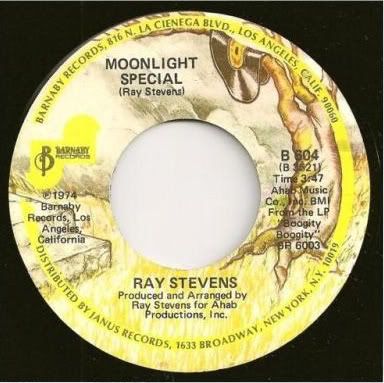 I'm not exactly sure off the top of my head at what point this single was issued in 1974...the official statistics indicate that "The Moonlight Special" was the A-side and "Just So Proud To Be Here" was the B-side. Each song is from his all-comedy album from 1974: Boogity-Boogity. That particular album featured "The Streak" for the first time...as the album was named for the slang phrase 'boogity-boogity' heard throughout the song. Some people mishear the enunciation of the boogity-boogity phrase and proclaim it to be "look at that, look at that" by mistake. For those still unfamiliar "The Moonlight Special" features a tour de force vocally for Ray in that he does impressions of several celebrities all centered around a spoof of the hit television show of the time, The Midnight Special. Ray does impressions of Gladys Knight and the Pips, an alternative rock singer whose name is a spoof of Alice Cooper, and a killer impression of the Killer himself: Jerry Lee Lewis! If all this wasn't enough Ray of course does an impression of the show's announcer, Wolfman Jack! Oh, we hear Ray's natural voice too...it's the voice heard singing the song's chorus. The song opens up with a rapid fire of heavy drum beats...and those drum beats serve as the cue for the various interludes of the song's chorus throughout the performance.
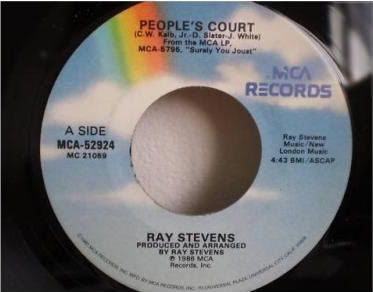 Another single demonstrating Ray's skill at character voices is this spoof of the television court program "The People's Court". Issued in 1986 on the MCA label it featured the dominant label design seen on countless MCA singles and LP's for years...that of the rainbow and clouds. The song was written by Buddy Kalb, Jack White, and David Slater. I assume the two writers named Jack and David worked for Ray's songwriting company during this time period. The song can be found on Ray's 1986 comedy album, Surely You Joust. In the song Ray plays the part of a man, woman, court reporter, and the Judge. Interestingly the voice that Ray uses for the court reporter is more associated with Jim Peck, the hushed voice court reporter on Divorce Court. I assume Ray performed the song on television...I'd never seen footage of it...but I assume he performed it on Nashville Now or Hee-Haw. I know that he performed another song from the 1986 album, "Can He Love You Half as Much as I", a lot of times on his television appearances.
This particular video upload located below is not brand new...it's been available since March of this year. It's Ray Stevens performing his hit single, "Honky Tonk Waltz", from a 1977 television appearance. The single was a hit during the latter half of 1976 and typically most singers promote their most recent hit in addition to their most recent recording whenever appearing on a television program. The performance has it's comical moments as you'll see even though the song itself is non-comical...
The song originates from Just For the Record, the debut album from Ray Stevens on the Warner Brothers label. I can't say enough about that particular album...it's one of my favorites...and mostly every song on that album deals with the subject of music in some aspect or another. For those who want to read more in-depth information about Ray's years on Warner Brothers {1976-1979} seek out my archives off to the right hand side of the screen and search for blog entries specifically dealing with songs or albums Ray recorded in the late '70s.
September 3, 2010
Let's Discuss Ray Stevens, Part Five...
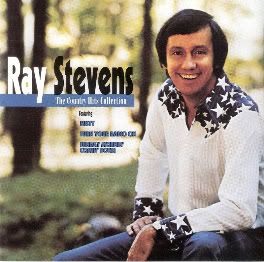 Varese Sarabande issued this collection in 1998...using the same picture of Ray that graces his 1973 album, Nashville. That particular album hit in November of 1973 and reached the country Top-40...as did the title track, "Nashville". In a lot of ways this was Ray's experiment with a distinctly country feel...of course during this era the mainstream country feel was pop-driven lyrically with a few country and bluegrass instruments thrown in like a banjo, fiddle, steel guitar, and or the mandolin. The added instrumentation was more or less an attempt by Music Row to embrace traditional country music while at the same time broaden it's appeal. This sort of thing has existed for decades even though some modern-day critics proclaim the 1990's as being the decade traditional country music died. This Country Hits Collection, issued in 1998, features an almost at random sampling of a lot of songs Ray Stevens recorded between 1969 and 1975. There's 16 songs altogether. The thing that this collection was notable for at the time was the almost exclusive album song track list. What I mean by that is the CD featured way more album songs from various Ray Stevens albums than actual commercial singles. Also, this collection was of importance to those who didn't have the actual vinyl albums from Ray...and therefore hadn't heard these songs until 1998. This collection marked the first time eleven of the sixteen songs were available on CD. Nowadays these songs are available as digital downloads thanks to Mp3 availability...but back in 1998 this material was still largely "out of print" and highly coveted among Ray Stevens fans. The CD features great liner notes and obscure pictures of Ray taken during the era in which these songs were recorded.
  The liner notes were written by an author named Mike Ragogna in the early part of 1998. This collection is still the only one to feature a 1975 single-only track, "Piece of Paradise". The song was originally released as the b-side of "Indian Love Call" but wasn't featured on the Misty album or any other album for that matter until this 1998 collection came along. "Piece of Paradise" isn't the same song as "Piece of Paradise Called Tennessee" which Ray recorded in 1983...they're two totally different songs with similar titles. Ray's version of "Young Love" is featured on this CD...it, too, comes from the Misty album. The thing about "Young Love" was it became the final single to reach the charts during Ray's tenure with Barnaby Records. It hit the country music charts in January of 1976...typically not the month new singles become available...but given that Ray's version of the song was deliberately a slow ballad it stood a chance to become a commercial, if not an airplay, hit. There's long been the belief that ballads do well in cold months while up-tempo songs do well in warm and hot months. Ray's version of the song did moderately well on the country charts...it didn't crack the country Top-40...but it managed to come close. The 16 songs on this CD are as follows...
1. Sunday Mornin' Comin' Down; 1969
2. Turn Your Radio On; 1972
3. Nashville; 1973
4. Misty; 1975
5. Young Love; 1976
6. She Belongs To Me; 1970
7. Losin' Streak; 1973***
8. Just One Of Life's Little Tragedies; 1973***
9. Easy Lovin'; 1973***
10. Sunshine; 1975
11. Take Care of Business; 1975
12. Undivided Attention; 1973
13. Destroyed; 1973
14. Loving You On Paper; 1970
15. Piece of Paradise; 1975
16. Deep Purple; 1975
***- These 1973 songs come from Losin' Streak, one of Ray's most under-rated and little known albums. The album featured no commercial hit singles even though the material is all top-notch and standard Ray Stevens perfection.
Subscribe to:
Comments (Atom)