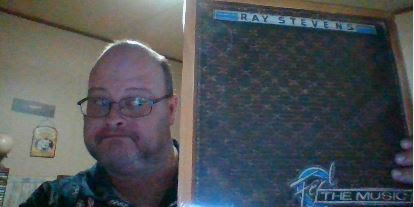
Showing posts with label feel the music. Show all posts

April 1, 2026

Ray Stevens sings "Get Crazy With Me"...

Well, hello all of you Ray Stevens fans!! It's the start of a brand new month...yes, it being April 1st usually means that some radio stations spotlight comedy/novelty songs. However, in this blog entry I'm spotlighting a love ballad, of sorts, from Ray Stevens titled "Get Crazy With Me". I have written about this song before as you could've probably guessed and I've written about the 1977 album it appears on, Feel the Music. That album is the one that featured Ray as the songwriter on 9 of the 10 tracks. The lone track that Ray didn't write, "Set The Children Free", is from the pen of Buddy Kalb. 

In the video upload you'll see Ralph Emery and Donna Fargo introduce Ray.. the performance is from an episode of Pop! Goes the Country. As a tie-in with Ray's song he appeared on the cover of Country Song Roundup magazine with an accompanying article/interview titled Get Crazy With Ray Stevens. I have a copy of that magazine but I don't have a photo of me showing it off. One day I'll probably get around to photographing it. In the meantime... Ray insists "Get Crazy With Me"... and so let's take a few minutes and listen to this obscure gem of a song.

January 29, 2024

Ray Stevens: 1977 Australian Release

Hello fans of Ray Stevens!! Several hours ago I come across a product being sold over on eBay that caught my eye. If you're familiar with the cassette tape releases on Ray Stevens from Warner Brothers in the late 1970s, well, this one may intrigue you considering that it's an Australian pressing of Ray's 1977 album, Feel the Music. I had seen the United States cassette copy of Feel the Music on eBay a number of years ago and it's overall cover design is identical to the other Warner Brothers cassette releases from that time period in the United States. However, the Australian copy of Feel the Music is aesthetically different as you can see. 

Yes, that's the Australian copy of Feel the Music. As you can see the album cover which accompanied the vinyl copy is on the cassette cover but then you have his name and the title of the release posted at the top. The thing that caught my eye the most is the title is shown in lower case letters. That particular album cover of a stereo speaker, as you can see, presented something of a challenge to the designers of the cassette tape release. We have Ray's name and the title of the album shown twice. In practically every cassette tape release of a vinyl album what typically happens is only the image of the vinyl album photo is used. However, in this case, since the 1977 album cover is an in illustration of a stereo speaker and not simply a photo of Ray it would've been impossible to to a magnification because Ray's name and album title is printed within the illustrated image of the stereo speaker. If they were to have done a blown up/magnified image of the album cover for the cassette tape release all a consumer would see is a large brown area...and it's hard to tell if consumers would've been able to figure out that what they're looking at is a stereo speaker should they not be familiar with the vinyl copy which contains more detail of the illustrated image. The United States cassette copy looks like this...

Do you own a copy of 1977's Feel the Music? If you have the vinyl album as I do then you know that on the back of the album it features a photo of Ray. Since the album cover is meant to look like a stereo speaker then, as you may have guessed, the back of the album looks like the back of a stereo speaker with illustrations of small screws and to indicate the look of a speaker's back panel. Also, the photo of Ray features small illustrated images of tape on the upper left and lower right hand sides. This is the typical appearance of how strips of tape look on the back of a stereo speaker holding up the plastic pouch containing the manufactures warranty. This 1977 album was almost completely written by Ray Stevens. There are 10 tracks on here and he wrote 9 of the 10 songs. The one song that he didn't write happens to be "Set the Children Free" which came from the pen of Buddy Kalb. Now, if you're a long time fan of Ray Stevens, then it should come as no surprise that the music on this album would've been considered country in 1977. In fact, Ray has always delivered what most of us would call Ray Stevens music. This means that a recording is produced and arranged as if Ray happened to have been the writer. When he's singing a song he didn't write it sounds like it was something he had written. Also, when we refer to it as Ray Stevens music what we're also saying is that the lyrics seem to fit Ray's style. 

Ray has a style? Yes...if you know your Ray Stevens music then you know that he has a style. That style comes across in the lyrics but also in the manner in which he performs the song, vocally, and when on stage, visually. The 1977 album is filled with this sort of thing where Ray demonstrates all kinds of delivery based on the lyrics...and since Ray is his own music arranger he decides how the songs will sound, instrumentally, as well as how the songs will be sung (tempo) even with songs that he didn't write. What are the 10 tracks on this marvelous 1977 album? "Dixie Hummingbird" reached the country charts in 1977. It was the highest charting single release from the album and therefore, in hindsight, it's referred to as the main release from the album. The single reached the Top-50 on the national country music charts but it ranked among the Top-40 and Top-30 lists of specific markets. If you do in-depth research on a lot of Ray's single releases from the bulk of his career you'll find out real quick that he had a lot of presence/impact in specific regions (markets) throughout the Midwest, the South, and the Plains states but you'd perhaps never realize that if you simply looked at the national charts of Billboard or Radio and Records, for example. Sometimes these statistics of regional activity would be presented in sections of the trade magazines and titled 'Regional Breakouts'. What it meant is that you'd see a city listed and it would include that city/radio station's most requested or most played songs. A lot of the time each local radio station's playlist would contain single releases that had yet to make the "national charts". Ray was on these lists hundreds of times. Now, then...here are the 10 tracks on the 1977 Feel the Music album.   

1. Feel the Music
2. Daydream Romance
3. Blues Love Affair
4. Alone With You
5. Junkie For You
6. Get Crazy With Me
7. Save Me From Myself
8. Road Widow
9. Set The Children Free
10. Dixie Hummingbird

In 1995 when Warner Brothers released three compilation albums of Ray's recordings they included most of the songs from this 1977 album. The songs were spread out over the three compilation releases except tracks 5, 6, and 8. The titles of those 1995 releases were Cornball, Do You Wanna Dance?, and The Serious Side of Ray Stevens.  

October 10, 2022

Ray Stevens on The Marty Robbins Spotlight...

I was looking through some of my archives a few minutes ago and noticed a blog entry from 2017 where I highlighted a performance from Ray Stevens on the Marty Robbins Spotlight television series. The series aired in first-run syndication throughout 1977 and I believe, in other markets, it aired for several more years (repeat episodes) until the end of the decade. The video embed in that blog entry, I discovered, no longer existed and so I edited the blog entry and removed the blank video screen. A few weeks ago Ray uploaded a 10 minute video clip from his 1977 appearance on Marty's show. Ray sings "Feel the Music" and this appearance includes a comical banter between Ray and Marty who sit at separate pianos, back to back. Marty's piano is designed as if it were to match stage clothes from that time period...you'll see that it has a blue plaid/checker design. Ray was a spotlight artist in one episode of Marty's show and he made a guest appearance in the spotlight episode of Chet Atkins. When Ray guest starred on Chet's episode they both sang "Frog Kissing". 

Country music in 1977 was riding a wave of national recognition and the music reflected the presence of what some would call outsider influence...the music had become more polished and had a pop penchant in an effort to attract a wider audience. I bring this up because some people would have you believe that country music didn't insert any changes until the early 1990s but if you look at country music over the decades you'll see all kinds of changes in sound and production...some era's the sound is traditional while other era's, like the mid to late '70s, the sound is pop-like. Most, not all, but most established country music artists resisted the changes but others embraced the benefits of expanding their audience reach. Ray Stevens is one of those artists that had never publicly stated what he defines as 'country music' or 'pop music'. Ray has always come across as an entertainer...not defining himself to any specific music format...but over the course of time it's the country genre that's had more of a welcome to his style of entertainment and with country having a sub-genre of 'country comedy' he fits right in...but in 1977 and specifically in this video clip Ray Stevens once again demonstrates that he can be serious, somber, and sensitive with his music one minute and the next minute he's a zany, silly, and absurdist comic with an endless supply of funny facial expressions and one liners.

May 12, 2022

Ray Stevens: "Feel the Music" reaches Sapphire...

Well, hello Ray Stevens fans!! As longtime readers of this fan created blog should be aware of by now I love the recordings Ray did for the Warner Brothers label in the mid to late 1970s. I like all of his songs...but I have a particular love for that era in his recording career. I've often wondered the reason for this...maybe it's because as a child growing up I wasn't as familiar with Ray's songs from that particular record label. It could also stem from, as I've discussed often, the sound of his recordings in this time period. There's a specific sound that you hear on the Ray Stevens Warner Brothers songs that you don't hear before and after he was on the label. Then again it could just be my own ear hearing things unique to that specific time period in his recording career (1976-1979). Well, in 2022, his 1977 album, Feel the Music, reaches 45. The gem stone that represents a 45th anniversary is Sapphire. This gem can come in different colors...I prefer blue. I had thought about typing out this blog entry in blue color but I decided I'd just use that color a few times. The album contains 10 songs...9 of the songs were written by Ray Stevens. There are several music styles heard on this album, too. A bluesy flavor dominates songs like "Blues Love Affair", "Junkie For You", and the title track, "Feel the Music". However, the title track starts out as if it's going to be a bluesy ballad but lyrically it's a motivational number...and the tempo picks up dramatically as the song reaches it's conclusion. All of the songs on the album are sensational, in my opinion. One thing to keep in mind, though, is the sound may be, to some, indicative of 1970s country music. I don't have a strong opinion, either way, with how the sounds in country music have changed throughout the decades but from beginning to end on this album you'll hear certain moments, if you're a student of country music of the late 1970s, where you'll know it's from that time period. 

The Warner Brothers label is the first to market Ray Stevens as a country music artist. If you were look up album reviews or write-up's in music magazines about Ray Stevens from the early to mid 1970s chances were he was being covered by Pop music and Easy-Listening music journalists and critics. When he'd cross-over to country music, frequently, beginning in the early 1970s, the country music section of weekly music magazines would feature reports on his albums and singles, too. As a legitimate cross-over artist he went decidedly country once he joined Warner Brothers in 1976. His second album for the company, Feel the Music, featured a couple of single releases. One of those releases was "Dixie Hummingbird" which reached the Country Top-40 in Record World magazine. In a 12 week run on the Country singles chart in Record World, beginning on June 11, 1977 the single reached it's peak on August 6, 1977 in it's 9th week. Ray Stevens reached the Top-40 with several single releases on the pages of Record World and Cashbox magazine which missed the Top-40 in Billboard magazine. "Dixie Hummingbird" is one of those examples of Ray having a Top-40 hit single in a publication other than Billboard. Another single release from the 1977 album arrived earlier in the year in the form of "Get Crazy With Me". This single reached the various music charts...achieving it's highest chart ranking in Record World where it peaked below the Top-40 on March 26, 1977. It was a single that had a funky sound to it. 


As mentioned the album reaches 45 this year...and in case you're wondering the front of the album is an illustration of a stereo speaker. Ray wants you to quite literally, "Feel the Music". The back of the album features an illustration of the back of a stereo speaker...and a photo of Ray Stevens is placed in a position where you'd normally find the manufacturer's warrantee taped. The illustration is so detailed you'll think you're looking at the back of a real stereo speaker. There's a gospel flavored sing-a-long on here titled "Save Me From Myself" and a slow love ballad called "Daydream Romance". The album reached the Top-50 Country Albums on Billboard and the Top-40 Country Albums on Record World...reaching it's highest peak in Record World in April 1977. If you are interested in hearing some of the songs on this 1977 album you can always look them up on YouTube. Ray has the audio of "Feel the Music" on his YouTube channel and there's also a performance of the song from the Marty Robbins television show on YouTube. If you love "Get Crazy With Me" as much as I do then you're going to love the entire Feel the Music album!! 

The ten songs on this album, not in chronological order, are: Feel the Music; Daydream Romance; Alone With You; Blues Love Affair; Dixie Hummingbird; Set The Children Free; Junkie For You; Road Widow; Get Crazy With Me; and Save Me From Myself.   

January 19, 2022

Ray Stevens: "Feel the Music" now Sapphire...

The 45th anniversary is represented by the gemstone, sapphire. So, with the Ray Stevens 1977 album, Feel the Music, reaching 45 this year it's now sapphire. If I were in charge of marketing I'd re-issue the album on sapphire vinyl (the color of sapphire is blue). The album comes from the time period in which Ray recorded for Warner Brothers records. He joined the label in 1976 and stayed there until the mid-point of 1979 before moving on to RCA later in the year. His output on Warner Brothers was eclectic and fun...he did a lot of experimentation with his overall sound while at the label. The Feel the Music album was written almost entirely by Ray Stevens. There are 10 songs on the album and 9 of them were written by Ray...the only song that wasn't happened to be from the pen of Buddy Kalb, "Set The Children Free". You'll hear a wide range of styles on this album and with that wide range of styles you'll hear a wide range of vocalization from Ray, too. The title track features a forceful vocalization...inspirational with a church choir overtone when he reaches the chorus of the song. The harmony singers on this album were: Ray Stevens, Toni Wine, Prissy Reed, and the Mt. Pisgah Young People's Chorus. It's my assumption that "Feel the Music" features the Mt. Pisgah group singing harmony while the remainder of the album features Ray, Toni, and Prissy as the primary harmony vocals. 


If you're a collector of Ray Stevens then you're probably always going to be on the hunt for cassette tapes of his vinyl albums...simply for the sake of adding them to your collection...and when I seen an image of the cassette copy of
Feel the Music I added it to my online image library. It's such a rare item and even more rare to see it with your own eyes. Cassette tapes of 1970's Ray Stevens vinyl albums just aren't in abundance...and the rare moments one comes up for sale on eBay or elsewhere the price is outrageous. I have the vinyl copy of Feel the Music but not the cassette tape. The cover art for the 1977 album is a stereo speaker. On the back of the album there's a photo of Ray and detailed art work of what the back of a stereo speaker looks like. The artist included a lot of detail! Ray's photo is depicted as if it's sticking to the back of the stereo speaker with a couple pieces of tape. So, yes, when I got the vinyl album and added it to my personal collection I looked at the back cover...which is rarely seen online. I sat there for several minutes looking at the art work and the songwriter credits, producer credits, etc. etc. The first single release from the album happened to be the adventurous "Get Crazy With Me". Ray remarked in a print interview in 1977 that he had a lot of fun in the studio while recording the song and made mention of the unusual audio hook found within the music itself. It's a crazy, memorable sound effect unlike anything heard before or since. The single, apparently, was a bit too out of left field because it charted for a total of 4 weeks on the Cashbox country chart...entering March 5, 1977 and exiting at the end of the month on March 26th. 

"Dixie Hummingbird" was the most commercially successful single release from the album. I have yet to see any video footage of Ray singing the song on television, though. The single hit in June of 1977 and reached the Top-30 in the Cashbox Country chart in late July. It flew up the 100 position Cashbox Country chart and was in the Top-30 in it's 7th week. It reached it's peak within the Top-30 the following week on July 30, 1977. Ray performed "Feel the Music" and "Get Crazy With Me" on a couple of television shows of the era but never performed "Dixie Hummingbird". The bluesy "Junkie For You", "Blues Love Affair", and "Road Widow" are a trio of songs that I'd have loved to have seen Ray sing on television. You can also add "Alone With You" to that list. Ray Stevens is always striving to sing, write, arrange, and produce music that is uniquely his own. He has often said that he doesn't concern himself too much, now, if he's the writer or if someone else writes the songs he sings. The main writer of songs for Ray Stevens is Buddy Kalb. In interviews Buddy has remarked that he writes lyrics and a melody but once he turns the lyrics over to Ray then it's turned into a song that sounds as if Ray wrote it. It's a personalization talent that Ray has with the songs that he sings...it's in the vocal delivery, the production, the music arrangements. The track list on the Feel the Music album is below...

1. Feel the Music
2. Daydream Romance
3. Blues Love Affair
4. Alone With You
5. Junkie For You
6. Get Crazy With Me
7. Save Me From Myself
8. Road Widow
9. Set The Children Free
10. Dixie Hummingbird  

August 25, 2020

Ray Stevens audio clip: "Dixie Hummingbird"...

Hello all!! Ray's social media sites have seen continued activity in this protracted pandemic. In this blog entry I'm sharing an audio clip of "Dixie Hummingbird". Now, this is a fabulous Ray Stevens recording from 1977 and it's from his album, Feel the Music. The single charted in the Top-50 on the country singles chart...falling several positions short of breaking into the country Top-40. It's always mystified me how the rise and fall of single releases go. A single comes onto the charts like gangbusters only to peak outside the Top-40...what could've halted the momentum!? There have been a number of single releases by Ray Stevens to do just that kind of thing: debut with a bang but for whatever reason peak outside the Top-40. In my mind, at least, it makes me think the sales and demand for a song was there but there was resistance along the way from radio. How else do you explain a single stopping in the mid 40's on the chart?

Me and Feel the Music LP
Regardless of whatever industry politics were at play "Dixie Hummingbird" and the album it's from, Feel the Music, are nevertheless another outstanding display of Ray's talents. The album has 10 songs on it...9 of the songs were written by Ray Stevens. Buddy Kalb contributed "Set The Children Free". I have never seen any video footage of Ray singing "Dixie Hummingbird" but if you search YouTube you'll find video footage of him singing "Feel the Music". In fact, I've written some blog entries and embedded the video of "Feel the Music" in them and so you can also search this blog for "Feel the Music" and you'll be able to find the video clip...but if you don't have the time to do in-depth searching then simply visit Ray's YouTube channel and look for "Feel the Music". In the meantime, "Dixie Hummingbird" tells the story of a man who's obviously in love and he tells about how he feels about her and that she's the silent type who doesn't say too many words but reassures him in her own way that she's loves him. He calls her his "Dixie Hummingbird".


I created the collage you see above several years ago. It's from a blog entry I wrote on July 8, 2018. It's what I call the Ray Stevens Warner Brothers Collage. It visually tells the story of Ray's Warner Brothers years...an era in his career that I love the most although I love his entire career. Here is the audio clip of "Dixie Hummingbird"...


July 3, 2020

Ray Stevens sings "Feel the Music"...

One of my favorite time periods in the career of Ray Stevens is the late '70s when he was recording for Warner Brothers. He recorded four studio albums for the label and then they issued a compilation album on him to promote a newly recorded novelty song, "I Need Your Help, Barry Manilow", in 1979. The label really hadn't did too much to keep the songs he recorded for them in print. In 1995 the label issued a 3-volume collection which, to date, remains the definitive series on Ray's years with Warner Brothers (1976-1979). His studio albums for the label haven't been re-issued. In 1977 he released a studio album titled Feel the Music which features 10 songs. Ray wrote 9 of the 10...he wrote the title track, "Feel the Music". The album cover, as you see below, is an illustration of a stereo speaker. The back of the album has a photo of Ray attached to the back of the 'speaker'. The illustration of the speaker is in great detail. This audio clip appeared on YouTube several days ago but I'm only now getting around to showcasing it in a fan created blog entry...


March 30, 2020

Ray Stevens: Three Volume Collection Turns 25...

Me and the 1995 cassettes; circa mid 2000s.
Longtime Ray Stevens fans should be aware of these 1995 releases from Warner Brothers. I've written about them plenty of times over the last 10+ years that I've been writing this fan created blog. Well, 2020 marks the Silver Anniversary of their release. I still have my cassette tapes and but I only have one of those in CD format. I have them in Mp3 format now but I won't toss out my cassettes...or CDs...or my vinyl. I have all of those songs, now, on vinyl on the original studio albums they appeared on. Anyway, in the years prior to these three releases coming along you couldn't find hardly anything in retail stores featuring Ray Stevens from his Warner Brothers years (1976-1979). You would come across compilation albums that featured one or two selections from that time period and that was it. Can you guess the songs from this era in Ray's career that got the most repeated exposure on compilation albums throughout the 1980s and into the mid 1990s? The novelty "In the Mood" late in 1976...released under a pseudonym, Henhouse Five Plus Too. The other song from this time period that's gotten a lot of reissue is 1979's "I Need Your Help, Barry Manilow". These 1995 releases went a long way at showcasing the obscurities that weren't kept in print on countless compilation albums. The irony is that these 1995 cassette releases, once they were re-released in CD format, went out print just as quickly as they arrived. A number of years later the releases were digitally uploaded for on-line sale...however, one of those 1995 releases is currently unavailable for digital/Mp3 purchase, but the other two are still available.

The titles of those releases are Cornball, Do You Wanna Dance?, and The Serious Side of Ray Stevens. The material compiled for those releases come from his studio albums for Warner Brothers in the late '70s. Cornball is a misleading album title...there are only three recordings that qualify as comical/novelty but there is a love ballad on there titled "Cornball" from 1976. The CD opens and closes with the chickens: "In the Mood" kicks off the CD and "Classical Cluck" closes out the CD. In between we have track two, "I Need Your Help, Barry Manilow" and beyond that the rest of the recordings are serious love ballads and inspirational easy-listening music. I'm aware that there is a segment of music listeners that can't distinguish between Ray's humorous and serious recordings. I say this because there are many that feel his 1975 recording of "Misty" is a comedy song (believe it or not) but it's actually a straight ahead country performance of a jazz/pop standard...to them it's funny when they hear it performed the way that Ray does it. Cornball is not available for digital download at Amazon but the other two collections are. I'm going to list the songs found on each release.

Do You Wanna Dance?:
1. Feel the Music; 1977
2. Dance Trilogy- Do You Wanna Dance/When You Dance/Save the Last Dance for Me; 1978
3. Blues Love Affair; 1977
4. Country Licks; 1976
5. Honky Tonk Waltz; 1976
6. One Man Band; 1976
7. Can't Stop Dancin'; 1976
8. Old Faithful Trilogy- Shake a Hand/Since I Met You Baby/Always; 1978
9. You've Got the Music Inside; 1978

Cornball:
1. In the Mood; 1976
2. I Need Your Help, Barry Manilow; 1979
3. You Are So Beautiful; 1976
4. Money Honey; 1978
5. Cornball; 1976
6. Dixie Hummingbird; 1977
7. One Mint Julep; 1978
8. Your Cash Ain't Nothin' But Trash; 1978
9. Save Me From Myself; 1977
10. Classical Cluck; 1976

The Serious Side of Ray Stevens:
1. One and Only You; 1976
2. Talk to Me; 1978
3. Alone With You; 1977
4. Daydream Romance; 1977
5. Once in Awhile; 1976
6. Set The Children Free; 1977
7. The Feeling's Not Right Again; 1978
8. Two Wrongs Don't Make a Right; 1978
9. L'amour; 1978
10. Be Your Own Best Friend; 1978

Ray issued two studio albums in 1978. In the first half of the year he released a covers project called There Is Something On Your Mind. This eight song album features Ray's renditions of rhythm and blues classics...and some obscurities that weren't heard on mainstream Top-40 pop radio. That album features commentary on both the front and back of the album by Ray where he discusses his desire to record this kind of an album and how that music was a big influence in his youth. If you have those 1995 releases the person that compiled the songs lists the material from that 1978 album as previously unreleased. I have no idea why those songs are noted as being previously unreleased when they appeared on that 1978 album. I've gotten some replies over the years that perhaps the reason they're noted as previously unreleased is because the 1978 album may have only been released in Canada and other predominantly English-speaking countries. It's possible...but it makes no sense, to me, why it wouldn't get issued in the United States as well.

Ray Stevens; 1978
The songs on these 1995 releases that come from that 1978 covers album are: "Talk to Me", "Money Honey", "Your Cash Ain't Nothin' But Trash", "One Mint Julep", "Old Faithful Trilogy", and "Dance Trilogy". The two recordings from that 1978 album that didn't get spotlighted in those 1995 releases were "Banned in Boston Trilogy" and the title track, "There is Something On Your Mind". The second studio album from Ray in 1978 was Be Your Own Best Friend. An abundance of songs from that album feature heavily on the 1995 CD titled The Serious Side of Ray Stevens. I don't think it will ever happen but nevertheless I still wish that Ray's studio albums for the label would get issued digitally.

In a 1977 video clip from an episode of Marty Robbins Spotlight here's Ray performing "Feel the Music". It's an even more soulful performance than the studio recording if that's even possible. You'll hear Ralph Emery provide the introduction...


Ray Stevens and Dolly Parton in 1977...

Hello all...as the COVID-19 pandemic continues and with the announcement yesterday that the Federal guidelines for combating the virus will remain intact for the month of April (no large gatherings; dine-in restaurants closed; limited retail purchases; etc.) it's obviously caused a chain reaction of events throughout the economy. Some may think it cynical or crass to even think of the economy when human lives are at risk but at some point those economical concerns will have to be addressed. The passage of the $2.2 trillion stimulus bill is a giant first step but we'll see if even that jaw dropping amount is enough. I don't know if any State Governor is going to be defiant and "re-open" their State in April and go against the Federal guidelines. Also, on the flip-side, if the Federal Government would decide to "re-open" the country I don't know if any State Governor would take the chance of COVID-19 cases skyrocketing without a vaccine at people's fingertips. Either way, without a definitive vaccine available, it's a no-win situation for either a State Government or the Federal Government.

To offer an escape, though, I came across a recently uploaded 1977 episode of Dolly, the variety show hosted by Dolly Parton in 1977, guest starring Ray Stevens. There had been a video of Ray and Dolly uploaded from this episode in the past...a clip of the two of them performing "Happy, Happy Birthday Baby" and "Searchin'". Ray's other footage from that episode had never been uploaded, to my knowledge, until recently. The video statistics show it was uploaded on March 28th but yet this is the first time I'd seen it posted on YouTube. I don't know why videos are slow to appear in YouTube search results nowadays. I've come across other video clips that are new to me but the stats for the video show that the video clips were uploaded days earlier.


The quality of the tape isn't top notch but that's to be expected...it's from 1977...and it isn't the master copy of the episode; but, in general, the episodes haven't been well preserved. The reason being is that the owners/distributors of these kind of television shows never had the slightest idea that there would be appreciation or an audience for 'retro' programming as they call it now. Back then I suspect the feeling was "who in the world would want to watch reruns?!?". In spite of the visual quality it's still fun to hear and watch...particularly Ray and Dolly performing "Sir Thanks-a-Lot". Ray performs one of his singles at the time, "Get Crazy With Me". Ironically there's an issue of Country Song Roundup from 1977 in which Dolly is on the cover. One of the articles in that issue is about Ray Stevens...and it's headline is Get Crazy with Ray Stevens.

The album from Ray Stevens in 1977 was a marvelous collection called Feel the Music. In a previous blog entry I wrote about Ray's 1976 appearance on Hee Haw. In that episode he sang "Honky Tonk Waltz" and "You Are So Beautiful", both songs from his 1976 album, Just for the Record. His performance was taped in the summer of 1976 during one of the marathon recording sessions for Hee Haw. The series taped their episodes twice per year: 13 episodes were taped in the summer and 13 episodes were taped in the fall. Ray's summer 1976 taping session appeared on an episode that aired on October 23, 1976.

February 17, 2019

Ray Stevens: Feel the Music video clip...

Hello one and all...in this particular blog entry I'm giving some spotlight to an album from Ray Stevens released in 1977. I'm doing so because of a recent video clip that surfaced on YouTube several days ago. I did a couple of blog entries centering around this album in the past...I think the last one I did was a couple of years ago (2017) when the album turned 40 but I'd have to consult the archive section off to the right hand side of the screen. In 1977 another music legend, Marty Robbins, hosted a syndicated television show called The Marty Robbins Spotlight. Ralph Emery was the announcer and each episode would focus on one or a couple of artists. The series consisted of 36 episodes in which Ray was the featured spotlight artist in one but he also had an appearance in the Chet Atkins episode as well. In that episode the two of them perform "Frog Kissing", a single that Ray published, produced, and arranged featuring Chet singing in addition to playing the guitar. The song itself was from the pen of Buddy Kalb. The episodes of Marty's series, based on my own assumption, were taped at some point in the first half of 1977 and perhaps into the summer months before they began airing in the fall and so Ray's album, Feel the Music, was widely available by the time his episode was airing.

The front of the album shows an illustration of a stereo speaker as a tie-in with the album's title. If you literally feel the music then you'll be placing your hand on an actual speaker...but, of course, the song itself has a much more deeper meaning. It's a motivational kind of song which says that you need to find purpose in life and live for yourself rather than living for other people...or, in other words, living a life in which everybody but your own self is happy. "Feel the Music" was issued as a single backed with "Dixie Hummingbird". There was also the usual promotional copy which featured "Feel the Music" on both the A and the B side. Strangely enough "Feel the Music" didn't reach the charts but then it's B-side was released as a single. "Dixie Hummingbird" received the promotional copy treatment but there wasn't a single released featuring it as an A-side. Instead, the record store employees went through and flipped "Feel the Music" over where "Dixie Hummingbird" was seen first by music consumers. The single releases didn't have an A or a B side designation anyhow. "Dixie Hummingbird", an outstanding performance, reached the middle pack of the country music chart...in that particular era the country singles chart matched the pop singles chart...each chart had 100 positions. It came oh so close to cracking the Top-40 of the country music chart. A third single from Feel the Music, "Get Crazy With Me", also reached the charts but it peaked in the lower half of the Top-100. Ironically it's B-side was none other than "Dixie Hummingbird". The back of the 1977 album features an image of Ray and the illustration of what the back of a stereo speaker looks like. The album was largely written by Ray with the exception of the Buddy Kalb composition, "Set the Children Free". The rest of the songs were all penned by Ray Stevens.

Buddy's songs didn't begin to feature prominently on Ray's albums until the mid 1980s onward. The first songwriter credit on a Ray Stevens album for Buddy Kalb was "One and Only You" on 1976's Just for the Record. The inclusion of "Set the Children Free" on 1977's Feel the Music means it's the second composition from Buddy Kalb to appear on one of Ray's albums. "Frog Kissing", the Chet Atkins hit with harmony vocals from Ray, didn't appear on any of Ray's albums but it marked a third Buddy Kalb penned song that Ray recorded in that 1976-1977 time frame.

A clip of Ray performing "Misty" on Marty's show was uploaded nearly a year ago (March 2018) and a couple days ago (February 13) the performance of "Feel the Music" was uploaded. The entire episode has never been uploaded onto YouTube but here's the most recent upload from the 1977 appearance on Marty's program...


Now then, even though the entire episode featuring Ray Stevens as the spotlight artist hasn't been uploaded onto YouTube as of this writing, the entire Chet Atkins episode (with a special guest appearance by Ray) is uploaded onto YouTube. A screen-cap from that appearance is below...


The Chet Atkins episode I'll embed further down the blog entry and the only reason I'm embedding the entire episode is because there isn't a video clip of Ray and Chet's performance from that episode. Ray and Chet would perform the song together several years later, in 1980, as part of an all-star salute to Chet's career. In that performance Ray was seated at the piano and by then had grown his recognizable facial hair...in other words he had become bearded...but the 1980 performance is just as good as the 1977 performance. The earlier performance, in comparison, comes off more lively and a lot of that has to do with the fact that the song was less than a year old when they performed it on Marty's show so by the time 1980 rolled around, with the song now going on four years old, it was still entertaining due to it featuring the novelty aspect of Mister Guitar singing.

Now, getting back to Ray's spotlight episode, I know you're all probably wanting to see the performance of "Misty" as well...and if so you can watch that performance below. In case you never seen this video clip before (it's been on YouTube for a year) it starts out with Ray and Marty in discussion and then there's a brief sketch involving a saxophone player and a violinist in which Ray interrupts with his comically exaggerated Austrian/German accent. I think the violinist is Lisa Silver. Afterward the camera returns to Ray and Marty discussing and laughing over what they just saw and eventually Ray performs "Misty"...


Now, here's the Chet Atkins episode in it's entirety. Ray Stevens makes his appearance 18 minutes into the show (actual time stamp showing 17 minutes, 53 seconds). Ray is introduced as "your average man on the street" (although you can hear the audience laugh and applaud when Ray's face appears on the video screen) but the brief routine continues as "the average man" is asked by Marty what he thinks of Chet being a singer. After some jokes at Chet's expense Marty officially introduces Ray and this leads into the "Frog Kissing" performance... 

July 8, 2018

My largest Ray Stevens Collage...

Hello all once again!! A very early Sunday morning here as I write another fan created Ray Stevens blog entry. There hasn't been any updates over on WSM's website in their Opry archive section and so, as of this writing, I don't have any audio link to provide of Ray's July 3rd guest appearance. In my previous blog post I made mention that I already had the idea of what this blog entry would be about and so I'm unveiling what could possibly be my largest Ray Stevens collage. I make collage's for pure enjoyment and to spotlight albums, single releases, or photo's of Ray over the years...often I add photo's of myself showing off whatever I might be writing about.

After I finished writing a recent blog entry about some of the compilation albums that have been issued on Ray Stevens I got the idea to try and put together a collage of nothing but Ray Stevens on Warner Brothers Records. This would cover the years 1976, 1977, 1978, and 1979 in his career timeline. What I did was I gathered up images of his vinyl studio albums from those years and I gathered up images of his single releases from those years on the label and I put them all together in a collage. I didn't concern myself with whether or not the single release I chose to place on the collage was from the U.S. or the international market but I did attempt to arrange everything in chronological order.

If you're long time readers of this fan created blog page then you should be very aware of how much I champion Ray's music and career, in general, but then I often give heightened coverage to his Warner Brothers recordings. A lot of it has to do with my personal feelings given my enjoyment of the songs he recorded but also what drives my focus is how under-rated that era of his career generally is and so after I began this fan created blog nearly 10 years ago I took it upon myself to spotlight his late '70s material at any opportunity. In a lot of the compilation albums that were issued on Ray Stevens over the decades (from the mid '80s onward) and then in the ones that appeared later in the 1980s and especially the 1990s there tended to be a pattern of covering an abundance of his Monument and Barnaby recordings (specifically the years 1968 through 1975) while more or less skipping over Warner Brothers (1976-1979) and RCA (1980-1982) except for a couple of novelty recordings for each of the two labels. I may do one of these collage projects spotlighting his RCA recordings but for now here's the one I did spotlighting his Warner Brothers era:

Now, I know this is way too small for anyone to actually see the writing on the albums and the single releases but you can click the image for a somewhat larger view. Anyway...this is probably...well, actually, it is the largest Ray Stevens collage I've created. In his three years with Warner Brothers he recorded four studio albums and one compilation album. The compilation album arrived in 1979 to cover the years 1976, 1977, and 1978 but it also featured his hit, "I Need Your Help, Barry Manilow", from earlier in the year which up to that point was only available as a vinyl single. The 1979 album is the fifth one in the collage off to the left (the first panel in row two). If you are familiar with Barry Manilow then you should see the comical connection in art work. Barry's 1975 album had a similar cover design and letter font and the name of his album that year was Trying to Get the Feeling whereas Ray's album in 1979 is titled The Feeling's Not Right Again (named after a song on Ray's previous studio album in 1978). I also added a comparison image of the single release of Ray's recording next to the cover design of Barry Manilow's second studio album. I have almost all of Ray's studio albums on vinyl and I have a vinyl copy of the "I Need Your Help, Barry Manilow" single but my copy doesn't feature the picture sleeve. My copy, which I bought on-line, arrived in a plain paper sleeve. I've seen auctions on eBay for the single and it's picture sleeve but those, obviously, were always out of my price range and so I opted for the cheaper alternative. I wanted the vinyl single anyway...not having the picture sleeve didn't change my feelings concerning the actual song. As you see in the collage there are five images of vinyl albums, 2 comparable cover art depictions, and eight single recordings. Here is the breakdown of everything you see...starting with the vinyl albums:

Just for the Record (1976); Feel the Music (1977); There is Something on Your Mind (1978); Be Your Own Best Friend (1978); and The Feeling's Not Right Again (1979).

The single releases, the month and year of release, and their catalog numbers:

"You Are So Beautiful" (April 1976; WBS 8198)
"Honky Tonk Waltz" (August 1976; WBS 8237)
"In the Mood" (December 1976; WBS 8301)
"Get Crazy With Me" (January 1977; WBS 8318)
"Dixie Hummingbird" (May 1977; WBS 8393)
"Be Your Own Best Friend" (July 1978; WBS 8603)
"I Need Your Help, Barry Manilow" (March 1979; WBS 8785)
"Get Crazy With Me" (June 1979; WBS 8849)

The comparable cover art depiction is of the picture sleeve of "I Need Your Help, Barry Manilow" and Barry's second studio album, Barry Manilow II. If you look at the chronological listing of single releases you'll notice a couple of things...at least I took notice right away. The first is the lapse of time between the release of "Dixie Hummingbird" and "Be Your Own Best Friend". There's more than a year separating the two. Then there is no further single releases throughout the rest of 1978 even though the Be Your Own Best Friend album had plenty of single worthy recordings such as "Comeback", "Two Wrongs Don't Make a Right", or the re-recorded "You've Got the Music Inside" which had originally been recorded in 1973 by Ray. Another thing you should notice is the re-issue of "Get Crazy With Me".

Warner Brothers originally issued the single in January 1977...right on the heels of Ray's surprise novelty hit with his chicken clucking rendition of "In the Mood". In the original release of "Get Crazy with Me" in January 1977 the B-side happened to be "Dixie Hummingbird". Ray's "Get Crazy with Me" isn't a novelty song but it's title would suggest otherwise and it's my guess Warner Brothers felt the title could serve as a follow-up and therefore become an immediate hit. Later on Warner Brothers re-issued it upon the strength of Ray's novelty hit, "I Need Your Help, Barry Manilow".

The re-issue of "Get Crazy With Me" in 1979 featured "The Feeling's Not Right Again" as it's B-side. Let's add more to this vinyl sea of confusion by pointing out "Dixie Hummingbird", the original B-side of "Get Crazy with Me" from January of 1977, when it was issued as an A-side single in May of 1977, it's B-side happened to be "Feel the Music". The funny thing is Ray performed "Feel the Music" on television several times in the mid '70s and once in the early '90s but I don't think he ever performed "Dixie Hummingbird", the actual A-side, on television...ever!

In the last couple of paragraphs I had some fun relating the single release pattern of Ray's Warner Brothers recordings but let that not scare you from seeking out those recordings. You are likely to find Mp3 copies of select recordings at Amazon. If you look up the 1995 compilation albums: Cornball, Do You Wanna Dance?, and The Serious Side of Ray Stevens then you'll find a lot of his Warner Brothers recordings. They're, to date, the only definitive look at his late '70s recordings. The only thing that could top those releases were to be if Warner Brothers were to re-issue Ray's actual studio albums in a series of CD's or Mp3's but there's been no indication such a thing will ever happen so those 1995 releases are your only hope in hearing those obscure recordings.

February 19, 2017

Ray Stevens and Marty Robbins...1977...

Hello once again!! Although Ray Stevens is busy behind the scenes getting things prepared for the next season of his television series there is another vintage appearance I'm about to promote on this fan-created blog. Call it perfect timing due to my habit of celebrating anniversaries involving Ray Stevens...but 40 years ago the one and only Ray Stevens was the featured Spotlight Artist on Marty Robbins obscure syndicated television series, Marty Robbins Spotlight. Late last year an episode spotlighting Chet Atkins appeared on YouTube and as a special guest, yes, it was Ray Stevens. I commented at the time that it would be great if the episode spotlighting Ray would appear on-line and like a wish come true such a thing happened this morning.

The episode is entertaining from start to finish. You don't ordinarily associate Ray with a Marty Robbins, for example, but this is another example of Ray's ability to adapt and interact with anybody. It reminds me of the time that Ray guest starred on an episode of George Jones' television series...there again he's appearing on a program hosted by someone you normally don't picture interacting together and yet the two come off as long-time friends. The same thing is true in the episode of Marty's program. Ray performs an outstanding "Feel the Music" and later, "Honky Tonk Waltz". He and Marty perform several bits together (a song medley, for example, features both of them at the piano) and there's an interview segment. One of the funniest parts of the episode is Ray in a trench coat, speaking in a thick German-American dialect, and performing a leg slapping routine. 

Throughout the segment featuring Ray and Marty at the piano the camera would frequently focus in on Marty's faux disbelief in hearing how varied Ray's musical styles happened to be...in the medley performance Ray gives his take on "What I'd Say" by Ray Charles and in a surreal moment Ray sings the first verse and chorus of "I Write the Songs", the smash hit recorded by Barry Manilow...why do I call it surreal? It's due to the fact that a couple of years after this episode aired Ray would record a song inspired by the sound and song titles from Barry's string of hits. Here is an example of one of those Marty Robbins comical looks of disbelief...


Marty's television series ran in syndication for a couple of years. I've seen information citing 26 episodes exist and other sources mention 24 episodes. I've even come across on-line sites stating the program has 52 episodes but I'm pretty sure only 24 (or 26) is the actual number. If anybody knows for sure how many actual half hour episodes of Marty Robbins Spotlight there happens to be leave a comment. It's a mystery to me, at least...and speaking of television programs...Ray himself has a television series...

Ray's television series, as a reminder, has jumped from RFD to PBS. It's been airing on scattered PBS stations since January after airing for a year and a half on RFD. The title has also changed from Ray Stevens' Nashville to Ray Stevens' CabaRay Nashville. The plan is to eventually tape episodes of the television series from the CabaRay venue.

Construction on his CabaRay entertainment venue is also well underway. It's still expected to open in the latter half of this year. Ray has periodically posted photo's of the venue's construction. The story of Ray embarking on construction of the venue broke in March of 2016 which is how the general public became aware but the most loyal of fans had been aware of the proposed venue for a couple of months prior. Does anyone not have the New Orleans Moon CD? In case this is all new to you the CD came out in 2007 as a salute to the music/culture of Louisiana a couple of years after Hurricane Katrina. The CD hit in March 2007 as an exclusive offered at Ray's web-store. It became available all over the internet in July of that year. It's been 10 years since it's release (technically a decade next month) but for the rest of this month (February) you can get the CD at a mark down price in celebration of Mardi Gras. I've been having a bit of trouble accessing the Store area of his website. Just in case you have the same trouble I'd suggest calling his office and ordering the CD over the phone. You can find ordering information/phone numbers at his official website by clicking HERE.

October 26, 2012

Ray Stevens: Golden LP Series, Part Fourteen...

The fourteenth studio album from Ray Stevens arrived in 1977 and was a return, of sorts, to his earlier LP's in that most of the songs were self-written. Feel the Music, the album, was filled with smooth sounding country music aimed at a general audience. In other words it was in the category of pop-country or country-pop, depending on which music critic one was reading. Ray, to be fair, never marketed himself as a traditional country music singer but he began to have considerable television exposure and media attention within country music's ever expanding umbrella during this mid-late '70s time period and he was eventually marketed as a country artist once he joined Warner Brothers. I suspect the fact that he was never marketed as a traditional country music artist is a big reason why he's never been elected to the Country Music Hall of Fame...human beings elect the members and it's human nature to let one's own biases or perceptions play a role in the decision making process. As mentioned, the LP features plenty of songs written by Ray. The emotions that are depicted throughout run the gamut from passionate, playful, happy, somber, melancholy, sad, and spiritual. The opening track, "Feel the Music", is an inspirational number about never giving up in life, be your own person, and always strive to accomplish whatever one sets out to achieve. It's one of the several written by Ray.

The back of Feel the Music shows a publicity photo of Ray Stevens that was used during that time period. The photo would surface several times throughout 1977 and into 1978...even after Ray grew his beard for good. The front of the LP is an illustration of a stereo speaker while the back of the album illustrates what the back of a standard stereo speaker looked like. A bit of trivia about the songs on this LP: the publishing is credited to Ray Stevens Music. Why do I bring that up? Well, prior to this 1977 album, all the songs that Ray published were under the Ahab Music Company name. This LP marked the first time his publishing was referred to by this new name. As far as the image goes I didn't think to take a picture showing the front of the album because that image could be found easily if one did an image search...yet seldom was shown of the LP's back cover and that's the reason why I took the picture. The front of the LP  is shown below. Obviously you all noticed that Ray's likeness doesn't appear on the front of the album...an unheard of concept for any recording artist...particularly one that was well established.

"Set The Children Free", a song written by Buddy Kalb, is a fascinating tale. The song has a religious/spiritual overtone as it tells of human behavior. It's a heavy song and Ray does a fabulous job on the recording. It's the only song on the 1977 LP that wasn't written by Ray. One of the more eye catching song titles on the album is "Junkie For You". It's a bluesy number in which Ray describes his addiction to the woman in his life. Do you want to know one of the best upbeat sad songs of all-time? The answer is "Alone With You". If you simply went by the song's title you'd think it was a passionate love ballad of some kind but it isn't! "Alone With You", with it's uptempo arrangement, tells the sad tale of a couple apparently in their final stages of marriage and how alone the two of them feel. It's arrangement will pull you in right from the start! Speaking of arrangements...the LP features another uptempo, heart pounding sing-a-long in the name of "Dixie Hummingbird". This was one of the two singles released from the album. "Dixie Hummingbird" tells all about a woman from the south that Ray can't get enough of. He hums along during the instrumental break. The single came ever so close to reaching the Country Top-40...it peaked several spots below #40...but it deserved a much better fate. At the other end of the emotional roller coaster there's "Blues Love Affair", a mid-tempo song dealing with the various complexities of love and it's motivation, from true love to one night stands, and everything in between. "Save Me From Myself", a gospel inflected number, tells the story of a man who can't stand being alone and that he's become mentally and physically unstable as a result. The only thing that can cure this, he says, is for the woman to return as soon as possible and rescue him from self-destruction.

"Road Widow", another all-time favorite, tells the story of an entertainer who spends a lot of time on the road. This distance from his wife, in his mind, must cause her to feel he's no longer alive and as a result she's referred to as a "Road Widow"...as he sings about the certain death of a relationship...but ironically he reassures himself that she knew and accepted the kind of life he led traveling all over the country and so there shouldn't be anything to worry about. "Daydream Romance" carries the same traveling man scenario as Ray sings about being on the road and fantasizing about an unspecified lover and how he can't wait to turn the daydreams into reality.   

"Get Crazy With Me" was the other single release from Feel the Music. In this recording Ray sings about breaking away from what's perceived as the norm. In the song Ray sings about a man whose had patience when it comes to a love life but seeing how patience leads to impatience, the man takes a plunge and decides to change his calm, complacent attitude toward not being in a relationship into a no holds barred, risk taking approach where he finds himself asking a woman to get crazy and wild with him...if only for one night. At the core of the song is the viewpoints of a lonely guy whose had a run of bad luck when it comes to women and now he has a chance to change all of that. The song featured an ear catching kind of arrangement...at one moment in the song it sounds as if laser beams are going to shoot from the speakers as a barrage of Sci-fi sounds take control and effectively blast the song into orbit. The sound was not necessarily something that was commonplace on country radio in 1977...but it did reach the popularity charts for a couple of weeks...peaking in the 80's on the Country chart. The song obtained several major publicity efforts...the one that was most impressive was the generous multiple page story in Country Song Roundup titled Get Crazy With Ray Stevens shown below...

The Feel the Music album reached the Top-50 on the Country Album chart. I think it's a great album and I'm sure the more dedicated fans of Ray Stevens then and now still love this album. It's one of my favorites in a long line of favorite Ray Stevens releases. His publishing company scored a big hit in 1977 when "Way Down" became a hit for Elvis Presley. It was the last hit single for Elvis during his lifetime and it features prominent bass vocals from J.D. Sumner. In the meantime, Ray was going about his business of doing concerts, recording songs, appearing on TV, writing songs, producing sessions, publishing songs, and becoming more and more familiar to country music audiences...amongst all of this activity emerged an LP with hardly any fanfare or major publicity. It sounds like to me that something was happening in early 1978...something that one just couldn't get out of one's minds...something...something...that certain something that leaps out at you when you least expect it...something was on Ray's mind and his fifteenth studio album elaborates on this. Be on the lookout for the next Golden LP Series installment...as we explore what was on Ray's mind with his follow-up release in early 1978.   

November 7, 2010

The Ray Stevens Web-Site...have you visited it Yet??

At the start of this particular blog entry there's 90 minutes left until NFL football kicks off at 1pm Eastern time...watching football on Sunday is something I've did for years and something I'll always do each Sunday during the season. Something else that I've been active in for a number of years is the official message board at Ray's web-site. You can find the message board here at Ray's official web-site. The message board is titled "Web Board" up in the top right hand side of the page. The official title of the board is "The Piano Room". There's bound to be some topics that'll perk anyone's interest. As far as message boards go there's much more reading that goes on and once you visit the site you'll understand what I mean right away.

Even though there's a message board the majority of the traffic, I assume, visits the site to either shop at his web-site store or read the latest news headline(s) and they probably don't even think to visit the message board area. Those who do happen to visit the message board read the messages but seldom make comments. This is evidenced by the fact that a lot of topics have hundreds of hits but fall short of that total in actual replies.

His web-site is free to join by the way. The only things that cost money is the Ray Stevens Backstage feature and, of course, the items for sale at his web-site store. Aside from those two exceptions everything else about the site is free.

I often encourage people to visit Ray's web-site because it's one of the only places where you'll find all of the up to date information about Ray. Those who visited his web-site were aware of his Branson, Missouri concerts in advance. Those who visit his site are informed about the latest music releases and video releases. Those of you who are fans of his and haven't visited his site owe yourselves to check it out and check the message board, too.

Have any of you visited his web-site yet?? If not, what's the delay?? You can visit it here.