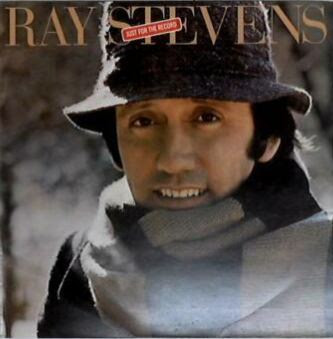
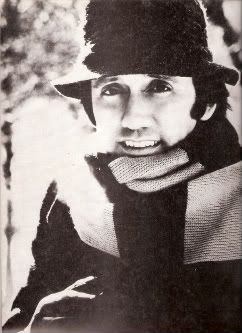
In early 1976 Ray Stevens became a recording artist for Warner Brothers Records. He had been on the Barnaby Records label since early 1970 and it was on that label in which Ray's music went international on a consistent basis...singles reaching the charts not only here in America but up in Canada and overseas, usually in the United Kingdom or Australia. Ray's debut for Warner Brothers arrived with the single, "You Are So Beautiful". The recording's arrangement was inspired by a previous single he'd issued a year earlier, "Misty". Ray's take on "You Are So Beautiful" featured the banjo, fiddle, and steel guitar as "Misty" and another recording of his from 1975, "Sunshine". "You Are So Beautiful" reached the Country Top-20 in the spring of 1976. The album featuring the single, Just For the Record, became available on April 2, 1976. The album's title is written in small print over top of Ray's name on the album cover. I always like to know the story behind the names of albums...I'm obviously talking about albums that aren't named for one of the songs. I've always wondered why this was titled Just For the Record. Some may have an answer. I've come across an explanation or two a number of years ago on message boards that no longer exist and one explanation was that several of the songs on the album deal with the subject of music. That's the only explanation that made sense. So, then, what are the songs on this 1976 album?? There's 10 songs altogether and most were written or co-written by Ray. There are several songs that were written by other writers.
Track List:
1. Cornball
2. Gimme a Smile
3. Once in Awhile
4. One and Only You
5. You Are So Beautiful
6. Can't Stop Dancin'
7. OM
8. One Man Band
9. Country Licks
10. Honky Tonk Waltz
As you can tell from the track list you'll come across love ballads that fill up Side One of the album (the first five songs). On Side Two it opens up with a song about music...specifically dancing...but if you listen carefully, though, it uses dancing as a metaphor. It's an inspirational song telling the listener to never give up and to always strive for positivity in life and not allow negativity and unpleasantness cloud your better judgement. "Can't Stop Dancing" would later become a hit for pop duo The Captain and Tennille. Ray co-wrote the song and he published it...and so he shared in the success as both co-writer and song publisher when The Captain and Tennille had a Top-20 pop hit with it in 1977.
The song, "OM", is all about transcendental meditation. I don't know if Ray was a student of transcendental meditation or if he was simply interested in what it was all about and therefore decided to write a song all about it. "One Man Band" is a sad song about a relationship that's ended and because of this Ray says he feels as if he's playing in a "One Man Band" since the harmony and joy in his life is now gone. "Country Licks", from the pen of Layng Martine, Jr., is a fabulous toe-tapping song with a bluegrass feel much like "You Are So Beautiful". The album closer is the equally clever "Honky Tonk Waltz" where a waltz and honky-tonk music is combined into one. "Honky Tonk Waltz" was the album's second single and it reached the Top-30 on the Country chart in the summer of 1976. The single's B-side is the previously mentioned "OM". That song, "OM", is 4 minutes and 39 seconds long and yes, it's a wonderful recording, and yes, you will probably feel as if you've been meditated by the time it's over. It has a lengthy electric guitar solo fade out. I could've posted a larger image but I didn't want my text shoved off to where it looks newspaper column style. That kind of design is okay if I were writing a newspaper column but this is a fan created blog spotlighting the legendary Ray Stevens. In hindsight I would've had the songs on Side Two on Side One since the name of the album is Just For the Record. However, since this was released primarily on vinyl, who says a fan couldn't play Side Two first? A cassette tape release was also available but they've become super obscure. I know a copy comes up for sale online every so often. On the pictorial time-line I have a photo of a cassette copy of Just For the Record.
Once the publicity and single releases ran their course Ray closed out 1976 with a novelty single, "In the Mood", credited as The Henhouse Five Plus Too. This chicken clucking novelty reached the Top-40 of both the pop and country charts here in America early in 1977 and it tickled the funny bones of those in the United Kingdom as well as it peaked inside their Top-40. In some international markets the single retained it's Henhouse Five Plus Too credit...the Netherlands release was credited simply to Henhouse. Ray's name appears on the B-side as the writer/publisher of "Classical Cluck", but the performance itself is credited to Henhouse. In other international markets the single is credited to Ray Stevens. In the photo above, from 1977, Ray Stevens is explaining to Ralph Emery about "In the Mood" and for visuals he brings into the conversation a ceramic chicken mask.
It's me once more!! The late '70s time period in the career of Ray Stevens, for me, is truly fascinating but yet I think the same way about any period of his career. However, that late '70s period takes a lot of priority for me because of how scarce and limited his music from that time period has become. It's a period of time where he was on Warner Brothers.
"You Are So Beautiful" was Ray's debut single for Warner Brothers in 1976. He joined the label after a five year stay at Barnaby Records. This is the label upon which he began publishing his songs under the name, Ray Stevens Music, rather than Ahab Music Productions. This is also a period of time where Ray decided to remain bearded rather than clean shaven. He's not appeared without a beard since the early part of 1978. The last studio album featuring clean shaven Ray Stevens on the cover is 1978's There is Something On Your Mind. "You Are So Beautiful" is performed in a country/bluegrass style...a concept used a year earlier for "Misty" which won Ray a Grammy at the 1976 Grammy Awards for 'Best Arrangement'. The performance above is from an early 1980 appearance on Pop! Goes the Country. Ralph Emery would retire as host of this syndicated television show following the 1979-1980 season...bringing to close a 6 and a half year hosting tenure that began in 1974. Tom T. Hall would become the new host at the start of the 1980-1981 season. Ray appeared on several episodes that Tom T. hosted. The show went out of production at the end of the 1982-1983 season.
Longtime Ray Stevens fans should be aware of these 1995 releases from Warner Brothers. I've written about them plenty of times over the last 10+ years that I've been writing this fan created blog. Well, 2020 marks the Silver Anniversary of their release. I still have my cassette tapes and but I only have one of those in CD format. I have them in Mp3 format now but I won't toss out my cassettes...or CDs...or my vinyl. I have all of those songs, now, on vinyl on the original studio albums they appeared on. Anyway, in the years prior to these three releases coming along you couldn't find hardly anything in retail stores featuring Ray Stevens from his Warner Brothers years (1976-1979). You would come across compilation albums that featured one or two selections from that time period and that was it. Can you guess the songs from this era in Ray's career that got the most repeated exposure on compilation albums throughout the 1980s and into the mid 1990s? The novelty "In the Mood" late in 1976...released under a pseudonym, Henhouse Five Plus Too. The other song from this time period that's gotten a lot of reissue is 1979's "I Need Your Help, Barry Manilow". These 1995 releases went a long way at showcasing the obscurities that weren't kept in print on countless compilation albums. The irony is that these 1995 cassette releases, once they were re-released in CD format, went out print just as quickly as they arrived. A number of years later the releases were digitally uploaded for on-line sale...however, one of those 1995 releases is currently unavailable for digital/Mp3 purchase, but the other two are still available.
The titles of those releases are Cornball, Do You Wanna Dance?, and The Serious Side of Ray Stevens. The material compiled for those releases come from his studio albums for Warner Brothers in the late '70s. Cornball is a misleading album title...there are only three recordings that qualify as comical/novelty but there is a love ballad on there titled "Cornball" from 1976. The CD opens and closes with the chickens: "In the Mood" kicks off the CD and "Classical Cluck" closes out the CD. In between we have track two, "I Need Your Help, Barry Manilow" and beyond that the rest of the recordings are serious love ballads and inspirational easy-listening music. I'm aware that there is a segment of music listeners that can't distinguish between Ray's humorous and serious recordings. I say this because there are many that feel his 1975 recording of "Misty" is a comedy song (believe it or not) but it's actually a straight ahead country performance of a jazz/pop standard...to them it's funny when they hear it performed the way that Ray does it. Cornball is not available for digital download at Amazon but the other two collections are. I'm going to list the songs found on each release.
Do You Wanna Dance?:
1. Feel the Music; 1977
2. Dance Trilogy- Do You Wanna Dance/When You Dance/Save the Last Dance for Me; 1978
3. Blues Love Affair; 1977
4. Country Licks; 1976
5. Honky Tonk Waltz; 1976
6. One Man Band; 1976
7. Can't Stop Dancin'; 1976
8. Old Faithful Trilogy- Shake a Hand/Since I Met You Baby/Always; 1978
9. You've Got the Music Inside; 1978
Cornball:
1. In the Mood; 1976
2. I Need Your Help, Barry Manilow; 1979
3. You Are So Beautiful; 1976
4. Money Honey; 1978
5. Cornball; 1976
6. Dixie Hummingbird; 1977
7. One Mint Julep; 1978
8. Your Cash Ain't Nothin' But Trash; 1978
9. Save Me From Myself; 1977
10. Classical Cluck; 1976
The Serious Side of Ray Stevens:
1. One and Only You; 1976
2. Talk to Me; 1978
3. Alone With You; 1977
4. Daydream Romance; 1977
5. Once in Awhile; 1976
6. Set The Children Free; 1977
7. The Feeling's Not Right Again; 1978
8. Two Wrongs Don't Make a Right; 1978
9. L'amour; 1978
10. Be Your Own Best Friend; 1978
Ray issued two studio albums in 1978. In the first half of the year he released a covers project called There Is Something On Your Mind. This eight song album features Ray's renditions of rhythm and blues classics...and some obscurities that weren't heard on mainstream Top-40 pop radio. That album features commentary on both the front and back of the album by Ray where he discusses his desire to record this kind of an album and how that music was a big influence in his youth. If you have those 1995 releases the person that compiled the songs lists the material from that 1978 album as previously unreleased. I have no idea why those songs are noted as being previously unreleased when they appeared on that 1978 album. I've gotten some replies over the years that perhaps the reason they're noted as previously unreleased is because the 1978 album may have only been released in Canada and other predominantly English-speaking countries. It's possible...but it makes no sense, to me, why it wouldn't get issued in the United States as well.
Ray Stevens; 1978
The songs on these 1995 releases that come from that 1978 covers album are: "Talk to Me", "Money Honey", "Your Cash Ain't Nothin' But Trash", "One Mint Julep", "Old Faithful Trilogy", and "Dance Trilogy". The two recordings from that 1978 album that didn't get spotlighted in those 1995 releases were "Banned in Boston Trilogy" and the title track, "There is Something On Your Mind". The second studio album from Ray in 1978 was Be Your Own Best Friend. An abundance of songs from that album feature heavily on the 1995 CD titled The Serious Side of Ray Stevens. I don't think it will ever happen but nevertheless I still wish that Ray's studio albums for the label would get issued digitally.
In a 1977 video clip from an episode of Marty Robbins Spotlight here's Ray performing "Feel the Music". It's an even more soulful performance than the studio recording if that's even possible. You'll hear Ralph Emery provide the introduction...
Hello all! A couple of days ago a video clip originated on Facebook containing the Ray Stevens performances from an episode of Hee Haw in 1976. The clip didn't originate on YouTube and it's one of those auto-play video clips where it begins playing as soon as it appears on your screen. I don't like embedding those kinds of video clips on my blog page and so I decided to just provide a link to the video clip. You can watch Ray Stevens perform two of his hit songs, "Honky Tonk Waltz" and "You Are So Beautiful", when you click HERE. Those two songs come from his 1976 Warner Brothers album, Just For the Record.
The video clip begins with Ray and Hee Haw cast member Jimmy Riddle. In this brief routine Ray sneaks up and surprises a startled Jimmy...who naturally reacts in hysterics...much to the delight of a laughing Ray Stevens. The two perform the classic eef and hambone routine usually performed on the show by Jimmy and Jackie Phelps who were billed as 'Riddle and Phelps' in the earliest years of Hee Haw.
Ray Stevens and Jimmy Riddle; 1976
Attempting to get a screen cap as Ray and Jimmy are doing the hambone routine can be difficult. Given the tempo of Ray's leg slaps it causes the right hand to look unfocused/blurry. Jimmy is in the process of eefing and making music with his hands. A photo posted further down the blog entry of the two of them from 1980 also features some blurry imagery during the hambone routine.
Ray Stevens; 1976
In the screen cap off to the left we have Ray Stevens immersed into his performance of "Honky Tonk Waltz". The song comes from the pen of songwriter Paul Craft. The Facebook video clip becomes only the second on-line video to feature Ray performing this song. There's another video clip from his appearance on an episode of Pop! Goes the Country and in that performance he plays both a guitar and the piano...and midway through the performance he dances briefly with Donna Fargo before being comically interrupted by host, Ralph Emery. In this performance from Hee Haw it is much more subdued and as you can see it's performed with a more serious flair. The song is a clever blend of two different styles of music. There's the honky tonk aspect and then there's the dance aspect of a waltz. The lead instrument is the mandolin followed closely behind by the fiddle. In the video clip the mandolin player is given screen time along side Ray. I've mentioned on social media sites that I think the mandolin player is Larry Sasser...and my assumption appears to be correct because in the second performance, "You Are So Beautiful", the same musician is playing the steel guitar. If my recollection is correct I believe Larry Sasser was part of Ray's touring band for a number of years...but not a lengthy member of his studio band. I think Larry played on just a couple of Ray's albums and those were in the 1980s. Larry appears as the steel guitar player during a performance of "Sunshine" that Ray taped for the Jerry Reed and Tom Selleck movie, Concrete Cowboys. I'll go back and edit this blog entry if I find out the identity of the mysterious mandolin/steel guitar player from the 1976 episode of Hee Haw...but I say it's Larry Sasser. In the meantime, "Honky Tonk Waltz" hit the Country chart on August 7, 1976 and remained charted for 10 weeks. It reached it's peak position in the Country Top-30 during it's 7th chart week on September 18, 1976. It appeared on the Country chart for it's 10th and final week on October 9, 1976. This episode of Hee Haw originally aired October 23, 1976. The footage was taped in the summer of 1976...right around the time "You Are So Beautiful" was his current release.
Ray Stevens and a couple of his musicians; 1976
"You Are So Beautiful" happened to be the debut single on Warner Brothers from Ray Stevens. He had recently left Barnaby Records after a 5 year run and his first single for Warner Brothers hit the Country chart on May 1, 1976. It reached it's Top-20 peak in it's 9th chart week on June 26, 1976 and remained on the chart until July 24, 1976. The single was arranged in a Bluegrass style similar to "Misty" from a year earlier. Whereas "Misty" was mid-tempo and the steel guitar, banjo, and fiddle were prominent "You Are So Beautiful" pushed for a more up-tempo delivery and an even heavier use of those instruments. In both songs there's an interlude where the musicians take center stage. In the performance of "You Are So Beautiful" both the steel guitar and fiddle player are on screen. The fiddle player is Lisa Silver. There's a brief routine with George Lindsey in this 1976 episode, too.
Author Update: 3/30/2020: ***I titled this blog using the year 1977 because I was using my eyes instead of going through my stats. I thought this episode originally aired in early 1977 and featured footage from a fall 1976 taping session. However, I decided to refresh my memory and I looked through my personal notes regarding Ray's career and found out this episode aired on October 23, 1976. This means the footage was taped in the summer of 1976, rather than the fall of 1976 as I originally thought. I've corrected the year, from 1977 to 1976, within the text of this blog entry and in the photo captions but I'm leaving the title of this blog entry as is. It's episode six of the 1976-1977 season of Hee Haw.***
I created a couple of photo comparisons earlier. Ray Stevens, in a 1980 appearance on Hee Haw, performed a hambone routine with Jimmy Riddle just as they had in the 1976 appearance. By this point Ray had grown a beard once again but unlike in years past he's kept the beard and it's become such a part of his look...I don't believe he's ever been clean shaven since the first half of 1978. In Ray's 1980 appearance on Hee Haw both Lisa Silver and Larry Sasser are part of the band. Here are the photos...
I often love to celebrate the music of Ray Stevens...I shouldn't say often...as most people have come to realize after having read just one of my blogs that I always celebrate the music of Ray Stevens. There is usually an era of his career that I find myself highlighting and spotlighting the most and it's typically the late '70s and early '80s. I do this because I feel that particular point in his career is woefully under-rated, under-appreciated, and under-reported. This is the time period between 1976 and 1983 where Ray recorded a wonderful series of albums for both Warner Brothers, 1976-1979, and RCA, 1980-1982...adding in one album from 1983 for Mercury. I happen to love the material he recorded during this era...but I also happen to love all the other material as well from the various time periods in his career. However, because this late '70s and early '80s period of Ray's career is marked by love ballads and mellow pop-country songs with an occasional comedy song thrown in, there are some who disregard this era. It's something I'll never understand, though. Those who have issues with Ray's material from this era must not be listening to the same songs because these songs are Grade A, U.S. choice material. I'll name off some of the songs from this era...chances are once you hear them, if you haven't already, you'll love them as much as I do: "Cornball", "One and Only You", "You Are So Beautiful", "Can't Stop Dancing", "Once in Awhile", "Honky Tonk Waltz", "Save Me From Myself", "Get Crazy With Me", "Road Widow", "Feel the Music", "Dixie Hummingbird", "Junkie For You", "Set The Children Free", "You're Magic", "L'amour", "Two Wrongs Don't Make a Right", and several more!! Anyway, this callous disregard for Ray's late '70s and early '80s work brings me to another point I want to bring up...
A lot of modern-day critics and even some from the past always collectively accuse those such as myself, for example, as being "revisionists" or they say that we're unwilling to bring up any negative or seemingly negative aspect of whatever it happens to be that we're discussing. The bottom line is when you're a fan of a singer chances are you're going to support that person...meaning that whatever it is that comes along in their career you're more or less going to be an ardent supporter. In my opinion that's the definition of being a fan...it doesn't mean that you're being a revisionist or purposely ignoring any criticisms that the singer may get from others. As a fan you learn to zero in on the positives and shrug off the negatives. It's not that you ignore the criticisms...some of the critics are brutal and go over the top in their harsh remarks...but shrugging them off is the best way to go.
Touching base upon a specific time frame in the career of Ray Stevens I want to journey back to the late 1970's when Ray's music home was Warner Brothers. Down through the years, either for financial reasons or otherwise, there was not much catalog repetition from Warner Brothers when it came to Ray Stevens. I don't know if it was a contractual decision...some artists may not want previously released material available and if they sign a contract stating so then that's the way it'll be. Also, some labels pick and choose which alumni they'll continue to release material on. It used to be second nature for labels to issue albums on artist's that had long since left their label. Sometimes this still goes on...usually if the artist is no longer living a record label will celebrate the artist's birth or remember their death with music releases. As an inquisitive fan of Ray Stevens it had always puzzled me why a lot of compilation releases didn't feature many Warner Brothers recordings. If any were included it was one or two songs at best...there was no real spotlight on his late 1970's songs for almost two decades.
This all changed in 1995 when Warner Brothers issued three special collections of Ray Stevens material. Cornball, Do You Wanna Dance, and The Serious Side of Ray Stevens. In reality, 99% of the songs on the three collections were serious...so it was a bit ironic to title one of the collections as such. These 1995 collections were my introduction to a large amount of material that Ray Stevens recorded in the late '70s. At the time I didn't own any vinyl albums as I do now...so I nearly wore out the 1995 cassette tapes. I didn't own a CD player at the time either, believe it or not! CD's cost too much in comparison to cassette tape. If I had a CD player of course, I would've bought the CD versions instead. Anyway...
Ray's tenure on Warner Brothers is often highlighted by two novelty songs. The first being "In The Mood" in which he clucked the performance in the vocals of a chicken. This recording isn't just a cluck or two...there are a lot of chickens clucking along in different harmony. A cow also lends a moo or two along the way. To the casual listener it may come off as a cheaply made recording that didn't take much effort but if you actually dissect the performance and realize a lot of effort and over-dubbing went into it you may walk away with more respect for the work that went into the performance and respect for Ray's creativity in the recording studio. The recording was released under an alias of all things: The Hen-House Five Plus Too. There was a time when people didn't really know it was Ray Stevens and would genuinely credit the fictional group as the "artists". I even heard a radio DJ refer to the performers by the fictional name instead of crediting Ray, the real person behind the song.
"In the Mood" in a lot of ways continued a concept, or a pattern, that was happening in Ray's career of covering pop-standards or covering pop songs in general. Prior to "In The Mood", Ray had enjoyed two back-to-back country hits in 1976. "Honky Tonk Waltz" became a Top-30 entry while Ray's debut on Warner Brothers was "You Are So Beautiful", a single that hit the country Top-20, and was a recent pop hit for Joe Cocker at the time. These two singles were taken from his debut album for Warner Brothers, Just For the Record. The album also featured his version of "Can't Stop Dancing" which would become a hit for the pop duo, The Captain and Tennille. Ray wrote and published the song as he did mostly every song he's recorded.
"In The Mood" had become a commercial single in late 1976, somewhere along the lines of the month of December, and so it didn't exactly reach it's peak until early 1977. It was one of those rare occurrences of a single hitting due to it's unique nature...which is one of the traits of a novelty song. It was a Top-40 pop and country hit in America and pop hit in England. It was released under Ray's name in England but in America it was continually referenced to the Hen-House Five Plus Too. Two is intentionally mis-spelled as "too" on the official single. If you scroll down the right hand side of the blog you'll see a picture sleeve for the single with the illustration of chickens.
Throughout the rest of 1977 and through 1978 in hindsight Ray's albums weren't promoted heavily. I did some research and looked through some news archives and found that there was barely any write-up's or any publicity focusing on any of Ray's singles or albums during that time period. As a consequence not much is chronicled and in terms of sales it's as if the albums didn't exist. Feel The Music was the lone album from 1977. It was a departure of sorts because it consisted of experimental sounds and a mixture of all kinds of genres. "Feel The Music" is a song that's inspirational and it features a grandiose chorus which is necessary for the message being delivered. "Get Crazy With Me" features a funky sound...I want to say that the arrangement is meant to sound far-out and crazy. "Junkie For You" is a wonderful bluesy ballad using clever lyrics in a love song that substitutes what a junkie is viewed as by society and he turns the word around to a positive meaning saying that he's addicted to a woman in every way and just her sight makes the man tremble and shake...in excitement. The album also features the slow love ballad, "Daydream Romance", and the bouncy single "Dixie Hummingbird".
In 1978 Ray issued two albums. Be Your Own Best Friend and There Is Something On Your Mind. Aside from my blog and perhaps a few others you won't really see much about these Warner Brothers albums on-line as far as blogs are concerned. Fortunately those 1995 collections that I wrote of earlier in this entry have become available as MP3's and can be purchased on-line...so for those interested in Ray's under-rated Warner Brothers era seek out those collections for yourselves. "Be Your Own Best Friend" became a Top-40 country hit in 1978 but that was the only single release of the year, strangely enough. The album contains several wonderful performances including "L'amour", "You're Magic", "Comeback", "Two Wrongs Don't Make a Right", and a re-recording of "You've Got the Music Inside". The second album from 1978 was a salute to classic R&B artists and it featured Ray's versions of the songs from that era like "One Mint Julep", "Money Honey", "Talk To Me", etc.
Ray closed out his association with Warner Brothers in 1979 following the surprise success of you guessed it...a novelty song. This time around Barry Manilow served as the subject matter. "I Need Your Help, Barry Manilow" is a satiric look at the sound/songs of Manilow while at the same time is fully entertaining at the same time without coming off as a "let's see how many Manilow references I can squeeze into the song". Dale Gonyea wrote the song and it hit the Top-50 on the pop chart and the Top-20 on the Adult-Contemporary chart. The single was later put on a compilation album that Warner Brothers specifically released to promote the song. The album, The Feeling's Not Right Again, contains songs that Ray had recorded during his first three years at Warner Brothers: 1976, 1977, and 1978 with the addition of 1979's "I Need Your Help, Barry Manilow".
After the release and success of that single, Ray departed the label for RCA Records.