Showing posts with label 1963. Show all posts

January 29, 2023

Ray Stevens: This Is a Diamond

Hello fans of Ray Stevens!! This is a Diamond anniversary for the 1963 Ray Stevens album, This is Ray Stevens. The album was released on Mercury Records, in 1963, and it was Ray's second studio album. The track list, as with his previous album, were songs written by Ray. Some people might say a good chunk of Ray's music legacy is tied to his first two studio albums. Now, when music historians/essayists say things like that, I tend to think they're simply referring to a couple of single releases lifted from his 1962 and 1963 studio albums. I wouldn't go so far as to definitively say that his first two studio albums served as a template for things to come but I understand why such an opinion would form. This 1963 album, like it's predecessor, is a mix of novelty songs and love ballads. When you listen to this follow-up album and compare it to it's predecessor one of the things you should notice right away is the detailed approach to each recording. This isn't to say that the 1962 album lacked any lyrical or musical detail...but the overall feel of the 1963 album is different and, as you can tell from reading my thoughts, it's hard to put in words the differences without getting overly complicated and ultimately confusing. Ray, as you can see, appears on the album cover and he's signaling a left turn. I don't know if Ray considered that his Bath-Mobile or not but the comical cover art obviously is meant to let consumers know that this won't be your usual album. 

There were several single releases from the 1963 album. The song that, in hindsight, would be considered the main single is "Harry the Hairy Ape". This novelty, sung in frenetic delivery, tells of an ape that escaped from a local zoo. Ray tells us that the ape is a prankster who likes to hide and jump out of the bushes to scare people. It features an ape call delivered vocally from Ray...and we're told what the translation is each time. The zany novelty song ends up having a satirical slant to it but you won't know this until near the end...with a comment on rock and roll performers of the day; and with that one line in the song it goes from being silly to satirical in split-second fashion. Ray charted pop (here in America as well as Canada) as well as rhythm and blues with both "Harry the Hairy Ape" and another single release, "Speed Ball". The latter novelty is about a motorcyclist and his wild ways...complete with vocal sound effects of a motorcycle as well as the motorcyclist's girlfriend, Sugar Beet. The 1963 album also contains "Funny Man". A serious love ballad about a guy who's known publicly as light-hearted and happy-go-lucky but in reality acts up-beat and funny to hide pain and anguish. The song stuck a chord with Canadian music consumers and it reached their pop chart...peaking in the Top-20. It made an appearance here in America on our pop chart but the Canada finish was by far the most successful. 


The album features 12 tracks...broken down as 6 novelty songs and 6 love ballads. The original vinyl album cover features liner notes on the back. One of the most hysterical, and if you're a legitimate fan of daytime drama, will you find it even more hilarious... a novelty on here called "Soap Opera". It's a wild parody of soap opera's in general and if you're knowledgeable on early soap opera's you might be able to guess which show was the main inspiration for this recording by listening to the dialogue. When you're listening to This is Ray Stevens you're going to hear a variety of songs plus you're going to hear a variety of vocalizations. Some of the vocalizations are intentionally silly and wild but then you're going to hear a vocalization from Ray that I've felt was his impression of country music singers in the song "The Weekend". It's a cheating song, so apparently, Ray wanted to incorporate a country vocal to it and it's an overall fun and lively performance. "The Deodorant Song" is about what you'd think it's about. Ray gives listeners some advice on how to keep friends close and what to do if things get a little too strong in the scent department. The 6 ballads are: "Funny Man", "Just One of Life's Little Tragedies", "Little Stone Statue", "Teen Years", "Loved and Lost", and "It's Been So Long". Interestingly the album closes with "It's Been So Long" rather than on an up-tempo laugh fest. As mentioned all the songs were written by Ray. They were all published by Lowery Music. The album's producer was Shelby Singleton. He also produced Ray's 1962 album. 

Ray re-recorded "Funny Man" in 1968, "Harry the Hairy Ape" in 1969 and in 2012, and "Just One of Life's Little Tragedies" in 1973.             

July 31, 2022

Ray Stevens audio track: "Speed Ball"

Hello fans of Ray Stevens!! This particular blog entry focuses on a novelty song from back in 1963...from the second studio album in the career of Ray Stevens. This is Ray Stevens was released in 1963 on Mercury Records. I have the vinyl album and I have a copy of it on CD. The compact disc copy is the second half of a 2-album-on-1-CD...it's paired with Ray's first studio album titled 1,837 Seconds of Humor. I first heard most of Ray's early 1960's recordings on a compilation that Mercury Records released in 1970 titled The Best of Ray Stevens. The copy I had happened to be a re-issue, in cassette tape format, from the mid 1980s. As a single it reached the Hot 100 of the pop chart and the Top-40 of the Rhythm and Blues chart. The single's B-side, "It's Party Time", didn't appear on Ray's 1962 or 1963 albums...to this day it remains a B-side exclusive. Ray's early '60s albums and songs were all produced by Shelby Singleton. Ray, on records, didn't start to become credited as a producer until his move to Monument Records in the latter half of 1963. He joined that record company, headed up by Fred Foster, as a session musician/record producer/music arranger but he remained a recording artist for Mercury Records for a few more years. Ray's first recording for Monument Records arrived in the final quarter of 1965. But let's got jump ahead...we're discussing the novelty song, "Speed Ball", from 1963. 

"Speed Ball" is a novelty song about a very fast motorcyclist and his girlfriend, Sugar Beet. Some hear the name as Sugar Bee, perhaps, but I've always heard it as Sugar Beet. The girlfriend has a very memorable experience on the motorcycle as she and Speed Ball pass a car on a hill and get a major surprise as they top the hill in the passing lane. I think the song would make a good limited animation music video...I'm sure many of you would especially be interested in how the scene involving Speed Ball and Sugar Beet topping the hill would be visually depicted on screen. Speed Ball, we're told, wears leather jackets and loves to peel out and throw debris all over the place as he takes off on the motorcycle. Ray includes some verbal effects of screeching tires and the genteel engine rev which, in contrast to the wild motorcycling, makes the revving hilarious. 

February 24, 2021

Ray Stevens: Seasons of Sessions...

If you all have been familiar with the career of Ray Stevens for as long as I have then you'll be aware that Ray used to appear on recording sessions in Nashville, Tennessee on a fairly frequent basis throughout the '60s and into the early '70s. Ray has often, when asked, spoken about his years as a session musician. He often cites specific things that took place in recording sessions or who he worked along side and as well as any information about the producer of those sessions. Sometimes, due to the passage of time, everything seems like a blur to him. He was declared a Nashville Cat a number of years ago for the sheer amount of recording sessions he appeared on. In addition being a musician he, at times, produced a lot of recording sessions for small labels. He also was a music arranger for a lot of recording artists on top of being a musician and record producer. Ray could more or less do it all, technically speaking, and he eventually became his own music arranger, producer, and leader of the studio band on his albums. 

If everything I made mention of isn't already impressive enough he is also a songwriter. He wrote a majority of the songs he recorded throughout the first half of his career. Well, I should say, he wrote the majority of his recordings between the years 1961 and 1983. He did several covers albums in the 1960s and 1970s which features a lot of songs that he didn't write...but if we're to focus primarily on the albums featuring original songs, well, most of those that were released in that time period were self-written. His songwriting helped him get elected to the Nashville Songwriters Hall of Fame in 1980. The same year he was elected to the Georgia Music Hall of Fame. It's also important to point out that a majority of the albums that Ray released during 1962-1983 were mostly all serious...filled with all kinds of ballads of various category. He sang love ballads that fit both the pop and country music formats; he sang rhythm and blues style songs; he sang up-tempo and mid-tempo songs that crossed most all music forms...including gospel music. He recorded social commentary with a heavy topical overtone and then there were the comedy/novelty songs. As I've touched on many times a lot of people would be surprised to learn that Ray really never released that many comedy albums in the 1960s or the 1970s. You'd think he would've had dozens of zany, novelty albums racked up in his discography from that time period but it just isn't the case. In those days the single record was heavily favored over the long-playing album (LP). So back then, if a single became a big hit, then a record company would build an album around it. 

His first two Mercury Records albums feature novelty songs and ballads: 1,837 Seconds of Humor (1962) and This is Ray Stevens (1963). Ray's first album to feature all comedy songs is Gitarzan (1969). In the recording sessions for Ray's earlier albums he played piano/keyboard...since that is his main musical instrument. He wasn't his own record producer in those days...it was Shelby Singleton. In the years prior to Shelby's involvement the main guidance of Ray's career happened to be Bill Lowery. Ken Nelson, Jerry Kennedy, Chet Atkins, Fred Foster, and Ralph Emery were also important figures in Ray's early career. Ray worked with the likes of Tommy Roe, Joe South, Jerry Reed, and Billy Joe Royal in and around Atlanta, Georgia. All of them at one time or another appeared on a local radio series called The Georgia Jubilee. Ray posted a photo from the early 1960s at the ABC/Paramount Recording Studio owned by record producer Sam Phillips. Ray was often on the recording sessions of various vocal groups and recording artists on small labels and larger labels. I can spot Ray from a mile away. There wasn't any background given as to why there's so many women in the photo. Some of us Ray Stevens fans spoke online about it might be some sort of field trip to a recording studio by a local high school music class or something. Ray identified some of the other people in the photo: Billy Sherrill, Tommy Roe, Allen Breed, and Hugh Jarrett. 


As far as Ray's recording sessions go a soul group known as The Tams, for example, some of their recordings were published by Bill Lowery (credited as Lowery Music, Inc.). On some of the single releases by The Tams the performances are credited as Ahab Productions, signaling that Ray Stevens was the record producer. This is no doubt a reference to Ray's 1962 novelty, "Ahab the Arab". Some of the recordings by The Tams were on ABC/Paramount and it's possible this photo is from when Ray was producing and working on sessions with The Tams. He produced their recordings of "Untie Me" and "Disillusioned" and the audio clips are on YouTube. When you listen to "Untie Me" you can hear Ray's 'sound' from that time period all over it. Joe South wrote "Untie Me". When Ray began his music publishing company he called it Ahab Music. He changed the name in 1977 to Ray Stevens Music. He's created several music publishing companies that are in the official umbrella of Ray Stevens Music but almost everything he's recorded since 1977 is credited to Ray Stevens Music.

Ray's involvement in so many recording sessions have almost gone by with little notice over the decades. I've been a fan for years and years and even I'm still discovering information about recording sessions that he participated in over the course of his career. Some of this has to do with the lack of proper credit...musician credits were rarely shown on albums from the '60s...unless the musician publicly disclosed everything they played on it was likely a general audience wouldn't have any idea who played on what.     

January 31, 2021

Ray Stevens audio clip: "The Weekend"...

A song making it's first appearance on a Ray Stevens album released in 1963, This is Ray Stevens, is "The Weekend". Ray performs the song in an exaggerated country music style. When I first heard the song a number of years ago (more than 10 years ago) I thought he was doing a wild impression of Buck Owens given the phrasing of a lot of the words. I've never found out if that's who he was channeling or if Ray was simply performing with an overly southern enunciation because it's suppose to be a country song he's singing. The music uses some country-pop elements but then there's a rousing, almost blistering horn solo that comes in after each singing of the song's chorus. 

It's a cheating song...Ray's singing about a guy who's frustrated that  he has to wait until "The Weekend" before he can meet up with the one he's having an affair with. Ray, artistically/commercially, was not part of the country music world in 1963 even though he played on a lot of recording sessions in Nashville with the likes of Shelby Singleton, Jerry Kennedy, Chet Atkins, and Fred Foster working as record producer. Ray played on recording sessions, did the music arranging on a lot of recordings, and produced numerous recording sessions throughout the 1960's for other artists. 

"The Weekend" is sort of what 'country music' may have sounded like to listeners not too familiar with it, or, for those who use generalities when they think of 'country music'. A generality when it comes to country music is "Oh, that's the music that glorifies drinking" or "Country music?? That's the music that glorifies adultery and then causes you to cry in your beer.". Those types of ignorant statements still manage to find themselves on message boards on social media sites to this day. Drinking, alcoholism, adultery, truck driving, doing time in jail/prison, trying to pay the bills, falling in love but breaking up, etc. are all things that happen in real life which is why country music, overall, lacks the sort of pretension you get with other forms of music. It's down to Earth. I love "The Weekend" (no surprise there!). I love how Ray sings it and I love the music accompaniment and I'm sure you all are going to love listening to it, too!  


May 23, 2020

Ray Stevens: Singling Out Funny Man...

1963 "Funny Man" single
Hello all and welcome to another installment in this Singling Out series of blog entries. In the first installment of the series I spotlighted a 1963 single from Ray Stevens titled "Speed Ball" backed with "It's Party Time" and I've singled out several other recordings from my Ray Stevens collection since then. This "Funny Man" single was purchased at a local flea market and finding it among the singles was something of a surprise considering most, if not all, dealers that sell vinyl albums and singles at flea markets concentrate on rock and roll records. The dealer's cubicle, as I call it, had a lot of vinyl singles randomly lined up in plastic bins on half a dozen tables. There were boxes of vinyl albums placed on other tables. Anyway, I purchased "Funny Man" there. If you notice there's some graffiti on the label. Whoever previously owned the single felt the need to circle, in blue ink, the single's running time. It's a promo copy re-release...which is rare in and of itself. This promo copy, according to on-line sources, was released by Mercury Records in 1968. The catalog number is 72816. The promo single of "Funny Man" issued by Mercury in 1963 has a green colored label and it's catalog number is 72098. The song is a love ballad...and it would probably have fit the description of angst and heartbreak. Ray sings of a man with a reputation of being a comic and playing it so well in public that it hides underlying feelings of sorrow. He would tackle this theme in a different kind of presentation with "It's Party Time". "Funny Man" reached the Hot 100 in the U.S. and was a regional hit in Canada. Pop radio stations used to conduct their own countdowns based on listener requests in case you're wondering what 'regional hit' means.

1963 B-side of "Funny Man"
The B-side has some graffiti on it as well. The Mercury Records logo at the top is filled in with a red marker by a previous owner. Now, if I were to see this single listed on-line and it had markings on it, I wouldn't even bother purchasing it...but since it was at a flea market and chances are on-line sellers may ask a high price for this single, whether there's markings on it or not, I decided to buy it. The B-side is another love ballad and it's titled "Just One of Life's Little Tragedies". In this particular ballad, which is heavier on strings and production than "Funny Man", Ray sings of a relationship that's fallen apart. The song is a character study of a man who tries to convince himself that he no longer cares about a woman and he minimizes her leaving him as "Just One of Life's Little Tragedies". The songs on this single come from Ray's second studio album, This is Ray Stevens. In the previous paragraph I mentioned that this is a re-release of the 1963 promo single of "Funny Man" and "Just One of Life's Little Tragedies". The irony of Mercury Records deciding to re-issue the 1963 recordings on a vinyl single in 1968 could have been in response to the fact that Ray re-recorded "Funny Man" for his 1968 Monument album, Even Stevens, but with a completely different arrangement. It's hard to tell why Mercury re-issued a promo and regular copy of "Funny Man" in 1968 but re-issue it they did...and the promo re-issue is in my collection.

May 13, 2020

Ray Stevens: Singling Out Speed Ball...

Me and Ray Stevens 1963 single
This is something of new series of blog entries I'll be posting periodically. They'll all be titled 'Singling Out' because the point of the series is to spotlight a single from Ray Stevens at random. This being the first blog entry and since it's spotlighting "Speed Ball" then this blog entry has the title 'Singling Out Speed Ball'. Get it? No, no hold back your applause...it's not that clever!! Seriously, though, I think the image is a bit too large, even though the photo program states that it's medium size, but if I were reduce it's size to 'small' it would be too tiny. This is my vinyl copy of a 1963 Ray Stevens novelty single, "Speed Ball". The song is based on a 'Brother' Dave Gardner routine about a motorcycle. If you've heard any number of comedy routines by 'Brother' Dave then you'll notice the influence he had on the very early novelty songs by Ray Stevens. There were phrases heard in numerous 'Brother' Dave recordings that made their way into some of Ray's songs...and the fact that Ray could deliver a line reminiscent of 'Brother' Dave was the icing on the cake. The single hit in the fall of 1963 and was featured on Ray's 1963 album, This is Ray Stevens. The novelty spent a brief three weeks on the national Hot 100 and the Rhythm and Blues chart...all within the month of October. In fact, "Speed Ball" debuted at it's peak position on the Rhythm and Blues chart but over on the Hot 100 pop chart it had what I'd consider a suspicious chart life. It debuted on the chart the week ending October 12, 1963. In it's second week it leaped a whopping 17 notches (jumping from 81 to 64). In it's third week it climbed to 59 where it peaked. The suspicion aroused by me centers around why the single abruptly vanished from the Hot 100 after two weeks of upward movement? To debut at 81 and then jump to 59 by week number three certainly tells me that it was hitting with the public but yet on the chart dated November 2, 1963 it's nowhere to be found on the entire Hot 100. I don't know if the chart had some sort of obscure rule dictating that singles had to be above a certain position by it's third week or what...but ever since I found out that the single vanished while it was showing signs of reaching an audience (I discovered this fact years ago when I purchased a chart book by Joel Whitburn) but ever since I came across the information of the short chart life of "Speed Ball" in spite of upward chart movement it's made me suspicious of just how subjective the music popularity charts truly were/are...more specifically how poorly Ray's music was treated by disc jockeys in general.

Me and Ray Stevens 1963 single
Off to the right is me with an overly excited facial expression because "It's Party Time"...not necessarily to be taken literally...but nevertheless the B-side of "Speed Ball" is the ballad "It's Party Time". I decided to make that image small just so you can see how tiny it is...the image above is medium size. The plot of the song revisits some of the drama that Ray sang about on another one of his earlier ballads, "Funny Man"; this time around "It's Party Time" tells the story of a man that throws a party just for the distinct purpose of telling the crowd that the woman he loves left him for his best friend during a previous party...but he reassures himself that he doesn't really care and encourages the rest of the people attending the party to drink, be merry, and have a fun ole time as he attempts to convince himself that he doesn't care she's left him. The melodrama is a far cry from the frenetic A-side novelty, "Speed Ball". It's a shame that disc jockeys didn't flip the single over and discover "It's Party Time". This is the earliest vinyl single I have in my personal collection of Ray Stevens items. I don't have a lot of his vinyl singles but I have all of his studio albums in one format or another (vinyl, cassette, CD, Mp3).

April 27, 2020

Ray Stevens: A Digital Album from the United Kingdom...

I don't typically create blog entries based on whatever digital download that comes along featuring Ray Stevens recordings...the reason I don't is because of the overlapping it creates. However, I was performing images searches of Ray Stevens and I came across a very familiar publicity photo of Ray from the mid 1980s. The thumbnail image also had The Best of Ray Stevens written below it and so I opened the site and discovered that a United Kingdom company has issued a 20 song digital album (Mp3). The collection contains randomly chosen recordings of Ray from the late '50s through the early '60s. A previous United Kingdom release from 2014 titled Ahab, Jeremiah, Sgt. Preston and More: The Early Ray Stevens on the Jasmine label covers a lot of the recordings that you'll find on The Best of Ray Stevens. So, then, why am I creating a blog entry for this latest compilation release? I'm doing so because the very last song in the collection, to my knowledge, has never appeared on any previous compilation on Ray Stevens.

"When You Wish Upon a Star" can be heard on YouTube...an official audio clip of the song was uploaded on Ray's social media sites a couple of months ago and the audio had been available prior to that, as well, through an upload by a YouTube user in 2014. In spite of that exposure this 2020 United Kingdom compilation, The Best of Ray Stevens, holds the distinction (as far as I know) as the first compilation on Ray Stevens to include 1961's "When You Wish Upon a Star". The recording originally appeared as the B-side of a novelty titled "Scratch My Back". Whereas "Scratch My Back" and it's predecessor, "Jeremiah Peabody", would go on to appear on Ray's debut album in 1962 (titled 1,837 Seconds of Humor) there wasn't a trace of "When You Wish Upon a Star" to be found. Since 1961 the recording remained out of circulation and to my knowledge wasn't featured on any of the countless compilation albums to surface on Ray Stevens throughout the '70s, '80s, '90s, or the last two decades until now.

I know nothing about this site but I'm sharing a link to it because of it containing Ray Stevens recordings for sale. Here is the LINK. I don't know if you have to become a member of their website in order to purchase music but I'm leaving it up to you all to decide to purchase the songs or not if you don't already have them in your collection as I do. The statistical data shows that the digital download was released on April 22, 2020 by a label called Vintage Jukebox. The site has other Ray Stevens products for sale, too, but I hadn't did a music search yet. It's a United Kingdom web store and so it deals in European pricing and so, obviously, you'll need to use a conversion table and see what 7 pounds, 99 pence is in American dollars. After I post this blog entry I'll explore that web store more thoroughly and in some future blog entry I'll remark on what I found.

August 11, 2019

Ray Stevens: The Road to the Country Music Hall of Fame, Part Two...

Ray Stevens, while at Mercury Records, became what is known in the music industry as an Artist and Repertoire man...someone that goes over recordings with artists, finds songs for artists to record, and perhaps rehearses the artist prior to the recording session. Those are just some of the more vague things a person in that occupation does. As you can see by looking at the image off to the left Ray was still an active recording artist as well. Let's back up a few months, though...following a late 1960 Christmas release on NRC titled "White Christmas" backed with "Happy Blue Year" Ray eventually found himself signing with the Mercury label in 1961. He still lived in Georgia at the time of his signing and would drive to Nashville for recording assignments throughout 1961. The first single that Mercury released on Ray was also his very first chart appearance on Billboard's national Hot 100 chart. He had previously appeared on the national lists a year earlier, in 1960, if you recall from Part One of this series...he bubbled under the Hot 100 with "Sgt. Preston of the Yukon". The debut single for Mercury, however, reached the Hot 100...not only did it reach the Hot 100 it eased up into the Top-40 area of the Hot 100. It's at this time I should point out, for those that don't know, that the pop music singles chart consists of 100 songs. Technically any song on this list is a 'hit'...however, as time went by and the music industry developed and became gigantic, focus began to zero in on the first 40 songs on the Hot 100 and once the phrase 'Top-40' was coined it became something of an unwritten rule that a song isn't a 'hit' unless it charts within the first 40 slots of the Hot 100.

I, for one, have long felt that having an unwritten rule such as that does a disservice to music and recording artists, in general. The work that goes into the making of just one recording, let alone an entire album, requires a lot of hard work, detail and attention...but yet if a recording or an album goes onto the market but doesn't sell hundreds of thousands of copies or if single releases from an album doesn't receive much airplay, if any, society in general has more or less been trained to regard that recording or album as a failure, as inferior, and something to ignore because it didn't rank on a popularity chart. I think that kind of thinking is crazy. The more 'popular', indicative of whatever single or album is getting the most airplay or the most sales, would determine it's ranking on the charts and over the course of time the art of recording music became a popularity contest rather than it being something that offers artistic expression whether the end result proves to be popular or not.

As you can see from the image above Ray's debut single for Mercury Records is a novelty song. The full title being "Jeremiah Peabody's Polyunsaturated Quick Dissolving Fast Acting Pleasant Tasting Green and Purple Pills". Do you find yourself singing the song's title when typing it out? I do...that's how I remember not to forget any of the words in the title! As I've mentioned in blog entries past I shorten the song's title to "Jeremiah Peabody's Green and Purple Pills". The novelty song approach tended to be the calling card for Ray...the last single from Ray that gained some national attention happened to be comedic...and so he continued that trend with this recording in 1961. It reached the Top-40 of the Hot 100 in the late summer/early fall of 1961. It's B-side, "Teen Years", is a ballad reflecting each teen year of a child's life as they reach adulthood. As hindsight almost always comes into play whenever one writes about past events it's been said by other writers/bloggers and those that write about music history that the song's unusually long title is a novelty all to itself. The entire song's title, also, had to be written on the paper sleeve on the actual vinyl single. You've all seen the paper sleeves...they're small and round to begin with...and to have the task of typing the song's complete title on the single release must've been a challenge. Mercury managed to do it which is all the more impressive given the lack of the kinds of computer graphics in existence nowadays.

In October of 1961 Mercury issued "Scratch My Back (I Love It)"...this is a funny song, more amusing, even though it wasn't probably designed to be comical. I can't help but grin as I listen to Ray relate how soothing and invigorating it feels when he's getting his back scratched...with the subtitle 'I love it' is repeatedly delivered in various harmonies from Ray. It's B-side is his nice cover of "When You Wish Upon a Star"...the same song associated with the Walt Disney company. Ray's recording of the song remains a B-side exclusive...it's never appeared on any albums. The first three single releases from Mercury, by the way, also featured the same art work and photo of Ray...with the obvious differences being song titles and credits. "Scratch My Back", nor it's B-side, reached the Hot 100. In January of 1962 Ray Stevens moved from Georgia to Nashville, Tennessee. As a resident of Music City, USA he could participate on many recording sessions, which he did, and he also established himself as a jack-of-all-trades in the recording studio. He worked under the guidance of Shelby Singleton. It's been reported for decades, and I'm passing it along here, that during a single day in the recording studio Mercury Records utilized Ray's talents on three recordings that became mega-hits. One of those recordings being "Wooden Heart" by Joe Dowell...the other being Leroy Van Dyke's recording of "Walk on By"...and the third being his own recording, "Ahab the Arab". The latter was released in June of 1962 and this is the song that I hinted at in the last blog entry...the single that caused Ray to become a 'super-star' overnight. The single was, of course, a novelty song and it ultimately became his highest charting single up to that time...reaching the Top-10 on the Hot 100 as well as the Top-10 on the Rhythm and Blues chart. The enormous success of the single provided Ray opportunities to appear on television and radio programs that he otherwise wouldn't have been scheduled but funny things happen when a recording artist has a 'hit'...those in the media tend to suddenly acknowledge your existence.
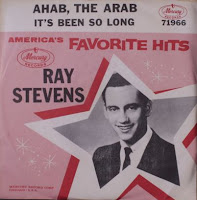
The success of the single provided Mercury the avenue in which to release a full length LP; as was commonplace back then practically every record label would issue singles on a recording artist and if the single or a series of singles proved successful in the label's eyes then they'd release a full length LP containing the songs that had been released as singles plus several album tracks...sometimes the album tracks would surface as future singles but often they'd remain on albums heard only by the most dedicated of fans. The feeling being that only the dedicated of fans would purchase an entire album of songs from one artist...while a general audience is more likely to purchase the single. "Ahab the Arab" tells the story of an Arab and his love for harem woman named Fatima...one of the women in the Sultan's harem...and throughout the song Ray tells of how Ahab and Fatima are in love with one another behind the Sultan's back. Ahab rides the dunes of the desert on a camel named Clyde. Ray has often spoke of the song's origins and how it's based upon the imagery seen in the film, The Sheik, as well as the books on Arabian culture...often cited is One Thousand and One Arabian Nights. The character names, as explained by Ray, come from various inspirations. Ahab is selected due to it rhyming with Arab (when pronounced Ay-rab rather than Air-ub). Fatima was a brand of cigarettes while the camel's name, Clyde, was inspired by Ray seeing Clyde McPhatter walking around in the recording studio one day. Clyde McPhatter, according to interviews I've read and heard from Ray and from passages in his memoir, was one of Ray's musical influences. Mercury edited the original recording of the song...cutting out a third verse...for time reasons. Ray, in later interviews, remarked that he was crushed when told that in order to potentially get airplay for the song it needed trimmed down. Whenever you see the 1995 music video of the song it includes the missing lyrics not included in the single release from 1962. The song's B-side, "It's Been So Long", is a delightful ballad...one of his more soulful of that time period. The success of Ray's first single releases led to Mercury releasing the LP titled 1,837 Seconds of Humor. The album contained almost all of the recordings found on the first three single releases on Ray by Mercury (missing was "When You Wish Upon a Star" and "It's Been So Long"). Some of the other songs on the album were: "Popeye and Olive Oyl", "PFC Rhythm and Blues Jones", "Saturday Night at the Movies", and "Julius Played the Trumpet". There were a lot of songs on that album specializing in pop culture satire which you can tell by some of the song titles. Those that didn't really care for rock and roll music had deep hatred for Elvis Presley...and when he was drafted into the military it tickled a lot of people's funny bones. Those that appreciated the things Elvis did for the music industry and those within the industry that liked this new kind of music also lent their contributions, in song, to the idea of a rock star being drafted into the military. Ray's song, "PFC Rhythm and Blues Jones", tackles the concept of a musician being in the military...in this case it's a rhythm and blues singer who goes by the name of Jones. It's explained that Jones would much rather be back home fronting his rhythm and blues band instead of dodging bullets from the enemy in some foxhole.

Mercury Records issued a further single on Ray in the fall of 1962...this time the love ballad was on the A-side and the comedy song on the B-side. However, the A-side come across as a novelty because it was unusual in it's delivery. As long time fans should already know but I'll explain for newcomers: a lot of Ray's songs in this time period that were intended to be taken seriously were often casually labeled 'novelty' by music critics due to the construction or vocal phrasing being different from what was being heard on radio. Novelty or off-beat were the common descriptions of Ray's serious recordings of this time period even though they were intended to be taken seriously. So, "Furthermore", his fourth single for Mercury, starts out with high falsetto from Ray delivering a scat singing introduction as music plays in the background. The delivery itself crams a lot of lyrics together in strings of what appears, to the ear, as run-on sentences but they're complete sentences but sung fast. It's a love song for sure...but given the performance it's described as off-beat. He re-recorded the song decades later as a slow, bluesy ballad. The B-side of the 1962 original is "Saturday Night at the Movies".

In the winter months of 1962 Mercury released the original recording of "Santa Claus is Watching You". Ray would re-record this song in 1985, with almost an entire set of different lyrics, which was accompanied by a famous music video; and he re-recorded it a second time in 1997. The 1962 original is a cute Christmas novelty...and it reached the Top-50 of the Hot 100. I like the original recording but I love the 1985 re-recording/partial re-write. The Christmas release remained a single exclusive until it began appearing on compilation albums. It should be noted that there's a lengthy recording of 1962's "Santa Claus is Watching You" and there's also an edited version for radio stations that clocks in a little over 2 minutes. The unedited recording is a little more than 3 minutes. You can find an audio clip on YouTube of the unedited 1962 recording by using the search phrase: Santa Claus is Watching You (1962). It was uploaded by a user named verycoolsound. Once you hear it and once you hear the edited version (the edits are noticeable) you'll wonder to yourself the reason why the editing took place...but again one only has to think back on the time period (early '60s) and how pop songs were typically quick and rarely ran longer than 2 and a half minutes whether it be a ballad or an uptempo recording.

As the calendar flipped to 1963 and as Ray was becoming more and more involved in the recording process with his session work and overall duties in the Artist and Repertoire department of Mercury he began to expand his workload...if only in terms of music arranging and other technical aspects of the recording industry. The first single release on Ray from Mercury in 1963 was "Funny Man" backed with "Just One of Life's Little Tragedies". Ray experienced some success in Canada with "Funny Man" as it reached the Top-20 of their pop music chart while on America's Hot 100 it peaked outside the Top-40. Mercury issued their second LP on Ray with the title being This is Ray Stevens. The overall flavor of the album was an almost even mix of comedy and serious recordings and it wasn't as pop culture heavy as the previous LP in 1962. "Harry the Hairy Ape" became a hit for Ray in the summer of 1963...it's all about an ape that wants to be a rock and roll singer...and how his entertaining ways leads to his becoming a recording artist following an encounter with a disc jockey. This novelty single became a Top-20 pop hit in America as well as a Top-20 Rhythm and Blues hit. On Canada's pop music chart it reached the Top-30. Ray's talents as a songwriter had long been on display. He wrote all the songs found on his first two albums. He and Margie Singleton wrote a song titled "My True Confession" which became a big hit for Brook Benton in the summer of 1963...so Ray not only found himself on the charts as a singer-songwriter of his own material but he was on the charts as a co-writer of the Brook Benton hit. Brook's hit was produced by Shelby Singleton (as was all of the songs found on Ray's first two albums) and it was arranged by Bill Justis. Brook was a major recording artist on the Rhythm and Blues as well as the Easy-Listening chart...the latter being a format devised in the aftermath of rock and roll...radio stations played songs from pop music artists who appealed mainly to adult audiences instead of teenagers. On the Hot 100 Brook's recording reached the Top-30 but in the Easy-Listening format it skyrocketed into the Top-10...it repeated this same Top-10 success on the Rhythm and Blues chart in 1963 as well.

Ray entered into a unique situation around this time period. I've never known the specific details but I've been able to come up with somewhat vague information stating that Ray signed a deal with Monument Records in 1963 as a producer/arranger/session musician while still under contract with Mercury Records as a recording artist. This meant that Ray would still issue recordings for Mercury Records but for Monument he was signed as a behind-the-scenes artist. The final single release from Mercury in 1963 on Ray happened to be "Speed Ball" backed with the ballad "It's Party Time". The A-side was another novelty hit...reaching the Hot 100 for several weeks...while reaching the Top-30 on the Rhythm and Blues chart. The B-side wasn't released on any album. I'm hoping that the first two chapters in this mini-blog series is helping go a long way at showcasing just how varied Ray's music career happens to be. In Part Three I won't be as story-telling as I probably come across in this blog entry...for in Part Three I'll be bringing into focus Ray's career as a music arranger and producer for other artists in addition to the recordings being issued on Ray by Mercury Records...so be on the look out for Part Three soon!

January 8, 2019

Ray Stevens vinyl Singles I came Across...

Over the weekend I made a visit to an area flea market. Some may not take the time to frequent them as often as they used to with so many on-line sites, most of time, offering the same kind of items: used books, crafts, machinery, music, memorabilia, etc. Anyway, I like to visit flea markets every so often because sometimes I come across things that I'd probably never come across on eBay or if I do come across things on eBay more than likely they'll be a whole lot cheaper at a traditional flea market or antique mall. I often come across vinyl copies of the Ray Stevens single, "Funny Man", on eBay and a lot of the time it's either an international release, a promo copy, or another similar kind of offering. The copy I came across is indeed a promo copy but there's a couple of markings on the label which, in the eyes of professional collectors, probably immediately decreases the single's value. However, because I'm not a professional collector/dealer and since I don't purchase Ray Stevens items or any other item for the purpose of selling it I decided to go ahead and purchase the single for my own collection. The song was released as a single by Mercury Records in 1963 and it hit the Top-20 on the pop chart in Canada. The B-side, "Just One of Life's Little Tragedies", is one of the many under-rated, under-appreciated ballads...by saying that I mean there's long been a popular misconception that Ray only sings comedy songs...but if one actually listens to his albums in their entirety rather than searching for, or focusing solely on, the 'hit' recording (which is often comical) you'd be surprised to learn just how many non-comedic songs he's actually recorded in his 60 plus year career.

In addition to the 1963 vinyl single I also came across a copy of Ray's 1980 single on RCA, "Shriner's Convention". This copy is also a promo featuring the edited take on one side and the unedited take on the other side. The short version has a length of 4 minutes, 10 seconds while the long version has a length of 5 minutes, 33 seconds. As is the case with a lot of single releases there were promo copies, international copies, domestic copies, alternate domestic copies, alternate promo copies often referred to as DJ copies, etc. There's a red vinyl copy of the single that was manufactured as well. It, too, features the short version of "Shriner's Convention" on Side A and the long version of the song on Side B. The single hit the Top-10 on the country chart early in 1980. In addition to the promo single of "Shriner's Convention" that I purchased at the flea market over the weekend I already had the commercial single that was issued to the general public in my personal collection. It's B-side is "You're Never Goin' To Tampa With Me". I'm not actively seeking the red vinyl copy of "Shriner's Convention" but if it ever comes into my possession I'd then have a copy of all the various single releases of that particular recording. There were a number of vinyl albums of Ray at the flea market that I already have. Here's an observation I made concerning the various vinyl album booths that I visited: in one of the booths at the flea market they had his vinyl albums in the country music section. In another music vendor's booth they had some of his vinyl albums mixed in with random vinyl albums of stand-up comedians.

August 26, 2018

Ray Stevens and his Latest Video Clips...

Oh yes it's another fan created blog about Ray Stevens written by me that you're reading at the moment and based on my previous blog entry it got me thinking a little about simian songs from Ray's career. I touched on this subject many blogs ago but with the recent YouTube upload of "Too Much Monkey Business" I decided to re-visit the topic. I also decided to write this blog entry to pass along specific unique view numbers for the latest video clips from Ray Stevens that are on YouTube.


The August 14th upload, "Too Much Monkey Business", has received 3,124 unique views so far. This is something of a dramatic pick-up since writing about the clip yesterday. I'm too modest to think my blog sharing helped it receive additional unique views but something definitely caused the video to get nearly a thousand more unique views. I'm not going to monitor the unique view numbers of either video clip on a daily basis. I used to do this in the past with other YouTube videos that Ray would upload but I no longer do that. Every so often I'll check the unique view count of these two videos and provide information on this blog at that time.


The August 17th upload, "Doctor, Doctor Have Mercy on Me", has received 20,068 unique views as of this writing. Yes, you read that correct, it's surpassed the 20,000 plateau as I write this. This video has also received a dramatic rise in unique views since I last wrote about it yesterday. The subject matter revolves around the medical profession and this is something that's been highly topical ever since politics crept into things in a major way in 2010. Although the song itself has nothing to do with that side of the medical profession (healthcare, Medicare, Medicaid, etc. etc.) it nevertheless is a song dealing with doctors...more specifically primary care doctors/family doctors and the frustrations all of us have when visiting the doctor. So the topicality of the subject matter gives it more of an edge in social media and you're seeing the results.

Simian silliness in song has been part of Ray's career dating back to the early 1960s. The cover photo of TV Magazine off to the left, though, is from the summer of 1970. The first notable recording spotlighting this happened to be 1963's "Harry the Hairy Ape". The recording became a Top-20 pop and a Top-20 Rhythm and Blues hit. Something more surprising is the fact that it's peak position was higher on the Rhythm and Blues chart. The song tells the story of an ape that spends his days attempting to scare people and it eventually leads to his becoming a rock and roll star. It was originally released on his 1963 album, This is Ray Stevens. 1969's "Gitarzan" took the fictional Tarzan and his jungle family and turned them into rock and roll performers. Although this Top-10 million selling pop hit is definitely more about it's parody of Tarzan as a rock and roll guitarist nevertheless there's the memorable vocal appearances of both Jane and their pet chimpanzee, Cheetah. The chimp is referred to as a monkey in the recording although technically Cheetah was a chimp. In this song the chimp likes getting intoxicated prior to his performances but you can't tell it based on the fervor in which he contributes to the jungle band. Why am I even making a distinction between a chimp and a monkey? You never know in this day and age...if I didn't make that distinction there would be somebody out there raising a fuss about Ray referring to a chimp as a monkey. Some people can be way too over-analytical. Ironically, Ray re-recorded "Harry the Hairy Ape" for the 1969 Gitarzan album. If you've got a lot of compilation albums released on Ray it's likely the 1969 recording of "Harry the Hairy Ape" that are on most collections. When the limited animation music video was produced of the song they used the 1969 recording instead of the 1963 recording.


In 1970 there came a song titled "Monkey See, Monkey Do" and it's from his Unreal album. The song itself had nothing to do with the simian but had more to do with social commentary and the slang phrase of people seeing other people behaving or thinking in some fashion and therefore adopting the character traits of others rather than being true to one's own point of view. The song itself adopts that slang phrase and also adds envy to the equation in which members of society, in general, attempt to mimic their peers as far as fashion, physical appearance, and income are concerned. A neighbor has a house with two garages and so that may inspire somebody else to top that and have a house built nearby with a three car garage. A person holds a certain belief but doesn't dare speak their mind for fear of being shunned by society and as a result this person adopts the opinion of "a majority" just to fit in...and at the crux of "Monkey See, Monkey Do" is the painting of society as a zoo as Ray asks us to find a mirror and look at ourselves. It goes hand in hand with the A-side of the single, "Come Around", a marvelous song criticizing excess, hypocrisy, and close mindedness found in some sectors of society. The picture sleeve of that particular single release you see above is from the overseas market. In America the A-side of the single was "America, Communicate with Me".

In 1984 Ray decided to do his version of the theme song of "The Monkees" television series. The song features Ray performing the theme song in a Monkees-like vocal performance at various moments throughout but the obvious highlight are the two greatly exaggerated fictional Austrian performers (Wolfgang and Fritzy) that frequently bicker and argue back and fourth as they attempt to perform their version of the theme song. You can find that hysterical performance on the album, He Thinks He's Ray Stevens.

In November of last year Ray uploaded a music video of "Aba Daba Honeymoon". The music video appeared out of the blue. Ray had recorded the song at some point in 2010/2011 for inclusion on his mammoth box set, The Encyclopedia of Recorded Comedy Music. The music video had been in existence since 2013 according to the video details on YouTube but it had never been uploaded onto the internet until November 2017. The song dates back to 1914 and so it was nearly 100 years old prior to Ray bringing it back when he decided to record it for his 2012 box set. It had been recorded numerous times and there were several pop hits of the song in the 1950s and it's chorus was parodied in a long running series of television commercials for Frito's. The song is incredibly simple if not entirely fictional as far as it's plot goes: a monkey and a chimpanzee fall in love and get married in a ceremony in which a baboon is the preacher. The nonsense phrase of the song's title is explained as monkey talk. The fun of the song is how the tempo of the song gradually moves higher and higher and the lyrics are performed in such a frenzied fashion aided by the use of some scat-singing, too, before the tempo falls back down for it's conclusion. Ray's version is outstanding...musically speaking and the actual vocal performance. The video features a cameo appearance of Ray as Gitarzan near the beginning.


This brings us, chronologically, to the performance from his CabaRay television series of "Too Much Monkey Business". Ray hasn't officially recorded the song but this performance of the song has become a video release on YouTube and that is what I started this blog entry with.

January 22, 2018

Ray Stevens CabaRay Nashville...Ray Hildebrand

Hello once again!! Did I ever get a surprise earlier today as I visited Ray's video streaming site...it's called raystevens.tv and I've written about it before. It's a premium site. I opened up the section which archives his episodes of the CabaRay Nashville television series and would you believe Season Five is already airing on PBS stations?

The season kicked off two weeks ago on January 6th but there hadn't been any promo videos emerge on YouTube promoting this fact. The local PBS affiliate in my area, KET2, airs his show but they began repeating episodes from Season Three after the New Year's Eve episode aired in late December and so I naturally assumed that once the repeat cycle completed then Season Five episodes would become available for PBS to air. The fifth season, like the previous four, will also contain 13 episodes and the first episode of Season Five features Ray Hildebrand as a special guest. An edited version of episode one guest starring Steve Wariner is slated as episode two of Season Five. The third episode, which aired on some PBS affiliates over this weekend, guest starred Paul Overstreet. Next week's episode (first airing will be January 26th) will guest star the Bluegrass duo, Dailey and Vincent.

The episodes are added to his video streaming site a week after they've aired on PBS. That means this past weekend's episode, airing the weekend of January 20th and guest starring Paul Overstreet, will be uploaded to Ray's video streaming site the weekend of January 26th...and the Daily and Vincent episode will be uploaded to Ray's video streaming site the following weekend in February.

Ray opened the episode singing "Beyond the Sea" and afterward introduced Ray Hildebrand and jokingly made reference to the artist going by the name of Paul. Given that both are named Ray I'm going to refer to the guest by his last name, Hildebrand, who comes out and tells the history of "Paul and Paula" and how it was originally issued on a label in Forth Worth, TX and how the LP was recorded in Nashville. Paula's real name happens to be Jill Jackson but she wasn't part of the show. He tells a whimsical story of being asked to fly from Kansas to California to record just one song at the insistence of Jon Bauman (Bowser from Sha Na Na). Ray mentioned that Shelby Singleton is responsible for picking up distribution rights to "Paul and Paula" and for changing the duo's name from Ray and Jill (which is how it appears on the original single release pressings in Fort Worth) to Paul and Paula. Hildebrand mentions that one of the things he remembers distinctly is hearing Shelby over the loud speaker saying "take 43..." and explains that there must have been something Shelby didn't like in the previous 42 attempts. He jokingly suggests it could have been the fault of Ray being at the studio...but Ray responds in mock egotism by saying it couldn't have been his fault because if he were involved they would've nailed down the song in one or two takes. For a minute I thought the two of them were going to get into a comical war of words recalling those recording sessions in the '60s.

Hildebrand performs "Hey Paula" with Ray's three female harmony singers. They each vie for the role of Paula and throughout the performance each one gently pushes the other out of the way each time it's their turn to sing Jill/Paula's lyrics. After this performance he tells of the time he abruptly left a Dick Clark tour because he couldn't take life on the road anymore. He says he slipped a note underneath the door and left. Dick had to fill in for Hildebrand throughout the remaining tour stops (three in total). Ray suggests that Hildebrand might be the music industry's father of Contemporary Christian music. Hildebrand talks of recording Christian music and Word Records. Ray brings up Hildebrand's past involvement with an organization known as The Fellowship of Christian Athletes. A performance of "Say I Do" by Hildebrand soon follows...but introduced by Ray as "here's Paul...no, Ray...or is it...well, whoever it is...". Upon the conclusion of the song Ray thanks him for being a guest on the show...and this is followed by an instrumental of "Tennessee Waltz" by Ray's band. The lead instrument is the electric guitar played by Jerry Kimbrough.

The show's announcer, Bill Cody, comes running onto the set to see if he could introduce the show's closing number...Ray agrees...and "You're Nobody Til Somebody Loves You" done in Ray Stevens style is delivered as the closing performance. One of the harmony singers frequently offers reaction lines which are greeted with giggles from the audience. It's definitely very different from the crooner version by Dean Martin.

This episode was taped during recording sessions held in 2017 and as I was mentioning in a couple of previous blog entries Season Five will be the final season of episodes taped at the current studio. His next recording sessions are going to take place at the CabaRay and those are going to get underway soon. The next recap I'll post will be this weekend once the Paul Overstreet episode is uploaded to Ray's video streaming site.

September 9, 2015

Ray Stevens: All-Time Hits...

As I often do I highlight compilation albums issued on Ray Stevens...some I've got in my collection and some I find posted on-line most typically listed on auction sites that I feel the need to comment about or promote through this fan-created blog page.

All-Time Hits is one of those misleading titles that many record companies place on compilation albums. The basic reason is to grab a consumer's eyes...and then once their attention's been obtained the next thing some, not all, but some consumers do is look at the album's photo/picture of the artist. Then the consumer, in the vinyl era, more than likely would flip the album over and read the song selections. Usually a different photo of the artist appeared on the back of the album...a kind of exclusive photo for those that purchased the album. Promos and ads rarely gave the back of album's much, if any, exposure and so a lot of fans that didn't purchase vinyl albums (preferring singles) weren't aware of the practice of having the main publicity photo of the artist on the front of the album and then a secondary photo on the reverse side.

One of the recurring concepts of compilation albums labeled either Greatest Hits, The Very Best of, or All-Time Hits is the use of photos of the artist that, usually, do not match the era in which the bulk of the recordings took place. This is, of course, more common for artists that have had incredible longevity in the music business. Even though there a lot of artists from Ray's generation and those that came before him that have had a massive catalog of compilation albums issued on them I've noticed that the compilations issued on Ray have had some of the most misleading photo's accompanying a release.

This release, All-Time Hits, originated in 1996 in cassette format and featuring a minimum of just eight recordings it was marketed as a budget-priced release. Issued on Polygram Records, a subsidiary of Mercury Records, the eight recordings on the project happened to have been recorded by Ray during his stay at Mercury (1961-1965, 1983) and one song, oddly enough, from his RCA period (1980-1982). Of course not every recording during his Mercury or RCA stint are represented but 8 recordings are. The track list: "Ahab the Arab", "Harry the Hairy Ape", "Jeremiah Peabody's Green and Purple Pills", "My Dad", "Shriner's Convention", "Speed Ball", "Furthermore", and "Funny Man". Six of those recordings come from the early 1960s but the photo of Ray that's used from a much later era (perhaps from a photo session in 1983 during the making of his studio album that year). If one is not too familiar or conversant with all things Ray Stevens as some of us are you'd probably think that Ray looked like that during the recordings found on this collection but in reality he did not. On six of the eight recordings found here he looked like this...


A note to collectors is this 1996 compilation includes the original recordings of his early 1960s hits on Mercury. A lot of compilations use the Monument re-recordings but on this collection, since it's affiliated with Mercury, the original recordings are featured.

All-Time Hits is also available in CD format. Although a cassette is perfectly capable of holding a large amount of recordings only 8 appeared on the cassette copy. However, for the CD release, three songs were added. In a move to entice CD sales using the allure of "bonus tracks" the 11 track version of All-Time Hits incorporated 2 additional recordings from the early 1960s and one recording from 1981. The three bonus recordings are "Butch Babarian", "Santa Claus is Watching You", and "One More Last Chance". The reason, well, one of the reasons that I have both the cassette and CD releases is because of my desire, at the time, to have any Ray Stevens release that appeared in retail stores.

Secondly it's because I only had a cassette player at the time...I didn't have a CD player and I definitely didn't have a record player, yet. So, once I got a CD player I found All-Time Hits in CD format and purchased it...the allure being I didn't have any of those songs on CD format at the time. You could say I was slow at getting the latest listening devices. I'm still like that...I don't have an Ipod or Ipad or tablet or whatever the most recent listening device happens to be but I do purchase/download songs on Amazon if I choose to but ordinarily I prefer a CD copy.

The CD copy of All-Time Hits displaying all 11 tracks. The titles that have an asterisk to their left indicate the bonus songs found only on the CD. Considering how obscure Ray's 1983 studio album for Mercury happens to be it always puzzled me as to why only "My Dad" appeared on this compilation and nothing else from that album...instead choosing a couple of his RCA recordings to represent the early '80s period. Don't get me wrong, though...the inclusion of "One More Last Chance" is most certainly a welcome addition. Given that "My Dad" appears it's still a mystery as to why his 1983 studio album, Me, has never made it's debut on CD or even Mp3 yet. Polygram, the label that issued this in 1996, certainly had the capability of including songs from the 1983 album or else "My Dad" wouldn't have made an appearance...so it's odd that they, nor Mercury itself, have ever thought to reissue Me. One thing about this collection that can't be said for other compilations issued on Ray Stevens is this one features single releases only. Every track on here found it's way onto the pop or country music charts. Usually the compilation releases included album tracks, chosen seemingly at random, along side the actual single releases. This practice raised awareness for a lot of recordings by Ray Stevens that were originally meant as album cuts.

Yes, this is the cassette copy...the one I purchased at the local Wal-Mart store back in 1996. It's still in excellent shape. I never handle cassettes, CD's, or vinyl singles and LP's in a rough manner or toss them around, etc. I guess the only strike against this collection is the lack of liner notes. I've become spoiled by the liner note concept that accompanies a lot of music collections even though, strangely enough, I never cared one way or another if something featured liner notes or not; but since I've gotten older and have seen a lot of liner notes and articles about Ray that are more fiction than fact it's becoming something of an interest of mine if a compilation features liner notes or not. The thing about liner notes is the subjective nature of the authors, which I don't mind, I'd be more offended to see negative criticisms...but the thing I'd noticed about liner notes is the passing of misinformation and the omission of information. Bios found on Ray omit the fact that Ray recorded an album for Mercury Records in 1983 and the label released several singles on him throughout the bulk of 1984 prior to his departure to MCA and his relaunch as a country comic. Liner notes often omit that Ray had more than a couple of hit recordings for RCA and Warner Brothers...in some liner notes only a couple of songs are highlighted during an entire 7 year time span (1976-1983) and this sort of lack of information does a disservice to any new fan of Ray's and it's maddening to long time fans that don't appreciate seeing his catalog of music go overlooked. So it's great if a CD has liner notes but it's also wise on the reader or the fan's part to do research for themselves, too. I was once a new fan of his...and my only exposure to his music happened to be what appeared on the CD's available in retail stores and the several cassette tapes originally owned by my grandparent's. If I remained content on just enjoying the songs on those projects I'd be missing out on a LOT of other great recordings from his career. Some prefer just to listen to a handful of recordings by him (recordings from the mid '80s primarily) and dismiss anything else he's recorded. 1987's Greatest Hits on MCA and Greatest Hits, Volume Two contain the recordings that are associated heavily with Ray...and therefore those compilations have gotten the most sales.

The liner notes for the Platinum 1987 album, however, doesn't mention that the recording of "Ahab the Arab" is from 1969. The author mentions the song was a hit in 1962...but this naturally suggests to a new fan that the recording they're hearing is from 1962. I didn't learn that the recording was from 1969 until some point in the 1990s...I had gotten the Mercury cassette titled Funny Man and heard his early '60s recordings for the very first time and that's how I heard "Ahab the Arab", the original recording, for the very first time. The cassette features a bearded Ray Stevens on the cover...looking nothing like he did in the early '60s...which fits in with the overall theme of this blog entry spotlighting compilation albums featuring misleading images of Ray on the cover.

December 14, 2014

Ray Stevens: Rayality TV webisode 34...

Once again it's time to take a look at Rayality TV...the 34th installment debuted this past Friday. The clip is from one of Ray's concert DVDs and it's a performance of "It's Me Again, Margaret". If you consider yourself a fan of Ray Stevens at all then you should already be very familiar with this song and, like a lot of his stage performances, you'll be hooked from the beginning. Ray knows how to perform on stage and to deliver every drop of visual comedy into a performance.

This is one of his all-time classics.


Margaret is just one of the various female characters that have become embedded into the collective memories of every Ray Stevens fan. Aside from Margaret we've heard Ray sing about Fatima, obviously, in the 1962 classic "Ahab the Arab". Fatima, a member of the Sultan's harem, is carrying on with Ahab. Most critics, if not all, usually (or deliberately) forget that it's a comical cheating song and it brings scorn and contempt from hypersensitive, politically correct zealots. In my opinion the song's cleverness of blending and mixing various fictional titles together and presenting it in a pop music recording is certainly praise-worthy, fictional stories such as Ali Baba and the 40 Thieves, The Thief of Baghdad, The Sheik, The Son of the Sheik...each of those classic stories/films inspired Ray.

In the official music video of "Ahab the Arab" (filmed in 1995), Ray pays homage to the Valentino films, appearing several times in brief silent-movie type footage. It's very noticeable so be on the lookout for it.


Ray's single became a hit in the summer months of 1962. In December that year a brand new movie premiered...titled Lawrence of Arabia. I'm certain that the movie's box-office popularity throughout the early half of 1963 had unexpectedly kept Ray's novelty single as a radio recurrent long after it's original peak in 1962. Ray's single sold more than a million copies...I'd have to say that the sales strength came from much more than airplay exposure alone.

In the 1969 hits "Gitarzan" and "Along Came Jones", Ray told us about Jane and Sweet Sue, respectively. Jane attempted to be the singer in the jungle band...but her mate's overly anxious performances got on her nerves so much she screamed out her catchphrase at the end of her contribution (you readers should know that catchphrase!!). "Gitarzan" sold a million copies. Here's Ray as "Gitarzan" on the picture sleeve that accompanied the 1969 vinyl single...


Sweet Sue, on the other hand, is the classic damsel in distress type...always put in danger but rescued in the nick of time by Jones. Neither participant in "Along Came Jones" have any aspirations of being a singing sensation, though. A Gitarzan album appeared in 1969. A year later Ray had himself another hit comedy recording featuring a fictional female character...can you guess the name of it? If you said Bridget you're absolutely correct!!

"Bridget the Midget" became a international hit in late 1970/early 1971. The biggest success happened to occur in the United Kingdom. The song tells the story of a fictional tap dancer named Bridget and her back-up group, Strawberry and the Short-Cakes. The hook/gimmick of the novelty song is the sped-up vocalization of Bridget. Ray, in his natural voice, acts as presenter/narrator and at several moments in the recording there's an appearance of a spaced out beatnik/hippie-type patron that offers his enthusiasm about the goings-on.

The most popular female character in a Ray Stevens recording is a 3-way tie, actually. One of those is the previously mentioned Margaret from "It's Me Again, Margaret". The second of the three is Sister Bertha from "The Mississippi Squirrel Revival". That song and the one about Margaret both arrived back-to-back on a 1984 comedy album from Ray called He Thinks He's Ray Stevens (a Platinum selling, Top-5 Album on the country charts). Sister Bertha is the unfortunate soul that had a peculiar thing happen to her during church service.

Sister Bertha wasn't the first religious fictional female character to appear in a Ray Stevens recording. Four years earlier, in 1980, Sister Doris and Sister Dewdrop debuted on "The Dooright Family". Their duty was to sing harmony and bless the hearts of all they see. That song, made into a music video in 1995, debuted on Ray's 1980 Shriner's Convention album.

The third female character in the 3-way tie is none other than Ethel...the legendary wife of the eyewitness of "The Streak", in 1974. She comes in at #1 in the 3-way tie...the reason being is her name is synonymous with streaking thanks to the song's catchphrase heard at various moments, "don't look Ethel!!!". Another reason she's first in the 3-way tie at #1 is because "The Streak" sold more than 5 million copies internationally and because of the comical twist and the end of the song regarding Ethel's future.

Here are some other female characters that have popped up or have been mentioned in numerous recordings from Ray Stevens through the decades...

Sally Smash (pop vocalist in "The Rock and Roll Show", 1962); Sugar Bee (companion of motorcyclist "Speed Ball", 1963);  Heidi Fokes (girlfriend of "Butch Babarian", 1964); Bubble Gum (the lead character in "Bubble Gum the Bubble Dancer", 1964); Mary (title character in "Mary, My Secretary", 1967); Fair Maiden/Damsel (victim in "Sir Thanks-a-Lot", 1969); Mildred Queen (pop vocalist in "The Moonlight Special", 1974); Rita (title character in "Rita's Letter", 1980); Melissa (title character in "Melissa", 1981); Mary Lou Picket (from "Country Boy, Country Club Girl", 1982).

I'll stop there or I'll find myself mentally recalling every studio album from Ray Stevens starting in 1983 and moving forward...thinking of each and every mention of a female's name in a song or in the title of a song and so I'll stop there...but the characters above make up a good enough list.  

March 18, 2014

Ray Stevens from Cover to Cover...

In a previous blog entry I remarked that a lot of compilation projects on Ray Stevens have been issued in some format or another throughout the latter half of the '60s and running non-stop through the mid '90s. A lot of those compilations were not under Ray's control...once an artist records songs for a label, the label in return takes ownership of those recordings and the distribution rights. It gets even more confusing and complex if a label is bought out or merges with another company or if the label gives distribution rights to a second, third, or fourth party...that sort of thing can create a scenario of multiple record labels issuing compilation albums of the same songs, just in different sequential order, and usually with varying audio quality, too. If I remember it correctly from some things I've read through the years, if the singer happens to be the song's writer or it's publisher then that artist owns the rights of the written 'song' (lyrics and music) but not the actual recording of that song (the recording is owned by the label). Having said that, if a singer is the song's writer but the publisher is someone else then it's said that the writer/artist and the publisher share ownership of the song but the recording is still under control by whatever label the artist recorded it for.

Ray Stevens is one of the pioneers, in my opinion, of savvy music sense. As soon as he as able he began to publish the songs he wrote and he began publishing pretty much every song he happened to record because he learned that the publisher had the most lucrative career. Every so often he'll record songs that aren't tied to his publishing house but those are exceptions to the norm...typically he records songs he's either written, co-written, or have been submitted to him by a core of songwriters that work in his publishing company. He produces his recording sessions from his own recording studio and arranges the music on the songs that he chooses to record and has long been the piano/keyboard/synthesizer extraordinaire of his albums (he'll occasionally play the trumpet, vibraphone, or other instruments but mostly he sticks with instruments in the piano family). On some of his albums (specifically the late '80s/early '90s) he handed over the piano duties to a musician named Gary Prim (if you look at the musician credits you'll see his name) but Ray was still credited for the keyboard and synthesizer contributions of those albums.

This 1992 compilation is exclusively Mercury Records oriented. It features 12 songs that Ray recorded during the years of 1961, 1962, 1963, 1964, and 1983. The catalog number is 838 169-2 and this CD more or less combines 8 recordings found on some earlier compilation releases in 1989 (also on Mercury) and adds in 4 additional recordings he did for Mercury to give the CD a total of 12 tracks. One of the oddities is the inclusion of a couple of early '80s recordings he did for the label. I say they're oddities strictly due to the fact that the 10 other Mercury recordings all come from the early '60s time period and his voice, by 1983, had deepened, mellowed and matured dramatically between the years of 1964 and 1983. For those curious, Ray had recorded three studio albums for RCA (1980, 1981, and 1982) after having signed to the label in the latter half of 1979. In addition to those 3 studio albums, RCA issued a Greatest Hits package on Ray in 1983. Later on that year Ray found himself at Mercury Records of all places...the label that made him a recording star in the early '60s...and he ended up recording one studio album for Mercury in 1983 titled, Me. From that 1983 album comes 2 of the songs on this otherwise exclusively early '60s track list: "My Dad" and "Game Show Love". The timeline for the publicity of the 1983 album got underway late in the year and much of it's publicity peaked sometime in mid 1984. After concluding his one year stay at Mercury he joined MCA almost immediately and by the end of 1984 he had refocused his career into country comedy and from that point forward he's marketed himself almost exclusively as a comedy/novelty act (something he had resisted doing for many years until he could resist no longer). The 12 tracks on that CD are listed below:

1. Ahab the Arab; 1962
2. Furthermore; 1962
3. Funny Man; 1963
4. The Deodorant Song; 1963
5. Harry the Hairy Ape; 1963
6. Just One of Life's Little Tragedies; 1963
7. Speed Ball; 1963
8. Bubble Gum the Bubble Dancer; 1964
9. My Dad; 1983
10. Jeremiah Peabody's Green and Purple Pills; 1961
11. The Rock and Roll Show; 1962
12. Game Show Love; 1983

I mentioned earlier that the songs on that 1992 CD had appeared on a compilation release from Mercury in 1989. The label issued 2 separate collections in 1989, each consisting of the same songs and the same image of Ray, but under different titles: One release is titled Funny Man and the other is titled Ahab the Arab. The project happened to be released under the Polygram Records imprint...a subsidiary of Mercury Records...and there are 8 songs altogether. The catalog number for the 1989 pressing titled Ahab the Arab is 838 169-4 (note it's similarity to the 1992 catalog number). The 8 songs on those 1989 collections are:

1. Ahab the Arab
2. Furthermore
3. Funny Man
4. The Deodorant Song
5. Harry the Hairy Ape
6. Just One of Life's Little Tragedies
7. Speed Ball
8. Bubble Gum the Bubble Dancer

As you can see, 1992's CD simply took the 8 songs from the 1989 compilation and tacked on 4 additional songs to give it 12 tracks altogether.

As I've mentioned in other blog entries, a 1970 release called The Best of Ray Stevens on Mercury Records, introduced me to Ray's early '60s recordings. I came across a cassette copy at some point in the early '90s just as I was slowly but surely putting together my Ray Stevens music collection. I then came across this cassette and seen a couple of song titles new to me: "The Deodorant Song" and "Just One of Life's Little Tragedies". I also seen "Furthermore" listed. At the time I was familiar with Ray's 1984 recording and before listening to the 1989 tape I assumed I'd be hearing the 1984 recording...what a jolt to hear the song in it's original, high octane 1962 presentation...completely unlike the bluesy 1984 rendition. I had so much more to learn about Ray's recordings that it's embarrassing to think back on what little I knew!! This is back in the days before the internet became the giant that it is today...long before video hosting sites, Mp3's, social media sites, and on-line stores and auction sites, etc. etc. In those days a person had to rely on looking through flea markets and yard sales and garage sales (in person) in order to find vinyl albums and vinyl singles or visiting book stores (in person) in the hopes of perhaps coming across reference material of some kind. The 1989 compilation titled Funny Man looks exactly the same...and the songs are in the exact order, too...

There's never been a reason given for the separate releases...each has the same catalog number, too...so it's like the same item but under a different title. My guess is Mercury may have released the Funny Man compilation first...to tie it in with Ray's reputation with the general public. Then the label could have re-issued it as Ahab the Arab...to tie it in with Ray's first big hit and potentially create more sales. Then there's the possibility that Mercury/Polygram issued it as Funny Man in certain parts of America and under the alternate title in other parts of America. I've never come across any explanation as to the reason behind the 2 nearly identical projects and so those are only my theories. The 1992 CD I mentioned earlier essentially wiped out the need for either of these 1989 releases but if you have them both they may become of value to some future fan of Ray Stevens. Some might find it baffling as to the reason Mercury issued the same 8 song collection during the same year, using the same image of Ray, the same catalog number, but utilized different titles. They may also be of value to a completest intrigued by the oddity/obscurity of those 1989 Mercury releases.