Showing posts with label harry the hairy ape. Show all posts

January 29, 2023

Ray Stevens: This Is a Diamond

Hello fans of Ray Stevens!! This is a Diamond anniversary for the 1963 Ray Stevens album, This is Ray Stevens. The album was released on Mercury Records, in 1963, and it was Ray's second studio album. The track list, as with his previous album, were songs written by Ray. Some people might say a good chunk of Ray's music legacy is tied to his first two studio albums. Now, when music historians/essayists say things like that, I tend to think they're simply referring to a couple of single releases lifted from his 1962 and 1963 studio albums. I wouldn't go so far as to definitively say that his first two studio albums served as a template for things to come but I understand why such an opinion would form. This 1963 album, like it's predecessor, is a mix of novelty songs and love ballads. When you listen to this follow-up album and compare it to it's predecessor one of the things you should notice right away is the detailed approach to each recording. This isn't to say that the 1962 album lacked any lyrical or musical detail...but the overall feel of the 1963 album is different and, as you can tell from reading my thoughts, it's hard to put in words the differences without getting overly complicated and ultimately confusing. Ray, as you can see, appears on the album cover and he's signaling a left turn. I don't know if Ray considered that his Bath-Mobile or not but the comical cover art obviously is meant to let consumers know that this won't be your usual album. 

There were several single releases from the 1963 album. The song that, in hindsight, would be considered the main single is "Harry the Hairy Ape". This novelty, sung in frenetic delivery, tells of an ape that escaped from a local zoo. Ray tells us that the ape is a prankster who likes to hide and jump out of the bushes to scare people. It features an ape call delivered vocally from Ray...and we're told what the translation is each time. The zany novelty song ends up having a satirical slant to it but you won't know this until near the end...with a comment on rock and roll performers of the day; and with that one line in the song it goes from being silly to satirical in split-second fashion. Ray charted pop (here in America as well as Canada) as well as rhythm and blues with both "Harry the Hairy Ape" and another single release, "Speed Ball". The latter novelty is about a motorcyclist and his wild ways...complete with vocal sound effects of a motorcycle as well as the motorcyclist's girlfriend, Sugar Beet. The 1963 album also contains "Funny Man". A serious love ballad about a guy who's known publicly as light-hearted and happy-go-lucky but in reality acts up-beat and funny to hide pain and anguish. The song stuck a chord with Canadian music consumers and it reached their pop chart...peaking in the Top-20. It made an appearance here in America on our pop chart but the Canada finish was by far the most successful. 


The album features 12 tracks...broken down as 6 novelty songs and 6 love ballads. The original vinyl album cover features liner notes on the back. One of the most hysterical, and if you're a legitimate fan of daytime drama, will you find it even more hilarious... a novelty on here called "Soap Opera". It's a wild parody of soap opera's in general and if you're knowledgeable on early soap opera's you might be able to guess which show was the main inspiration for this recording by listening to the dialogue. When you're listening to This is Ray Stevens you're going to hear a variety of songs plus you're going to hear a variety of vocalizations. Some of the vocalizations are intentionally silly and wild but then you're going to hear a vocalization from Ray that I've felt was his impression of country music singers in the song "The Weekend". It's a cheating song, so apparently, Ray wanted to incorporate a country vocal to it and it's an overall fun and lively performance. "The Deodorant Song" is about what you'd think it's about. Ray gives listeners some advice on how to keep friends close and what to do if things get a little too strong in the scent department. The 6 ballads are: "Funny Man", "Just One of Life's Little Tragedies", "Little Stone Statue", "Teen Years", "Loved and Lost", and "It's Been So Long". Interestingly the album closes with "It's Been So Long" rather than on an up-tempo laugh fest. As mentioned all the songs were written by Ray. They were all published by Lowery Music. The album's producer was Shelby Singleton. He also produced Ray's 1962 album. 

Ray re-recorded "Funny Man" in 1968, "Harry the Hairy Ape" in 1969 and in 2012, and "Just One of Life's Little Tragedies" in 1973.             

April 27, 2020

Ray Stevens: A Digital Album from the United Kingdom...

I don't typically create blog entries based on whatever digital download that comes along featuring Ray Stevens recordings...the reason I don't is because of the overlapping it creates. However, I was performing images searches of Ray Stevens and I came across a very familiar publicity photo of Ray from the mid 1980s. The thumbnail image also had The Best of Ray Stevens written below it and so I opened the site and discovered that a United Kingdom company has issued a 20 song digital album (Mp3). The collection contains randomly chosen recordings of Ray from the late '50s through the early '60s. A previous United Kingdom release from 2014 titled Ahab, Jeremiah, Sgt. Preston and More: The Early Ray Stevens on the Jasmine label covers a lot of the recordings that you'll find on The Best of Ray Stevens. So, then, why am I creating a blog entry for this latest compilation release? I'm doing so because the very last song in the collection, to my knowledge, has never appeared on any previous compilation on Ray Stevens.

"When You Wish Upon a Star" can be heard on YouTube...an official audio clip of the song was uploaded on Ray's social media sites a couple of months ago and the audio had been available prior to that, as well, through an upload by a YouTube user in 2014. In spite of that exposure this 2020 United Kingdom compilation, The Best of Ray Stevens, holds the distinction (as far as I know) as the first compilation on Ray Stevens to include 1961's "When You Wish Upon a Star". The recording originally appeared as the B-side of a novelty titled "Scratch My Back". Whereas "Scratch My Back" and it's predecessor, "Jeremiah Peabody", would go on to appear on Ray's debut album in 1962 (titled 1,837 Seconds of Humor) there wasn't a trace of "When You Wish Upon a Star" to be found. Since 1961 the recording remained out of circulation and to my knowledge wasn't featured on any of the countless compilation albums to surface on Ray Stevens throughout the '70s, '80s, '90s, or the last two decades until now.

I know nothing about this site but I'm sharing a link to it because of it containing Ray Stevens recordings for sale. Here is the LINK. I don't know if you have to become a member of their website in order to purchase music but I'm leaving it up to you all to decide to purchase the songs or not if you don't already have them in your collection as I do. The statistical data shows that the digital download was released on April 22, 2020 by a label called Vintage Jukebox. The site has other Ray Stevens products for sale, too, but I hadn't did a music search yet. It's a United Kingdom web store and so it deals in European pricing and so, obviously, you'll need to use a conversion table and see what 7 pounds, 99 pence is in American dollars. After I post this blog entry I'll explore that web store more thoroughly and in some future blog entry I'll remark on what I found.

August 26, 2018

Ray Stevens and his Latest Video Clips...

Oh yes it's another fan created blog about Ray Stevens written by me that you're reading at the moment and based on my previous blog entry it got me thinking a little about simian songs from Ray's career. I touched on this subject many blogs ago but with the recent YouTube upload of "Too Much Monkey Business" I decided to re-visit the topic. I also decided to write this blog entry to pass along specific unique view numbers for the latest video clips from Ray Stevens that are on YouTube.


The August 14th upload, "Too Much Monkey Business", has received 3,124 unique views so far. This is something of a dramatic pick-up since writing about the clip yesterday. I'm too modest to think my blog sharing helped it receive additional unique views but something definitely caused the video to get nearly a thousand more unique views. I'm not going to monitor the unique view numbers of either video clip on a daily basis. I used to do this in the past with other YouTube videos that Ray would upload but I no longer do that. Every so often I'll check the unique view count of these two videos and provide information on this blog at that time.


The August 17th upload, "Doctor, Doctor Have Mercy on Me", has received 20,068 unique views as of this writing. Yes, you read that correct, it's surpassed the 20,000 plateau as I write this. This video has also received a dramatic rise in unique views since I last wrote about it yesterday. The subject matter revolves around the medical profession and this is something that's been highly topical ever since politics crept into things in a major way in 2010. Although the song itself has nothing to do with that side of the medical profession (healthcare, Medicare, Medicaid, etc. etc.) it nevertheless is a song dealing with doctors...more specifically primary care doctors/family doctors and the frustrations all of us have when visiting the doctor. So the topicality of the subject matter gives it more of an edge in social media and you're seeing the results.

Simian silliness in song has been part of Ray's career dating back to the early 1960s. The cover photo of TV Magazine off to the left, though, is from the summer of 1970. The first notable recording spotlighting this happened to be 1963's "Harry the Hairy Ape". The recording became a Top-20 pop and a Top-20 Rhythm and Blues hit. Something more surprising is the fact that it's peak position was higher on the Rhythm and Blues chart. The song tells the story of an ape that spends his days attempting to scare people and it eventually leads to his becoming a rock and roll star. It was originally released on his 1963 album, This is Ray Stevens. 1969's "Gitarzan" took the fictional Tarzan and his jungle family and turned them into rock and roll performers. Although this Top-10 million selling pop hit is definitely more about it's parody of Tarzan as a rock and roll guitarist nevertheless there's the memorable vocal appearances of both Jane and their pet chimpanzee, Cheetah. The chimp is referred to as a monkey in the recording although technically Cheetah was a chimp. In this song the chimp likes getting intoxicated prior to his performances but you can't tell it based on the fervor in which he contributes to the jungle band. Why am I even making a distinction between a chimp and a monkey? You never know in this day and age...if I didn't make that distinction there would be somebody out there raising a fuss about Ray referring to a chimp as a monkey. Some people can be way too over-analytical. Ironically, Ray re-recorded "Harry the Hairy Ape" for the 1969 Gitarzan album. If you've got a lot of compilation albums released on Ray it's likely the 1969 recording of "Harry the Hairy Ape" that are on most collections. When the limited animation music video was produced of the song they used the 1969 recording instead of the 1963 recording.


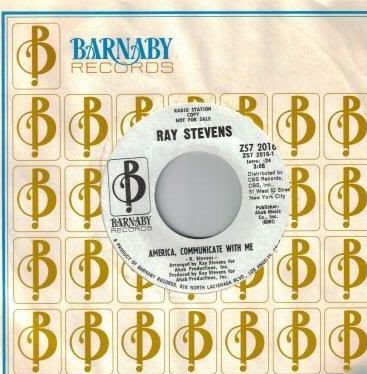
In 1970 there came a song titled "Monkey See, Monkey Do" and it's from his Unreal album. The song itself had nothing to do with the simian but had more to do with social commentary and the slang phrase of people seeing other people behaving or thinking in some fashion and therefore adopting the character traits of others rather than being true to one's own point of view. The song itself adopts that slang phrase and also adds envy to the equation in which members of society, in general, attempt to mimic their peers as far as fashion, physical appearance, and income are concerned. A neighbor has a house with two garages and so that may inspire somebody else to top that and have a house built nearby with a three car garage. A person holds a certain belief but doesn't dare speak their mind for fear of being shunned by society and as a result this person adopts the opinion of "a majority" just to fit in...and at the crux of "Monkey See, Monkey Do" is the painting of society as a zoo as Ray asks us to find a mirror and look at ourselves. It goes hand in hand with the A-side of the single, "Come Around", a marvelous song criticizing excess, hypocrisy, and close mindedness found in some sectors of society. The picture sleeve of that particular single release you see above is from the overseas market. In America the A-side of the single was "America, Communicate with Me".

In 1984 Ray decided to do his version of the theme song of "The Monkees" television series. The song features Ray performing the theme song in a Monkees-like vocal performance at various moments throughout but the obvious highlight are the two greatly exaggerated fictional Austrian performers (Wolfgang and Fritzy) that frequently bicker and argue back and fourth as they attempt to perform their version of the theme song. You can find that hysterical performance on the album, He Thinks He's Ray Stevens.

In November of last year Ray uploaded a music video of "Aba Daba Honeymoon". The music video appeared out of the blue. Ray had recorded the song at some point in 2010/2011 for inclusion on his mammoth box set, The Encyclopedia of Recorded Comedy Music. The music video had been in existence since 2013 according to the video details on YouTube but it had never been uploaded onto the internet until November 2017. The song dates back to 1914 and so it was nearly 100 years old prior to Ray bringing it back when he decided to record it for his 2012 box set. It had been recorded numerous times and there were several pop hits of the song in the 1950s and it's chorus was parodied in a long running series of television commercials for Frito's. The song is incredibly simple if not entirely fictional as far as it's plot goes: a monkey and a chimpanzee fall in love and get married in a ceremony in which a baboon is the preacher. The nonsense phrase of the song's title is explained as monkey talk. The fun of the song is how the tempo of the song gradually moves higher and higher and the lyrics are performed in such a frenzied fashion aided by the use of some scat-singing, too, before the tempo falls back down for it's conclusion. Ray's version is outstanding...musically speaking and the actual vocal performance. The video features a cameo appearance of Ray as Gitarzan near the beginning.


This brings us, chronologically, to the performance from his CabaRay television series of "Too Much Monkey Business". Ray hasn't officially recorded the song but this performance of the song has become a video release on YouTube and that is what I started this blog entry with.

March 18, 2014

Ray Stevens from Cover to Cover...

In a previous blog entry I remarked that a lot of compilation projects on Ray Stevens have been issued in some format or another throughout the latter half of the '60s and running non-stop through the mid '90s. A lot of those compilations were not under Ray's control...once an artist records songs for a label, the label in return takes ownership of those recordings and the distribution rights. It gets even more confusing and complex if a label is bought out or merges with another company or if the label gives distribution rights to a second, third, or fourth party...that sort of thing can create a scenario of multiple record labels issuing compilation albums of the same songs, just in different sequential order, and usually with varying audio quality, too. If I remember it correctly from some things I've read through the years, if the singer happens to be the song's writer or it's publisher then that artist owns the rights of the written 'song' (lyrics and music) but not the actual recording of that song (the recording is owned by the label). Having said that, if a singer is the song's writer but the publisher is someone else then it's said that the writer/artist and the publisher share ownership of the song but the recording is still under control by whatever label the artist recorded it for.

Ray Stevens is one of the pioneers, in my opinion, of savvy music sense. As soon as he as able he began to publish the songs he wrote and he began publishing pretty much every song he happened to record because he learned that the publisher had the most lucrative career. Every so often he'll record songs that aren't tied to his publishing house but those are exceptions to the norm...typically he records songs he's either written, co-written, or have been submitted to him by a core of songwriters that work in his publishing company. He produces his recording sessions from his own recording studio and arranges the music on the songs that he chooses to record and has long been the piano/keyboard/synthesizer extraordinaire of his albums (he'll occasionally play the trumpet, vibraphone, or other instruments but mostly he sticks with instruments in the piano family). On some of his albums (specifically the late '80s/early '90s) he handed over the piano duties to a musician named Gary Prim (if you look at the musician credits you'll see his name) but Ray was still credited for the keyboard and synthesizer contributions of those albums.

This 1992 compilation is exclusively Mercury Records oriented. It features 12 songs that Ray recorded during the years of 1961, 1962, 1963, 1964, and 1983. The catalog number is 838 169-2 and this CD more or less combines 8 recordings found on some earlier compilation releases in 1989 (also on Mercury) and adds in 4 additional recordings he did for Mercury to give the CD a total of 12 tracks. One of the oddities is the inclusion of a couple of early '80s recordings he did for the label. I say they're oddities strictly due to the fact that the 10 other Mercury recordings all come from the early '60s time period and his voice, by 1983, had deepened, mellowed and matured dramatically between the years of 1964 and 1983. For those curious, Ray had recorded three studio albums for RCA (1980, 1981, and 1982) after having signed to the label in the latter half of 1979. In addition to those 3 studio albums, RCA issued a Greatest Hits package on Ray in 1983. Later on that year Ray found himself at Mercury Records of all places...the label that made him a recording star in the early '60s...and he ended up recording one studio album for Mercury in 1983 titled, Me. From that 1983 album comes 2 of the songs on this otherwise exclusively early '60s track list: "My Dad" and "Game Show Love". The timeline for the publicity of the 1983 album got underway late in the year and much of it's publicity peaked sometime in mid 1984. After concluding his one year stay at Mercury he joined MCA almost immediately and by the end of 1984 he had refocused his career into country comedy and from that point forward he's marketed himself almost exclusively as a comedy/novelty act (something he had resisted doing for many years until he could resist no longer). The 12 tracks on that CD are listed below:

1. Ahab the Arab; 1962
2. Furthermore; 1962
3. Funny Man; 1963
4. The Deodorant Song; 1963
5. Harry the Hairy Ape; 1963
6. Just One of Life's Little Tragedies; 1963
7. Speed Ball; 1963
8. Bubble Gum the Bubble Dancer; 1964
9. My Dad; 1983
10. Jeremiah Peabody's Green and Purple Pills; 1961
11. The Rock and Roll Show; 1962
12. Game Show Love; 1983

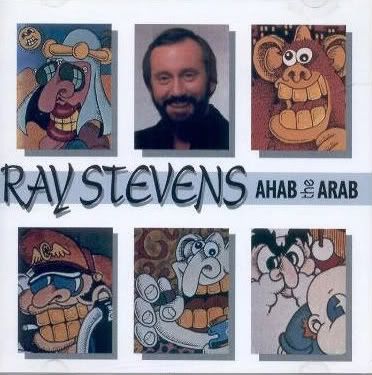
I mentioned earlier that the songs on that 1992 CD had appeared on a compilation release from Mercury in 1989. The label issued 2 separate collections in 1989, each consisting of the same songs and the same image of Ray, but under different titles: One release is titled Funny Man and the other is titled Ahab the Arab. The project happened to be released under the Polygram Records imprint...a subsidiary of Mercury Records...and there are 8 songs altogether. The catalog number for the 1989 pressing titled Ahab the Arab is 838 169-4 (note it's similarity to the 1992 catalog number). The 8 songs on those 1989 collections are:

1. Ahab the Arab
2. Furthermore
3. Funny Man
4. The Deodorant Song
5. Harry the Hairy Ape
6. Just One of Life's Little Tragedies
7. Speed Ball
8. Bubble Gum the Bubble Dancer

As you can see, 1992's CD simply took the 8 songs from the 1989 compilation and tacked on 4 additional songs to give it 12 tracks altogether.

As I've mentioned in other blog entries, a 1970 release called The Best of Ray Stevens on Mercury Records, introduced me to Ray's early '60s recordings. I came across a cassette copy at some point in the early '90s just as I was slowly but surely putting together my Ray Stevens music collection. I then came across this cassette and seen a couple of song titles new to me: "The Deodorant Song" and "Just One of Life's Little Tragedies". I also seen "Furthermore" listed. At the time I was familiar with Ray's 1984 recording and before listening to the 1989 tape I assumed I'd be hearing the 1984 recording...what a jolt to hear the song in it's original, high octane 1962 presentation...completely unlike the bluesy 1984 rendition. I had so much more to learn about Ray's recordings that it's embarrassing to think back on what little I knew!! This is back in the days before the internet became the giant that it is today...long before video hosting sites, Mp3's, social media sites, and on-line stores and auction sites, etc. etc. In those days a person had to rely on looking through flea markets and yard sales and garage sales (in person) in order to find vinyl albums and vinyl singles or visiting book stores (in person) in the hopes of perhaps coming across reference material of some kind. The 1989 compilation titled Funny Man looks exactly the same...and the songs are in the exact order, too...

There's never been a reason given for the separate releases...each has the same catalog number, too...so it's like the same item but under a different title. My guess is Mercury may have released the Funny Man compilation first...to tie it in with Ray's reputation with the general public. Then the label could have re-issued it as Ahab the Arab...to tie it in with Ray's first big hit and potentially create more sales. Then there's the possibility that Mercury/Polygram issued it as Funny Man in certain parts of America and under the alternate title in other parts of America. I've never come across any explanation as to the reason behind the 2 nearly identical projects and so those are only my theories. The 1992 CD I mentioned earlier essentially wiped out the need for either of these 1989 releases but if you have them both they may become of value to some future fan of Ray Stevens. Some might find it baffling as to the reason Mercury issued the same 8 song collection during the same year, using the same image of Ray, the same catalog number, but utilized different titles. They may also be of value to a completest intrigued by the oddity/obscurity of those 1989 Mercury releases.

January 20, 2013

Ray Stevens and the Golden hairy ape...

Reaching the 50 year golden milestone this year happens to be one of rock music's most under-rated fictional stars, a hairy ape named Harry. This carefree ape was introduced to the music world in 1963. His story is told to us in song by the always entertaining Ray Stevens in a recording known as "Harry the Hairy Ape", a novelty recording that hit the Top-20 on both the pop and R&B charts. This 1963 single was Ray's third Top-40 pop hit in America following 1962's "Ahab the Arab" and 1961's "Jeremiah Peabody's Green and Purple Pills" and it was his fourth Top-40 single overall. He had a few other chart singles along the way, "Furthermore", "Funny Man", and the original "Santa Claus Is Watching You", but these great recordings didn't rise into the Top-40 in America. However, "Funny Man" did reach the Top-40 in Canada, going all the way into the upper half of their Top-20.

Historians like to keep chart statistics separate from country to country and from music format to music format, etc. etc. but as a fan I don't do this sort of thing. I combine all of the statistics on Ray's single and album releases both here in America and overseas. By approaching things from that angle I feel it gives a much better representation of Ray's body of work than when one splits hairs and examines which radio format, what geographic locale, or what age group his music is playing to.

"Harry the Hairy Ape" hit in the summer of 1963 and within the song there's a reference to a hurricane fence, a slang term for a common everyday chain link fence. There's also mention of a dance craze called mashed potato. As mentioned, the single hit the Top-20 on both the pop and R&B charts...placing higher on the R&B charts by the way. Like a lot of Ray's earliest novelty recordings this one contains frenetic vocalization which was almost a novelty attraction itself. Also, the song wasn't a fixture at his concerts as time went by so it didn't have the ability to become instantly familiar to the generations of fans to come. It's a bouncy novelty song that also serves as a satirical look at rock and roll music as seen through the eyes of a more conservative America but this revelation isn't made aware until the song's final chorus. My introduction to this song came with the 1987 cassette from Mercury, The Best of Ray Stevens. This particular project had originally been released on vinyl in 1970. That 1987 cassette re-issue is where I heard Ray's early '60s recordings for the very first time. "Harry the Hairy Ape" was originally released on the 1963 vinyl album, This Is Ray Stevens, on Mercury Records. Ray re-recorded the song in 1969 for his Gitarzan album. This re-recording is often placed on the various compilation releases that have been issued since 1971 instead of the 1963 original. Licensing fees, I assume, play a role in why the 1969 re-recording appears more frequently on compilation albums rather than the 1963 original.

October 13, 2012

Ray Stevens: Golden LP Series, Part Two...

Ray's second studio album, 1963's This Is Ray Stevens, features a more even split between the comedy and serious recordings. In the first album there was only one selection that was in the love ballad category but in the second album we have six...count 'em...six ballads and six novelty songs. Ray was no stranger to love ballads, though. In his single-only years, 1957-1961, the bulk of his releases were in the teen-idol love ballad category. When the superb love ballads failed to reach the national music charts Ray turned to novelty/comedy in 1960 with a song about Sgt. Preston of the Yukon, a fictional adventure hero on radio and in films. The single reached a subsidiary of the national Hot 100 chart entitled Bubbling Under the Hot 100, a list of songs that were regionally popular but hadn't broken out nationally yet. When this single became a regional hit and the threat of a lawsuit was announced by the owners of the fictional character, the song was removed from the marketplace. However, it led Ray to the decision that comedy/novelty could be the break he'd been looking for nationally. One thing led to another and during 1961-1962 Ray was able to breakthrough nationally with the music I wrote about in Part One of this particular series. This Is Ray Stevens was perhaps a deliberate attempt to spotlight the love ballad side that had become hidden underneath the comical reputation. As mentioned, of the 12 songs on this album, 6 of them were of the love ballad variety. The album kicks off with "Harry the Hairy Ape", which became the biggest hit single of the collection, and it's a novelty recording. It reached the Top-20 on both the pop and the R&B chart in 1963. The album features Ray sitting in a bathtub during what appears to be rush hour using hand signals to show he's going to make a left turn. A second hit from the album, "Speed Ball", reached the R&B Top-30. A third release, "Funny Man", is an exceptional recording. It's a love song about how a man's reputation for clowning around causes those around him to not take him seriously and as a result he has to pretend to be all smiles and full of cheer under any circumstance. The song became quite a hit in Canada where it reached the Top-20. "Loved and Lost" is one of the shortest songs on the album. It's one of those sing-a-long pop songs that were commonplace in that era. It carries an inspirational undertone as it offers advice on romance. "Teen Years", musically, sounds as if it comes straight from a high school prom but it's a nostalgic look at the events that take place during a typical person's teenage years leading into adulthood. "It's Been So Long", another of the six love ballads, tackles separation. "Just One of Life's Little Tragedies" and "Little Stone Statue" are the remaining two love ballads on the collection. On the comical side, in addition to "Harry the Hairy Ape" and "Speed Ball", we have several demented and truly unique forms of comedy. "Soap Opera" takes the cake when it comes to insanity on vinyl. In this performance Ray shows just why he's a master at recorded comedy music. We hear Ray spoof a soap opera, Ma Perkins in particular, and not only does Ray portray the role of the narrator but he also portrays the 'son' and the 'mother' who appear to have quite a dilemma on their hands in the lumber yard...made wildly hilarious by Ray's vocalizations as the slobbering, shrieking, melodramatic 'mother' as the stereotypical soap opera organ plays away in the background. "The Great Sebastian" takes place at the circus...and it's a brief tale of a tight rope walker...ending with a clever line about show business. "The Deodorant Song" is about what you think it's about while "The Weekend" features Ray spoofing topics found in country songs...delivering the song in a country music vocalization. It's a good natured parody of a genre that would become extremely important to Ray by the middle of the following decade.

Coming up next in this series is Ray's third studio album, Even Stevens, from 1968.   

October 31, 2011

Revisiting Ray Stevens, Part 14...

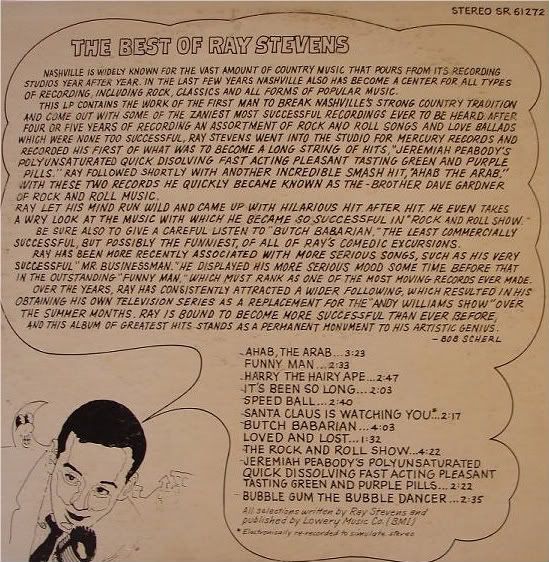
Halloween day...October 31, 2011...I posted a Halloween themed blog a couple of days ago where I spotlighted some of the songs Ray recorded with a Halloween overtone. Search the archives on the right side of the screen for the blog titled The Entertaining Ray Stevens, Part 2. In this particular blog entry I decided to post the other side of The Best of Ray Stevens, a compilation that Mercury Records issued on Ray Stevens in 1970. This release features material Ray recorded during the years of 1961 through 1963. It's a combination of album songs and single releases. The collection is notable for a very rare recording of "Ahab the Arab" from some point in the early '60s. I do not know, even to this day, when this performance was recorded. The recording is made more rare by the fact that country music personality, Ralph Emery, is heard at the beginning introducing Ray to a small audience. My guess is this is an audio taken from a television program...I know Ralph hosted a pop music program at one time in the mid '60s and perhaps that's where this audio comes from!? Wherever it comes from it's an obscure recording. Purists are dismissive of the recording and complain that it doesn't belong on a collection like this but I have a differing opinion on the matter.

The liner notes, as you see here, were written by someone named Bob Scherl. Since the collection was released in 1970 the liner notes slip in references to some of the songs Ray recorded in the late '60s (which aren't part of this collection). Tracks 6, 7 and 11 were originally released as commercial singles exclusively and weren't part of his 1962 or 1963 albums for Mercury, which is where 7 of the songs on this 1970 compilation comes from.

The songs on the collection were all written by Ray Stevens:

1. Ahab the Arab
2. Funny Man; 1963
3. Harry the Hairy Ape; 1963
4. It's Been So Long; 1963
5. Speed Ball; 1963
6. Santa Claus Is Watching You; 1962
7. Butch Babarian; 1963
8. Loved and Lost; 1963
9. The Rock and Roll Show; 1962
10. Jeremiah Peabody's Green and Purple Pills; 1961
11. Bubble Gum the Bubble Dancer; 1964

Ray's 1962 album for Mercury is titled 1,837 Seconds of Humor. Tracks 9 and 10 in the above collection are from that album. His 1963 album for Mercury was titled This Is Ray Stevens...tracks 2 through 5 and track 8 are from that album. Track 1 was previously unreleased while tracks 6, 7 and 11 were issued as single-only releases. Some of Ray's singles featured b-sides that have not yet appeared on any commercially released album. His version of "When You Wish Upon a Star" is the original b-side of "Scratch My Back" from 1962. The b-side has never made it to any LP or CD in the last 49 years. "Scratch My Back" never made it to the Hot 100 but was released as a follow-up to "Jeremiah Peabody's Green and Purple Pills".

"Don't Say Anything" is the b-side of 1963's "Butch Babarian". "It's Party Time" is the b-side of 1963's "Speed Ball". A song that I commented about several blogs ago, "Laughing Over My Grave", is the b-side of 1964's "Bubble Gum the Bubble Dancer". A couple of other singles, both the A and B side, that Ray recorded for Mercury have never been available since their original release: 1965's "Rockin' Teenage Mummies" and it's b-side "It Only Hurts When I Laugh" as well as "Mr. Baker the Undertaker" and it's b-side "The Old English Surfer". The releases in 1964 and 1965 came after he had signed with Monument Records. The recordings took place at some point in the early '60s when he was still with Mercury.

August 23, 2010

Ray Stevens: Nostalgia Valley, Part 12...

In the 12th installment of the nostalgia valley we begin by taking a look at the early '60s material from Ray Stevens on this 1995 CD. The picture of Ray that the CD manufacturer used is obviously deceptive. This picture of Ray is from the early '80s but the material on the CD is from the early '60s. The illustrations that you see were lifted from Mercury's 1970 release, The Best of Ray Stevens. I don't have this particular CD so I can't say if the version of "Ahab the Arab" featured on here is the studio recording from 1962, the radio edited version cutting out the final verse, or the live recording from the mid '60s with an introduction from Ralph Emery. The live recording with the Ralph Emery introduction is on The Best of Ray Stevens from 1970. There isn't any new ground being covered on this CD that wasn't already covered on The Best of Ray Stevens or 1989's eight song compilation, Funny Man. The idea I guess was to keep Ray's earliest works for Mercury in print. There are at least eight recordings that Ray did for Mercury in the '60s that have never saw the light of day on commercial CD yet: 1961's "When You Wish Upon a Star", 1963's "It's Party Time", 1963's "Don't Say Anything", 1964's "Laughing Over My Grave", 1965's "Rockin' Teenage Mummies", "It Only Hurts When I Love", "Mr. Baker the Undertaker", and "The Old English Surfer". There's also no telling how many songs Ray recorded for Mercury that have never even been issued at all. It's common practice for all singers to perform a lot of songs during recording sessions...and then some are cut from album consideration and are put away "in the vaults" as the saying goes.

I came across a couple message boards/blogs late last week proclaiming that Ray Stevens "used to be a liberal". One of the people making this accusation cited this song, "America, Communicate With Me", as proof. "Everything is Beautiful" and "Mr. Businessman" are also brought up by those attempting to make comparisons between vintage Ray Stevens and contemporary Ray Stevens. In my opinion Ray was never a liberal...and certainly wasn't a progressive...but I feel that those political oriented songs he recorded in the past are rooted in middle of the road and Independent rationale...which is pretty much the same stance of contemporary Ray Stevens. A lot of the lyrics in "America, Communicate With Me" clearly show Ray's frustration with both political parties and the useless violence and rioting that was going on. Rioting, mind you, that for the most part was carried out by the liberal youth of the '60s and early '70s. I think some people need to re-listen to this song a few more times before proclaiming that Ray "used to be a liberal". This song attempts to make sense of a chaotic world circa 1970...in no way, shape, or form is it a rallying cry for any political group.

Now, in a lot of the newspaper and magazine articles and interviews did on Ray Stevens during that early '70s time period it reveals Ray highly in tune with the social scene and the hot topics of the day. This doesn't necessarily translate into Ray being a liberal, though. I've never seen an interview where Ray explicitly stated that he's 100% in favor of any political party. In some of his interviews he speaks about the relationships between music and people and the communication aspects that artists attempt to convey through whatever it is that they do: sing, talk, act, etc etc. The interviews he gave in the early '70s, for example, indicate a restless musician constantly on the search for something to share with the public. This is something that continues to be a character trait with the contemporary Ray Stevens...the enthusiasm and excitement of performing new material for the audience which was evident in the '70s is still evident today.

You can see performances of Ray Stevens from the '70s in a couple of DVD's spotlighting the series, Pop! Goes the Country. I mentioned these DVD's back in March and I hope some of you have gone ahead and purchased them for yourselves. Ray appears on the following DVD's: Volume Four, Volume Nine, Volume Fifteen, and Volume Seventeen. You can see the entire 20 Volume collection here: Classic Country DVD. I don't have Volume Nine yet...it features the 1977 episode where Ray performs "Honky Tonk Waltz", "Get Crazy With Me", and a bit of "Feel the Music". Ralph Emery is the host of all the episodes from Volume One through Volume Fifteen and Volume Twenty. Tom T Hall hosts the episodes featured in Volume Sixteen through Volume Nineteen. Speaking of Ralph Emery...he'll be inducted into the National Radio Hall of Fame this coming fall.