Showing posts with label sunday morning coming down. Show all posts

August 18, 2019

Ray Stevens: The Road to the Country Music Hall of Fame, Part Four...

Welcome to Part Four of this blog mini-series as I spotlight Ray Stevens' Road to the Country Music Hall of Fame. The year is 1968 and Monument releases their fifth single on Ray in January...a unique offering titled "Unwind". This single credits both Fred Foster as well as Ray Stevens as producers...Ray also wrote both sides of the single. By unique offering I'm referring to the blending of tempo heard throughout the performance. The recording starts off with Ray in frenetic mode detailing all of the things he's got to do throughout the course of the working day and then as his descriptions near the hour of 5pm his vocalization has decreased in tempo to where he sings about winding down once he arrives home and the vocalization has long since shifted from frenetic to mellow but then, following a brief vocal break as the instrumentation plays, the tempo begins to pick back up and the frenetic vocalization resurfaces as the new workday is underway...and the routine plays itself out...but, once more, Ray winds down his vocalization as it draws closer to the end of the workday at 5pm. In the career time-line of Ray Stevens "Unwind" is typically the single that bridges the gap between the various phases of his career. By this I mean it's a single that frequently shown up on various greatest hits and best-of albums released on Ray Stevens even though it wasn't as widely known as his follow-up single...but if you base a 'hit' as a single that makes an appearance on a popularity chart then "Unwind" certainly qualifies. In part three I mentioned how "Freddie Feelgood" (from 1966) returned Ray to the national Hot 100 pop chart for the first time in three years...that single also appeared on the pop singles chart in Australia. "Unwind" reached midway up the Hot 100 here in America in early 1968 and in Canada it reached their pop music chart, too, peaking the Top-30. The B-side of "Unwind" is a devastating ballad titled "For He's a Jolly Good Fellow". Monument followed up this hit single with a song from Ray dripping in social commentary...a pointed look at the corporate elitists...a song partially inspired by a business deal gone bad involving Ray.

It's often been reported about by historians, journalists, and mentioned by Ray in interviews that early in his career he was taken advantage of, briefly, by opportunists that mishandled his money through unwise investments and when he decided to take a look at his earnings he seen how lousy those in charge of his finances happened to be. As a result of the mishandling of his finances and a general negative feeling overall he came up with "Mr. Businessman"...a single that burst onto the music landscape in the summer of 1968. Production by Ray and Fred Foster this self-penned vocal outrage dealing with corporate America's amoral attitudes, misplaced priorities, and the bottom line was a startling contrast to the bluesy love ballads, easy-listening renderings, and novelty songs he'd long been noted for. The single features single note piano key strikes at the beginning of the song...as the tempo rises the key strikes get more stinging and more keys are added into the performance...as more and more instrumentation is added into the performance the piano blends into the background. It's a great hook and in concert whenever Ray starts to play those familiar piano strikes there's an obvious enjoyment that flows from the audience. Commercially "Mr. Businessman" was a very big hit...it reached the Top-30 on the Hot 100 and, ironically enough, the single had even more impact in Canada where it hit the Top-10. Perhaps it's not an irony...I'd say that the subject matter Ray sings about in the song is almost universal...there's good and bad businessmen and businesswomen all over the world.

The success of "Mr. Businessman" ultimately spawned the release of a vinyl album. In those days record companies often preferred to release singles...and if an artist had accumulated a series of hit singles then the record company would issue an album featuring those single releases, their B-sides, and several other recordings to fill out the collection of songs. This means that a lot of vinyl albums of this era were usually filled with one or two recordings that had been released as singles...and most of the time the album was named for one of those hit singles...while the rest of the album contained songs that were not commercially driven and sometimes an album would contain whatever the artist or producer felt like placing there...knowing full well that albums were purchased by the most loyal of consumers while a single was designed to cater to a general audience. In country music the record companies would release a vinyl album named for the hit single but then the remainder of the album wouldn't be explored by the record label for future single releases. There are a lot of country albums of this era with 10 or 11 songs but only one of those would be the single release...to say the album was looked upon with contempt is putting it mildly. Anyway...Monument Records issued their first studio album on Ray titled Even Stevens in the fall of 1968 on the heels of "Mr. Businessman". The album was produced by Fred Foster and Ray Stevens. It features 10 recordings in which Ray was the songwriter on 8 songs, a co-writer of one, while a tenth song was written by another writer. Ray also arranged every song on the album except two of them.


I created that collage a couple of years ago...or it could have been last year...anyway it's me attempting a similar pose from Ray Stevens as he appears on the Even Stevens album of 1968. The back of the album shows Ray seated in front of a music stand. The album comes with liner notes authored by Tupper Saussy. By the way Tupper is the one responsible for the only song on the album that Ray never had a hand in writing or arranging: "The Earl of Stilton Square". Tupper wrote and arranged the song. One of the television shows from this era, Get Smart, had a popular catchphrase...well, the show had several, but to borrow just one of those phrases... 'would you believe??' that Even Stevens never made an appearance on the Billboard 200 album chart!! If that wasn't ironic enough...Ray himself became a businessman but this was out of necessity given how little faith he had in someone else looking after his finances. He was once quoted as saying that nobody's going to look after you but you and so he reluctantly had to become more involved in the business side of the music industry. He eventually hired a manager, though, by the name of Don Williams...not to be confused with the country singer of the same name.

In the meantime the B-side of "Mr. Businessman", for those curious, is the album's seventh song, "Face the Music". Ray wrote the B-side but the music arranging is credited to Louis Nunley. Monument released "The Great Escape" as a single in the fall of 1968 backed with a phenomenal ballad called "Isn't It Lonely Together?". The A-side followed the social commentary vein and it charted on Canada's version of America's Hot 100...but in America the single Bubbled Under the Hot 100. A third figure emerged prominently in Ray's career during the making of Even Stevens and that figure happened to be Jim Malloy. He's credited as the production assistant to Fred and Ray on the 1968 album in addition to being the engineer's assistant. The engineer of the album was Charlie Tallent. The album itself was recorded at Bradley's Barn (a studio owned by legendary music producer Owen Bradley). In early 1969 Monument released a single on Ray that, according to Ray's interviews and his recollections in a memoir, that Fred Foster was completely against.

The single in question had the unusual name of "Gitarzan"...a word that Ray credits to Bill Justis, which as you can see, combines guitar with Tarzan. A title like that led Ray into creating a story about Tarzan, Jane, and their chimp forming a rock and roll jungle band. Ray also credited the rhyming dictionary in guiding him, line by line, in the song's construction. The song is filled with internal rhymes and end rhymes as well as pseudo-rhymes where sound-a-like words follow each other even though they're not identical rhymes. According to Ray's recollections Fred told him that if this song became a hit then Ray would have complete creative control on his next project. "Gitarzan" became a gigantic hit...in America and internationally...and throughout the first half of 1969 the massive popularity of the novelty song eventually brought certifications of a Gold record by the RIAA. In those days a gold record was indicative of sales of over a million copies. The single hit the Top-10 on the Hot 100, the Top-10 in Canada, the Top-10 in Australia, and the Top-10 in New Zealand. It made the charts in other international markets, too, but I decided to limit it to three additional countries for this blog entry. As you can see in the credits the producers are Ray, Fred Foster, and Jim Malloy. In addition to being a co-producer Jim returned as engineer assistant as he had been during the previous album from Ray in 1968. Songwriting credits go to Ray and Bill Justis...credited under his birth name of Bill Everette. The song's B-side, "Bagpipes-That's My Bag", was written by Ray and produced by both Ray and Fred Foster. For whatever reason Jim Malloy isn't credited...but obviously this is more or less due to his not being a part of the B-side's production. Monument issued their second album on Ray, Gitarzan, in the late spring/early summer of 1969. The album features liner notes from talk show host, Merv Griffin. Upon the release of the album from Monument Records they issued a new single...Ray's version of "Along Came Jones"...and while it didn't hit the Top-10 or sell millions of copies it nevertheless reached the Top-30 on the Hot 100 in America and the Top-30 in Canada in addition to it charting in Australia's Top-20. The original recording of the song had been a hit 10 years earlier by one of Ray's influences, The Coasters. The B-side of "Along Came Jones" happened to be another cover of a Coasters hit, "Yakety Yak". There are those that have often remarked that Ray's version of "Along Came Jones" is the funniest...and a lot of it has to do with the additional material that Ray brought to the song. The original from The Coasters lacks the falsetto cries of Sweet Sue as she's being tortured by Salty Sam...and the original also lacks the sinister laugh from the villain. Those are things that Ray brought to the song. The back to back novelty hits and the album itself labeled Ray a novelty singer...even though some may never have recognized him as being anything but a novelty singer in spite of the recorded evidence proving otherwise...some think "Mr. Businessman" is a funny song. Go figure!

In addition to all of this well deserved and long overdue success Ray had been enjoying lately he became acquainted with pop entertainer Andy Williams by the latter half of 1969. Earlier I mentioned that Ray hired a manager named Don Williams...well, he happens to be one of Andy's brothers...but I don't know what came first off the top of my head. I don't know if Ray and Andy got acquainted first and it led to Don becoming Ray's manager or if Ray hired Don as a manger before becoming a business associate of Andy's. Whatever came first Andy Williams began to have some influence in Ray's career around this point in time...and perhaps not a coincidence Ray began making infrequent appearances on Andy's television series. When "Gitarzan" became a massive hit earlier in the year Fred Foster, as mentioned earlier, made Ray a friendly bet that if it became a hit then on the next project Ray would be given complete creative control over. Fred lost the unofficial bet and so Ray and co-producer Jim Malloy set out to work on his next project for Monument Records...and it was a beauty of an album...which I'll go into more detail about in Part Five of this mini-blog series!!

July 1, 2018

Ray Stevens: Compilation Look-Back...

Earlier in my blog posts I posted some entries surrounding the abundance of compilation albums you can find on-line released on Ray Stevens. Those releases are largely available on vinyl but there's a lot of them available on cassette and CD, too. Some of the compilations that I've posted about are ones I have in my own collection or they're collections I found while visiting on-line music stores and I saved their images for future blog entries. I've posted quite a few blog entries surrounding a certain 1979 compilation album that I do not have in my collection but I happen to like the cover art and obviously the songs found on that album are a must-have for any newcomer to Ray's career. The album often comes up for sale on eBay...and some of you may wonder if the album often comes up for sale then why haven't I purchased it by now?? One of the main reasons is the price is not reasonable (for me) and most, if not all, offerings are from the United Kingdom and the most recent offering is asking almost thirty dollars for it (which doesn't factor in international shipping, handling, and taxes). If I ever come across this compilation album on-line for a much more economical selling price I may at long last make a purchase...but for now I love the album from a distance...

The Best of Ray Stevens, as this one is titled, was released in 1979 on the Imperial House label in the United Kingdom. It's a 2-LP collection of 20 songs. The obvious recordings are here: "Ahab the Arab", "Mr. Businessman", "The Streak", "Everything is Beautiful", "Gitarzan", "Along Came Jones", "Misty", "The Moonlight Special", "Turn Your Radio On", "Bridget the Midget The Queen of the Blues", and 10 more. I wouldn't begin to guess how many compilation albums released on Ray Stevens have been given this title. The Best of Ray Stevens and another often used title, The Very Best of Ray Stevens, have long sent confusion for a number of fans because you can't necessarily refer to a compilation as The Best of Ray Stevens because the most loyalist of fans will wonder if you're referring to this 1979 release or perhaps the 1970 release by Mercury Records or maybe an import album from another part of the world or perhaps a compilation imported to America from Canada. The most often used compilation title is by far Greatest Hits. I grin as I type this because of the sheer number of Ray Stevens compilation albums that have been titled Greatest Hits over the decades. A lot of these compilation albums are the result of mass production of easily licensed recordings. A majority of Ray's Monument and Barnaby recordings fell into that category. By this I mean the recordings weren't too expensive and a lot of compilations on Ray Stevens began to surface in the late 1970s, and especially throughout the 1980s and into the 1990s, as an assortment of record companies began to offer many compilation albums on Ray that often featured the same set of songs but in different sequential order depending on which album you purchased.

Some compilation albums would tack on a couple new selections just to keep things a bit different but by and large the 20 songs found on this 1979 album would make numerous appearances throughout the next decade on many of those compilation albums. Ray didn't have a say in those releases, either. To my way of thinking, and it's based on snippets of interviews I'd heard and read from Ray, the only greatest hits releases that he actively took part in and was truly aware of their existence were: Greatest Hits (1971; Barnaby); Greatest Hits (1974; Barnaby); The Very Best of Ray Stevens (1975; Barnaby); Greatest Hits (1983; RCA); Greatest Hits, Greatest Hits Volume Two, and Get The Best of Ray Stevens (all in 1987 on MCA); His All-Time Greatest Comic Hits (1990; Curb); and Greatest Hits (1991; Curb). In fact, the 1991 compilation on Curb Records features an alternate version of "There's a Star Spangled Banner", a song that originally appeared on his 1989 MCA album, Beside Myself. In the 1989 recording Ray tells the story of a P.O.W. in Beirut in addition to celebrating the American Flag itself. In the 1991 alternate recording it retains the same chorus and music arrangement but the verse lyrics are completely different. If you're not a devoted fan or student of all things Ray Stevens then you wouldn't be aware of the two completely different versions of the song. You'd think by looking at the track list that it's merely the same recording previously released on Beside Myself. Way back when I purchased 1991's Greatest Hits, believe me, I was also surprised to hear this different take on the song. By the way, you can click on each of the images of the LP for a larger view. As I mentioned I do not own that 1979 compilation album but it's safe to say the versions of "Ahab the Arab" and "Harry the Hairy Ape" come from his 1969 Monument album, Gitarzan, instead of the original recordings on Mercury in 1962 and 1963 respectively. The inspiration for this particular compilation album seems to be the recording that the record label tacked on as the last song on side two of the second LP. "I Need Your Help, Barry Manilow" was a hit for Ray on Warner Brothers in 1979 and so this song was added to the more familiar line-up of recordings. The songs found on the LP range from the years 1968 to 1975 and then it jumps to 1979...curiously omitting the hit recordings he had during 1976-1978...which only added to the obscurity in the next decade of his Warner Brothers recordings as they weren't kept in print.

In 1995 Warner Brothers seemingly out of the blue issued a 3-CD/3-cassette collection of many of his recordings for the label in the late 1970s. As a member of Ray's once active fan club and in the years before the internet explosion came along I used to type letters and mail them to Ray's fan club seeking information about whatever happened to be on my mind at the time and when I spotted those Warner Brothers compilations I sent off a letter telling of the Ray Stevens goldmine of music I found and how rare these songs happened to be (I'm sure they also realized how rare his Warner Brothers recordings were and still are and probably knew of the compilations beforehand); but, anyway, in the next fan club newsletter that arrived in the mail I was given some recognition by Ray's office staff in a brief section where they thanked me for letting them know that some of Ray's out of print and obscure recordings were available for purchase once again.

I bought those 3 compilation albums released by Warner Brothers with some of the high school graduation money I got...they're titled: Cornball, Do You Wanna Dance?, and The Serious Side of Ray Stevens.

October 19, 2014

Ray Stevens Gospel Collection, Part 6...

Hello Ray Stevens fans!! It's 6am on a Sunday morning as I begin this latest fan-created blog entry. I started the day doing a search on social media sites of any articles pertaining to Ray Stevens. I came across a link to a site named Hallels.com and there's a new publicity piece for Volume One of the Ray Stevens Gospel Collection.

If that site's name sounds familiar you must have a sharp memory. The site featured a much earlier promo piece (posted August 8th) for the gospel collection CD. The August 8th promo and the one posted today are by the same author. I posted a link to the earlier article back in August.

You can see the latest promo piece for the gospel collection HERE.

Once there be on the lookout for a link to that August 8th publicity article. It can be found at the end of the article before you get to the comments area. The August posting contains a track list for the CD, too. The CD's been available since August 19th and it can be purchased HERE. If you purchase digital music/Mp3's there's a link to the Mp3 format on the CD's product page.

YouTube corner...the two concurrent music videos from Ray Stevens have the following unique views as of 6:42am Eastern time...

1. If You Like Your Plan: 30,572 (uploaded September 22, 2014; view HERE).

2. Nero Fiddled: 14,702 (uploaded October 10, 2014; view HERE).

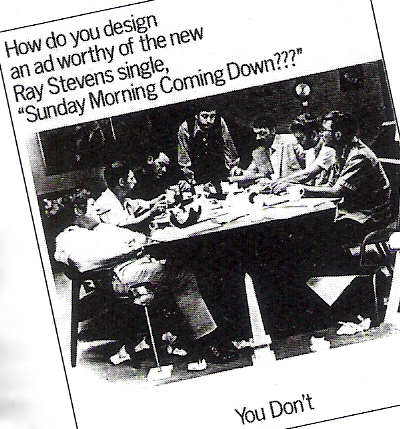
And so...after searching several social media sites and Google for Ray Stevens happenings, I did an eBay search...and on page 1 at the moment there's an item being offered of a rare magazine publicity ad. The promo ad originated 45 years ago...right around this time of the year...back in 1969. No, no...for those that might be thinking "Gitarzan", it isn't the promo ad for that single (that hit came earlier in 1969). In the latter part of 1969 Ray had returned to his more serious side again and Monument Records began publicizing the latest single release, "Sunday Mornin' Comin' Down". The eBay listing for the magazine promo ad for that single can be seen HERE. There have been thumbnail images of this ad that have surfaced in several CD compilation projects over the years.

I used to think Ray had a beard in that photo whenever I'd see the small, thumbnail replica. The reason being is the copy of the photo that appears in the fold-out cover of a 1998 compilation CD is so small and the lighting on the picture not so great that, to my eyes, it looked as if he had a beard. I've long since seen a bigger image of the promo ad and seen for myself he's clean shaven. Those interested in seeing/purchasing the promo ad can click the above link.

March 24, 2011

Let's Discuss Ray Stevens, Part 29...

From 1969 this has got to be one of the earliest pictures of Ray Stevens with a beard. Here we see him looking hopeless standing in front of a conference table...playing out the part of one who's struggling to figure out how to promote "Sunday Morning Coming Down". Note the image of the Monument on the floor below the table...of course this was released on the Monument label...and this was the first commercial recording of "Sunday Morning Coming Down". Ray entered the country charts for the first time with this single and it also reached the pop Hot 100...but the same song became a #1 hit for Johnny Cash later on. The reason for this is simply due to the image factor...Ray had a much more clean-cut image whereas Johnny Cash didn't. Listeners could picture Johnny Cash going through a hang-over. This is one of the few songs that seem fit to be a success for just a certain style of singer...if a singer's image doesn't match the lyrics nearly word for word then it'll be a tough sell!

Yesterday marked the 1 year anniversary of a dark day in America...it was on March 23, 2010 that Obamacare became law. In the months leading up to it Ray gave the world "We The People", a song and music video warning Congress if they voted for Obamacare that they'd pay for it at the ballot box in November. The music video's gotten 4.2 million unique views since December 2009...and upon the bill becoming law in March 2010, Ray issued the music video, "Throw the Bums Out!", and it's gotten 689,167 unique views in a year's time. Meanwhile, his current TSA music video, "The Skies Just Ain't Friendly Anymore", has gotten 118,237 unique views! "Come to the USA", issued in May 2010, surpassed 5 million views a couple of days ago and now stands at 5,020,222 (an increase of over 20,000 views!).

September 5, 2010

Let's Discuss Ray Stevens, Part Seven...

This particular compilation album was released in 1984 and it showcased 11 songs from Ray Stevens. The emphasis was on the non-comedy songs as of the 11 featured, 7 were serious. This collection was one of many compilation albums issued on Ray Stevens...something I've written about before. The material that Ray recorded, especially for Monument and Barnaby, became widely distributed by a whole host of record labels throughout the late 1970's but specifically throughout the 1980's and into the early 1990's. The many compilations that seemed to be routine slowly came to a halt by the mid '90s. Ever since the late '90s and into the 2000's there hadn't been as many compilations released on Ray Stevens. A lot of it has to do with changes in the marketing of music where you don't have hardly any Independent labels anymore specializing in vintage material and you rarely, if ever, see labels attempt to make a quick buck from their current roster of artists or former roster members. Artists today have much more control over their music...remember, this is an era where a singer can sue their record company if the company releases material against the singer's wishes. Even though, technically, the music an artist records for a label is owned by that label. Years ago that kind of thing where an artist takes their label to court was unheard of...it may have gone on in private but with the invention of the internet and all sorts of other cyber-media resources it's almost impossible to keep anything private anymore particularly when you have people who seem to specialize in leaking controversial elements of any story to the media.

This 1984 compilation as you can see features 11 songs...you can always click the images for a bigger picture. The material is taken from the 1968-1975 era. The abundance of Ray Stevens compilations truly shows just how popular he is...you wouldn't have so many labels putting out Ray Stevens material if it wasn't profitable. Today, though, the lack of compilations isn't a reflection on his popularity score...as I mentioned it's just a sign of the times. The four comedy songs found on this compilation are "Ahab the Arab", "Along Came Jones", "Bridget the Midget", and "The Streak".

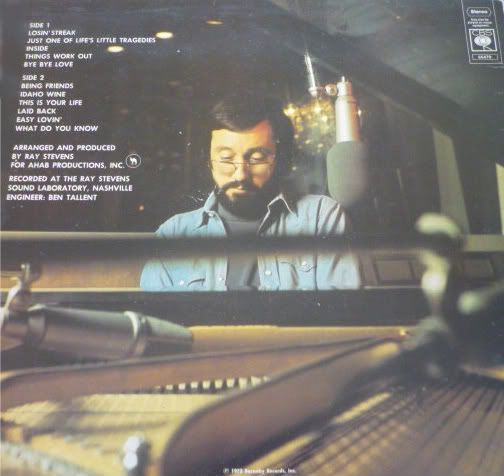
Losin' Streak was one of two albums released by Ray Stevens in 1973. The other album, Nashville, is the one that was more commercially successful by comparison. Losin' Streak features 11 songs as well...all of the songs are non-comical. One of the recordings, "Laid Back", is an instrumental. Ray included an instrumental on Nashville as well...on that album "Float" is the instrumental. On Losin' Streak we get to hear Ray do some studio experimentation with microphone techniques and overall sound quality...according to reports I've read this was his first album recorded at his own studio which had the name of The Ray Stevens Sound Laboratory. His voice is crisp and clear...and he belts out a lot of songs on this particular collection. "This Is Your Life" demonstrates the experimental efforts during the post-production. "Bye Bye Love" is his take on the bouncy Everly Brothers pop hit...and in Ray's hands the song is transformed from a bouncy sing-a-long to a melancholy ballad.

"Inside" is a motivational song and one of my favorites...and then there's the clever "Idaho Wine" which tells the story of a mismatched couple. Ray offers another cover song, "Easy Loving", which was a gigantic hit for Freddie Hart in 1971. Hart had also written the song. The title track, "Losin' Streak", is a song about a man with a gambling problem and how it interferes with his personal life. It's a song with some rather unusual phrasing that's for sure...it was written by a writer by the name of Nick Van Maarth. It's on this album that Ray does a wonderful re-recording of an earlier song he wrote and recorded while at Mercury, "Just One of Life's Little Tragedies". A few words about "What Do You Know?"...I've never known of any songs that seriously examine the inner psyche or ponder the human mind's abilities and weaknesses as this song does. It's a song that comes off as if it was written by Sigmund Freud. Losin' Streak remains the only album that Ray recorded for Barnaby Records to not get a re-issue of some kind. Several years ago all of Ray's studio albums on Barnaby got re-issued except this one...and it continues to remain a mystery as to why this album is overlooked and hasn't had a proper re-issue yet.