35 years ago...March 1979...to be specific the week of March 24, 1979...Ray Stevens entered the Hot 100 pop chart with a brand new recording, "I Need Your Help, Barry Manilow". The song, written by Dale Gonyea, can be seen as a parody, a satire, a spoof, or some may take it as a tribute...nevertheless, it became a 'surprise hit' to a lot of people in the spring and summer of 1979. I first heard this song on 1987's Greatest Hits, Volume Two on MCA Records. That particular release is the one that features Ray as the baseball player on the album's cover. I immediately loved the song upon hearing it...entirely clueless as to who Barry Manilow happened to be. Raised on country music I never became familiar with Barry's actual recordings until the early/mid 1990s when I started to purchase some of the CD's that I came across at the local store. I had wanted to hear for myself the singer that Ray sang about. Once I heard "I Write the Songs" and seen a lot of the titles of songs on several of Barry's Greatest Hits collections I started loving "I Need Your Help, Barry Manilow" even more than I already did. The thing that attracted me to the song, aside from it being RAY STEVENS of course, is the arrangement/music structure. I loved that sound so much that I actually became something of a fan of Barry's thanks largely to Ray's 1979 hit song...which perhaps wasn't originally meant to have such a positive effect and have the potential to create fans for Barry...but, yet, in my case that's exactly what happened. Later on, once I heard "Copacabana", I found out who Lola happened to be...Ray mentions that name in his 1979 hit. As you can see, the marketing department at Warner Brothers really got into the promotion and publicity of this single...designing the picture sleeve of Ray's single to look identical to Barry's second studio LP.
The similarities didn't stop there...Ray's 1979 album The Feeling's Not Right Again is pretty much identical in design/cover art of Barry's 1975 album of a similar title, Trying To Get the Feeling. The ironic thing is, excluding the "I Need Your Help, Barry Manilow" hit single, the rest of Ray's 1979 album is a Best-of collection. The remainder of the LP is filled out with selected album songs, and a couple of single releases, lifted from three of Ray's previous four studio LP's for Warner Brothers (from the years 1976, 1977, and 1978). "Get Crazy with Me" is track 2 on the 1979 album. It originally was issued as a single in 1977, from the Feel the Music album...and by the way, "Feel the Music" is found on this 1979 album, too. The title track of one of his 1978 albums, "Be Your Own Best Friend", closes out the 10 song LP. It had been issued as a single in 1978 and reached the Top-20 on Canada's country music chart and the Top-40 country chart here in America. In fact, of the 10 songs on the 1979 album, 5 of them come from his 1978 Be Your Own Best Friend album. 2 songs come from the 1976 Just For the Record album ("OM" and "Gimme a Smile").
So, if we break it down, here's what we have: two songs from 1976, two songs from 1977, five songs from 1978, and the lead-off 1979 release, "I Need Your Help, Barry Manilow".
The catalog number for the single is WBS-8785. It's b-side, the Ray Stevens-penned "Daydream Romance", comes from 1977's Feel the Music album. On some releases the label credits 1979 on both sides of the single...especially on the larger 33 1/3 single release and the UK export. The 45-RPM single released in America accurately credits the A-side as 1979 and the B-side as 1977.
There are several nostalgic items from 1979 centered around this particular single. One of the items is a 1979 issue of Country Song Roundup that features an interview with Ray for an article called Help Me, Ray Stevens. I prefer that article...I have that issue in my collection...I purchased it on eBay in early 2000s. There also happens to be another 1979 article about the single in the pages of People magazine (a May 1979 issue). The story can be seen on-line but it contains a couple of factual errors (proclaiming his 1975 single, "Misty", to be his last hit prior to 1979's Manilow parody; another error is the intimation that his career had ceased to exist during that 4 year period between songs).
The truth is, Ray's career and song releases had simply moved over to country radio and into country music-oriented programming...he didn't "vanish" and his career certainly didn't cease to exist. It continued to thrive as the '70s continued on.
The song debuted on the Hot 100 pop chart on March 24, 1979 and made it's way into the Top-50 during an 8 week run. Music industry politics, no doubt, played a factor in the single not going higher than it did on the Hot 100. A week later, on March 31, 1979, the single debuted on the Adult-Contemporary chart. It's on this particular chart and radio format that the single achieved it's greatest success (reaching the Top-15 during a healthy 13 week chart run). This is something of an irony if you consider that in 1979 Barry Manilow was certainly the king, or at least one of the kings, of soft-rock and the master of the power ballad...and here was a song that had fun with that very sound...and so, as mentioned at the start of this blog entry, some may have taken this as a tribute of sorts to Barry (rather than see it as a parody).
For whatever reason, Warner Brothers decided to issue the song to country radio, too. A song about a megastar in pop/Adult-Contemporary music gets released to a radio format that doesn't even play that artist. It doesn't make much business sense but nevertheless it happened. The single, unbelievably, made the country charts in April 1979 largely, I assume, on the strength of sales and the publicity it generated on country music programs that Ray appeared on. It had a brief 3 week stay on the country music chart that month (it peaked in the much lower half of the then 100 position country single chart). It debuted on the April 14, 1979 chart and was in it's third and final week on the April 28th chart. The only time I've seen Ray perform the song is on a 1979 television special called Nashville Salutes America. It was released on DVD in 2005. Jerry Reed hosted the special and a lot of artists appeared on it performing their latest or their biggest hits...and Ray performed "Freddie Feelgood" and then spoke about his then-current single titled "I Need Your Help, Barry Manilow" before launching into it. Laughter greeted the narrative part of the song where Ray lists several Manilow song titles in a one sided conversation with a woman named "Mandy".
And that's some of the information on "I Need Your Help, Barry Manilow"...a very funny song from Ray Stevens that made it's chart debut 35 years ago this month!
Showing posts with label easy-listening. Show all posts
March 10, 2014
October 14, 2012
Ray Stevens: Golden LP Series, Part Three...
We take a look at the third studio album from Ray Stevens today entitled Even Stevens. This particular album was a surprising departure from the material that was found on his first and second albums in 1962 and 1963 respectively. The third album came along in 1968. In between his last studio album in 1963 and the release of Even Stevens in 1968 he had left Mercury Records and signed up with Monument Records. It was during this period that Ray became a key figure in the A&R department. His songwriting, musical skills, and production prowess led him into a series of single-only projects for a whole host of artists and groups on a wide variety of record labels. Almost all of the acts that Ray worked with were heavily involved in R&B, sometimes soul, and straight ahead pop music. As early as 1962 he was becoming familiar as a session musician but this activity didn't necessarily pick up in any considerable way until the mid '60s. Some of the most important people in Ray's early career were Bill Lowery, Shelby Singleton, Chet Atkins, Ralph Emery, Fred Foster, and Andy Williams. Each of those talented personalities individually gave Ray all kinds of advice, studio work, and career boosts. Monument Records had released four consecutive singles on Ray between the years of 1965 and 1967. A couple of those singles became regional hits but a fifth release titled "Unwind" broke through the Hot 100 and reached the Top-60 early in 1968 yet in Canada the single hit the Top-20. The next release, "Mr. Businessman", did even better in America as it reached the Top-30 of the Hot 100 and the Top-10 in Canada. Monument issued their first studio album on Ray that very year...Even Stevens.
The album features 10 songs and runs the gamut from the social commentary of "Mr. Businessman" to the poignant and haunting "Isn't It Lonely Together?". The material seems to have been written specifically for the time period, too, as we get another topical entry by the title of "The Minority". In that song we hear about specific instances where a person's activities are examined as being a representation of a majority or a minority point of view and how neither points of view should automatically render an outcome valid. It's some heavy stuff but this was the era of the protest song where pop music artists were routinely inserting political and social points of view into their writings. "Mr. Businessman", "Isn't It Lonely Together?", "The Minority", "Unwind", and "The Great Escape" all feature heavy topicality and social commentary. In the case of "The Great Escape" we hear about the angst, irritation, and overall headache a worker experiences as he makes his way to and from work everyday. The worker, living outside the city in a quiet area, can't stand the traffic and the overall fast paced environment he has to put himself through day to day all for a paycheck and yearns to make the escape once the clock on the wall indicates it's time to go home. The single reached the Top-30 in Australia. It's b-side, "Isn't It Lonely Together?", told the story of unwanted pregnancy while "Unwind" celebrated the quiet life in a similar fashion as "The Great Escape" does. The hook of "Unwind", for me, is how Ray goes from a frantic, uptempo delivery of the song's verses to a mellow, laid back delivery at the start of the song's chorus. In essence what Ray did was transition from one tempo to the next, back to back, to show he's vocally unwinding and becoming more relaxed and subdued as the music softens but then he's right back uptempo with the start of the next verse. The single's b-side is "For He's a Jolly Good Fellow". Ray wrote 8 of the 10 songs himself, co-wrote one of the songs with Bob Tubert, while the one exception is "The Earl of Stilton Square" from the pen of Tupper Saussy. That song carries a British flavor musically. It is on this album that Ray gives us an updated and much more melancholy take on "Funny Man". The original from 1963 had a soaring tenor vocal effect from Ray but in the 1968 update it's much more sedate by comparison.
I have the vinyl album in my collection and the CD version that came along in 1996 that you see in the picture above. The CD features all 10 songs plus four bonus additions.
This 1968 project is collectively referred to by critics and fans alike as Ray's first serious album...and it wouldn't be his last...yet what some have described as an internal musical battle between the comic and the crooner would play out for the next decade and a half as Ray valiantly attempted to create awareness for his more serious work while the infrequent comedy recordings he'd issue every once in awhile were what music consumers were ultimately buying. He'd eventually top the acclaim that the serious work on this album had garnered but more about that later on in this series.
Coming up next in this series is Ray's fourth studio album, the all-comedy project, Gitarzan!
The album features 10 songs and runs the gamut from the social commentary of "Mr. Businessman" to the poignant and haunting "Isn't It Lonely Together?". The material seems to have been written specifically for the time period, too, as we get another topical entry by the title of "The Minority". In that song we hear about specific instances where a person's activities are examined as being a representation of a majority or a minority point of view and how neither points of view should automatically render an outcome valid. It's some heavy stuff but this was the era of the protest song where pop music artists were routinely inserting political and social points of view into their writings. "Mr. Businessman", "Isn't It Lonely Together?", "The Minority", "Unwind", and "The Great Escape" all feature heavy topicality and social commentary. In the case of "The Great Escape" we hear about the angst, irritation, and overall headache a worker experiences as he makes his way to and from work everyday. The worker, living outside the city in a quiet area, can't stand the traffic and the overall fast paced environment he has to put himself through day to day all for a paycheck and yearns to make the escape once the clock on the wall indicates it's time to go home. The single reached the Top-30 in Australia. It's b-side, "Isn't It Lonely Together?", told the story of unwanted pregnancy while "Unwind" celebrated the quiet life in a similar fashion as "The Great Escape" does. The hook of "Unwind", for me, is how Ray goes from a frantic, uptempo delivery of the song's verses to a mellow, laid back delivery at the start of the song's chorus. In essence what Ray did was transition from one tempo to the next, back to back, to show he's vocally unwinding and becoming more relaxed and subdued as the music softens but then he's right back uptempo with the start of the next verse. The single's b-side is "For He's a Jolly Good Fellow". Ray wrote 8 of the 10 songs himself, co-wrote one of the songs with Bob Tubert, while the one exception is "The Earl of Stilton Square" from the pen of Tupper Saussy. That song carries a British flavor musically. It is on this album that Ray gives us an updated and much more melancholy take on "Funny Man". The original from 1963 had a soaring tenor vocal effect from Ray but in the 1968 update it's much more sedate by comparison.
I have the vinyl album in my collection and the CD version that came along in 1996 that you see in the picture above. The CD features all 10 songs plus four bonus additions.
This 1968 project is collectively referred to by critics and fans alike as Ray's first serious album...and it wouldn't be his last...yet what some have described as an internal musical battle between the comic and the crooner would play out for the next decade and a half as Ray valiantly attempted to create awareness for his more serious work while the infrequent comedy recordings he'd issue every once in awhile were what music consumers were ultimately buying. He'd eventually top the acclaim that the serious work on this album had garnered but more about that later on in this series.
Coming up next in this series is Ray's fourth studio album, the all-comedy project, Gitarzan!
Labels:
1968,
AM pop,
easy-listening,
monument records,
Mr. Businessman,
ray stevens
August 2, 2010
Ray Stevens: 45 at 41...
As a Ray Stevens fan and nostalgia nut, looking back, I noticed that Ray's success relied almost entirely on the older, adult-driven market...but some of his songs would appeal to the mostly younger Top-40 set. A single released by Ray 40 years ago, namely "America, Communicate With Me", is a perfect example of the discrepancy between the various age groups and what one age group thought was great and what one age group didn't embrace as much. Among the Top-40 listeners the single did moderately well...almost reaching Top-40 status...but over in the radio formats aimed at the adults 35 and older the single reached the Top-15. Going by that statistic it goes a long way at explaining Ray's long-standing appeal and why it wasn't so difficult to market him as a country singer as time went on.
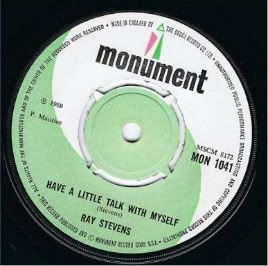
The Have a Little Talk With Myself album featured a couple of new songs but the bulk of the material was Ray's versions of contemporary pop hits by other artists. I wrote about this album in a previous blog entry called Have a Little Talk...about Ray!. You all can find it by exploring the archives on the right hand side of the screen.
A couple years ago Ray issued a CD where he covered the songs of Frank Sinatra. The CD was originally released in 2008 on his own label and sold exclusively through his own web-site and during concert stops. The actual title is Ray Stevens Sings Sinatra...Say What??. I purchased by copy at a merchandise table at one of his concerts. When I saw the CD I was stunned because at the time it wasn't being sold on his web-site and I'd wondered why...I then assumed that it must be an exclusive to concert goers but then it became available at his web-site store. Anyway, in 2009 the CD was released nationally but without any fanfare or promotion...I think it's a great CD salute. In an attempt, perhaps, to create a mood or an ambiance, Ray has the music come off like it's from a small, intimate session at some all-night lounge...complete with audience cheers and applause. Ray doesn't keep the same arrangements on every song, though, and the musical accompaniment is more along the jazz/R&B side than big band and swing. A couple of the songs are shortened, as well. The CD contains the following songs made famous by Sinatra...I’ve Got You Under My Skin
Night and Day
I Get A Kick Out Of You
All The Way
High Hopes
Witchcraft
The Tender Trap
Young At Heart
Strangers In The Night
That’s Life
February 3, 2010
Ray Stevens: Country-Pop, Pop-Country?
Is this album pop-country or country-pop? Easy-listening or Adult-Contemporary? Beautiful Music or inspirational?
Feel The Music isn't 100% any of those music genres. The overall flow of the album carries that easy sound but there are a couple of songs on here that are distinct in their sound. Those distinct recordings happen to be "Dixie Hummingbird", which carries a country music feel; "Junkie For You" is decidedly more bluesy in it's delivery. We have religious/inspirational numbers on here like "Set The Children Free", "Save Me From Myself", and the title track, "Feel The Music". There are straight forward love ballads like "Daydream Romance" and "Road Widow" and then we have the story of a couple in the songs, "Alone With You" and "Blues Love Affair". I consider "Get Crazy With Me" a pop song more than country. It's arrangement pretty much confirms this. In 1995 Warner Brothers issued a 3 set collection of songs that Ray recorded for the label. The only songs from this 1977 album that weren't spotlighted on those 1995 collections are "Junkie For You", "Get Crazy With Me", and "Road Widow". To date this album is the only place to find those songs.
Labels:
1977,
country-pop,
easy-listening,
MOR,
ray stevens
July 6, 2009
Ray Stevens: Getting Crazy with Ray...
A 1977 single from Ray Stevens entitled "Get Crazy With Me" featured a one of a kind arrangement. It wasn't exactly country and it wasn't pop, either...it had this different arrangement...several instruments I think were computer enhanced and were manipulated into sounding certain ways. The mid to late '70s period, known as the Warner Brothers era, featured Ray on the cutting edge of sound techniques and in-studio accomplishment. His publishing company, Ray Stevens Music, affiliated with BMI, was also reaping benefits from a couple of major hit singles recorded by other artists during this time period. The first, "Can't Stop Dancing", a song Ray co-wrote and later covered by pop duo The Captain and Tennille, became a Top-20 pop hit for the duo in 1977. Ray had recorded the song a year earlier in 1976 for his Warner Brothers debut album, Just for the Record. The other single Ray was associated with was "Way Down", a song recorded by Elvis. This song was on the charts at the time of Elvis' death.
Elvis and the Captain and Tennille weren't the only artist's to have songs published by Ray's company. Layng Martine, Jr at one time wrote for Ray. Ray produced/published the song, "Rub It In", which was recorded and released by Layng before Billy 'Crash' Craddock. Layng was the song's writer but Craddock's version became the major hit. Ray's publishing company was called Ahab Music at first. I believe in 1977 it switched names to Ray Stevens Music...at least I assume as much because the songs on his 1976 album shows Ahab Music as publisher while the songs from the 1977 album show Ray Stevens Music. Ray often publishes his own recordings...but every so often his company will publish outside material. In the early '90s Ray's company published two Sammy Kershaw hit singles: "Cadillac Style" and "I Can't Reach Her Anymore" because Mark Petersen was a songwriter for Ray Stevens Music.
As part of the publicity for "Get Crazy With Me", there was an issue of Country Song Round-Up available featuring Ray on the cover and the article "Get Crazy With Ray Stevens".
The song itself, as I touched upon, is very different from the standard Ray Stevens material...nothing before or since has sounded quite like this song. The music itself seems to suggest insanity...there are all kinds of techno sounds in the instrumentation. There is a video montage of the song available at You Tube. The sound quality is okay. The sound isn't superb, though, but you can hear for yourselves the techno/alternative instrumentation. Chances are you'll have to hear it for yourselves since I can't adequately describe it...it's originally from the 1977 album, Feel The Music, that I did a blog about several days ago.
Elvis and the Captain and Tennille weren't the only artist's to have songs published by Ray's company. Layng Martine, Jr at one time wrote for Ray. Ray produced/published the song, "Rub It In", which was recorded and released by Layng before Billy 'Crash' Craddock. Layng was the song's writer but Craddock's version became the major hit. Ray's publishing company was called Ahab Music at first. I believe in 1977 it switched names to Ray Stevens Music...at least I assume as much because the songs on his 1976 album shows Ahab Music as publisher while the songs from the 1977 album show Ray Stevens Music. Ray often publishes his own recordings...but every so often his company will publish outside material. In the early '90s Ray's company published two Sammy Kershaw hit singles: "Cadillac Style" and "I Can't Reach Her Anymore" because Mark Petersen was a songwriter for Ray Stevens Music.
As part of the publicity for "Get Crazy With Me", there was an issue of Country Song Round-Up available featuring Ray on the cover and the article "Get Crazy With Ray Stevens".
The song itself, as I touched upon, is very different from the standard Ray Stevens material...nothing before or since has sounded quite like this song. The music itself seems to suggest insanity...there are all kinds of techno sounds in the instrumentation. There is a video montage of the song available at You Tube. The sound quality is okay. The sound isn't superb, though, but you can hear for yourselves the techno/alternative instrumentation. Chances are you'll have to hear it for yourselves since I can't adequately describe it...it's originally from the 1977 album, Feel The Music, that I did a blog about several days ago.
June 25, 2009
Ray Stevens: You gotta feel the music...
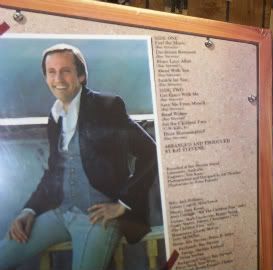
One of the several under-rated albums in the career of Ray Stevens is this one from 1977. Feel The Music was unique as you can see...Ray's picture didn't appear on the front of the album. Instead, Ray's picture appeared on the back...a publicity picture of sorts. The album consisted of 10 love ballads and a couple of inspirational songs, which the title track, "Feel the Music", falls under. It was released on the Warner Brothers label and it featured two chart singles. "Get Crazy With Me" and "Dixie Hummingbird" were released as singles from this album...although neither of the songs reached Top-40 status, "Dixie Hummingbird" came the closest...peaking in the Top-45. The song carried a bluesy feel and it featured several places in the song where Ray hums along to the rhythm while a saxophone is heard as the lead accompaniment. It's a sexy song, actually, if you pay attention to the lyrics and I imagine that underlying element is what caused it to connect with some country music buyers in 1977. Given that Ray has an expressive voice you can tell he's got a grin on his face while singing various parts of the song. The title track, "Feel the Music", starts out with just a piano and Ray asking if anyone out there's ever felt as if they don't belong and if they're living for themselves or living to please someone else. If so, that's when you gotta feel the music...and not waste time trying to be what others wish you to be. The thing about Ray is that chart positions and critical acclaim didn't seem to be as important to him as the song itself. As I've mentioned in several other blog entries, Ray wanted the songs he recorded to sound great, whether they were commercial or not. In some circles, commercialism isn't looked at too highly by the pop music purists who feel an artist should write or perform songs based on their personal feelings, not based on the "current sound" or what might get radio airplay. Again, much like the argument over what's considered off-limits for comedy, commercialism vs. non-commercialism is an argument that's debatable with no end in sight.
In addition to "Feel The Music" being inspirational, we have the gospel feel of "Save Me From Myself" which incorporates a lot of over-dubbing on the part of Ray. He performed all the voices in this song, from tenors to bass, spliced them all together and created the gospel choir effect. The song is about two people separating...and the man asking for help because he can't see any point in anything anymore. "Set The Children Free" is in the inspirational vein as well. This song is about adults setting the children inside ourselves free...it's basically a song that says that it's okay for adults to have fun and act like kids every now and then. Some people feel that once you reach adult-hood you have to be serious, strict, and mature all the time.
"Blues Love Affair" carries a bluesy-country arrangement as you would expect given it's song title. In this song Ray sings about relationships in general and wonders why opposites attract and why finding the right person isn't easy. The resulting effect of never finding the right person leads one down the road of one-night stands and sordid affairs, or a "Blues Love Affair" in this case.
Feel The Music was Ray's second album release for Warner Brothers. It was a follow-up to 1976's Just For The Record. This 1977 album is a direct opposite from the 1976 collection of songs and that's as it should be. Several of the songs from this 1977 album were issued on CD in 1995 as part of Warner Brothers various compilation projects: Do You Wanna Dance, The Serious Side of Ray Stevens, and Cornball. Those 1995 releases have been re-released as MP3 digital albums for anyone wanting to hear Ray's recordings for Warner Brothers since the material is out of print in CD format. Beware, though...there are several Warner Brothers recordings that were not issued on CD in 1995 and those recordings still have yet to be re-issued. "Junkie For You" and "Get Crazy With Me" from this 1977 album were not among the songs that were re-issued on CD in 1995. So, the only way to hear those particular songs is to have the vinyl album of Feel The Music, which I do. You can find it for sale at on-line auction sites.
Track List:
1. Feel The Music
2. Daydream Romance
3. Blues Love Affair
4. Alone With You
5. Junkie For You
6. Get Crazy With Me
7. Save Me From Myself
8. Road Widow
9. Set The Children Free
10. Dixie Hummingbird
December 6, 2008
Ray...30 years ago
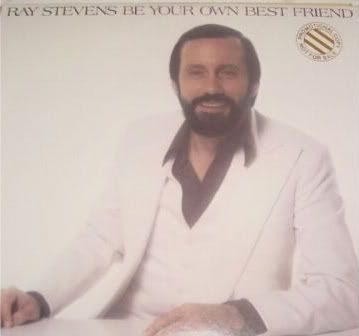
Thirty years ago...1978...Ray Stevens releases the albums Be Your Own Best Friend and There Is Something On Your Mind. The album on top...the white album, you could say, is a very good album that simply got lost. The music is in step with the light pop sounds of the time period. There is no song on here that really screams out COUNTRY but yet the title track, "Be Your Own Best Friend", did hit the country charts. The song lyrics of all the songs are posted on the back of the album for fans to sing-a-long with. The album as I mentioned, is soft-rock/light pop...mellow. I'll go out on a limb and say that the only song on this collection that reaches a fever pitch...one that has a bit of a rocking sound...is "Comeback". The album kicks off with a very nice sing-a-long, "L'amour", which carries an international feel in it's musical delivery. Ray co-wrote this song with a man named Gilbert Becaud. This may be the song Ray once referred to when he spoke about an instrumental he heard while in England and he wanted to write words to it...the music certainly has a British over-tone, to my ears at least. When you hear it you may understand what I'm trying to say.
"Comeback" carries a rush of urgency...pretty much the only up-tempo/rocker driven song on the album. Ray tells us about how a relationship has ended and fills us in about how much she meant to him in spite of her leaving him...and all she has to do is comeback...come, come, come, comeback. "Daydream Romance" is an ultra-mellow love song...it tells the story of a musician on the road and thinking of the woman he's left at home. "With a Smile" carries a similar positive message that "Be Your Own Best Friend" carries...in "With a Smile" we hear Ray telling us how important it is to smile, no matter what you're saying, try a smile and when life makes you frown, "just take that frown, and turn it around". "Be Your Own Best Friend", meanwhile, tackles a similar message but in this song Ray tells us that it's okay to be your own judge and be your own person no matter what others may have to say and that only you are able to look after yourself because nobody else is going to. "You're Magic" is one of my favorites from the album. I love the arrangement, the melody, the lyrics...I wish it were released as a single or would have become something more well-known. "Two Wrong's Don't Make a Right" borrows the phrase passed down through the ages and transplants it into a love song setting about two people and how the woman likes to cheat but the man can't bring himself to go through with cheating on her...but as Ray says, "nothing's gained by revenge and spite", bringing us to the song's title.
"Hidin' Place" is a bluesy number to my ears. It's simply a song about getting away from it all with your lover/spouse and how just being together provides seclusion from the world. "You've Got the Music Inside" is a re-recording of a song he originally recorded in 1973 for his Nashville album. The 1973 version was performed slower and had a touch of drama whereas the 1978 re-recording is also recorded as a ballad but this time with a more smoother vocalization when compared to 1973. His voice had matured even more. "The Feeling's Not Right Again" is an unusual love song in that it tells about a couple who can't find the answers to whatever it is they are searching for...even though they seem to fit together, almost. "The Feeling's Not Right Again" is also unusal in that it became the name of his 1979 album...because it had a similar sounding title to a Barry Manilow song/album called "Trying To Get The Feeling"...so much so that Warner Brothers, the label Ray recorded for, parodied the Barry Manilow album in 1979. See my three Ray Stevens blog entries about the Barry Manilow parodies for more information.
The Be Your Own Best Friend album featured nine songs. It was very ballad heavy.
1. L'amour
2. Two Wrongs Don't Make a Right
3. You've Got the Music Inside
4. Hidin' Place
5. Be Your Own Best Friend
6. The Feeling's Not Right Again
7. Comeback
8. You're Magic
9. With a Smile

This album, There Is Something On Your Mind, was recorded in 1978 and it was Ray's labor of love...an album spotlighting the beloved R&B music he grew up listening to. The album is one of those under the radar releases that when you blink, you'll miss it. The material is all top-notch and covers plenty of R&B...material known today as classic R&B. One of the things you'll notice is Ray's expertise in R&B...his liner notes appear at the top of the album above the picture. On the back of the album he gives his thoughts on each and every performance. There are only eight selections on this album but the selections are rather lengthy, and that will perhaps make it feel like a typical 10-11 song album by the time you're through listening to it. First off, Ray's sandwiches nine R&B songs into three separate medleys.
"Dance Trilogy" features abbreviated performances of "Do You Wanna Dance?", "When You Dance", and "Save The Last Dance For Me". "Old Faithful Trilogy" features portions of "Shake a Hand", "Since I Met You Baby", and "Always". Then there is the adventurous "Banned In Boston Trilogy" which spotlights three abbreviated R&B songs that were banned on Boston radio stations: "Sixty Minute Man", "Work With Me Annie", and "Annie Had a Baby". Ray tells us on the back of the album that these songs were banned because the subject matter was considered too racy.
Aside from the three medleys/trilogies, we hear full performances of five R&B classics: "Money Honey", "Your Cash Ain't Nothin' But Trash", "Talk to Me", "One Mint Julep", and the title track, "There Is Something On Your Mind", which includes an audience background. Several of these recordings resurfaced in 1995 when Warner Brothers issued three compilation CD's on Ray: Cornball, The Serious Side of Ray Stevens, and Do You Wanna Dance? The recordings from this 1978 album that have yet to make their way onto CD are the title track and the medley of songs that were Banned in Boston.
There's just so much Ray Stevens music the public at large just isn't aware of!!
The liner notes that appear above the picture go as follows:
"I'm not a nostalgia nut I guess, along with everyone else, I'm a little tired of hearing, with rare exception, nothing but parodies of the '50s music. True, a few of the hits deserve nothing but a tongue-in-cheek treatment, but then maybe every era is vulnerable to ridicule from somebody's point of view.
Be that as it may...I have had the desire to record some of the old '50s songs for sometime now minus the "grease" and "doo-wop"! A lot of the lyrics are still relevant and the idea's expressed poignant and communicative to any generation. I have tried to present this collection of "oldies" with as much sincere appreciation for merit as reality will allow.
I grew up with these songs and they played in the background of my formative years as a singer and musician. I like these songs. Some of the lyrics are not what you could call heavy but they translate into a feeling that reads between the lines...to me, anyway.
I recorded this album in my little studio in Nashville on 24 tracks using a few musicians that I have known and worked with for years."
========================================
The band accompaniment was sparse...no more than 7 separate musicians played on this album. The musicians for the most part played on all the songs with a few exceptions. Here is the musician list for this album...
Ray Stevens {keyboards, synthesizer, percussion, background harmony}
Jerry Carrigan {drums}
Jerry Kroon {drums on "Money Honey" and "Old Faithful Trilogy"}
Jack Williams {bass}
Reggie Young {electric guitar}
Johnny Christopher {acoustic guitar}
Mark Casstevens {guitar on "Money Honey" and "Old Faithful Trilogy"}
Quite a few of those musicians would continue to appear on Ray's albums over the next 10-15 years.
Labels:
classic R and B,
easy-listening,
oldies,
R and B music,
ray stevens
November 7, 2008
Ray Stevens: I Saw Elvis!
In the above picture, Ray is singing "I Saw Elvis In a UFO" at his Branson, Missouri theater. The song originated from 1989 on the Beside Myself album. The song deals with the tabloid stories that have often appeared proclaiming that Elvis was spotted at Burger King restaurants and at all other places around the world. What about in a UFO? It can happen if you have the imagination to think up a song...not only is Elvis up in the UFO but there's seats reserved for Col Parker, Liberace, Howard Hughes, and Jimmy Hoffa. The melody of the song is a broad interpretation of the Bob Seeger pop hit "Old Time Rock and Roll", explaining why Ray vocally delivers this song in a certain kind of way. The song starts out innocently...the Evening News signs on with the announcement that we're being taken to a field, where reporter Renaldo Rivera is on the scene. Renaldo interviews a man who claims to have seen a UFO...not only that, he claims Elvis was up in the UFO...and the man bursts into song. As the song progresses we get to hear the chipmunk flavored sing-a-longs from pink aliens and UFO sound effects. As the song ends it's easy to tell we're dealing with a nut-case because the man being interviewed has assumed the identity of Elvis, demanding that he be taken on a UFO.An early pop novelty recording from Ray called "The Rock and Roll Show" featured an Elvis-type act named Tommy Jimmy.
On 1987's Greatest Hits, Volume Two Ray debuted "Mama's in the Sky With Elvis" about a couple who are separated because of tragedy. The man's wife, a big Elvis fan, falls to her death over a balcony while dancing with her Elvis doll, giving literal meaning for mama being up in the sky with Elvis. I love the song.
Another Elvis song came along in 1989, the previously mentioned "I Saw Elvis in a UFO". In 1997 Elvis made another comeback reference on a Ray Stevens album. Hum It, which featured "Virgil and the Moonshot", "Mama Sang Bass", as well as "Too Drunk To Fish" also featured "She Loves Elvis Better Than Me". In that Elvis song, Ray bemoans the fact that his wife loves Elvis more and tells us that he's attempted Elvis moves, such as doing karate kicks and shooting TV sets, but she still prefers the King.
The below image is of the Elvis single, "Way Down", released in 1977. Ray's publishing company published the song. It was the last commercial single released during Elvis' lifetime. Ray's publishing company is listed up underneath where it says Victor if you've got good eyes. I think you may be able to click the picture for a better view.

Ray was not done with the King of Rock and Roll...another Elvis song from Ray hit in 2000. "The King of Christmas" tells the funny story of Elvis as Santa Claus. The song can be found on the 2000 album Ear Candy and the 3-CD collection from 2005, Box Set.
Labels:
easy-listening,
elvis presley,
pop music,
ray stevens
Subscribe to:
Posts (Atom)